
Does a Thicker Floor Protection Roll Provide Better Protection? How Buyers Balance Thickness, Weight and Construction Efficiency
For overseas buyers, one common question when purchasing Floor Protection Roll is:
Does a thicker protection roll always provide better protection?
When selecting floor protection materials, many buyers focus on thickness first because thicker materials usually provide a stronger cushioning feeling.
However, for renovation projects, commercial construction and long-term bulk purchasing, thickness is not the only factor that determines whether a Floor Protection Roll is suitable for a specific application.
In real projects, buyers need to consider material weight, installation efficiency, transportation cost, construction environment and final protection requirements together.
Therefore, the right Floor Protection Roll is not simply the thickest option, but the product that achieves the best balance between protection performance and construction efficiency.
Why Do Buyers Often Believe a Thicker Floor Protection Roll Provides Better Protection?
In floor protection applications, thickness usually affects the cushioning performance of the material.
When construction sites involve dropped tools, frequent foot traffic or equipment movement, thicker protection materials can generally provide better impact buffering.
For example, in commercial renovation, large construction projects or high-traffic areas, contractors usually pay more attention to whether the protective material can reduce the risk of scratches, impact damage and contamination on the floor surface.
Therefore, many buyers assume:
The thicker the material, the higher the protection level.
This idea is partly reasonable, but it is not the complete picture.
The actual protection performance of a Floor Protection Roll also depends on multiple factors, including material structure, GSM, fiber density, lamination method and surface performance.
How Does Floor Protection Roll Thickness Affect Product Performance?
First, thickness influences the cushioning ability of the material.
A thicker nonwoven protection material generally contains more fiber volume, which can help absorb external pressure during construction activities.
For projects requiring longer protection periods, such as new flooring protection, commercial remodeling or large construction sites, an appropriate thickness can improve usage stability.
Second, thickness affects installation experience.
A thicker Floor Protection Roll is usually softer and can better cover slightly uneven surfaces, reducing movement during installation.
In addition, thickness also affects roll diameter and transportation conditions.
For the same roll length, increasing thickness usually means:
Larger roll diameter;
Higher roll weight;
Different 40HQ container loading quantity;
Higher transportation cost.
Therefore, buyers should evaluate not only protection performance but also the overall supply chain cost.
Why Does Increasing Thickness Not Always Mean Better Construction Experience?
In actual construction environments, excessive thickness can also create certain challenges.
For example:
The material becomes heavier and more difficult to handle on site;
The roll takes up more warehouse space;
Installation may require more labor adjustment;
Transportation costs may increase.
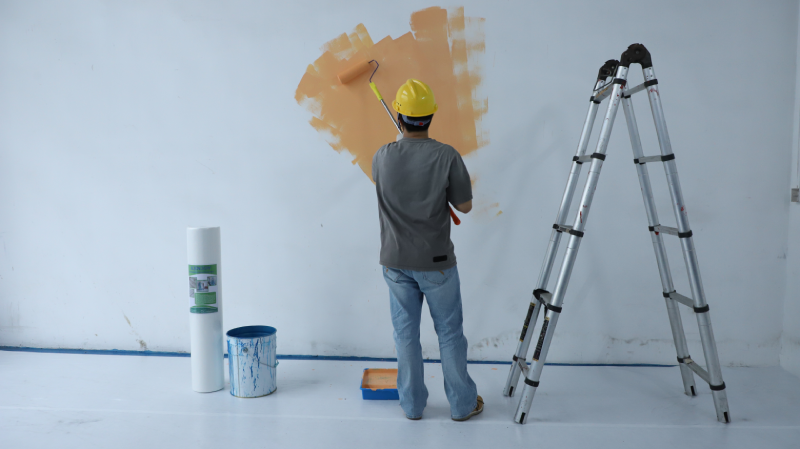
For short-term renovation projects, such as residential painting, wall finishing or furniture installation areas, extremely thick protection rolls may not always be the most economical choice.
If the main risks at the construction site are dust, paint and water contamination rather than heavy impact, buyers may need to focus more on:
Water resistance;
Slip resistance;
Surface protection;
Installation convenience.
Therefore, Floor Protection Roll selection should be based on construction risks rather than thickness alone.
How Should Buyers Choose Floor Protection Roll Thickness for Different Applications?
Different projects have different protection requirements.
For light-duty renovation environments, such as residential painting, wall construction and furniture installation areas, buyers usually focus more on:
Easy installation;
Convenient handling;
Cost control.
These applications may not require extremely thick protection rolls.
For commercial renovation, office remodeling and continuous construction environments, there is usually higher foot traffic and longer protection time.
Buyers often need a better balance between thickness and durability.
For large-scale projects, heavy equipment areas or high-frequency construction environments, more attention should be paid to compression resistance, wear resistance and long-term protection performance.
Therefore, buyers should not only tell suppliers:
“I need a thick floor protection roll.”
Instead, they should provide:
Construction type;
Protection duration;
Floor material;
Traffic level;
Waterproof or anti-slip requirements;
Expected application environment.
This information helps suppliers recommend a more suitable product structure.
Why Is GSM More Practical Than Thickness Alone for Comparing Floor Protection Rolls?
For nonwoven Floor Protection Roll products, thickness is only one visible parameter.
GSM (grams per square meter) can more directly represent the material weight per unit area.
During professional purchasing, buyers usually compare multiple specifications together, including:
GSM
Thickness
Material Composition
Roll Length
Width
Backing Structure
Even if two products have similar thickness, different fiber structures can create different protection performance.
Therefore, experienced buyers usually do not only compare which product is thicker. They evaluate whether the complete product specification matches the project requirements.
What Information Should Buyers Confirm When Purchasing Floor Protection Roll?
To avoid choosing unsuitable products, overseas buyers should confirm the following information during the RFQ stage:
GSM
Thickness Range
Roll Width
Roll Length
Material Structure
PE Lamination Requirement
Waterproof Requirement
Anti-slip Requirement
Packaging Method
OEM Customization Requirements
These details help suppliers provide accurate recommendations instead of quoting only based on thickness.
How Does JHC Support Customized Floor Protection Roll Projects?
As an experienced nonwoven manufacturer, HuiZhou JinHaoCheng Nonwovens Co., Ltd. has more than 20 years of experience in nonwoven material production and provides Floor Protection Roll, Painter Felt, Protective Fleece and customized nonwoven products for overseas importers, wholesalers and brand customers.
For different construction applications, we can support customized solutions including different GSM, thickness, width, color, packaging and laminated structures, as well as OEM/ODM projects.
For long-term purchasing programs, we recommend that buyers provide the actual application environment instead of only specifying thickness requirements.
By evaluating construction conditions, protection requirements and transportation factors together, buyers can select a more suitable Floor Protection Roll solution.
Conclusion
For overseas buyers, a Floor Protection Roll is not always better simply because it is thicker.
Thickness affects cushioning performance, installation experience and transportation cost, but the final selection should be based on construction environment, protection requirements and overall purchasing cost.
A professional purchasing decision is not about finding the thickest product.
It is about finding a Floor Protection Roll solution that is:
Suitable for the project;
Stable in supply;
Reasonable in cost;
Consistent in long-term quality.




