
How to Choose GSM, Thickness and Density for Recycled PET Felt Based on the Application?
When purchasing recycled PET felt, many overseas buyers directly ask suppliers for “2mm, 5mm, or 10mm products,” or specify a particular GSM. However, for actual purchasing, simply determining the thickness or GSM is usually not enough to define the right material. Even when recycled PET needle punched felt is made from the same type of recycled PET material, different fiber structures, needle punching densities, and degrees of consolidation can result in different levels of softness, support, cushioning, and structural stability.
Therefore, once buyers have decided to use recycled PET felt, a more practical approach is not to select a fixed thickness first, but to work backward from the functional requirements of the final product. Lightweight products, cushioning, surface protection, acoustic applications, structural support, furniture protection, and forming may all require different combinations of GSM, thickness, and density.
The real question is: What material structure does my product need, and how should GSM, thickness, and density be combined?
Why Can’t Buyers Determine the Specifications Simply by Choosing Recycled PET?
Choosing recycled PET only completes the material type selection. It does not mean that the GSM, thickness, and density have already been determined. Recycled PET needle punched felt can be produced with different fiber specifications, fiber structures, and levels of needle punching, creating different product grades. Therefore, the same recycled PET raw material can be used for different final products.
For example, a product that requires lightweight covering material may focus more on low weight and a thin structure, while a product requiring cushioning or protection may need a higher GSM and appropriate thickness. For products that require a certain level of structural support, simply increasing the thickness may not provide the desired result. Density and fiber entanglement also need to be considered.
This is why overseas buyers should not simply tell a supplier, “I need 5mm recycled PET felt.” If the supplier does not know the final application, it is difficult to determine what GSM, density, and material structure the 5mm product should have.
A more practical purchasing logic is:
Final Application → Performance Requirement → GSM + Thickness + Density → Sample Validation
This helps buyers avoid selecting a number first and discovering later that the actual material performance does not meet the application requirements.
Buyers Should First Define What the Final Product Needs, Rather Than Specify a Thickness
Before determining the material specifications, buyers should first identify the actual function required by the final product.
If the main requirement is lightweight construction, the material direction will generally involve lower GSM and a thinner structure. If cushioning is required, the buyer needs to consider appropriate thickness as well as a fiber structure that can provide suitable resilience and support. If the primary purpose is protection, material weight, thickness, and overall coverage capability may become more important.
If the product is intended for acoustic applications, it should not simply be assumed that “thicker is always better.” Thickness, density, and fiber structure need to be considered together with the acoustic requirements of the final product. For products requiring structural support or forming, a higher-density and more stable structure may be needed rather than simply increasing the material thickness.
Therefore, buyers can first describe their requirements as:
Lightweight
Cushioning
Protection
Acoustic
Structural Support
Furniture Protection
Forming
They can then ask the supplier to recommend the appropriate specifications based on these requirements.
This approach provides suppliers with a clearer understanding of the application and makes it easier to obtain samples with meaningful specification recommendations than simply stating “2mm recycled PET felt” in an inquiry.
How Should Buyers Consider GSM and Thickness for Lightweight Products?
If the final product primarily emphasizes lightweight construction, buyers generally need to avoid unnecessarily high GSM and excessive thickness.
A lower GSM can reduce the weight per unit area, while a thinner structure can reduce material volume and the burden associated with transportation and processing. However, this does not mean that the lowest GSM or thinnest structure is always better, because the material still needs to meet the basic protection, covering, or processing requirements of the final product.
For example, for certain liners, lightweight coverings, separators, or products designed to reduce material weight, thin recycled PET felt may be more suitable than thick recycled PET felt. In such cases, buyers should focus on whether the material can maintain reasonable weight and structural stability while still providing the required basic function.
Therefore, if your purchasing objective is lightweight recycled PET felt, you can provide the supplier with the final application, target weight, required thickness range, and processing method instead of specifying only one thickness value.
For products requiring precise fitting or assembly, the buyer should also confirm the acceptable thickness tolerance. Even when two products have the same nominal thickness, significant variation during production may affect subsequent die cutting, lamination, or assembly.
When Cushioning and Protection Are Required, Why Can’t Buyers Simply Increase the Thickness?
Many buyers assume that a thicker felt will automatically provide better protection. However, thickness is only one factor in the material structure.
If the product requires cushioning, buyers need to consider GSM, thickness, and density together. A thicker material may provide more space and cushioning, but if the structure is too loose, it may not provide sufficient support. Conversely, a higher-density structure may be more stable, but excessive consolidation may reduce softness and available compression space.
Therefore, for protective pads, packaging liners, furniture protection, or other cushioning applications, buyers should not simply move from 3mm to 5mm and then from 5mm to 10mm.
A more practical approach is to first determine the required cushioning level, the type of pressure the product will experience, and whether the material needs to remain soft or provide a certain level of support. Different combinations of GSM, thickness, and density can then be compared through samples.
This is also why high density recycled felt is not necessarily suitable for every protection application. Increasing density may provide a more stable structure, but whether it is more suitable still depends on the actual function of the product.
Why Should Acoustic Products Consider Both Thickness and Density?
When recycled PET felt is used in acoustic products, buyers should particularly avoid judging the material only by thickness.
Thickness affects the available fiber space and overall structure, while density, fiber composition, and needle punched structure also influence the internal structure of an acoustic material. Therefore, two recycled PET felt products with the same thickness may not necessarily provide the same acoustic performance.
For wall acoustic panels, ceiling materials, furniture acoustic components, or other acoustic applications, buyers should first clarify whether the target is sound absorption, noise reduction, or a decorative acoustic structure. They can then discuss thickness and density with the supplier.
For example, a 3mm recycled PET felt and a 10mm recycled PET felt cannot be judged simply by their numbers to determine which is more suitable for an acoustic application. The final specification also needs to be evaluated based on the product structure, installation method, and target performance.
Therefore, acoustic projects are better suited to a purchasing approach based on “target performance + sample validation” rather than simply selecting a commonly available thickness.
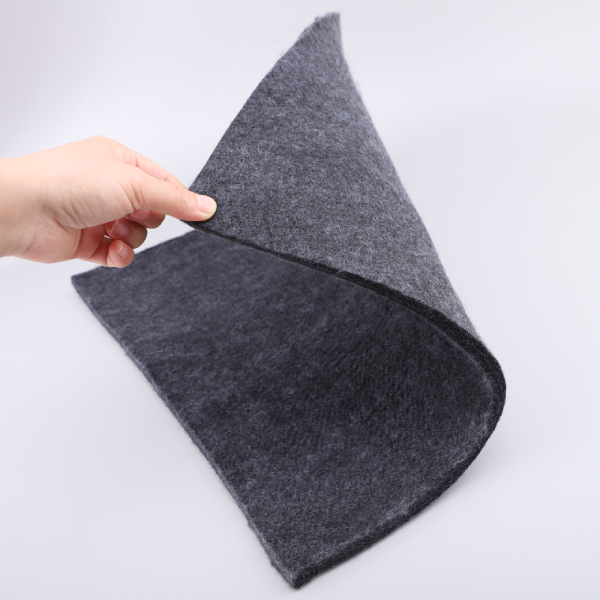
When Should Buyers Choose Higher-Density Recycled PET Felt?
If the final product requires a more stable, compact, or supportive structure, buyers may need to consider higher density PET felt.
A high-density structure generally means that the fibers are more closely consolidated within a given volume, which may provide greater structural stability and support. This can be particularly important for products that need to retain their shape, withstand a certain level of pressure, or be processed into a specific structure.
However, higher density does not mean that every performance characteristic will be better. For products that require softness, loft, or stronger compression resilience, excessive density may not be the best choice.
Therefore, buyers should first determine whether the final product requires a soft, semi-hard, or firmer structure, and then determine the appropriate density direction.
For forming, molding, or products requiring stable dimensions, higher-density recycled PET felt may be worth considering. For furniture protection, soft liners, and similar applications, a softer or semi-hard structure may be more appropriate.
The final specification should still be confirmed through sample evaluation rather than being determined solely by the product description “high density.”
Why Do Furniture Protection, Cushioning, and Forming Products Need Different Structures?
Different products have very different requirements for recycled PET felt, so one specification cannot be used for every application.
Furniture protection typically focuses more on softness, surface protection, and a certain level of cushioning. If the material is too hard or excessively compact, it may affect how it contacts the furniture surface. Therefore, a soft or semi-hard structure may be more suitable for certain furniture protection applications.
For cushioning products, buyers generally need to find a balance between thickness, GSM, and density so that the material has sufficient thickness while providing reasonable compression and support.
Forming or molding applications have different structural requirements. These products generally place greater emphasis on dimensional stability, structural retention, and subsequent processing performance. Therefore, a higher-density or more stable material structure may be required.
This shows why 2mm, 5mm, or 10mm cannot directly represent a specific application for recycled PET felt. The actual specification is determined by the material structure required by the final product.
How Should 2mm, 3mm, 5mm, and 10mm Be Used in Purchasing Specifications Rather Than as Product Names?
2mm, 3mm, 5mm, and 10mm can all be target thicknesses for recycled PET felt, but buyers should not treat the thickness number itself as a complete purchasing specification.
For example, if a buyer requests “5mm recycled PET felt,” the supplier still needs to know what GSM, density, fiber structure, and final application should correspond to that 5mm requirement.
Similarly, 2mm recycled PET felt may be suitable for products requiring a lightweight and thin structure. 3mm recycled PET felt may be used where some additional thickness is required while keeping the material relatively lightweight. 5mm recycled PET felt may be considered for applications requiring greater cushioning or covering capability. 10mm recycled PET felt may be suitable for applications requiring more noticeable thickness and structural space.
However, these thicknesses should not be assigned fixed application ranges. Different suppliers may use different fibers, needle punching parameters, and production structures. Even products with the same nominal thickness may therefore have noticeable differences.
For this reason, a better way to describe the requirement in an RFQ is:
Target Thickness: 5 mm
Target GSM: To be confirmed
Density / Structure: According to application
Application: Furniture protection / Acoustic panel / Cushioning / Forming
Required Performance: As specified
This allows the supplier to provide a more accurate sample and specification recommendation based on the complete requirement.
How Should Overseas Buyers Translate the Application Into Specific Specifications During an Inquiry?
If buyers have already decided that they need recycled PET felt but do not yet know the exact GSM, thickness, and density, they can provide the supplier with the final application directly during the inquiry.
For example, if the buyer needs a lightweight material, they can state:
“We need a lightweight recycled PET felt for a protective covering application.”
If cushioning is required, they can state:
“We need recycled PET felt with cushioning performance for a protective pad.”
For acoustic applications, they can state:
“We are developing an acoustic panel and need recycled PET felt for the acoustic structure.”
For forming or structural support, they can state:
“We need a relatively firm and stable recycled PET felt for forming.”
Buyers can also provide existing samples, product photos, drawings, target thickness ranges, or the final processing method.
After receiving this information, the supplier is in a better position to determine whether the project requires thin recycled PET felt, a higher-GSM structure, a higher-density structure, or a balance between several specifications.
For a formal RFQ, it is recommended to confirm at least:
Recycled PET fiber requirement
Target GSM or acceptable GSM range
Target thickness or thickness range
Density or required material structure
Final application
Required performance
Width and roll length
Sample approval requirements
This allows the specification discussion to move from a simple “I need 5mm felt” to a practical purchasing specification.
How Can HuiZhou JinHaoCheng Nonwovens Co., Ltd. Support Recycled PET Felt Specification Customization?
For overseas importers, distributors, and product manufacturers looking for a recycled PET felt supplier, if the GSM, thickness, and density have not yet been fully determined, buyers can provide the final application and performance requirements during the inquiry stage and work with the manufacturer to confirm the specifications.
HuiZhou JinHaoCheng Nonwovens Co., Ltd. specializes in needle punched nonwoven manufacturing and can customize materials based on customer requirements, including GSM, thickness, width, hardness, and final application. For recycled PET felt projects, buyers can specify the recycled PET fiber, recycled content, product application, and target specifications during the inquiry and then further confirm the final material structure based on sample testing.
For OEM/ODM projects requiring different combinations of thickness, GSM, and density, the manufacturer can adjust the specifications according to the final product requirements rather than requiring buyers to choose only from fixed standard specifications.
For overseas buyers, this approach is particularly useful for projects where the final material parameters have not yet been fully determined but the end application is already clear. Confirming the application and performance requirements first and then determining the specific specifications is generally more practical than simply comparing “2mm, 5mm, or 10mm.”
Conclusion
When purchasing recycled PET felt, GSM, thickness, and density should not be considered separately, and it should not simply be assumed that “thicker, heavier, or higher density is always better.”
A more practical purchasing method is to work backward from the final application to determine the material structure. Lightweight products may be better suited to lower GSM and thinner structures. Products requiring cushioning and protection need a balance between thickness, GSM, and density. Acoustic products need to consider thickness, density, and fiber structure together. Products requiring structural support or forming may be better suited to higher density and a more stable structure.
Therefore, 2mm, 3mm, 5mm, and 10mm should be treated as target parameters within the purchasing specification rather than as product names or direct indicators of performance.
For overseas buyers, the most effective inquiry is not simply to tell the supplier, “I need 5mm recycled PET felt.” Instead, buyers should explain what the final product is, what function the material needs to provide, the target thickness and GSM, and whether a specific density or structure is required. This allows the recycled PET felt supplier to provide more useful specification recommendations based on the actual application and confirm the final solution through samples.




