
Is Waterproof Floor Protection Roll Really Waterproof? How Overseas Buyers Can Verify Liquid Penetration Performance
For overseas importers, wholesalers, distributors, and building material brands, one question is easy to overlook when purchasing waterproof floor protection roll: what does “waterproof” actually mean when a supplier describes the product that way?
Some Floor Protection Roll products can temporarily prevent water or paint from passing through the surface, but under prolonged liquid contact, foot traffic, pressure, or insufficient edge protection, liquids may still penetrate through the material structure, backing layer, or joints. Therefore, the more important purchasing question is not whether the supplier writes “waterproof” on the quotation, but whether the product can pass a liquid penetration test that is reasonably close to its actual application conditions.
For projects involving hardwood floors, tile, marble, or other finished surfaces, buyers should separately verify the actual barrier performance of waterproof floor protection before approving the sample or placing a bulk order.
Why Doesn't a Supplier's “Waterproof” Claim Automatically Mean Buyers Can Accept the Product?
In Floor Protection Roll purchasing, “waterproof” is not enough to complete a purchasing decision by itself.
Different products can have different material structures. For example, ordinary needle-punched nonwoven fabric can provide absorption and cushioning, but when a project requires water, paint, or other liquids to be prevented from penetrating to the floor below, buyers need to confirm whether the product uses a PE film or another waterproof laminated structure. Existing product information on the website also shows that PE laminated felt uses a waterproof film combined with needle-punched nonwoven material to improve liquid barrier performance.
More importantly, even when a product uses a waterproof backing, buyers should not simply assume that the entire roll will provide exactly the same waterproof performance under every condition. The bonding condition between layers, film integrity, cut edges, and pressure during actual use can all affect whether liquid continues to penetrate downward.
Therefore, overseas buyers should turn “waterproof” from a product description into a performance requirement that can be verified. In other words, buyers need to clarify what type of liquid, contact time, and application conditions the product needs to withstand, and what level of liquid barrier performance is expected under those conditions.
First Distinguish Between “Water-Resistant Surface” and Actual Liquid Penetration Protection
Water forming droplets on the surface of a Floor Protection Roll does not, by itself, prove that the product provides sufficient waterproof protection.
If the main function of the product is to absorb paint, water, or other construction liquids, the surface may visibly absorb liquid. In this situation, what buyers really need to confirm is whether the liquid continues through the material and reaches the protected floor, rather than simply whether the surface remains completely dry.
For waterproof floor protection roll products using a PE film laminated structure, a more meaningful evaluation is to check whether liquid penetrates through the complete material structure after a defined contact period. This helps buyers distinguish between liquid absorption and liquid barrier performance.
This distinction is important for procurement. A material can have good absorption performance while its waterproof backing prevents the liquid from continuing toward the floor. Therefore, buyers should not immediately conclude that a product is “not waterproof” simply because the surface absorbs some liquid, nor should they assume that a product is suitable for every construction environment simply because no visible leakage occurs during a short test.
Why Must the Sample Be Prepared According to the Actual Application Method Before Testing?
If the testing method is completely different from the actual installation conditions, the purchasing value of the test result is also reduced.
For example, a buyer may purchase a roll product that is unfolded, cut, joined with other rolls, and exposed to foot traffic and moving tools during installation. In this situation, simply placing a small piece of material on a table and pouring some water onto it may not provide enough information. The test should use a representative product structure and, as far as practical, simulate the actual application conditions.
The buyer should also confirm which side of the sample is the top and which side faces the protected floor. For a PE laminated Floor Protection Roll, it is important to understand which side is intended to face the construction environment and which side faces the protected surface. Testing the material in the wrong orientation can produce results that do not accurately represent field performance.
If the product will be used on hardwood floors, tile, or other high-value surfaces, the testing conditions should also be reasonably close to those of the final project. The purpose is not simply to prove that the material is “waterproof” in a laboratory-like situation, but to determine whether it can provide the required protection in the actual purchasing application.
How Should Overseas Buyers Conduct a Basic Liquid Penetration Test?
One of the simplest verification methods is to perform a controlled liquid barrier test during the sample stage.
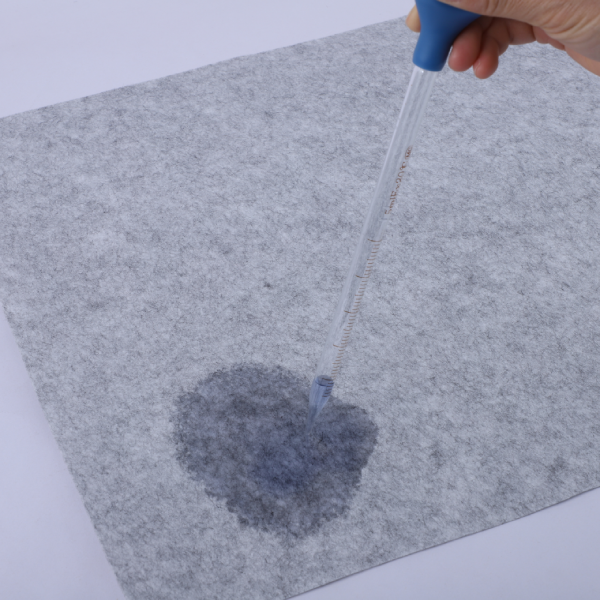
First, prepare a representative piece of Floor Protection Roll and place a dry test surface underneath it where liquid marks can be easily observed. Then apply a defined amount of water to the surface of the protective material and maintain a predetermined contact time.
During the test, buyers should not only observe whether the water disappears from the surface. They should also inspect the bottom of the material and the test surface underneath for wet marks, liquid leakage, or visible moisture.
If the product is mainly intended for paint protection, buyers can also introduce application-related liquid tests where appropriate. However, different liquids have different viscosity, surface tension, and drying characteristics, so the result of a water test should not automatically be treated as proof of protection against every other construction liquid.
For buyers, the most important part of the test is not creating an unnecessarily complicated laboratory number, but establishing testing conditions that can be clearly understood and repeated by the supplier. For example, buyers can record the test liquid, liquid quantity, contact time, sample size, installation method, and whether penetration was observed underneath the material.
This makes later comparison between samples from different suppliers much more meaningful.
Why Do Testing Time and Liquid Conditions Affect the Result?
Waterproof performance is not completely independent of exposure time.
Some materials may show no obvious penetration when exposed to a small amount of water for a short period, but the result may change when liquid remains in the same area for a longer period or when pressure is applied to the material. Therefore, if the actual construction environment may involve water, paint, or other liquids remaining on the surface for an extended period, the sample should not be evaluated only after a few seconds.
Buyers can establish a reasonable testing period based on the final application. For example, a short-term wall painting project and a renovation project requiring continuous floor protection for several days or weeks may have different requirements for liquid barrier performance.
During testing, buyers should also avoid artificially removing the liquid too quickly. If liquid may remain on the material for an extended period during actual construction, the test should also allow sufficient contact time. Otherwise, the result may represent an overly idealized situation.
Therefore, during RFQ or sample approval, buyers should clarify the expected application period rather than simply asking a supplier for a “waterproof” conclusion without any testing conditions.
Why Should Buyers Pay More Attention to the Joints, Edges, and Cut Areas of Floor Protection Roll?
The waterproof performance of an intact section of material does not necessarily represent the protection performance of the entire installed floor covering.
During actual construction, Floor Protection Roll may need to be joined with other rolls and cut around rooms, stairs, corners, equipment, or other areas. Liquid may penetrate not only through the main material but also through joints, edges, or cut areas.
Therefore, buyers purchasing material for large-area construction projects should not test only one complete, uncut section.
Edge and joint testing can be added during the sample stage, especially when multiple rolls will be joined to cover a large floor area. The purpose is not to expect an installation to have no joints at all, but to confirm that joints and edges do not become obvious liquid penetration risks under normal installation conditions.
For the supplier, this type of testing can also help determine whether the product requires a specific installation method, edge treatment, or additional fixing measures rather than simply increasing the nonwoven GSM.
Why Is It Necessary to Simulate Pressure and Foot Traffic During Construction?
Actual construction conditions are different from static laboratory-style testing because Floor Protection Roll is usually not completely stationary on a jobsite.
Workers may walk over the material, tools and renovation materials may be placed on the surface, and some areas may experience continuous pressure. If liquid is present at the same time, pressure may push the liquid further into the material or toward weaker areas of the laminated structure.
Therefore, after the basic liquid penetration test, buyers can add a simple simulated-use step. Allow the material to contact a defined amount of liquid, apply a light level of pressure that reasonably represents actual construction conditions, and then inspect the underside for new wet marks.
This test is not intended to reproduce every complex jobsite condition. Instead, it helps buyers identify an important question: when liquid and actual use pressure occur at the same time, does the product still provide the required protection?
For buyers who regularly purchase floor protection for commercial renovation, construction protection, or large-area projects, this type of verification provides more practical information than simply relying on a “waterproof” description in a product catalog.
How Should Buyers Record and Evaluate the Test Results of Waterproof Floor Protection Roll?
It is better to include the waterproof test results in the sample approval record rather than simply writing “sample passed” in an email.
The test record should include, at minimum, the product structure, sample specifications, test liquid, contact time, test orientation, test area, and whether liquid penetration was observed underneath the material.
For customized products, buyers should also record the confirmed GSM, thickness, width, PE film structure, or other key requirements. This allows the approved testing conditions to become a reference for future repeat orders instead of relying on whether a new batch simply “looks similar.”
The evaluation should also be related to the final application. For a product mainly intended to protect against light water droplets and paint, the agreed acceptance criteria may be different from those required for a long-term construction environment involving continuous liquid exposure.
A useful result is therefore not simply “waterproof” or “not waterproof.” It should clarify under what conditions the product meets the purchasing requirements and when a higher-performance structure or additional installation measures may be necessary.
If the Test Result Is Unsatisfactory, What Should Buyers Ask the Supplier to Modify?
If the sample shows liquid penetration, buyers should not immediately ask the supplier only to “increase the GSM.”
GSM mainly represents the weight per unit area of the material and does not independently determine waterproof performance. Existing Floor Protection Roll content on the website also indicates that material structure, needle-punching processes, and PE laminated backing can affect final performance, so waterproofing issues should first be analyzed from the laminated structure and actual application conditions.
If penetration mainly occurs through the main material area, buyers should further confirm the waterproof backing structure, film integrity, and lamination condition. If the problem mainly occurs at the edges or cut areas, the cause should be considered from the actual installation method and edge treatment.
If the material itself passes the test but significant leakage occurs at the joints after installation, the issue may not be entirely related to the material itself and may instead be associated with the installation method used on site.
Therefore, when a sample does not meet the requirement, overseas buyers should tell the supplier where the failure occurred, under what conditions it occurred, and how long it took to occur. This type of feedback is much more useful for targeted structural adjustment than simply asking the supplier to “make it more waterproof.”
How Does HuiZhou JinHaoCheng Nonwovens Co., Ltd. Support Waterproof Floor Protection Roll Performance Verification?
There is no single waterproof structure suitable for every Floor Protection Roll application or overseas market. The material combination should be determined according to the protected surface, liquid exposure risk, application period, and actual construction method.
HuiZhou JinHaoCheng Nonwovens Co., Ltd. specializes in needle-punched nonwoven and Floor Protection Roll manufacturing and can provide PE laminated nonwoven, different GSM and thickness options, widths, roll lengths, and other OEM/ODM solutions according to purchasing requirements.
For overseas buyers who need to verify waterproof floor protection performance, it is helpful to provide the actual application scenario, floor type, expected liquid exposure, application period, and liquid penetration requirements during the inquiry or sample stage. This allows the supplier to evaluate the sample according to actual purchasing conditions rather than simply providing a standard product based on the keyword “waterproof.”
Conclusion
Determining whether a waterproof floor protection roll is truly suitable for purchasing cannot rely only on the product name, product images, or a supplier's description of the product as “waterproof.”
A more reliable approach is to turn the waterproof requirement into an executable liquid penetration test during the sample stage and evaluate the material according to its actual installation orientation, contact time, joints, edges, and construction pressure.
For overseas importers, wholesalers, distributors, and building material brands, the product worth approving is not simply a product labeled “waterproof.” It is a Floor Protection Roll that has demonstrated its ability to meet the required liquid barrier performance under clearly defined application conditions. This can help reduce the risk of leakage, customer complaints, and project losses after bulk purchasing.




