
What Should Buyers Confirm When Sourcing Nonwoven Geotextile for Retaining Wall Drainage?
For retaining wall contractors, geosynthetic importers, distributors, and project procurement teams, sourcing nonwoven geotextile for retaining wall drainage involves more than comparing GSM, thickness, or price. The key question is whether the geotextile filter layer is compatible with the soil behind the wall, the drainage aggregate, and the overall engineering design.
Drainage measures are commonly incorporated behind retaining walls to manage water and help control water pressure, according to the project design. Depending on the application, the system may include drainage aggregate, a geotextile filter layer, drainage pipes, or other drainage components. Because drainage configurations and design requirements vary, buyers cannot determine suitability from the product name alone.
Before requesting quotations, buyers should confirm the filter layer's intended function, the characteristics of adjacent materials, the technical requirements specified in the design, and the documentation needed to verify that the proposed product meets those requirements.
This guide explains the key considerations when sourcing geotextile for retaining wall drainage, helping overseas buyers reduce the risk of material mismatches before selection, quotation, sample evaluation, and bulk purchasing.
What Role Does Geotextile Play in a Retaining Wall Drainage System?
The drainage structure behind a retaining wall must be designed according to the wall type, backfill conditions, groundwater conditions, and engineering requirements. Some systems use drainage aggregate to create a permeable pathway and may also include drainage pipes or other water-conveyance components.
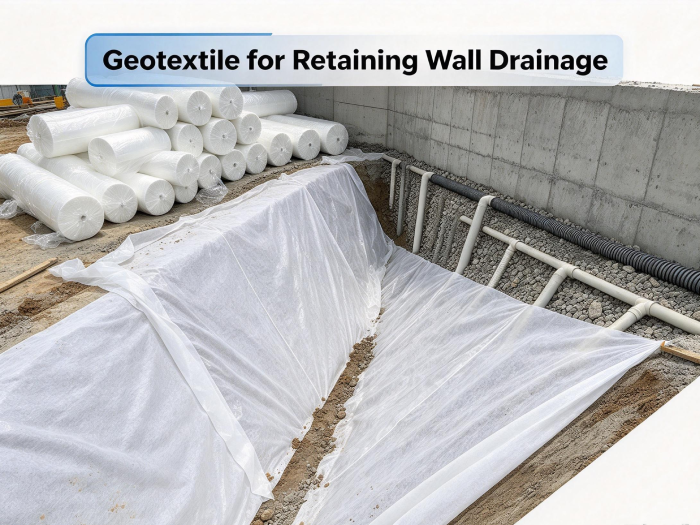
In these systems, geotextile may be used as a filter layer between the surrounding soil and the drainage aggregate.
Its function is to help retain soil particles while allowing water to pass through, subject to the project's design requirements. This helps reduce the risk of soil particles migrating into the drainage aggregate or drainage pathways.
However, the filter layer does not operate independently. Its suitability depends on the particle-size distribution of the adjacent soil, the characteristics of the drainage aggregate, the expected water-flow conditions, and the design of the complete drainage system.
Buyers should understand that the geotextile filter layer, drainage aggregate, and drainage pathways are separate system components with different functions. Geotextile does not replace the water-collection function of drainage aggregate or the water-conveyance function of a drainage pipe or other drainage component.
If the project uses a geocomposite drainage board or another system with a drainage core, buyers should also confirm the specified combination of the filter layer and core, drainage capacity, connection details, and installation requirements.
Therefore, the first purchasing step is to confirm the geotextile's position and function within the complete retaining wall drainage structure, rather than immediately selecting a GSM.
Why Should Buyers Not Select Filter Materials Based Only on GSM or Water Permeability?
GSM, or grams per square meter, is a common specification for nonwoven geotextile. However, GSM alone cannot establish whether a material is suitable for retaining wall drainage.
Products with the same GSM may differ in fiber material, fiber structure, thickness, pore characteristics, and other physical properties. These differences may affect soil retention, water flow, and performance during service.
When evaluating a geotextile filter layer for retaining wall drainage, buyers should distinguish between several requirements.
Soil Retention
The filter material needs to meet the project's soil-retention requirements based on the characteristics of the adjacent soil. Knowing the geotextile's GSM is not enough to establish whether it is suitable for a particular soil.
Water Permeability and Flow Capacity
The filter layer must allow water to pass through as required by the design. However, permeability should not be considered independently of soil retention. A material that allows water to pass through easily may still fail to meet the project's filtration requirements if its characteristics are not compatible with the surrounding soil.
Clogging Resistance
Fine particles may migrate toward the filter layer during service. Buyers should confirm any relevant design requirements rather than assuming that all needle-punched nonwoven geotextiles have the same resistance to clogging.
Installation Survivability
Geotextile may experience mechanical stresses during handling, placement, backfilling, and compaction. The material should meet the installation survivability requirements specified for the project.
Therefore, buyers should evaluate the properties relevant to filtration, permeability, clogging resistance, and installation survivability instead of assuming that a higher GSM automatically makes a geotextile more suitable.
What Retaining Wall Drainage Information Should Buyers Confirm Before Requesting a Quote?
Before contacting suppliers, buyers should obtain as much information as possible about the retaining wall drainage design. Clear project information makes it easier to identify the material properties that need to be verified.
Retaining Wall Type and Geotextile Placement
First, confirm the retaining wall configuration and the exact location where the geotextile will be installed.
For example, the filter layer may be placed between the retained soil and drainage aggregate, or it may form part of a geocomposite drainage system. Different installation positions may require different material properties.
Whenever possible, buyers should provide engineering drawings, cross-sections, or material layout details instead of simply stating that the geotextile is intended for retaining wall drainage.
Backfill and Adjacent Soil Conditions
Geotextile selection must account for the soil in contact with the filter layer. Buyers should provide available soil classification information, particle-size distribution data, geotechnical investigation reports, or relevant details from the design documents.
These materials can help the project engineer determine the applicable filtration requirements.
If soil particle-size data are unavailable, buyers should not assume that a general-purpose geotextile will be suitable for every soil condition. They should first confirm whether additional information is required by the project design.
Drainage Aggregate and Drainage Components
Confirm the type and location of the drainage aggregate and whether the system includes drainage pipes, geocomposite drainage boards, or other water-conveyance components.
For composite drainage systems, buyers should also verify the specified combination of the filter layer and drainage core, the drainage pathways, and the connection details.
Even if the geotextile itself has suitable filtration properties, that does not independently establish that the entire drainage system has adequate drainage capacity. Other components and installation details must also comply with the design.
Groundwater and Service Conditions
Groundwater conditions, potential water-level changes, and the surrounding environment may affect retaining wall drainage design.
Buyers should provide the available hydrogeological information and relevant project requirements so that the responsible technical team can determine the necessary filter-layer properties.
Design Standards and Acceptance Criteria
Different countries, regions, and engineering projects may follow different design standards, test methods, and material acceptance requirements.
Buyers should confirm the applicable standard, edition, relevant clauses, and acceptance documentation. If the engineering drawings, material schedule, and technical specifications contain inconsistent requirements, the discrepancies should be clarified with the designer or responsible technical reviewer before ordering.
How Can Buyers Determine Whether the Geotextile Filter Layer Is Compatible with the Soil and Drainage Aggregate?
The suitability of geotextile for retaining wall drainage must be evaluated in relation to the adjacent materials and the complete drainage structure. It cannot be established from the product name or a single specification alone.
Verify Soil Retention Requirements
Based on the engineering design, buyers should confirm which soil particles need to be retained and which apparent opening size or other filtration criteria apply.
Apparent opening size (AOS) may be part of the technical evaluation, but its required value should be determined from the adjacent soil's particle-size distribution, design conditions, and applicable standards. Values from unrelated projects should not be applied automatically.
Verify Water Permeability Requirements
The filter layer must allow water to pass through while satisfying the project's filtration requirements. Buyers should confirm the specified permeability or other relevant hydraulic performance indicators, the test methods, and the acceptance criteria in the project documents.
If the supplier provides permeability or water-flow data, buyers should verify that the data correspond to the quoted product, test method, and specification.
Confirm Relevant Clogging Requirements
If the project has explicit requirements for long-term filtration or clogging resistance, these should be included in the technical review.
Buyers should not conclude that a filter layer will remain free of clogging in actual service simply because it is thick, has a high GSM, or allows water to pass through during a simple demonstration. Performance should be assessed in relation to the soil conditions, filter design, and applicable test data.
Verify Installation Survivability
During placement, fixing, backfilling, and construction equipment operations, geotextile may be exposed to tensile, tearing, puncture, or other mechanical stresses.
Buyers should confirm the mechanical properties required by the design and check whether the supplier's technical data meet the relevant criteria.
Confirm Compatibility with the Complete Drainage Structure
Finally, buyers should examine how the geotextile works with the drainage aggregate, drainage core, and other system components.
For example, the filter layer's placement, overlaps, connections, and relationship with drainage pathways may affect system performance. These details should follow the engineering drawings and applicable construction requirements rather than relying solely on general product descriptions.
What Technical Data and Test Documents Should Buyers Verify?
Once the project requirements are clear, buyers can request technical documentation corresponding to the specified material.
The exact documents required should be determined by the project specifications and contract.
Product Technical Data Sheet
Confirm the material name, fiber type, unit weight, thickness, roll dimensions, and other specified product properties.
If the material must meet particular filtration or drainage requirements, check whether the relevant performance data are also available.
Filtration and Hydraulic Performance Data
According to the engineering requirements, verify relevant apparent opening size, permeability, or other filtration indicators. Check the corresponding test methods, units, and report details.
Not every project requires the same set of tests. Buyers should follow the engineering design rather than automatically requesting every possible performance test for every product.
Mechanical Property Data
If the design specifies tensile strength, tear resistance, puncture resistance, or other mechanical properties, confirm that the supplier's data correspond to the actual product specification and use test methods consistent with the project requirements.
Test Reports and Product Traceability
If a supplier provides test reports, buyers should check the product name, material type, specification, test items, and test methods stated in the report.
A report for one product should not automatically be treated as evidence that every other specification complies with the project requirements. Test results for a different product should not be substituted for those of the material being purchased.
Sample and Specification Approval
If the project requires sample evaluation, record the sample specification and associated documentation. The final technical requirements should be clearly confirmed in the purchase order.
Appearance, hand feel, or a simple water-flow demonstration provides only limited information and cannot replace engineering-specified performance testing or technical document review.
What Should Buyers Check During Sample Approval, Installation, and Incoming Inspection?
Buyers should ensure that the approved sample, formal order, bulk production material, and delivery documents remain consistent.
During sample approval, record the product specification, technical documents, test results if available, and approval date. If the project specifies filtration or mechanical performance requirements, evaluate or test the material using the methods required by the project.
When placing the order, include the confirmed technical requirements in the purchasing documents. Also specify the accompanying documentation, product identification information, and other contractual requirements.
Upon delivery, buyers can inspect the roll labels, product specifications, batch information, packaging, and technical documents according to the project requirements. If the contract requires sampling or third-party testing, follow the agreed sampling method and acceptance criteria.
During construction, geotextile placement, overlaps, connections, fixing, and integration with drainage components should follow the engineering drawings and construction specifications. Even when a material meets individual performance requirements, an installation method that does not comply with the design cannot guarantee that the overall drainage structure will perform as intended.
Therefore, buyers should treat specification confirmation, document review, sample approval, and installation requirements as connected stages rather than checking product parameters only at the beginning of procurement.
What Information Should Buyers Provide When Requesting a Quote?
To help suppliers evaluate geotextile for retaining wall drainage more accurately, buyers should prepare the following information.
Project Application: Explain where the geotextile will be installed behind the retaining wall and whether its specified function is filtration, separation, or another requirement.
Engineering Drawings: Provide retaining wall cross-sections, drainage layout drawings, material placement details, or other relevant design documents.
Soil Information: Share available soil classification data, particle-size distribution, geotechnical investigation reports, or parameters specified by the project designer.
Drainage Structure: Describe the drainage aggregate, drainage pipe or geocomposite components, and the intended geotextile placement.
Technical Requirements: List the specified filtration, permeability, mechanical property, test method, and applicable standard requirements.
Purchasing Requirements: Provide the estimated quantity, roll width, roll length, packaging method, delivery destination, and purchasing schedule.
Documentation Requirements: State whether technical data sheets, test reports, sample approval, or other project documents are required.
If not all material parameters have been established, buyers can begin by providing the available engineering documents and asking the project designer or responsible technical reviewer to clarify the outstanding requirements. Suppliers can provide product information based on the known conditions, but general product specifications should not replace engineering decisions.
HuiZhou JinHaoCheng Nonwovens Co., Ltd. manufactures needle-punched nonwoven and related materials and offers customization services. For retaining wall drainage inquiries, buyers can provide project drawings, adjacent soil information, drainage structure details, and specific technical requirements to discuss suitable material specifications and available product documentation.
Conclusion: Confirm Filter Compatibility with the Complete Drainage Structure
When sourcing geotextile for retaining wall drainage, the priority is not to select a particular GSM immediately. Buyers need to confirm whether the filter layer meets the project's soil-retention, permeability, and installation survivability requirements and is compatible with the drainage aggregate and other drainage components.
Buyers should use engineering drawings and technical specifications to establish the filter layer's location, required material properties, test methods, and acceptance criteria. They should then review the supplier's product data and samples against those requirements.
Before bulk purchasing and construction, the approved specifications, formal order, production material, delivery documents, and installation requirements should also remain consistent.
This approach helps overseas engineering buyers evaluate material suitability more clearly and reduces the risk of making purchasing decisions based only on a product name, an individual specification, or price.
If you are sourcing nonwoven geotextile for retaining wall drainage, prepare the retaining wall drainage drawings, adjacent soil information, and project technical specifications before discussing the required material with a supplier. This provides a more reliable basis for selecting and purchasing geotextile according to the complete drainage structure.




