
How Should Buyers Specify and Verify Recycled PET Acoustic Felt for Sustainable Interior Products?
As sustainable building and interior design continue to develop, more overseas buyers are looking for Recycled PET Acoustic Felt for interior decoration, acoustic products, and other sustainable interior products.
However, for importers, brands, wholesalers, and product manufacturers who need to purchase materials on a long-term basis, “eco-friendly acoustic felt” is not a sufficiently clear purchasing requirement.
For example:
Is the material actually made from recycled PET?
What percentage of the material is recycled PET?
Does the product use recycled PET fibers or standard polyester?
Can the supplier provide relevant material information and environmental certification documents?
After the sample is approved, can the same material composition be maintained during mass production?
If these questions are not clarified before purchasing, the product may still look and perform as expected, but the material may not meet the sustainability requirements of a brand, project, or customer.
Therefore, for buyers developing sustainable interior products, the more practical question is not:
“Which acoustic felt is the most eco-friendly?”
It is:
“How should I specify and verify Recycled PET Acoustic Felt before placing a bulk order?”
This article explains how overseas buyers can define the material requirements for Recycled PET Acoustic Felt from a purchasing and product-development perspective, helping reduce the risk of unclear material specifications during bulk purchasing.
What Is Recycled PET Acoustic Felt from a Buyer’s Perspective?
Recycled PET Acoustic Felt is generally made with PET (Polyethylene Terephthalate) fibers derived from recycled sources and processed into acoustic felt through nonwoven manufacturing processes.
However, buyers should understand one important distinction:
“Polyester Acoustic Felt” does not automatically mean “Recycled PET Acoustic Felt.”
Polyester describes a material category, while Recycled PET emphasizes the source of the raw material.
Therefore, if your project specifically requires recycled PET, simply writing:
“Eco-friendly Polyester Acoustic Felt”
may not be sufficiently clear.
A more specific purchasing description can include:
Material Type: Recycled PET Acoustic Felt
Recycled Content: Confirm according to project requirements
Fiber Composition: Confirm the specific fiber composition
Environmental Requirement: Provide relevant documentation according to project requirements
This makes it clear to the supplier that your requirement is not simply to purchase an “eco-friendly” polyester felt, but to use a material with a clearly defined recycled raw-material source.
How Should Recycled PET Requirements Be Written Into an RFQ?
For overseas buyers, one common problem is writing an RFQ that simply says:
“Please quote eco-friendly acoustic felt.”
This description is still relatively broad from the supplier's perspective.
Different suppliers may interpret “eco-friendly” differently.
Therefore, if your customer or project specifically requires recycled PET, the material requirement should be clearly stated in the RFQ.
First, Clearly Specify Recycled PET
If the project requires recycled PET, write:
Recycled PET Acoustic Felt
instead of simply:
Eco-friendly Acoustic Felt
This can reduce the possibility of receiving a quotation based on standard Polyester Acoustic Felt.
Second, Specify the Required Recycled Content
If your customer has already specified a recycled-content requirement, such as a specific percentage, it should be stated directly in the RFQ.
If the percentage has not yet been determined, you can first ask the supplier to provide available recycled PET material compositions and then select the appropriate option according to the final product requirements.
The key point is:
Do not allow “recycled” to remain an undefined marketing term.
Third, Confirm the Fiber Composition
If the product is not made entirely from recycled PET and instead uses a combination of recycled PET and other fibers, buyers should know the specific material composition.
Different fiber combinations can affect:
Material performance
Product appearance
Processing methods
Subsequent certification requirements
Environmental declarations for the finished product
Therefore, clearly defining the fiber composition during product development is more useful than simply confirming the product name.
Why Does Fiber Content Matter More Than the “Eco-Friendly” Label?
In actual purchasing, “eco-friendly” is a very broad description.
Different suppliers may use completely different materials while selling products under the same name:
Eco-Friendly Acoustic Felt
Some may use recycled PET.
Some may use virgin polyester.
Some may use blended fibers.
Some products may contain only a certain percentage of recycled material.
Therefore, if a project has specific sustainability requirements, buyers should not rely only on the product name.
A more practical purchasing logic is:
Product Name → Fiber Composition → Recycled Content → Supporting Documentation
This helps buyers determine whether the material supplied by the manufacturer actually matches the project's requirements.
For overseas brands and interior product manufacturers in particular, material information may also need to be passed to customers, design teams, or project owners.
If the material composition is not clearly confirmed at the beginning, trying to verify it again after mass production has started may increase development costs and delivery risks.
What Documents Should Buyers Ask for Before Bulk Purchase?
If a project specifically requires Recycled PET Acoustic Felt, buyers should not rely only on a supplier's verbal statement.
A more reliable approach is to ask the supplier for documentation related to the actual material.
First, confirm:
Fiber Composition Information
This helps confirm which fibers are actually used in the product.
Second, confirm:
Recycled Content Information
This helps determine whether the recycled PET content meets the project's target.
If the project requires specific environmental certifications, buyers should also confirm:
Relevant Environmental Certification
It is important to understand that environmental certification requirements vary between projects. Buyers should therefore determine which documents are required according to the target market, customer requirements, and project specifications.
For example, Jinhaocheng's existing company and product information includes certifications such as GRS and OEKO-TEX Standard 100, but whether a specific certification applies to a particular product should still be confirmed against the actual product and order requirements during the purchasing process.
For buyers, the most important point is not simply to have “more certifications.” The key question is:
Do the certification or supporting documents match the actual purchased product, actual material composition, and project requirements?
Why Must the Approved Sample Match Mass Production?
This is an issue that can easily be overlooked in long-term purchasing projects.
Suppose a brand is developing a new sustainable interior product.
During the first stage, the supplier provides a Recycled PET Acoustic Felt sample.
After the sample is approved, the order moves into mass production.
If the buyer only confirms:
Color
Thickness
Dimensions
but does not confirm:
Fiber Composition
Recycled Content
then there may be a risk that the approved sample and the mass-production material do not fully match the original material requirements.
Therefore, for long-term projects, buyers should define the key material requirements during the sample approval stage.
For example:
Approved Sample
Fiber Composition
Recycled Content Requirement
Thickness
GSM
Width
Color
as well as other requirements that must remain stable.
The purpose here is not to require every buyer to use one fixed GSM or thickness. The important point is that:
Material source and fiber composition should also be part of the approved sample requirements.
This can reduce the risk of receiving a product that looks the same but uses a different material composition during mass production.
What Should Be Confirmed During Sustainable Interior Product Development?
Recycled PET Acoustic Felt should not be introduced only at the final stage of product development.
If your product is positioned as a sustainable interior product from the beginning, the material requirements should ideally be established during the design stage.
For example:
Product Positioning
Does the product specifically require recycled materials?
Material Requirement
Must the product use recycled PET?
Fiber Content
Is there a minimum recycled-content requirement?
Documentation
Does the customer require material or environmental certification documents?
Production Consistency
Must the material composition remain consistent during mass production?
Processing Requirement
Does the material need cutting, die cutting, laser cutting, or other further processing?
The earlier these requirements are clarified, the clearer the subsequent purchasing and production communication will be.
For overseas buyers, this is also more effective than simply searching for a product page labeled “Eco-Friendly Acoustic Felt.”
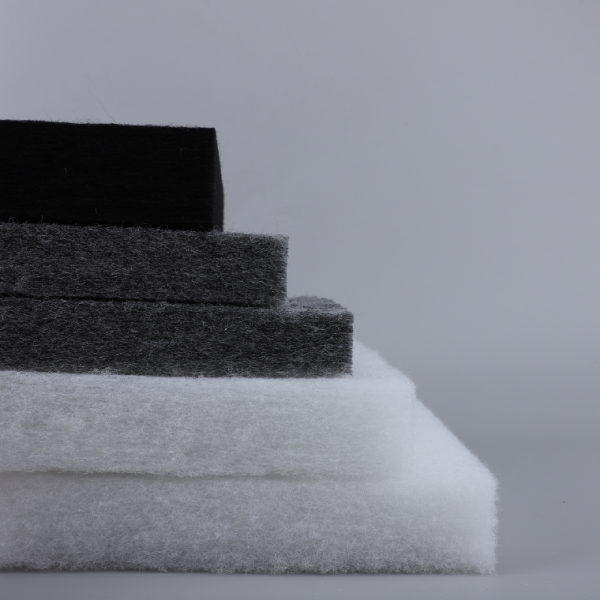
Which Interior Products Can Use Recycled PET Acoustic Felt?
Recycled PET Acoustic Felt can be considered for a wide range of interior product development projects, but the purpose here is not to list every possible acoustic felt application.
The focus is on interior products with clear sustainable-material requirements.
For example:
Acoustic Wall Products
Some interior acoustic wall products can use Recycled PET Acoustic Felt as part of their material structure.
Decorative Acoustic Products
For interior acoustic products that place importance on both visual design and material sourcing, recycled PET can form part of the product's material solution.
Office Interior Products
Office partitions, meeting spaces, and other interior products may have recycled-material requirements during product development.
Commercial Interior Products
For hotels, commercial spaces, and public interior projects, recycled PET acoustic material can be considered when the project owner has specific requirements for sustainable materials.
However, one important point should be emphasized:
Using Recycled PET does not automatically mean that a product complies with a specific green-building standard or project certification.
Whether the final product meets a particular project requirement still depends on the specific material, product structure, certification documents, and project specifications.
Therefore, buyers should not automatically equate “Recycled PET” with “compliant with every environmental certification.”
Why Is It Important to Communicate Directly With the Manufacturer About Recycled PET Acoustic Felt?
For small-volume purchases of standardized products, buyers may only need an existing material.
However, for:
Brand Product Development
Long-Term Projects
Large-Volume Purchasing
Customized Acoustic Felt
direct communication with the manufacturer about material composition and production requirements becomes more important.
These projects require buyers to confirm not only the product name, but also:
Fiber
Material Structure
GSM
Thickness
Width
Color
Production Consistency
and other project requirements.
If a supplier simply purchases finished materials from the market and resells them, buyers may have less direct communication regarding material composition, production adjustments, and long-term consistency.
By contrast, a professional Nonwoven Manufacturer China can participate in the early-stage discussion from a material-development and manufacturing perspective.
How Does Jinhaocheng Support Recycled PET Acoustic Material Projects?
HuiZhou JinHaoCheng Nonwoven Co., Ltd. has been engaged in nonwoven material R&D and manufacturing since 2005.
The company has approximately 26,000 square meters of production facilities, 15 automated needle-punching production lines, and annual production capacity exceeding 10,000 tons, with manufacturing capabilities covering needle-punched nonwoven and thermal-bonded materials.
For overseas customers developing Recycled PET Acoustic Felt, we can discuss requirements including:
Fiber Composition
GSM
Thickness
Width
Density
Color
and other material requirements.
The company also supports OEM, ODM, and Custom Nonwoven Products, allowing materials to be customized according to customer product-development requirements.
For sustainable interior product projects, buyers can confirm the material composition, product specifications, and required documentation during the sampling stage before proceeding to mass production.
This helps turn Recycled PET Acoustic Felt from a broad “eco-friendly material” concept into a purchasing specification that can actually be defined and verified.
What Is the Most Important Purchasing Sequence for Recycled PET Acoustic Felt?
If your project specifically requires Recycled PET Acoustic Felt, you can follow this purchasing logic:
Project Requirement
↓
Recycled PET Requirement
↓
Fiber Composition
↓
Recycled Content
↓
Supporting Documentation
↓
Approved Sample
↓
Mass Production Consistency
The purpose of this sequence is not to compare supplier prices first, but to define the material requirements clearly.
Only after the material requirements are clearly defined can quotations and samples from different suppliers be meaningfully compared.
For long-term purchasing projects, buyers should also confirm:
Does the approved sample remain consistent with mass production?
This step is particularly important for brands, importers, and interior product manufacturers.
Conclusion: When Purchasing Recycled PET Acoustic Felt, Look Beyond “Eco-Friendly”
For overseas buyers developing sustainable interior products, the purchasing priority for Recycled PET Acoustic Felt is not simply to find a product labeled “Eco-Friendly.”
The more important task is to confirm whether the material actually meets the project's raw-material requirements.
The key questions are:
Is it actually made with recycled PET?
What is the fiber composition?
What recycled content is required?
What supporting documentation is available?
Can the approved material remain consistent during mass production?
When these questions are clarified during quotation, sampling, and before mass production, buyers can reduce potential risks caused by unclear material definitions.
For long-term purchasing, brand development, or customized material projects, working with an experienced Needle Punched Nonwoven Manufacturer or Nonwoven Manufacturer China, and confirming material requirements directly during the early stage of product development, can be more effective than simply comparing products labeled “eco-friendly acoustic felt.”
If you are developing interior products that require Recycled PET Acoustic Felt, Custom Nonwoven Products, or OEM/ODM Nonwoven Material, you can start by discussing your material composition and project requirements with the manufacturer to determine a suitable material solution.




