
How Can Buyers Choose Absorbent Felt for Flower Transportation? Balancing Stem Hydration and Leakage Control
For flower packaging manufacturers, floral logistics packaging suppliers, and flower wholesalers, moisture management during transportation is an important part of packaging design and product handling.
Fresh flowers may require an appropriate water supply during storage and transportation. At the same time, liquid inside the package needs to be controlled. If liquid leaks out or the packaging materials become excessively wet, handling, stacking, and transportation can become more difficult.
Therefore, when sourcing absorbent felt for flower packaging, buyers should not focus only on how much liquid the material can absorb. More importantly, they need to determine how the material works with the flower stems, hydration method, and outer packaging to meet the actual requirements for absorption, liquid retention, and package structure.
For buyers developing flower transportation packaging with hydration requirements, material selection should begin with the intended moisture management solution and packaging structure, followed by sample testing to confirm suitability.
Why Does Flower Packaging Need Moisture Management?
Moisture management in flower transportation packaging is not simply a matter of adding absorbent material to a package. Different flower packaging methods, transportation times, stem quantities, and hydration designs can create different requirements. Buyers should first identify the specific problem the packaging needs to solve.
For example, some packages may need a material that can hold moisture around the flower stems. Other designs may need to control the movement of water that has already been added, preventing liquid from spreading to other areas of the package. Some packaging systems must also balance material softness, available space, and assembly efficiency.
These requirements cannot always be met by relying on a single material property. Absorbent felt can absorb and temporarily retain compatible liquids, but it is not a sealed container and cannot automatically guarantee that flower stems will receive sufficient water throughout the entire transportation period.
For buyers, the first step is to clarify how the flower packaging will be used. Consider whether the flower stems will directly contact the absorbent material, whether the material will be pre-moistened, whether the package may be compressed during transportation, and whether a separate leakage-control structure is required.
Once these conditions are clear, buyers can determine the function the absorbent felt needs to perform and discuss a suitable material solution with the supplier.
How Can Absorbent Felt Be Used Around Flower Stems?
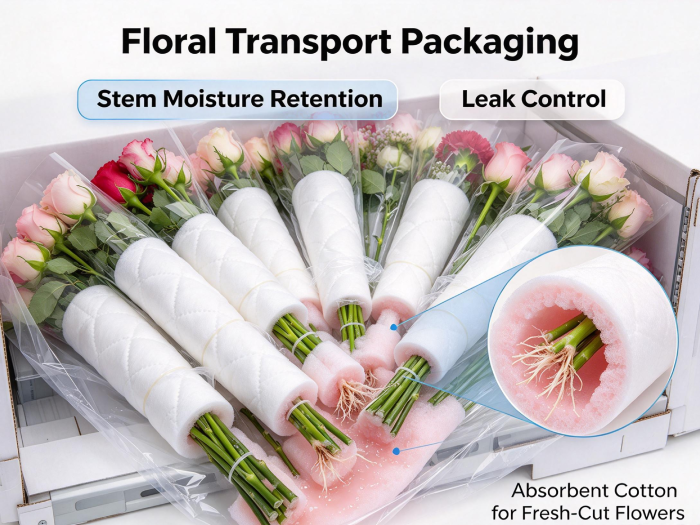
In flower transportation packaging, absorbent felt can be positioned around flower stems or incorporated into a dedicated hydration component, depending on the packaging design. The appropriate arrangement depends on the bouquet structure, number of stems, package dimensions, and hydration method.
For example, if the packaging is designed to provide moisture near the cut ends of the stems, the absorbent material needs to work appropriately with the designated hydration area. Its dimensions, softness, and shape should fit the available space. The material should be easy to assemble without interfering with stem positioning or the installation of other packaging components.
If the absorbent felt needs to be pre-moistened, buyers should also consider how the material behaves after absorbing water. Whether it becomes excessively soft, changes shape significantly, or affects package stability and handling should be evaluated under actual usage conditions.
It is important to understand that absorbent material performs an absorption or temporary liquid-retention function; it does not independently provide every requirement for flower preservation. The moisture needs of fresh flowers are also affected by flower species, post-harvest handling, temperature, transportation time, and packaging conditions.
Therefore, buyers should not determine suitability based only on the material name or appearance. The absorbent felt should be evaluated within the actual packaging structure to confirm how it works with the flower stems, hydration method, and outer packaging.
How Can Buyers Balance Water Retention and Leakage Control?
One issue that is easy to overlook when purchasing materials for flower packaging is that liquid absorption and leakage prevention are not the same function.
Absorbent felt can absorb and temporarily retain a certain amount of liquid, but its actual performance depends on fiber composition, material structure, absorption conditions, and how it is used. If the amount of water exceeds what the material can hold under the relevant conditions, or if the package is compressed, liquid may still migrate or leak out.
Therefore, buyers should not simply ask suppliers for a material with “high absorbency.” They should also explain where the water comes from, how it is introduced, and what conditions the package will encounter. For example, is the material moistened before being placed in the package, or does it come into contact with a water source during use? Could the package be placed horizontally, compressed, or stacked during transportation? These factors can affect the performance of the material solution.
The outer packaging structure is equally important. If the project has specific leakage-control requirements, buyers need to evaluate how the absorbent material works with liners, containers, sealed areas, or other liquid-barrier components. The absorbency of the felt alone cannot establish that the entire package is leakproof.
A more reliable approach is to test the material in packaging that closely reflects actual transportation conditions. During testing, observe the condition of the material after absorption, whether liquid migrates to surrounding areas, whether contact surfaces become wet, and whether leakage occurs during handling or appropriate compression.
This approach helps buyers distinguish whether a problem comes from the absorbent material, hydration design, or outer packaging structure, rather than trying to solve every issue simply by increasing material thickness.
What Should Buyers Check When Selecting Floral Absorbent Felt?
When selecting absorbent felt for flower packaging, buyers should focus on performance under actual usage conditions rather than comparing quotations or relying on a single specification.
First, confirm whether the absorption rate and liquid-retention behavior meet the packaging requirements. If the package needs to absorb liquid quickly, evaluate the material's absorption process under the relevant conditions. If maintaining moisture during transportation is the main concern, observe the material over the intended usage period. Absorption rate and liquid-retention capacity are different evaluation criteria, and one should not be used as a substitute for the other.
Next, check the material's dimensions, softness, and structural stability. The material must fit the space around the flower stems and the other packaging components. If it is too large, assembly may become more difficult. If it is too small, it may not cover the intended contact area. Changes in dimensions and shape after absorbing water should also be included in the evaluation.
Buyers should then confirm the material's performance within the actual package. A sample that performs well in isolation does not necessarily meet the requirements when installed in a complete packaging system. The number of flower stems, material placement, amount of water, outer packaging, and transportation conditions can all affect the final result.
Therefore, buyers should provide an actual packaging sample or a clear structural drawing before finalizing the material. Testing should be conducted under conditions that closely reflect the intended use. If the product has specific requirements for moisture-retention time, leakage, or material dimensions, the evaluation method and acceptance criteria should be defined in advance.
For projects involving long-term purchasing, buyers should also retain the approved sample and specification records so that subsequent batches can be checked against the same requirements.
What Information Should Buyers Provide for Customized Floral Felt?
If standard absorbent felt does not meet the requirements of a flower packaging design, buyers can request customization. To reduce unnecessary communication, however, they should provide sufficient application information when requesting a quotation rather than simply asking for a “highly absorbent flower packaging material.”
First, explain the intended use of the flower packaging, including the approximate number of flowers or stems, the packaging format, the position of the material, and whether the material needs to be pre-moistened before use. This information helps the supplier understand the function the material needs to perform.
Next, provide the available packaging space and required material dimensions. If the material needs to be cut into a specific shape, buyers can supply a dimensional drawing, packaging structure drawing, existing sample, or clear product photos. If the material also needs to be laminated with other packaging layers or undergo further processing, this should be explained during the inquiry.
Buyers should then describe the expected conditions of use, such as transportation time, package handling methods, potential compression, and specific requirements for moisture retention and leakage control. If an existing test method or acceptance standard is available, include it as well. If the technical specifications have not yet been established, buyers can begin by discussing material options through samples rather than guessing every parameter at the inquiry stage.
Finally, specify the estimated order quantity, required supply format, and packaging requirements. This information allows the supplier to assess the feasibility of sample development, material customization, and subsequent bulk production.
An effective customization inquiry should explain how the finished product will be used, what function the material needs to perform, and how the sample will be evaluated. This is more helpful for material selection than providing only a GSM figure or material name.
How Can a Nonwoven Manufacturer Support Customized Floral Packaging Projects?
For flower packaging manufacturers and overseas buyers, a supplier needs to understand more than the material specifications. The supplier should also understand the role of the absorbent felt within the finished packaging. Material development, sample evaluation, and bulk production should all follow the same set of application requirements.
HuiZhou JinHaoCheng Nonwovens Co., Ltd. specializes in needle punched nonwoven and related composite nonwoven materials. The company can discuss absorbent material composition, specifications, and processing requirements for different product applications, and supports OEM/ODM projects. For flower packaging projects, buyers can provide the packaging structure, material placement, dimensional requirements, and expected moisture management performance to help establish a suitable sample solution.
If buyers have not yet finalized the complete technical specifications, they can begin by providing an existing material sample, packaging drawing, or photos of the finished product. Clarifying the application and usage conditions before confirming specifications can reduce the uncertainty associated with purchasing based only on a material name or a single parameter.
For customers who import materials and purchase in bulk over the long term, it is also important to maintain specification records after sample approval, monitor consistency between production batches, and confirm that the supplier can continue to meet the agreed requirements.
Conclusion: Choose Floral Absorbent Felt Based on the Complete Packaging System
When selecting absorbent felt for flower transportation packaging, the key consideration is not simply how much water the material can absorb. It is whether the material works appropriately with the flower stems, hydration method, and outer packaging structure.
Buyers should first clarify the moisture needs of the flower stems, the placement of the material, the risk of liquid movement within the package, and the actual transportation conditions. Sample testing can then be used to confirm whether absorption performance, material condition, and leakage control meet the requirements.
For customized absorbent felt, providing the number of flower stems, packaging dimensions, material usage method, expected moisture-retention requirements, and existing samples can help the supplier understand the project more accurately. For packaging designs with leakage-control requirements, the outer packaging structure must also be evaluated. Absorbent felt itself should not be treated as a complete leakage-prevention solution.
By selecting and validating materials based on real packaging conditions, flower packaging manufacturers, floral logistics packaging suppliers, and flower wholesalers can evaluate material options more effectively and establish clear acceptance requirements before bulk purchasing.




