
Can Absorbent Felt Be Customized? How to Specify PET Needle Punched Absorbent Felt
Yes. PET needle punched absorbent felt can be customized according to your product requirements, including GSM, thickness, width, length, density, supply format, and custom shape. However, successful customization involves more than choosing dimensions or weight. Buyers also need to explain the liquid absorption requirements, intended application, and downstream processing method so the supplier can recommend a suitable material structure.
For overseas importers, wholesalers, distributors, and product manufacturers, the goal is to obtain a material that meets the requirements of the final product and can be reproduced consistently in bulk production.
If standard absorbent felt specifications do not meet your needs, this guide explains which parameters can be customized, what information to provide when requesting a quotation, and how to evaluate samples before placing a bulk order.
Why Should You Define Your Product’s Liquid Absorption Requirements Before Customizing Absorbent Felt?
Before selecting GSM, thickness, or dimensions, buyers should clarify what the absorbent felt needs to do in the final product.
For example, does the product need to absorb water quickly, retain liquid for a certain period, or distribute liquid across a larger surface? Will the material be used once or repeatedly? Will it be exposed to continuous moisture, occasional spills, or a specific liquid during normal operation?
These requirements can affect the material structure and the specifications that need to be confirmed with the manufacturer.
It is also important to distinguish between liquid absorption rate and liquid absorption capacity. A material that absorbs liquid quickly does not necessarily retain the greatest amount of liquid. Similarly, a material with a high absorption capacity may not be suitable if the product requires liquid to be absorbed within a very short time.
Therefore, when requesting custom PET needle punched absorbent felt, describe the actual operating conditions rather than simply stating that the material needs to be highly absorbent. If possible, provide an existing sample, product photo, drawing, or description of the expected absorption performance.
GSM: How Should You Specify the Weight of Custom Absorbent Felt?
GSM refers to grams per square meter and indicates the weight of the material per unit area. It is one of the basic specifications buyers should confirm when customizing PET needle punched absorbent felt.
However, a higher GSM does not automatically mean better absorption performance. The amount of liquid a material can absorb depends on several factors, including fiber type, fiber structure, density, thickness, and any finishing treatment. Two materials with the same GSM may perform differently under the same conditions.
When determining the target GSM, consider the amount of liquid the product needs to handle, the available installation space, the required flexibility, and the overall weight limitations of the finished product. These factors help establish a more appropriate starting point for material development.
If you already have a material specification, provide the target GSM and any acceptable tolerance. If you do not know which GSM is suitable, explain the intended application and required absorption performance so the manufacturer can help evaluate possible options.
Thickness: Which Product Requirements Should Determine the Thickness?
Thickness is another important specification for customized absorbent felt. It can affect the material's fit, cushioning, flexibility, and suitability for the space available in the finished product.
For example, a product with limited installation space may require a relatively thin absorbent layer. Another product may need a thicker material to provide more space within its fiber structure or to meet particular structural requirements. The appropriate choice depends on the design and operating conditions of the final product.
However, thickness should not be evaluated independently of GSM and density. Materials with similar thicknesses may have different fiber structures, weights, and absorption characteristics. A thicker sample is not necessarily the most suitable option for every application.
When requesting customization, specify your target thickness and acceptable tolerance if known. If the exact requirement has not yet been established, provide the product dimensions, available installation space, and performance expectations. The supplier can then help assess the relationship between thickness and the other material specifications.
Width and Length: How Should You Determine the Material Dimensions?
Width and length should be determined according to the finished product dimensions and the way the material will be processed.
If the absorbent felt will be used directly from a roll, its width and roll length should match the buyer's production equipment, handling method, and material consumption requirements. Incorrect dimensions can create unnecessary trimming, material waste, or interruptions during production.
If the material will be cut into smaller pieces, pads, strips, or components, the buyer should consider the dimensions of the finished parts and the cutting layout. Providing this information early can help the manufacturer assess the appropriate supply dimensions and reduce unnecessary secondary processing.
For customized orders, buyers should clearly distinguish between the dimensions of the raw material and those of the finished product. For example, the required roll width is not the same as the width of an individual cut piece.
If you do not know the ideal roll dimensions, provide the finished product dimensions, estimated consumption, and processing method. These details give the supplier a practical basis for discussing suitable width and length options.
Density: Why Should You Not Judge Density by Thickness Alone?
Density describes how much material is contained within a given volume. In needle punched absorbent felt, it is related to the fiber structure and the way the material is formed during manufacturing.
Density can influence the material's firmness, flexibility, internal structure, and the way liquid moves through it. However, its effect on absorption depends on the fiber material, fiber arrangement, thickness, and other manufacturing conditions.
This means that two absorbent felt samples with the same thickness may have different densities and may behave differently during use. Likewise, a denser material is not automatically better for every liquid absorption application.
When customizing PET needle punched absorbent felt, buyers should communicate any known density requirements. If density is not specified in the existing product design, describe the required hand feel, structural stability, liquid absorption behavior, and installation conditions instead.
The manufacturer can then help evaluate whether density needs to be controlled as a separate specification. For repeat orders, the agreed material requirements should be documented so that future production can be compared with the approved sample.
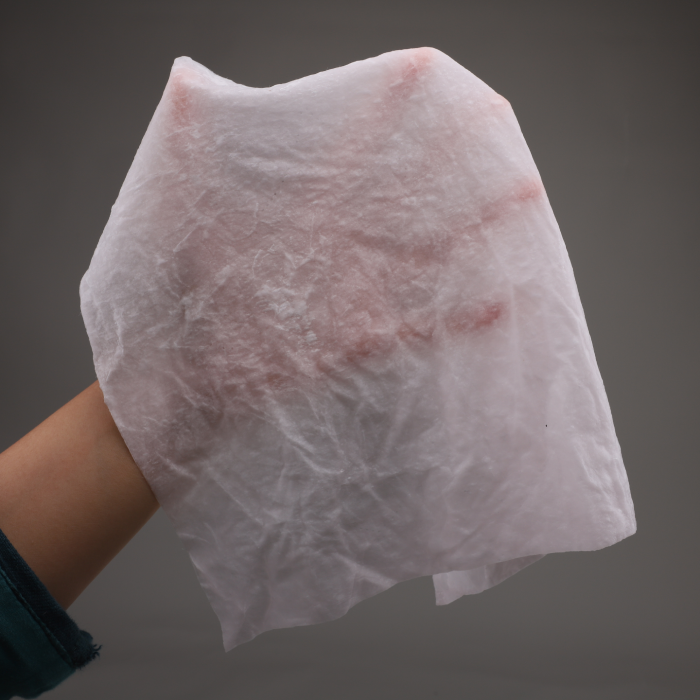
Roll or Sheet: Which Supply Format Is More Suitable for Your Production?
Customized absorbent felt can be supplied in rolls or sheets, depending on the product design and downstream processing requirements.
Rolls may be suitable when the material will be fed continuously into production equipment, cut to length, laminated, or converted into multiple components. Roll supply can also make sense when the buyer needs longer continuous lengths of material.
Sheets may be more suitable when the material is processed or assembled as individual pieces, when the production process requires defined sheet dimensions, or when handling full rolls is inconvenient.
The choice should be based on the buyer's actual manufacturing workflow rather than appearance alone. Buyers should consider cutting equipment, storage space, handling requirements, packaging, and how the material will be used after delivery.
When requesting a quotation, specify whether you need rolls or sheets. For roll materials, provide the required width and length where known. For sheets, provide the length, width, and any dimensional tolerances. If the format is still undecided, explain your production process so the supplier can discuss the available options.
Custom Shape: What Information Should You Provide for Specially Shaped Absorbent Felt?
Some products require absorbent felt in shapes that cannot be supplied as standard rolls or rectangular sheets. Examples may include pads, inserts, strips, and components designed to fit a particular product.
For these projects, buyers should provide the required dimensions and shape information before requesting a quotation. A technical drawing is useful because it can show the overall dimensions, cut-out areas, holes, edges, and other details that affect the finished component.
If a drawing is not available, clear product photos, a physical sample, or a dimensioned sketch can help the manufacturer understand the requirement. Buyers should also explain how the component will be installed or used, especially if the shape must fit into a specific space or work with other materials.
It is important to confirm whether the quotation is for the absorbent felt in roll or sheet form, or for finished pieces that have already been cut to the required shape. These are different supply requirements and may involve different processing arrangements.
Providing complete shape and application information at the beginning helps the manufacturer evaluate the project more accurately and makes it easier to confirm sample dimensions before bulk production.
What Information Should You Prepare Before Requesting a Quote from an OEM Nonwoven Manufacturer?
A clear inquiry helps the supplier understand your requirements and reduces the risk of quoting a material that does not match your intended application.
When requesting custom PET needle punched absorbent felt, buyers should provide the final product application and the type of liquid the material needs to absorb, if known. They should also explain the expected absorption behavior, such as whether fast absorption, liquid retention, or repeated use is important.
The basic material specifications should include the target GSM, thickness, density, width, and length wherever these values are already known. Buyers should also specify whether they need rolls, sheets, or custom-shaped components.
If the product requires further processing, describe the relevant method, such as cutting, die-cutting, laminating, or assembly with other materials. The expected order quantity and any packaging requirements should also be included when available.
You do not need to know every technical specification before making an inquiry. If GSM, thickness, or density has not yet been determined, provide an existing sample, product drawing, photos, finished product dimensions, and a description of the required performance. A professional OEM nonwoven manufacturer can use this information to discuss possible material options with you.
How Can You Move from a Customized Sample to Bulk Purchasing?
Confirming the initial specifications is only one stage of a custom absorbent felt project. Before placing a bulk order, buyers should evaluate whether the sample meets the actual requirements of the finished product.
The evaluation should reflect the intended application. Depending on the product, this may include checking liquid absorption behavior, material dimensions, thickness, flexibility, fit, and compatibility with downstream processing. If specific performance targets have been established, the sample should be assessed against those requirements rather than judged by appearance alone.
Once the sample is approved, the buyer and supplier should document the agreed material specifications and the acceptance criteria for production. These may include GSM, thickness, dimensions, supply format, and other relevant material characteristics.
For repeat orders, the approved sample and specification record provide a common reference for checking consistency. This is particularly important for importers, wholesalers, and manufacturers that need a stable supply of customized absorbent felt over time.
The practical purchasing process is therefore to define the application, discuss suitable specifications, evaluate the sample, approve the requirements, and then proceed to bulk production.
How Can HuiZhou JinHaoCheng Nonwovens Co., Ltd. Support Custom Absorbent Felt Projects?
For overseas buyers, a customization project requires more than changing a single parameter. The supplier needs to understand the product application and help establish material specifications that can be evaluated before bulk production.
HuiZhou JinHaoCheng Nonwovens Co., Ltd. has experience in nonwoven material manufacturing and provides needle punched absorbent felt and customized nonwoven solutions for different product requirements. Its OEM/ODM support allows buyers to discuss material specifications and processing needs according to their intended applications.
When discussing a custom absorbent felt project, buyers can provide information about the liquid absorption requirements, GSM, thickness, density, dimensions, supply format, and any special shape or processing requirements. If the exact specifications are not yet available, an existing sample, product drawing, or application description can help establish a starting point for discussion.
For importers, wholesalers, and product manufacturers, the objective is to develop a material that meets the requirements of the finished product and can be evaluated against agreed specifications before moving into bulk purchasing.
Conclusion: Customize Absorbent Felt Around Your Product Requirements
PET needle punched absorbent felt can be customized by GSM, thickness, width, length, density, supply format, and shape. However, selecting these parameters should begin with the liquid absorption requirements and the way the material will be used in the finished product.
GSM and thickness alone cannot fully determine absorption performance. Density, fiber structure, dimensions, and the downstream processing method also need to be considered when relevant to the application.
For overseas buyers, the most useful starting point is to provide the supplier with the final product application, expected liquid absorption behavior, available dimensions, processing requirements, and estimated order quantity. If some technical specifications remain unknown, a sample, drawing, or product photo can help the supplier understand the project.
By clarifying the requirements, evaluating customized samples, and documenting the approved specifications before bulk production, buyers can establish a clearer purchasing process for custom PET needle punched absorbent felt.




