
How Do Buyers Choose Absorbent Pads for Fresh Fruit Packaging?
For fruit packaging manufacturers, food packaging suppliers, and overseas buyers, choosing absorbent pads is not simply about finding a material that can absorb moisture. The more important questions are where the liquid inside the package comes from, where it needs to be absorbed, and whether the absorbent pad can work effectively with the tray, liner, and other packaging components.
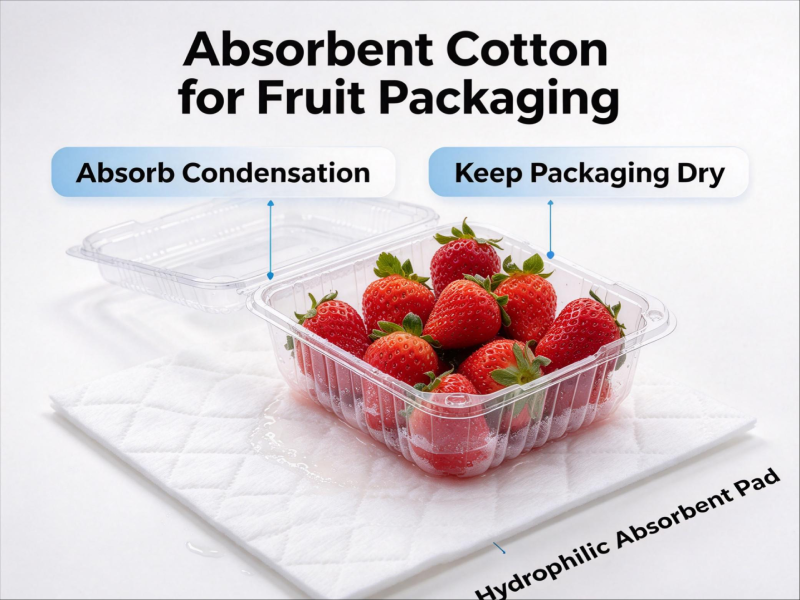
During storage, transportation, and display, fresh fruit packaging may contain condensation, liquid released from the fruit, or juice from damaged fruit. These liquids have different sources and occur under different conditions. Therefore, buyers should not determine the material type and specifications based only on the general requirement for absorbent felt for fruit packaging.
A more practical approach is to identify the source of the liquid and understand the packaging structure before confirming the pad's dimensions, placement, material integrity, and actual absorption performance. Only when the absorbent pad matches the finished packaging system can sample testing and bulk purchasing be evaluated against clear requirements.
Where Does Excess Liquid in Fresh Produce Packaging Come From?
Before selecting absorbent pads for fresh produce packaging, buyers should first understand where the excess liquid inside the package originates. Different types of liquid may require different packaging management approaches. If every moisture problem is attributed to insufficient absorption capacity, the actual cause may remain unresolved.
The first possible source is condensation. When fruit or packaging materials experience temperature changes, moisture may condense inside the package. In this case, the liquid may not come directly from the fruit but may be related to temperature differences, humidity, ventilation, and packaging conditions. If condensation is the main concern, buyers should identify where and how extensively the moisture appears before deciding whether an absorbent pad is needed in a specific area.
The second possible source is liquid released by the fruit itself. Different fruit varieties, maturity levels, surface conditions, and storage or transportation conditions can affect the moisture present inside the package. When liquid appears on the fruit surface, buyers should determine whether it results from normal moisture accumulation, a wet fruit surface, or another cause. An absorbent pad can be part of a liquid-management solution, but it cannot replace an evaluation of storage conditions and packaging design.
The third possible source is juice released when fruit is compressed, impacted, or damaged. This liquid may accumulate in a localized area or spread as the package moves. If the problem is primarily caused by fruit damage, simply adding more absorbent material may not solve the underlying issue. Buyers should also examine tray support, product positioning, transportation protection, and the available space inside the package.
These three situations may occur together, but they are not the same problem. Before developing an absorbent pad for fruit packaging, buyers should explain the source of the liquid, where it appears, how frequently it occurs, and the actual packaging conditions. This information helps suppliers determine which areas the material needs to cover and how sample testing should be designed.
When Is an Absorbent Pad Useful in Fruit Packaging?
When excess liquid needs to be collected or temporarily held inside a fruit package, an absorbent pad can serve as a functional component of the packaging system. Its specific role depends on the material structure, liquid contact conditions, and final packaging design rather than on the product name alone.
For example, when liquid may accumulate at the bottom of a tray, an absorbent pad can be evaluated as a bottom absorbent layer that contacts liquid inside the package. If liquid is likely to appear only in a localized area, buyers can consider a smaller pad or a custom die-cut piece instead of automatically covering the entire bottom of the package.
If liquid may move along the surface of an inner liner or tray, the pad's position and coverage become more important. Even if a material has a certain level of absorption capacity, it may not perform as expected if the liquid cannot effectively reach it. Buyers should therefore consider the liquid's movement path, the placement of the absorbent pad, and the relationship between the packaging components.
However, an absorbent pad cannot replace every packaging function. It does not automatically solve problems caused by an unsuitable tray structure, inadequate sealing, improper temperature control, or fruit compression. If the packaging needs to prevent liquid from leaking to the outside, buyers should separately evaluate the tray, liner, seals, and other barrier structures. An absorbent pad and a leak-resistant structure serve different functions. A material's ability to absorb liquid does not prove that the complete packaging system is leakproof.
Absorbent felt is also used in other applications, including floral packaging, fragrance products, and selected liquid-management systems. Learn more about PET absorbent felt applications and how buyers evaluate absorbent materials for different end uses.
Buyers should also avoid assuming that an absorbent pad will extend fruit shelf life, inhibit bacteria, or reduce spoilage simply because it absorbs moisture. These outcomes depend on the specific fruit, packaging environment, and storage or transportation conditions and require relevant product testing or supporting evidence. For food packaging projects, the actual application and contact conditions should be confirmed first, followed by the required performance and compliance requirements.
How Should Buyers Match the Pad to the Tray or Package?
Choosing an absorbent pad for fresh produce packaging requires considering the final packaging structure. Even if two materials have similar absorption performance, differences in size, shape, or placement can lead to different results in actual use.
First, buyers need to confirm the usable dimensions of the tray or package bottom. Whether the absorbent pad should cover the entire bottom, cover only part of the area, or be placed at a specific liquid accumulation point depends on the packaging design. A pad that is too small may not reach the target liquid area, while an oversized pad may fold, curl at the edges, or interfere with the assembly of other packaging components.
Second, buyers should consider the relative positions of the absorbent pad, tray, liner, and fruit. Whether the pad is placed directly on the tray bottom, underneath an inner liner, or within another part of the structure affects how liquid contacts the material. If another component separates the pad from the liquid, or the pad does not align with the area where liquid is likely to appear, buyers need to verify whether the liquid can still reach the absorbent layer.
Third, the available space inside the package needs to be considered. An absorbent pad occupies a certain amount of space and may change in condition after absorbing liquid. Buyers should confirm whether the material affects fruit positioning, tray closure, package stacking, or the normal use of other components. Checking the dimensions of the dry material alone is not enough; its behavior under actual use conditions should also be evaluated.
For packaging projects involving mass production, buyers should also confirm the required converting format in advance. Depending on the project, the material may be evaluated in rolls, sheets, or custom die-cut shapes, but the final format must match the packaging line's operating method. If the production line requires the pad to be placed, positioned, or assembled with the tray quickly, these requirements should be communicated during sample development.
Therefore, before confirming the GSM, thickness, or material composition of the absorbent pad, buyers should provide the tray dimensions, packaging structure, and intended pad location. Resolving where the pad should be placed and which area it needs to cover before deciding its specifications can help reduce repeated adjustments later.
What Should Buyers Check Beyond Absorption Capacity?
Absorption capacity is an important evaluation factor for fruit packaging absorbent pads, but it cannot determine material suitability on its own. Buyers should also consider how liquid spreads through the material, whether the pad maintains its integrity during handling, and how it fits into the packaging system.
First, check whether liquid can be absorbed and distributed effectively in the target area. If liquid remains concentrated in one location or cannot reach the material's effective absorption area, a high laboratory absorption value may not translate into effective performance inside the actual package. Sample testing should reproduce the expected liquid location and contact method as closely as possible, rather than comparing materials only by immersing entire samples in water and measuring weight gain.
Second, inspect material integrity during handling, cutting, and packaging operations. For absorbent pads that need automated placement or bulk converting, excessive fiber shedding, loose edges, dimensional changes, or an unstable structure may complicate production. Buyers should evaluate whether the pad can maintain its shape and whether normal handling affects other packaging components.
Third, assess compatibility between the absorbent pad, tray, and liner. The pad may need to remain flat without significant curling, shifting, or covering areas that must remain accessible within the packaging design. If the material needs to contact or be combined with other layers, buyers should confirm whether these combinations affect liquid contact, material integrity, or package assembly.
Fourth, evaluate samples under the intended storage and transportation conditions. Temperature, humidity, packaging method, storage duration, and transportation may all affect the moisture conditions inside the package. Buyers should establish test conditions based on the target market and actual product use rather than treating one set of test results as a universal conclusion for every fruit and packaging format.
If the absorbent pad is intended for food packaging, buyers should also verify whether the fiber composition, additives, manufacturing process, and intended use meet the applicable requirements of the target market. Food-contact compliance must be assessed according to the actual contact conditions, sales region, and specific product. A supplier's description of a material as an “absorbent pad for food packaging” does not by itself establish compliance.
What Should Buyers Provide When Sourcing Custom Fruit Packaging Pads?
When requesting a quotation, clear packaging information is usually more valuable than providing only a GSM or thickness figure. Because an absorbent pad needs to match the fruit, tray, liner, and packaging process, suppliers need to understand the final application before evaluating suitable materials and converting formats.
First, specify the fruit type and packaging application. For example, the pad may be intended for an individual fruit tray, a compartmentalized package, a transportation package, or another packaging system. Buyers should also explain where the liquid inside the package mainly comes from and where it usually appears. If the liquid source has not yet been confirmed, actual packaging photos and a description of the current problem can still provide a useful starting point.
Second, provide the packaging structure and dimensions. This information should include the internal dimensions of the tray or package, the intended location of the absorbent pad, whether an inner liner is used, and whether the material needs to cover the entire bottom or only a specific area. Product drawings, packaging photos, existing samples, or simple structural sketches can help suppliers understand the available space and installation requirements.
Third, define the absorption performance that needs to be evaluated. Buyers may be more concerned with the speed at which liquid enters the material, the amount of liquid the pad can hold, liquid distribution within the pad, or material integrity after absorption. If internal test standards, reference samples, or acceptable test ranges already exist, they should be provided as well. If numerical requirements have not yet been established, describe the problem that needs to be solved and discuss appropriate validation methods with the supplier.
Fourth, explain converting and bulk production requirements. Specify whether the absorbent pad should be supplied in rolls, sheets, or custom shapes, and whether particular die-cut dimensions, packaging methods, or automated placement requirements apply. The estimated order quantity and future purchasing plans should also be included. For long-term supply projects, the key specifications and acceptance criteria for bulk production should be agreed upon after sample approval.
If the material will be used in packaging that directly or indirectly contacts food, buyers should disclose the target sales market, intended contact conditions, and relevant compliance requirements in advance. This allows the supplier to consider suitability during development rather than discovering after sample production that additional material evaluation or testing is required.
For projects where all specifications have not yet been finalized, buyers do not need to provide every parameter in the first inquiry. Clear information about the application, packaging structure, liquid conditions, and intended function is often enough to help both parties determine whether custom development is necessary and how the samples should be evaluated.
Conclusion: Match the Absorbent Pad to the Packaging System
When choosing absorbent pads for fresh fruit packaging, the priority is not simply to find a material with a higher absorption capacity. Buyers should determine the required function and structure of the pad based on the source and location of excess liquid and the actual packaging conditions.
Condensation, liquid released by fruit, and juice from damaged fruit may require different liquid-management approaches. The absorbent pad must also match the tray dimensions, liner structure, liquid contact area, and packaging process. Evaluating samples under actual packaging conditions provides a more reliable basis for determining whether the material is suitable for the intended product.
For overseas importers, wholesalers, and fruit packaging manufacturers, it is advisable to provide the fruit type, packaging drawings or photos, liquid source, intended pad location, target absorption performance, and compliance requirements when requesting a quotation. The material composition, GSM, thickness, and converting format can then be confirmed.
HuiZhou JinHaoCheng Nonwovens Co., Ltd. provides needle punched absorbent felt, needle punched nonwoven materials, and related custom converting services. The company can discuss material and processing options according to specific applications. For fruit packaging projects, the actual packaging structure, liquid-management requirements, and applicable compliance requirements should still be confirmed first, followed by sample evaluation to determine material suitability.




