
What Should Buyers Include in an Anti-Condensation Felt RFQ? A Buyer’s Specification Checklist
For metal roofing manufacturers, building material importers, roofing distributors, and steel building contractors, one common question when purchasing Anti-Condensation Felt is:
What roof conditions and material specifications should buyers provide when requesting a quotation to reduce the risk of ordering an unsuitable product?
If an inquiry simply says, “We need Anti-Condensation Felt,” the supplier may not have enough information to determine whether the material matches the roof structure, installation method, and intended application. Even when several suppliers offer anti-condensation felt, their quotations may differ in GSM, roll width, roll length, backing construction, and other technical requirements.
For metal roofing products manufactured on continuous roll-forming lines, the material must also be compatible with the actual production process. If these conditions are not confirmed before purchasing, buyers may need to revise the sample, adjust production arrangements, or deal with differences between the expected and actual application results.
Therefore, purchasing anti-condensation felt should not start with comparing unit prices. Buyers should first clarify the roofing application, material specifications, and acceptance requirements.
This guide explains what an actionable Anti-Condensation Felt RFQ should include and how overseas B2B buyers can confirm samples and key requirements before placing a bulk order.
Why Is “Anti-Condensation Felt” Alone Not Enough for a Quotation?
Anti-condensation felt can be used in different metal roofing projects, but roof structures, installation methods, and operating environments may vary significantly.
For example, warehouses, agricultural buildings, industrial facilities, and other metal-roofed buildings may have different roof panel profiles, indoor humidity levels, ventilation conditions, and installation requirements.
Even if buyers already know they need anti-condensation felt, they may not yet have confirmed which material specifications are suitable for their project.
If an RFQ contains only the product name, a supplier may quote a standard specification while the buyer actually needs a particular width, roll length, color, or backing construction compatible with a specific roofing process.
An effective anti-condensation felt RFQ should explain the intended application, roof conditions, target material specifications, and acceptance requirements.
If some information has not yet been finalized, buyers can identify the outstanding details and ask the supplier to discuss suitable options rather than leaving the supplier to make assumptions.
Start by Describing the Roof Panel Type and Operating Environment
Roofing conditions are an important starting point for an Anti-Condensation Felt RFQ because they help the supplier understand the product and environment in which the material will be used.
Roof panel type
Identify the type of metal roofing panel used in your project. If possible, provide the panel name, cross-sectional drawing, product drawing, or photographs of the actual panel.
Different roof panel profiles and manufacturing methods may require different material arrangements. The supplier needs to understand the actual product before evaluating compatibility.
Roof manufacturing method
If you manufacture metal roofing panels, explain whether the anti-condensation felt will be laminated during continuous roll forming or applied during another manufacturing or installation stage.
If the material will run through a continuous roll-forming line, provide the relevant production conditions and equipment requirements. Compatibility should not be judged by the finished product's appearance alone.
Building application
Explain whether the roof will be used for a warehouse, industrial facility, agricultural building, commercial building, or another application.
The building's intended use helps the supplier understand the project, but it does not determine the material specification on its own. Buildings with high indoor humidity or continuous moisture generation may require additional information about their operating environment.
Environmental conditions and condensation management requirements
Describe the indoor humidity conditions, day-to-night temperature changes, ventilation arrangements, and any existing condensation problems as clearly as possible.
If the project has a specific objective, such as reducing condensation dripping onto equipment or stored goods, include that objective in the RFQ.
Keep in mind that actual performance also depends on the material's moisture absorption characteristics, drying conditions, roof construction, and ventilation. The product name or a single specification value cannot guarantee that the entire roofing system will remain free from dripping.
Specify the Anti-Condensation Felt Material Requirements
Once the supplier understands the roofing application, the next step is to confirm the material specifications.
Material type and construction
If your project specifies a particular fiber material or construction, state it clearly. If the material has not yet been selected, describe the application and performance objectives so the supplier can discuss possible options.
GSM
If you have a target GSM, provide the required value and acceptable tolerance. If it has not been determined, avoid asking only for the highest-GSM product. Instead, discuss suitable specifications in relation to the roof application and actual requirements.
GSM is one part of the material specification and does not represent the product's entire performance.
Roll width
Specify the required roll width and whether it needs to match the roof panel dimensions or production line requirements.
For continuous manufacturing applications, an unsuitable width may increase trimming, material waste, or production adjustments. It is therefore useful to confirm the width during the sample stage.
Roll length
If the material will be supplied in rolls, state the required length per roll. If roll length is restricted by packaging, transportation, installation, or production equipment, explain those limitations in advance.
Color
If the finished roofing product has color requirements, specify the target color and provide a reference sample or color standard when necessary.
Do not rely solely on screen images for final color approval. For repeat orders, agree on a sample approval method so subsequent batches can be compared against the approved reference.
Dimensional tolerances and batch consistency
If variations in width, length, GSM, or other specifications could affect production, state the acceptable tolerances in the RFQ. Confirm whether the supplier can manufacture and inspect the material according to the agreed requirements.
These details help reduce differences between supplier quotations and provide a reference for sample approval and bulk-order inspection.
Confirm the Backing Construction and Installation Method
Not all anti-condensation felt products use the same backing structure or installation method.
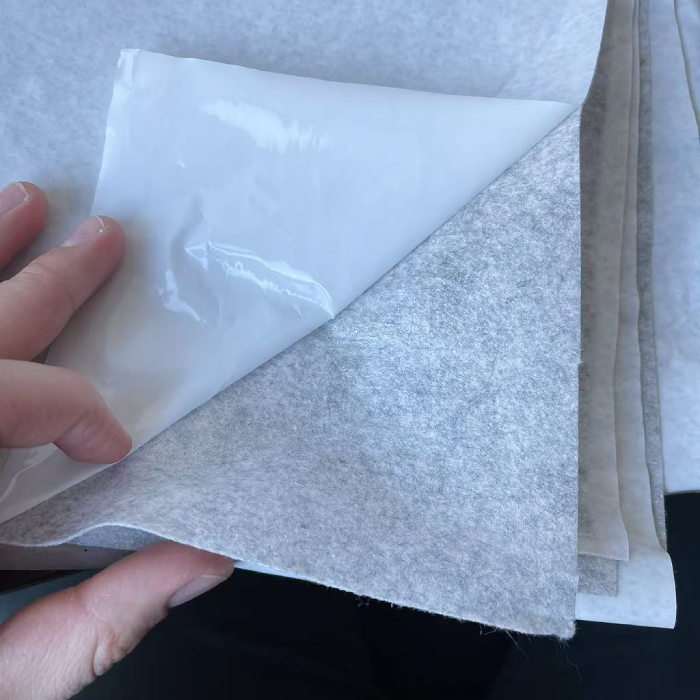
Depending on the product design, the material may require a self-adhesive backing, another composite structure, or a specific method of bonding to the metal roofing panel.
Buyers should therefore describe the required construction in the RFQ rather than assuming that all anti-condensation felt products can be installed in the same way.
If the product requires a self-adhesive or laminated construction, confirm the following details.
Backing construction: State whether a self-adhesive backing, composite layer, or another specified structure is required.
Metal surface conditions: Describe the roofing panel surface, coating condition, and any surface preparation requirements before manufacturing or installation.
Processing requirements: If the material will be used on a continuous production line, provide relevant process information so the supplier can assess compatibility.
Bonding requirements: If the project has specific requirements for bonding stability, state them in advance and agree on how the sample will be evaluated.
For roofing products intended for long-term use, the initial bonding condition alone is not enough to establish long-term suitability. Validation should, as far as practical, reflect the intended processing conditions and operating environment.
Define the Condensation Management Objective Instead of Simply Asking for “No Dripping”
When purchasing anti-condensation felt, buyers should clarify the role the material is expected to play in the overall roofing system.
For example, a project may require the material to absorb temporarily formed condensation and gradually release the moisture when environmental conditions allow.
However, this does not mean the material can store moisture permanently or that installing it eliminates the need for appropriate ventilation and other humidity management measures.
An RFQ should therefore clarify the following information.
Intended application: Identify the roof and building type in which the material will be used.
Main problem to address: Explain whether the objective is to reduce condensation dripping from the underside of the roof or to meet a defined material performance requirement.
Environmental conditions: Describe indoor humidity, temperature changes, ventilation, and any continuous sources of moisture.
Performance validation: If the project has a specified test method, customer standard, or acceptance requirement, provide it during the quotation stage.
If no formal test standard has been established, discuss an appropriate sample evaluation method with the supplier. The important point is to define what needs to be evaluated instead of judging suitability based only on the name “Anti-Condensation Felt.”
What Should Buyers Check During Sample Approval?
When a sample arrives, buyers should not check only whether its appearance matches expectations. Sample approval should establish whether the proposed material meets the agreed specifications and application requirements.
First, verify the material specifications.
Check the material construction, GSM, width, color, and other agreed parameters. If dimensional or weight tolerances apply, evaluate them using the agreed inspection method.
Second, check the backing and laminated construction.
For self-adhesive or laminated materials, confirm that the construction matches the requirements and evaluate its suitability under the intended processing conditions.
Third, confirm compatibility with the production process.
If the material will be used on a continuous roll-forming line, validate it under representative production conditions where practical. A manual application test alone may not adequately represent the actual manufacturing process.
Fourth, confirm how the required performance will be evaluated.
If the project requires verification of condensation management, bonding stability, or other specific properties, agree on the test conditions and acceptance criteria in advance. Different test conditions can produce different results, so an isolated data point without a defined method should not be the sole basis for approval.
Fifth, keep an approval record.
For long-term purchasing projects, retain the approved sample, specification sheet, drawings, and inspection requirements as references for subsequent production and repeat orders.
These steps help buyers identify specification mismatches before bulk purchasing rather than after the material enters production or installation.
How Should Buyers Define Acceptance Requirements Before Bulk Purchasing?
Sample approval does not automatically mean that every subsequent production batch will meet the requirements. For metal roofing manufacturers and importers purchasing anti-condensation felt regularly, the inspection process for mass production should also be defined.
During the quotation or order-confirmation stage, buyers can agree with the supplier on the following requirements.
Specification acceptance: Define the required GSM, width, roll length, color, other key parameters, and acceptable tolerances.
Appearance inspection: If surface uniformity, visible defects, or material integrity could affect production, specify the relevant inspection items.
Backing inspection: For self-adhesive or laminated products, identify the construction and bonding requirements that must be checked and how they will be evaluated.
Sampling and inspection: Define the inspection frequency, sampling method, defect criteria, and any required inspection records.
Batch traceability: For long-term orders, buyers may request reasonable production batch records and corresponding specification information to help investigate quality issues.
Nonconformity handling: Agree in advance on how specification deviations or quality issues will be communicated, reviewed, and addressed.
These requirements should reflect the importance of the project and the practical capabilities of both parties. Not every order requires an elaborate inspection system, but clearly defined acceptance criteria are especially useful for large-volume, specification-sensitive, or repeat purchases.
An Anti-Condensation Felt RFQ Checklist Buyers Can Use
If you are preparing an inquiry to an anti-condensation felt supplier, the following checklist can help. Fill in confirmed values and mark uncertain items as “supplier recommendation required.”
Product name: Anti-Condensation Felt
Final application: Warehouse, industrial building, agricultural building, or another roofing project.
Roof panel type: Provide the panel name, cross-sectional information, drawings, or photographs.
Manufacturing method: Continuous roll-forming lamination, another manufacturing process, or on-site installation.
Environmental conditions: Describe indoor humidity, temperature changes, ventilation, and the main condensation management objective.
Material type and construction: State the confirmed requirements or ask the supplier to evaluate suitable options.
Target GSM: Provide the required GSM and acceptable tolerance, if known.
Roll width: Specify the target width and acceptable tolerance.
Roll length: State the required length per roll.
Color: Specify the target color or provide a reference sample.
Backing construction: Indicate whether self-adhesive backing, a composite structure, or another specified construction is required.
Performance requirements: Identify any condensation management, bonding stability, or other properties that need to be evaluated.
Sample requirements: State the required sample format, quantity, and approval method.
Acceptance requirements: Provide applicable inspection items, test methods, and acceptance criteria.
Order quantity: State the estimated initial order quantity and whether repeat purchasing is expected.
Packaging and delivery: Specify packaging, labeling, transportation, and target delivery requirements.
Additional documents: Include roof panel drawings, physical samples, existing material samples, or customer specifications when available.
An RFQ does not have to contain every final parameter at the first point of contact. However, it should explain the actual application, roof structure, target material requirements, and key acceptance conditions. This allows the supplier to identify what has already been confirmed and what still needs to be discussed or validated through samples.
How Can Buyers Evaluate an Anti-Condensation Felt Supplier for Long-Term Cooperation?
For overseas importers, wholesalers, and roofing panel manufacturers, supplier evaluation should not be based on a single quotation alone.
If the material will be used repeatedly on the same production line or in long-term roofing projects, buyers should confirm whether the supplier can meet the order requirements and maintain the approved specifications.
The following areas are worth checking.
Manufacturing and customization capabilities: Can the supplier discuss different GSM, widths, roll lengths, colors, and relevant construction options according to the project requirements?
Sample-to-production consistency: Can the supplier retain the approved sample and key specifications as references for production?
Quality control: Can the supplier inspect key specifications and provide appropriate inspection records?
Communication and delivery: Can the supplier confirm specifications, packaging, order quantities, and delivery requirements before production?
HuiZhou JinHaoCheng Nonwovens Co., Ltd.was established in 2005 and supplies needle-punched nonwoven materials, anti-condensation felt, and related nonwoven products. Depending on the specific project, customization options such as GSM, width, color, roll length, and packaging can be discussed. For overseas buyers, providing roof panel information, production process details, and target material specifications helps clarify the product requirements during sample evaluation.
The available constructions, specifications, and processing options should be confirmed against the specific product and order requirements.
Conclusion: A Clear RFQ Helps Reduce Specification Errors When Purchasing Anti-Condensation Felt
When purchasing anti-condensation felt, the product name is only the starting point of an inquiry, not a complete technical specification.
Buyers should provide as much information as possible about the roof panel type, manufacturing method, building environment, target material construction, GSM, width, roll length, color, backing, and acceptance requirements.
For roofing panel manufacturers using continuous roll-forming processes, compatibility with the actual production line should also be confirmed. For projects with defined performance requirements, sample validation methods and acceptance criteria should be agreed upon in advance.
A practical purchasing process is:
Define project requirements → Provide roof and material information → Confirm quotation specifications → Evaluate samples → Agree on acceptance criteria → Place the bulk order.
If some technical parameters have not yet been finalized, start by providing roof drawings, application conditions, and existing samples. You can then discuss possible material options with the supplier.
If you are sourcing Anti-Condensation Felt, Roofing Nonwoven Felt, or customized nonwoven materials, start with a complete RFQ so that the supplier can understand your actual application rather than relying only on the product name and unit price.




