
How Do Nesting Pad Thickness and GSM Affect Fit, Cushioning, and Handling?
When sourcing chicken nesting pads, GSM and thickness are usually two of the first specifications buyers compare. However, for poultry equipment manufacturers, importers, wholesalers, and private-label buyers, meeting the specified numbers does not automatically mean that a pad will fit properly inside a nest box.
Nesting box pads for chickens must match the usable dimensions, bottom structure, and installation method of the actual nest box. If a pad is too thick, its edges may be compressed against the sidewalls or curl upward. If it is too thin or has an unsuitable structure, it may not provide the laying surface and support that the buyer expects. Even when two products have the same stated GSM, their actual thickness, softness, and behavior under compression may differ.
Therefore, buyers should not finalize an order based on a single GSM value. Instead, they should consider the nest box design, product dimensions, material characteristics, and sample test results to determine the most suitable specifications.
What Do GSM and Thickness Actually Tell Buyers?
GSM refers to the weight of a material per square meter and is mainly used to describe its mass per unit area. Thickness refers to the physical thickness of the finished product under specified measurement conditions. The two are related, but they are not interchangeable.
For chicken nesting pads, the same GSM does not necessarily mean the same thickness or cushioning performance. Factors such as fiber composition, fiber arrangement, needling structure, and finishing methods can affect bulkiness, firmness, and changes under compression.
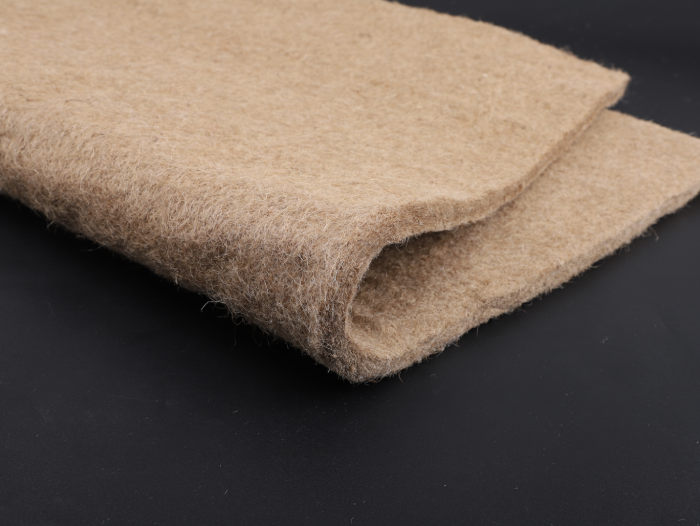
For example, two jute nesting pads with the same GSM may have different surface structures and thicknesses. One product may appear more bulky but compress more noticeably under pressure. Another may have a firmer, more compact structure and feel harder. The GSM label or visual appearance alone cannot determine which product is more suitable for a particular nest box.
Buyers should therefore record the target GSM and thickness requirements separately. When precise fit is important, they should also agree on the thickness measurement method and conditions. If the required specifications have not yet been established, buyers can provide an existing nesting pad sample, a nest box drawing, or the actual equipment dimensions before discussing a suitable material structure with the supplier.
How Does Thickness Affect Nest Box Fit?
The thickness of a nesting pad should not be evaluated separately from the internal structure of the nest box. During installation, the pad occupies space, while sidewalls, bottom edges, grooves, and fixing structures can all affect the available clearance.
Why Are the Internal Dimensions More Important Than the External Dimensions?
When measuring a nest box, buyers should first confirm the usable area that the pad needs to cover instead of relying directly on the outside dimensions of the box.
If the nest box has raised edges, frames, grooves, or an angled bottom, the usable space may be smaller than the external dimensions suggest. Buyers should record the actual usable length and width and confirm whether the pad needs to follow a specific outline.
If the pad must fit into a recess or between sidewalls, buyers should also consider the space occupied by the material during installation. The required clearance should be determined according to the actual equipment design rather than applying one universal measurement to every nest box.
Why Can a Pad That Is Too Thick Have Curling Edges?
When the actual dimensions of a nesting pad are close to the internal dimensions of the nest box, material thickness, flexibility, and bending characteristics can all affect the installed condition.
If the pad is too wide, its edges may be compressed against the sidewalls. If the material does not bend easily to follow the bottom surface, the edges may also fail to lie flat. In some designs, excessive thickness may interfere with the proper fit of grooves or fixing points.
However, curling edges are not necessarily caused by thickness alone. Cutting tolerances, the product outline, material structure, and installation method can also contribute to the problem. Buyers should therefore check finished dimensions, thickness, and actual fit together instead of simply asking the supplier to reduce the thickness.
Does a Thinner Pad Always Mean a Poor Fit?
Not necessarily. Suitability depends on the nest box design and the intended application. There is no single thickness that works for every poultry nesting system.
Buyers need to confirm whether the pad covers the required area, is easy to install, maintains its intended shape after installation, and provides the expected surface feel and structure. For rollaway nest boxes, buyers should also confirm that the pad does not obstruct the egg-rolling channel that needs to remain clear.
The final decision should be based on the actual fit inside the target equipment rather than the assumption that a thicker or thinner pad is always better.
How Do GSM and Material Structure Affect Cushioning and Handling?
Thickness and GSM can influence how a nesting pad feels, how flexible it is, and how it is handled, but neither specification alone determines its cushioning performance.
A higher GSM means that the material weighs more per unit area. It does not necessarily mean that the pad is softer, more elastic, or better at recovering after compression. Fiber structure and material compactness are also important.
For wholesalers and poultry equipment suppliers, the following characteristics deserve particular attention.
First, check whether the pad unfolds easily during installation, follows the bottom surface of the nest box, and resists unnecessary folding or curling at the edges.
Second, compare how well the product maintains its shape during normal handling and installation. If the pad needs to be removed frequently for inspection or replacement, its ease of handling should be evaluated during sample testing.
Third, check whether normal use pressure causes obvious permanent deformation and whether any deformation affects the original coverage area or installed fit. The specific test conditions should reflect the intended application. Long-term performance should not be inferred from hand feel alone.
If a project has defined cushioning or compression-performance requirements, buyers should agree with the supplier on appropriate test methods and acceptance criteria. Without test data, specific cushioning performance should not be promised based only on GSM or thickness.
How Should Buyers Test a Sample Before Bulk Ordering?
The purpose of sample testing is not simply to check whether a product looks suitable. It is to verify whether its specifications meet the actual installation and use requirements of the target nest box.
Step 1: Record the Basic Sample Specifications
Before testing, record the material composition, GSM, thickness, length, width, and overall shape. If thickness is a critical requirement, define the measurement method and conditions to avoid results that cannot be compared directly because different suppliers use different measurement methods.
For jute fiber and other natural-fiber products, buyers should also confirm the material composition and product structure rather than judging them by color or appearance alone.
Step 2: Test-Fit the Sample in the Target Nest Box
Place the sample inside the actual nest box and check whether it covers the specified area, whether its edges interfere with the sidewalls or other structures, and whether obvious gaps, folds, or curling occur.
If the pad is intended for a rollaway nest box, confirm that it does not block the egg-rolling channel or interfere with the equipment's intended operation. Requirements may differ between nest box designs, so the target equipment should be used for verification.
Step 3: Check Installation, Handling, and Shape Retention
Install the sample using the intended method, then remove and reinstall it as required in normal use. Observe whether the material curls, shifts, or develops unnecessary creases.
If the product is compressed during installation, check whether it still meets the equipment's dimensional and shape requirements afterward. One test fitting can verify the installation condition at that time, but it cannot prove long-term performance under every possible use condition.
Step 4: Compare the Sample With the Purchase Requirements
Compare the test results against the agreed dimensions, thickness, GSM, and installation requirements. If the product does not fit flat, first determine whether the issue comes from dimensions, material thickness, flexibility, or the fixing method before deciding which specifications need to change.
When comparing products from multiple suppliers, use the same nest box, installation method, and inspection conditions whenever possible. This reduces the risk of misleading conclusions caused by inconsistent testing conditions.
Step 5: Keep the Approved Sample and Specification Records
After approving the sample, buyers should retain the approved sample and record the final specifications, key dimensions, thickness measurement conditions, and installation inspection results. The supplier should then use these confirmed specifications and the approved sample as references for mass production.
If the thickness, GSM, or product outline needs to change later, the revised product's fit should be evaluated again. Buyers should not assume that the original sample approval automatically applies to the modified version.
What Information Should Buyers Provide Before Requesting a Quotation?
To reduce repeated sampling and specification adjustments, buyers should provide as much of the following information as possible when requesting a quotation.
Nest box information: Include the equipment model, usable internal length and width, bottom structure, sidewall or groove positions, and actual installation method.
Product specifications: Include the material composition, target GSM, thickness range, finished dimensions, overall shape, and acceptable dimensional tolerances. If the exact specifications are not yet known, buyers can provide an existing sample or equipment drawing for evaluation.
Application requirements: Explain the intended use of the nesting pad, installation method, whether frequent removal is required, and whether there are specific requirements for cushioning, shape retention, or clearance around the egg-rolling channel.
Purchasing information: Include the estimated order quantity, specification options, packaging requirements, and sample requirements. This information helps the supplier evaluate customization options and subsequent production arrangements.
For custom chicken nesting pads projects, drawings, physical samples, and clear specification records help buyers and manufacturers establish a shared technical reference. Even when a supplier offers customization, the final specifications should be used for mass production only after sample verification.
For overseas buyers developing customized chicken nesting pads, HuiZhou JinHaoCheng Nonwovens Co., Ltd. can discuss material composition, GSM, thickness, dimensions, and related customization requirements according to the specific project, and provides OEM/ODM manufacturing services. As a needle-punched nonwoven manufacturer, the company offers production and customization capabilities that can support material-selection discussions for different projects. However, whether a particular product is suitable for a target nest box must still be verified against the equipment design, sample performance, and technical requirements agreed upon by both parties.
Conclusion: Verify Fit Before Finalizing Bulk Order Specifications
GSM and thickness are important purchasing parameters for chicken nesting pads, but they cannot independently determine whether a product fits the target nest box. Internal nest box dimensions, material structure, installation clearance, edge conditions, and actual use requirements can all affect the final fit.
For wholesalers, importers, and poultry equipment manufacturers, a more reliable purchasing process is to confirm the usable space and installation method first, determine the target GSM, thickness, and finished dimensions next, and then verify the product through sample fitting.
Only after the specifications, sample, and acceptance requirements have been clearly confirmed should they be used as the basis for mass production. This process helps reduce rework caused by dimensional mismatches, curling edges, or differences between approved samples and bulk production.




