
Custom Wool Emergency Blanket Manufacturing: From Material Specifications to Bulk Orders
For importers, brand owners, and wholesalers planning to develop custom wool emergency blankets, finding a manufacturer that can supply wool blend materials is only the first step.
What really affects product development and subsequent bulk supply is whether the material composition, GSM, thickness, finished dimensions, packaging method, and acceptance criteria are clearly defined before production. If these requirements are not confirmed in advance, misunderstandings may arise during bulk production, even when the supplier has already provided samples.
Custom wool emergency blanket manufacturing usually involves several stages: requirement confirmation, material solution development, sample production, specification approval, and bulk order confirmation. Buyers should first define the intended application and then provide the manufacturer with the required material and finished product specifications to evaluate a suitable production solution.
For emergency product brands, wholesalers, and humanitarian supply companies, understanding this process can help reduce repeated communication and improve the efficiency of OEM product development.
Who Needs Custom Wool Emergency Blankets?
Different types of buyers may need custom wool emergency blankets, but their product positioning and purchasing requirements are not always the same.
Emergency product brands usually need products developed under their own brand names. They may need to specify wool content, material weight, finished dimensions, colors, labels, and packaging methods to maintain consistent product specifications.
Importers and wholesalers are more concerned with whether the product meets the requirements of their target markets and whether the manufacturer can supply subsequent bulk orders according to the approved specifications. For long-term purchasing projects, material consistency and order management are also important.
Disaster relief and humanitarian supply companies usually need to confirm the dimensions, weight, coverage requirements, and packaging quantities of individual blankets according to project specifications. Requirements may vary between projects, so buyers should clarify the details before requesting a quotation.
Emergency product distributors and product development companies may not have finalized their material structure. They may need to discuss wool and other fiber blending options with the manufacturer and evaluate the materials through sample development.
Regardless of the buyer's business type, a product name alone is not enough to start a customization project. Manufacturers need to understand the intended application, target specifications, and order requirements before evaluating a suitable material solution.
Wool Blend Material Development
Wool emergency blankets can be developed with different fiber compositions and needle-punched material structures according to the requirements of the finished product. For buyers, material development starts with confirming the wool content and whether other fibers, such as polyester, should be included.
Wool blend materials do not all use the same fiber ratio. Different blends can affect material hand feel, processing characteristics, structural stability, and cost. The appropriate composition should therefore be discussed according to the intended application.
Wool Content
Wool content is one of the basic specifications buyers need to define.
If the product is positioned around natural wool content, buyers should specify the target wool percentage in advance and clarify whether the percentage refers to the fiber raw material composition or another product specification.
It is important to understand that wool content alone cannot fully determine the softness, thermal comfort, or structural performance of the finished product. Fiber characteristics, blending ratios, needle-punched structure, and material weight should also be considered.
Fiber Blend Ratio
Wool can be blended with polyester or other suitable fibers. The blending ratio should be discussed according to material processing requirements, product feel, structural stability, and cost targets.
If buyers already have a reference product, they can provide a physical sample or material composition information to help the manufacturer understand the target requirements.
If the blending ratio has not yet been determined, buyers can first explain the intended application and expected product characteristics. The manufacturer can then discuss possible material options, which can be evaluated through sample development.
Needle-Punched Material Structure
The needle-punching process mechanically entangles fibers to form a nonwoven material with a certain thickness and structure.
For wool blend needle-punched materials, fiber composition, GSM, thickness, and density need to be considered together. Buyers should not expect a manufacturer to determine all production parameters based only on a specified wool content.
If the project has specific requirements for softness, structural stability, or finished product weight, these factors should be evaluated during the sample development stage.
Customization Options for Wool Emergency Blankets
In an OEM wool emergency blanket project, customization involves more than fiber composition. It also includes material specifications and finished product requirements.
The following parameters are particularly important for buyers to confirm.
GSM
GSM refers to the weight of a material per square meter and is usually expressed in g/m².
It affects the material weight per unit area and is also an important reference for manufacturers when evaluating material solutions and preparing quotations.
Buyers should provide a target GSM or an acceptable weight range. If the exact value has not yet been determined, they can provide a reference sample or explain the finished product weight and application requirements.
Thickness and Density
Thickness and density are two different material parameters.
Thickness refers to how thick the material is, while density relates to the mass of material per unit volume. Even if two materials have the same GSM, their thickness and density may differ because of variations in fiber composition and needle-punched structure.
Therefore, buyers should confirm thickness and density separately according to their product requirements rather than using one parameter as a substitute for the other.
Blanket Dimensions
Finished dimensions directly affect the coverage area, packaging volume, and final product positioning.
Buyers should specify the finished length and width, as well as any dimensional tolerance requirements.
If the product is intended for a specific emergency supply project, buyers should provide the required project dimensions or the specifications of a reference product instead of simply choosing a manufacturer's standard size.
Color
Color can be discussed according to brand positioning and purchasing requirements.
If a consistent color is required, buyers should provide a color reference, physical sample, or acceptable color range. For products using specific brand colors, the actual material color should be checked and approved during the sample stage.
Edge Finishing
Finished blanket edge treatment should also be clarified during customization.
Buyers need to specify whether they require cut edges, bound edges, stitched edges, or another finishing method. Different edge finishing requirements may affect the product appearance, processing method, and production arrangements.
The manufacturer should confirm which finishing methods are suitable for the specific material structure and product requirements. Not every finishing method should be assumed to work with every material.
Individual or Bulk Packaging
Packaging methods should be determined according to the product's sales channels and final distribution requirements.
For retail or branded products, buyers may require individual packaging, product labels, brand identification, and specific folding methods.
For bulk supply projects, buyers may pay more attention to the number of blankets per carton, carton dimensions, packaging protection, and storage convenience.
Packaging requirements should be provided in advance to avoid changing the packaging structure after sample approval.
Roll Material vs. Finished Blanket Supply
When purchasing wool emergency blankets, buyers also need to decide whether they require needle-punched nonwoven material in rolls or fully processed finished blankets.
These two supply formats are suitable for different types of customers.
Roll Material Supply
If buyers have their own cutting, sewing, packaging, or finished product assembly capabilities, they can consider purchasing wool blend needle-punched material in rolls.
This option is suitable for manufacturers that handle subsequent processing themselves and brand owners who want to manage their own finished product processing stages.
When requesting a quotation, buyers should specify material width, roll length, GSM, thickness, density, fiber composition, and roll packaging requirements.
Finished Blanket Supply
If buyers prefer to purchase finished blankets directly, they need to confirm the finished dimensions, edge finishing, folding method, labels, and packaging requirements.
Compared with roll material purchasing, finished blanket procurement involves more final product specifications. In addition to the material itself, buyers need to clarify which processing and packaging stages should be completed by the supplier.
For OEM projects, buyers should state in their RFQ whether they require fully finished blankets and whether specific packaging or branding requirements apply.
It is important to understand that roll material supply and finished blanket supply involve different processing requirements. Whether specific cutting, sewing, edge binding, or other post-processing services can be provided should be confirmed by the manufacturer according to the order requirements.
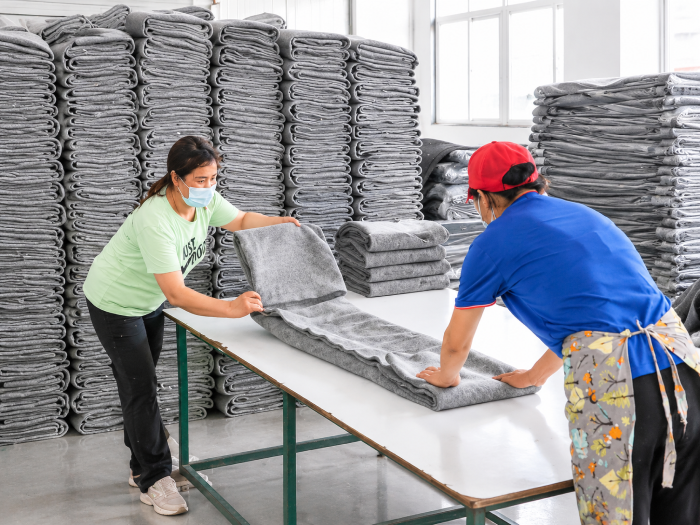
Sample Development and Specification Confirmation
For custom wool emergency blanket projects, sample approval is an important stage before bulk production.
Buyers should not judge whether a product is suitable based only on photographs or material descriptions. Physical samples allow both parties to evaluate material hand feel, thickness, weight, surface condition, and finished dimensions.
Before sample development, it is advisable to prepare a basic specification sheet.
The specification sheet should include wool content, fiber blend ratio, GSM, thickness, density, finished dimensions, color, and packaging requirements. Any special edge finishing or additional processing requirements should also be stated in advance.
After receiving the sample, buyers should check the following points.
Whether the material composition meets the requirements. Check whether the wool content and other fiber components match the agreed material solution.
Whether GSM and thickness meet the target specifications. Carry out the necessary material measurements instead of relying only on hand feel.
Whether softness and surface condition match the product positioning. If the blanket is intended for direct body coverage, pay particular attention to its feel and comfort during use.
Whether finished dimensions and weight meet the requirements. Confirm the dimensions and weight of the finished product, especially for orders with specific project specifications.
Whether packaging and appearance meet the requirements. Check the folding method, labels, packaging quantities, and finished product appearance.
If the product involves special functional requirements, such as flame retardancy or other safety-related performance, the applicable testing standards and acceptance requirements must also be clarified. Sample approval for an ordinary thermal blanket cannot replace the specific testing required for fire protection products.
After sample approval, both parties should prepare a written final specification document. This document can serve as the reference for subsequent bulk production and product inspection.
Bulk Production and Batch Consistency
For importers and wholesalers with long-term purchasing requirements, sample approval is only one part of the project. Maintaining consistency with the approved specifications during bulk production is equally important.
Wool blend materials involve different fiber compositions and material parameters. If a specification is approved during the sample stage but not clearly defined for the bulk order, misunderstandings may arise between the buyer and manufacturer.
Before starting bulk production, the following requirements should therefore be clearly recorded in the order specification document.
Fiber types and wool content should match the approved material solution.
GSM, thickness, and density should have clearly defined target values or acceptable ranges.
Finished dimensions, dimensional tolerances, and edge finishing methods should be confirmed in advance.
Color, surface condition, and appearance requirements should have clear reference standards.
Packaging methods, labels, and quantities per carton should match the order requirements.
If the fiber composition, GSM, or processing method needs to be changed after sample approval, the impact of the change on the finished product should be evaluated and confirmed by both parties before production.
For bulk inspection, buyers and manufacturers should agree in advance on sampling methods, measurement methods, and acceptable specification tolerances. Using the phrase "the same as the sample" should not be the only acceptance criterion.
For repeat purchasing projects, keeping approved samples and specification documents also helps both parties compare subsequent orders with the original requirements.
What Should Buyers Include in an OEM RFQ?
To help manufacturers evaluate a custom wool emergency blanket project more accurately, buyers should provide as much product information as possible when sending an RFQ (Request for Quotation).
The following information can serve as a basic checklist for an OEM wool emergency blanket inquiry.
RFQ Item | Recommended Information |
Product Application | Body coverage and warmth, emergency supplies, temporary shelter, or another application |
Fiber Composition | Wool content and other blended fibers |
GSM | Target GSM or acceptable range |
Thickness | Target material thickness |
Density | Target density, if required |
Blanket Size | Finished length and width |
Finished Weight | Target weight per blanket, if required |
Color | Required color or reference sample |
Edge Finishing | Cut edges, bound edges, stitched edges, or other requirements |
Supply Form | Roll material or finished blankets |
Packaging | Individual packaging, bulk packaging, labels, and carton requirements |
Quantity | Initial order quantity and estimated future purchasing volume |
Testing Requirements | Applicable testing standards and performance requirements |
Destination | Target market or delivery destination |
Reference | Product photographs, physical samples, or technical documents |
If buyers have not yet finalized all material parameters, they do not need to provide arbitrary figures just to request a quotation. They can first share the intended application, target dimensions, expected weight, reference samples, and estimated order quantity. The manufacturer can then discuss an initial material solution based on this information.
For OEM brand projects, buyers should also provide their brand logos, label requirements, and packaging designs.
For humanitarian or disaster relief supply projects, buyers should provide any project-specific requirements for dimensions, weight, packaging, and inspection. This helps reduce repeated specification changes after the quotation stage.
Working with a Needle Punched Wool Blanket Manufacturer
When selecting a wool emergency blanket manufacturer, buyers should not compare unit prices alone. They should also confirm whether the supplier understands needle-punched nonwoven materials and can discuss suitable customization options based on the final product requirements.
For wool blend needle-punched materials, fiber composition, GSM, thickness, density, and finished product structure are related. Manufacturers need to evaluate the material solution according to the intended application and target specifications rather than preparing a quotation based on only one keyword or a single parameter.
HuiZhou JinHaoCheng Nonwovens Co., Ltd. was established in 2005 and has needle-punched nonwoven manufacturing capabilities, as well as customization services covering materials and related finished product processing. For wool blend needle-punched material projects, buyers can provide their intended application, fiber composition, GSM, thickness, and finished product requirements to discuss a suitable material solution with the factory.
If the product is intended for body coverage and everyday warmth, buyers should specify requirements for softness, comfort, wool content, fiber blend ratio, GSM, thickness, weight, and finished dimensions.
If the product is intended for fire protection or safety applications, flame-retardant treatment, material structure, heat resistance requirements, and applicable testing standards should be confirmed according to the actual application. Fire protection products have different material requirements from ordinary thermal blankets and should not be evaluated using the same specifications or performance criteria.
For customers who need finished products, it is also necessary to confirm whether cutting, edge finishing, packaging, and other post-processing stages can be completed according to the project requirements.
Before placing a formal order, buyers are advised to complete the material solution discussion, sample approval, and final specification confirmation. Bulk supply arrangements can then be discussed according to the order quantity and production requirements.
If you are looking for a needle-punched wool emergency blanket manufacturer and planning to develop an OEM wool emergency blanket, you can start by providing the intended application, target material specifications, finished dimensions, packaging requirements, and estimated order quantity. The clearer the information, the easier it will be for both parties to evaluate a suitable material solution and supply format.
Conclusion: From Custom Material Development to Bulk Orders
Custom wool emergency blanket manufacturing involves more than simply choosing wool material and confirming the finished dimensions. For OEM brand owners, importers, and wholesalers, the purchasing process also includes fiber composition, GSM, thickness, density, finished dimensions, processing methods, packaging, and bulk inspection criteria.
During product development, buyers should first clarify the intended application and then discuss the wool blend structure and target specifications with the manufacturer. Samples should subsequently be evaluated, and the final specifications should be documented to provide a clear reference for future bulk orders.
For customers with long-term purchasing requirements, clearly defined specifications and batch acceptance criteria are more helpful for establishing a stable supply relationship than simply comparing a single quotation.
Whether you need wool blend needle-punched material in rolls or want to develop finished custom emergency blankets, start with the actual product requirements and confirm a feasible solution with a manufacturer that has relevant material production and customization capabilities.




