
How Do Different Pipe Applications Affect the Requirements for Self-Adhesive Felt Wrap?
Self-adhesive needle-punched felt pipe wrap can be used for external pipe covering, supplementary protection, and composite material applications according to different project requirements. However, domestic plumbing, HVAC, and industrial pipelines operate under different conditions. Buyers should therefore not select a product based only on its material name or a fixed GSM specification.
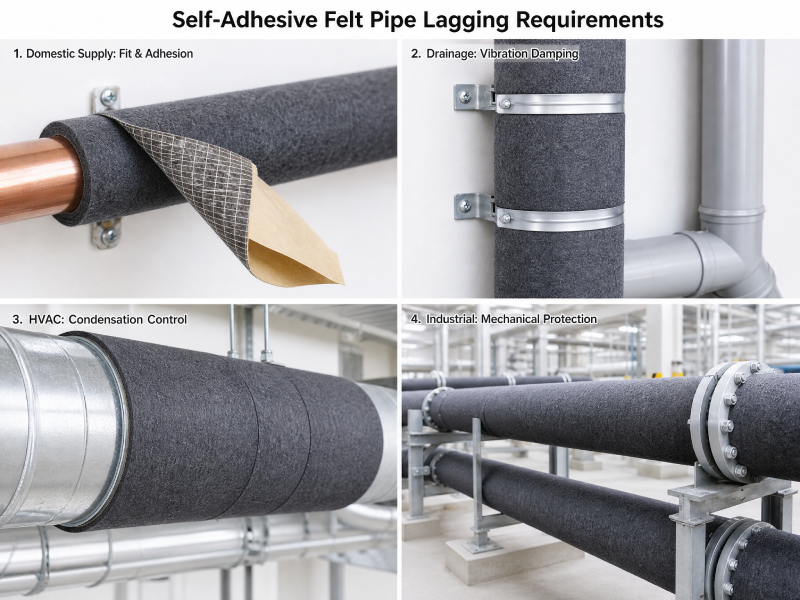
For example, domestic water pipes may require particular attention to whether the material conforms to the pipe surface and whether the adhesive backing is compatible with the target substrate. Drainage projects may involve pipe location, vibration, noise sources, and wrapping construction. HVAC pipelines need to be evaluated in relation to heating and cooling conditions, condensation risks, and the complete insulation system. Industrial pipelines may place greater emphasis on mechanical protection, roll stability, and reinforcement structures.
For buyers sourcing self adhesive felt pipe wrap, the key considerations are the pipe application, surface material, diameter and shape, operating environment, and the specific functions the material needs to perform during installation and use.
It is important to understand that self-adhesive needle-punched felt should not automatically be treated as the primary insulation layer for every pipe system. Nor should it be considered a replacement for complete thermal insulation, condensation prevention, or freeze protection design. Its suitability for a particular project must be evaluated according to the actual material construction, installation method, and sample testing results.
Why Do Different Pipe Applications Require Different Felt Wraps?
Different pipe systems vary not only in the materials or fluids they carry, but also in their surface conditions, operating environments, installation locations, and exposure to external forces.
Domestic water supply pipes are often installed indoors or near building structures. Buyers may be more concerned with whether the material can conform to the pipe surface and whether installation is convenient. In addition to wrapping and surface protection, drainage pipes may involve water-flow noise, pipe vibration, and the treatment of contact points. HVAC pipelines need to be evaluated in relation to heating and cooling media, ambient temperature, humidity, and the design of the complete insulation system.
Industrial pipelines can involve more complex conditions. Different equipment and production environments may expose materials to temperature changes, mechanical friction, handling forces, chemical media, or other special requirements. Therefore, buyers should not select a material based only on the general description of an industrial pipeline.
For self-adhesive needle-punched felt, buyers should first identify the material's specific position and function within the pipe system.
If the material is mainly used as an external supplementary protective layer, the purchasing priorities may include flexibility, surface conformity, and installation method. If it is intended to form part of a composite construction, buyers also need to confirm the composition and bonding method of the other layers. If the roll needs frequent slitting, handling, or exposure to mechanical forces, additional mesh reinforcement may also be worth evaluating.
Therefore, the selection of felt pipe wrap should start with actual application conditions rather than the assumption that one material specification can be used for every type of pipe.
What Requirements Does Felt Wrap Have for Domestic Water Supply Pipes?
For domestic water supply pipe applications, the first step is to confirm the pipe material and installation location.
Common pipes may be made from different plastics, metals, or composite materials. Their surfaces can vary in smoothness, coating condition, and cleanliness. These factors may affect the actual bonding performance of self-adhesive backing.
If buyers choose self-adhesive needle-punched felt, they need to confirm whether the adhesive is suitable for the target pipe surface. A product should not be assumed to bond to every type of pipe simply because it has a self-adhesive backing.
Pipe diameter and available installation space are also important. For pipes with smaller diameters, the material needs to bend around the pipe. For pipes with elbows, joints, and connectors, buyers should also consider whether the material may develop wrinkles, lifted edges, or excessive overlapping during wrapping.
Buyers should also clarify the intended purpose of the material. If the goal is simply to provide an additional protective layer on the outside of a pipe, the requirements are different from those of a complete insulation system designed to perform thermal management functions.
For indoor domestic water supply pipes, buyers can provide the pipe material, outside diameter, installation location, required wrapping length, and information about whether elbows or other connections are present. The supplier can then evaluate the felt thickness, width, adhesive backing, and roll specifications according to the actual construction.
If the project involves hot water pipes, the actual operating temperature and application conditions must also be provided. A needle-punched felt suitable for general pipe wrapping should not automatically be considered suitable for continuous exposure to high temperatures.
What Should Be Considered When Using Felt Wrap for Drainage and Plumbing Systems?
Pipes in drainage systems may require consideration of noise generated by water flow, pipe vibration, and contact between pipes and surrounding structures such as walls, floors, or other building components.
For these projects, needle-punched felt wrap may be evaluated as an external supplementary covering or contact protection layer. However, ordinary self-adhesive needle-punched felt should not be described as a complete pipe sound insulation system.
Buyers should first identify the source of the noise.
If the main issue is sound generated as water flows through the pipe, the material construction and the design of the complete pipe system may both affect the final result. If the problem comes from contact between the pipe and walls, supports, or other building structures, the actual contact points and installation method also need to be considered.
The pipe installation location is another important factor. Exposed drainage pipes and pipes concealed inside walls or ceilings have different installation spaces and maintenance requirements. Whether the material can be easily cut, wrapped, and secured needs to be evaluated according to the site conditions.
For pipes with multiple elbows, branches, and connection points, buyers should also provide the relevant dimensions or structural photos. Supplying only the diameter of a straight pipe may not be enough to determine the dimensions and installation method for the complete wrapping material.
If a project has specific noise reduction requirements, buyers should first confirm the target frequency range, test conditions, and acceptance criteria. The performance should then be evaluated using the actual pipe construction. Noise reduction should not be inferred simply from the felt thickness or the presence of adhesive backing.
Therefore, purchasing felt wrap for drainage pipes involves more than material specifications. Buyers also need to consider the noise source, installation location, contact structure, and final verification method.
What Different Requirements Do HVAC Heating and Cooling Pipelines Have for Felt Wrap?
Heating and cooling pipelines in HVAC systems may operate under different temperature and humidity conditions. Buyers therefore need to evaluate wrapping materials according to the actual operating environment.
For heating pipelines, the temperature that the material may contact or be exposed to needs to be confirmed, along with its specific position within the complete system. If needle-punched felt is used only as an external supplementary protective layer, its requirements are different from those of an insulation layer directly responsible for thermal management.
For cooling and chilled water pipelines, buyers need to consider not only the pipe temperature but also the ambient temperature and humidity, as well as the condensation prevention design of the complete system.
If the pipe surface temperature falls below the dew point of the surrounding air, condensation may occur. Adding a layer of needle-punched felt to the outside of a pipe should not automatically be considered a solution to condensation. Depending on the actual system design, the complete construction may also need to address insulation layers, vapor barriers, joints, and installation quality.
The self-adhesive construction also requires particular attention in HVAC applications.
First, the adhesive backing needs to be suitable for the actual contact surface. Second, the material needs to conform to the design around elbows, connections, and different pipe diameters. For applications involving temperature changes, buyers should also evaluate whether the adhesive layer and composite construction are suitable for the relevant operating environment.
When requesting a quotation, buyers should specify whether the pipeline belongs to a heating or cooling system, its operating temperature range, installation location, pipe surface material, whether a primary insulation layer is already present, and where the felt wrap is intended to be installed.
These details are more useful for evaluating material suitability than providing a single GSM value alone.
Why Might Industrial Pipeline Protection Require Reinforced Felt?
Compared with general indoor piping, some industrial pipeline applications may involve more complex mechanical and installation conditions.
For example, rolls may be repeatedly unrolled, handled, slit, or wrapped during storage, transportation, and on-site installation. If the material needs to withstand frequent pulling and localized tension, buyers should pay attention to its overall structural integrity.
For these requirements, reinforced adhesive felt can be evaluated as an option for self-adhesive needle-punched felt with an additional reinforcement structure.
If the product construction actually includes reinforcing mesh, the mesh layer may provide additional support and participate in distributing some external forces within a suitable composite structure. Whether it improves tear resistance and converting stability needs to be evaluated according to the mesh material, position, bonding method, and actual sample performance.
Reinforcement does not mean that the material is completely tear-proof. It also does not automatically mean that the product meets high-temperature, chemical resistance, or other industrial safety requirements.
The operating environment of an industrial project needs particular attention.
If pipelines are exposed to high temperatures, chemical media, oil contamination, continuous vibration, or mechanical friction, buyers must first determine whether these conditions may affect the needle-punched felt substrate, adhesive backing, and composite layers. For applications involving high temperatures or special media, ordinary PET self-adhesive needle-punched felt should not be recommended without material verification.
Industrial pipelines may also have different diameters, elbows, valves, and equipment connections. Whether the material needs to be pre-slit, cut into pieces, or supplied in another processed form can also affect purchasing specifications.
Therefore, the selection of materials for industrial pipelines should start with mechanical requirements, operating conditions, and actual installation methods. Reinforcing mesh should be evaluated according to these requirements rather than assuming that every industrial pipeline needs a reinforced structure.
How Do Pipe Diameter and Surface Shape Affect Material Requirements?
Pipe diameter and surface shape directly affect how wrapping materials are unrolled, bent, and fitted.
For straight pipes, buyers generally need to provide the outside diameter, wrapping length, and intended coverage area. Based on the pipe dimensions and wrapping design, the supplier can further evaluate roll width, cutting dimensions, and whether overlapping is required during installation.
For elbows, the material needs to accommodate changes in surface direction. If the wrapping material is too thick, insufficiently flexible, or cut to unsuitable dimensions, wrinkles, localized overlapping, or uneven surface contact may occur.
Tees, valves, and connection points usually have more complex shapes. Buyers should provide structural drawings or on-site photos. Where necessary, existing wrapping samples can also help the supplier understand the actual coverage requirements.
In addition to surface shape, the condition of the pipe surface needs to be confirmed.
Smooth metal surfaces, coated pipe surfaces, and different types of plastic surfaces may affect adhesive performance in different ways. Dust, oil, moisture, and surface preparation conditions may also influence actual bonding results.
Therefore, material suitability cannot be determined by pipe outside diameter alone. Buyers should also confirm pipe shape, surface material, available installation space, and bonding conditions.
For custom pipe insulation felt roll products, buyers should also specify roll width, roll length, thickness, GSM, and whether adhesive backing and release paper are required. If mesh reinforcement is needed, the reinforcement structure should be specified separately to prevent different suppliers from quoting products with different constructions.
How Do Material Requirements Differ Across Different Pipe Systems?
Different pipe systems have different priorities when selecting self-adhesive needle-punched felt. The comparison below can help buyers organize their project requirements before requesting quotations.
Pipe Type | Main Considerations | What Buyers Need to Confirm |
Domestic Water Pipes | Supplementary wrapping, surface protection, installation method, and adhesive compatibility | Pipe material, outside diameter, surface condition, operating environment, and installation location |
Drainage Pipes | Noise sources, vibration, contact points, and wrapping construction | Noise source, pipe location, elbow and joint structures, and installation method |
HVAC Heating and Cooling Pipelines | Supplementary protection, temperature conditions, condensation risks, and system compatibility | Operating temperature, ambient temperature and humidity, presence of a primary insulation layer, and installation construction |
Industrial Pipelines | Mechanical protection, tear resistance requirements, roll stability, and suitability for special environments | Operating temperature, media exposure, mechanical forces, reinforcement construction, and acceptance requirements |
As the comparison shows, buyers should not select materials based only on the pipe category.
For example, domestic water pipes and industrial pipelines may use similar needle-punched felt substrates, but industrial applications may require further evaluation of mechanical forces and reinforcement structures. HVAC cooling pipelines and ordinary drainage pipes may both use self-adhesive wrapping materials, but their environmental conditions and system design requirements can be quite different.
For self-adhesive needle-punched felt, buyers are advised to compare at least the following specifications: substrate type, GSM, thickness, flexibility, adhesive construction, release paper, reinforcement layer, roll width, and roll length.
If a project requires special temperature resistance, flame retardancy, sound insulation, or other specific performance, the relevant test standards and target requirements should be listed separately. These properties should not be judged by the product name alone.
What Information Should Buyers Provide When Requesting Samples?
To avoid having suppliers recommend materials based on the wrong application scenario, buyers should provide as much information as possible about the pipeline and material requirements when requesting samples or quotations.
First, specify the pipe application.
Clarify whether the product is intended for domestic water supply, drainage, HVAC heating, HVAC cooling, or industrial pipelines. For industrial applications, buyers should also explain the specific equipment or pipeline environment.
Second, provide pipe dimensions and surface information.
Include the pipe outside diameter, whether the pipe is straight or has elbows, the pipe surface material, surface coating, and actual installation location. If the pipe construction is complex, provide photos, drawings, or existing wrapping samples.
Third, clarify the needle-punched felt construction requirements.
Specify whether adhesive backing and release paper are required, whether reinforcing mesh is needed, and whether the material needs to be laminated with other films or nonwoven fabrics. If the project already has a clear construction drawing, it should be provided instead of relying only on a product name.
Fourth, describe the operating environment.
Include the operating temperature range, ambient temperature and humidity, possible exposure to moisture, oil, or other media, and whether continuous vibration or mechanical friction is present.
Fifth, define the purchasing specifications.
For example, specify the substrate type, GSM, thickness, roll width, roll length, color, packaging method, and estimated order quantity. If some specifications have not yet been determined, buyers can first provide the final application and sample requirements for the supplier to evaluate.
Finally, explain how the sample will be inspected and approved.
For self-adhesive products, buyers can check the compatibility of the adhesive backing with the target pipe surface, surface conformity, and edge condition. For reinforced products, the mesh position, interlayer bonding, and cut edges can be inspected. For products that need to bend around pipes, sample testing should be carried out as closely as possible to the actual pipe diameter and installation method.
If the project involves specific requirements for thermal insulation, condensation prevention, flame retardancy, or noise control, the relevant test methods and acceptance criteria must also be agreed upon by both parties. Without supporting test evidence, the appearance of an ordinary sample or the results of a simple manual test should not be treated as a performance guarantee.
HuiZhou JinHaoCheng Nonwovens Co., Ltd. can discuss customization options for needle-punched felt and composite materials according to customer requirements, including substrate, thickness, width, roll length, and adhesive backing. For pipeline projects requiring reinforcing mesh or suitability for special operating environments, the actual material construction and performance must still be confirmed according to the factory-approved product solution and sample testing results.
For pipe wrapping projects, the most important consideration is not finding one fixed specification that suits every pipeline. It is ensuring that the material construction matches the pipe application, surface conditions, installation method, and actual operating environment.




