
Firm vs. Semi-Rigid Felt: How Do You Define the Support Your Product Needs?
For overseas importers, product manufacturers, industrial material buyers, and OEM project managers, one common question when sourcing needle punched felt is this: if the finished product needs some structural support but should not become completely rigid, should you choose Firm Felt or Semi-Rigid Felt?
Some buyers simply tell their suppliers, “We need a firmer needle punched felt.”
However, “firmer” is not a sufficiently precise purchasing requirement. Different products may need very different levels of support from the material.
Some products require the material to retain a certain shape after processing. Others need the material to bend or conform during assembly. Some require structural support but cannot use a board-like material that is difficult to adjust.
Therefore, choosing Firm Felt or Semi-Rigid Felt should not depend solely on the material name or initial hand feel.
What buyers really need to confirm is how much shape retention, structural support, and bending flexibility the finished product requires, and whether the material can meet those requirements after processing and assembly.
This guide approaches the decision from a product development and purchasing perspective, helping buyers define their support requirements and verify material suitability through samples and finished-product assembly.
1. Why Is “We Need a Firmer Needle Punched Felt” Not Enough?
When sourcing needle punched felt, Firm Felt and Semi-Rigid Felt can both be used to describe materials that feel relatively firm or offer a certain degree of structural support.
However, Firm and Semi-Rigid are not necessarily standardized hardness grades with identical test methods or numerical hardness values across all suppliers.
Different manufacturers may use these descriptions according to their product ranges, fiber structures, processing conditions, and customer requirements.
Therefore, when a buyer simply asks for a “firmer material,” the supplier may still not understand the actual problem that needs to be solved.
For example, the buyer may need a material that resists deformation after cutting. Alternatively, the product may need to maintain a certain shape during assembly, or the material may need to bend to a specified position while still providing some support.
These requirements are not the same.
Without further clarification, a supplier might provide a material that feels firm but does not meet the finished product's actual requirements.
Before choosing Firm Needle Punched Felt or Semi-Rigid Felt, buyers should therefore define what the material needs to do in the finished product rather than specifying only a hardness category.
2. What Is the Practical Difference Between Soft, Firm, and Semi-Rigid Felt?
During product development, different felt materials can be understood in terms of three characteristics: shape retention, structural support, and bending flexibility.
Soft Felt
Soft needle punched felt is generally easier to bend and conform to a product surface. It may be considered when a product requires flexibility, surface conformity, or easier shape adjustment.
However, softness does not automatically mean that a material provides no support. Its actual behavior still depends on fiber structure, thickness, product geometry, and how it is used.
Firm Felt
Firm Felt generally describes a felt material that feels relatively substantial and provides a certain degree of structural support. It can be considered for products that need to maintain a particular shape during processing or use.
However, Firm Felt does not necessarily mean that the material can support a load independently, nor does it mean that the material has the same rigidity in every direction.
Semi-Rigid Felt
Semi-Rigid Felt generally describes a felt material that offers some shape retention while retaining a degree of flexibility or adjustability.
It may be considered when a product should not use an overly soft material but does not require a completely rigid board-like structure.
It is important to emphasize that these terms are primarily used for initial communication. They cannot replace actual performance requirements. Firm Felt and Semi-Rigid Felt supplied by different manufacturers may have different structures and behaviors, so final suitability should still be confirmed through samples.
3. How Should Buyers Determine the Structural Support Their Product Needs?
For buyers, structural support is not a single property. A more practical approach is to break it down into several requirements directly related to the finished product.
Shape Retention
If the material needs to maintain a specified shape after cutting, die-cutting, or assembly, buyers should evaluate whether the processed material retains the required form.
For example, they may need to consider whether the material bends noticeably, whether the edges deform easily, and whether the assembled product retains its intended outline.
Structural Support
If the material needs to support its own shape or help the finished product maintain its structure, buyers should define where the support is required, the direction in which the material will be used, and the actual support requirements of the product.
It is important to distinguish structural support from load-bearing capacity. The names Firm and Semi-Rigid alone cannot establish whether a material can withstand a specific weight or external load.
Bending Flexibility
Some products require the material to bend during installation or use so that it conforms to a particular shape or assembly position.
If the material is too flexible, it may not maintain the intended shape. If it is too firm, it may be difficult to fit into the product structure or unsuitable for the intended assembly method.
Buyers should therefore clarify whether the material needs to remain flat, allow a certain degree of bending, or conform to a specific curved surface.
Stability After Processing
If the material will undergo die-cutting, cutting, lamination, or other processing, its initial hand feel alone is not enough to determine suitability.
The final shape, edge condition, and assembly behavior can all affect whether the material works in the finished product.
Firm Felt and Semi-Rigid Felt can be selected more accurately when these requirements are connected to the actual product.
4. Why Is Hand Feel Alone Not Enough to Determine Whether Felt Is Firm Enough?
Hand feel can help with preliminary material screening, but it cannot replace a complete material evaluation.
The actual behavior of needle punched felt may be affected by fiber material, fiber structure, GSM, thickness, finishing methods, and product geometry.
Even if two materials both feel firm to the touch, they may behave differently when bent, retain their shapes differently after processing, or fit differently during assembly.
In addition, increasing thickness or GSM alone does not guarantee that the material will provide the required support.
If a product requires a defined level of shape retention, buyers should explain the target shape and actual use conditions to the supplier rather than simply asking for greater thickness or higher GSM.
For projects with specific technical requirements, appropriate test methods should be selected according to the product's needs. Without verification, buyers should not infer a numerical hardness value, bending modulus, or load-bearing capacity solely from hand feel.
Hand feel is useful for preliminary screening, but the final selection should be based on product requirements and sample validation.
5. How Can Buyers Turn “We Need Some Structural Support” into Clear Purchasing Requirements?
Before requesting a quotation, buyers can answer the following questions.
First, where will the material be used?
Explain the finished product and the role the material will perform. Will it maintain an external shape, support a particular section, or provide structural support while bent?
Second, what shape must the material retain?
If the product has a defined outline, angle, or curved surface, provide a product drawing, dimensioned diagram, or photos of the actual product to help the supplier understand the intended shape.
Third, how much bending flexibility is required?
Explain whether the material needs to bend or conform to a curved surface during installation or use, or whether it needs to remain relatively flat. An existing sample or assembly structure can also be provided.
Fourth, must the material maintain its shape independently?
Some products obtain their structure from multiple material layers or other components. If the needle punched felt is used only for filling, lining, or auxiliary support, its requirements may differ from those of a component that must retain its shape independently.
Fifth, what processing will the material undergo?
Explain whether cutting, die-cutting, lamination, or other processing is required. The shape requirements after processing should be included in sample evaluation rather than being addressed only after bulk production begins.
With this information, buyers can turn the vague request for a “firmer material” into specific requirements that a supplier can understand and evaluate.
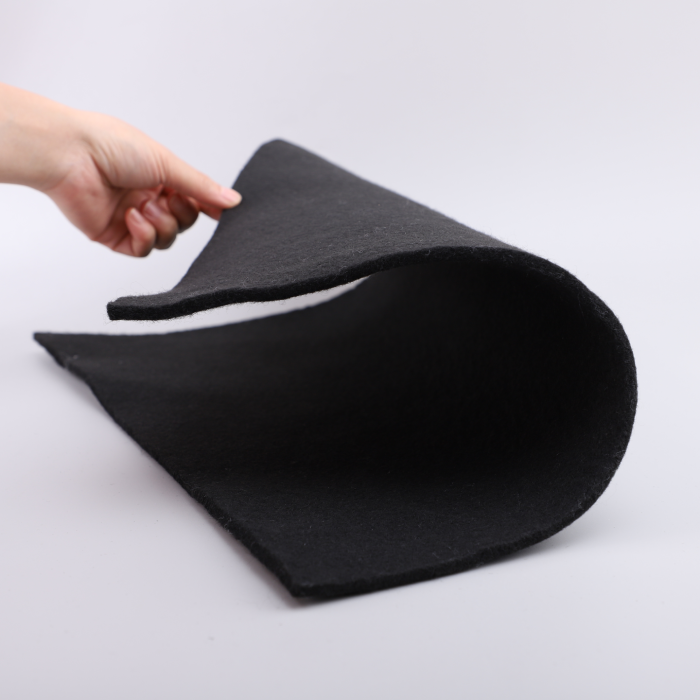
6. How Can Samples Help Buyers Decide Whether Firm Felt or Semi-Rigid Felt Is Suitable?
For projects with defined requirements for firmness and structural support, sample approval is an important part of the purchasing process.
Rather than simply handling a sample and judging its feel, buyers should compare samples according to the actual needs of the finished product.
Check the Basic Material Specifications
First, confirm that the sample's fiber material, thickness, GSM, dimensions, and surface condition match the agreed requirements.
This helps prevent materials with different basic specifications from being compared as if they were equivalent.
Evaluate Bending and Adjustment Under Relevant Conditions
If the finished product needs to bend or conform to a particular shape, evaluate the sample using the intended installation method.
Observe whether the material can be adjusted to the target shape and whether its behavior meets the product requirements.
Check Shape Retention
If the product must retain a specified outline, compare different samples under the same conditions.
The goal is to determine whether the material meets the finished product's requirements, not simply to identify which sample feels firmer.
Confirm Fit Within the Actual Assembly
If the material will be installed with other components, place the sample into the actual assembly structure or a representative prototype whenever possible.
A material's behavior when tested separately may not be the same as its behavior after installation.
Record the Sample Approval Results
After approval, record the material information, thickness, GSM, structural requirements, and critical shape requirements associated with the approved sample.
This provides a clear reference for subsequent quotations, production, and repeat orders.
7. Why Should Buyers Also Validate the Material in the Finished Product?
Even if a piece of needle punched felt appears suitable during an initial inspection, that does not guarantee that it will work in the finished product.
The final structure may be affected by other components, assembly methods, and processing conditions.
For example, once the material is fixed inside a frame, housing, or another component, its actual shape-retention requirements may differ from those observed when the material is tested separately.
If the material undergoes die-cutting or lamination, its final form may also differ from the original roll or sheet.
For products with clearly defined structural requirements, buyers should consider validating samples in two stages.
Material Stage: Confirm whether the material's firmness, bending behavior, thickness, and basic structure meet the requirements.
Finished-Product Stage: Use the material in an actual assembly or representative prototype to confirm its shape, fit, and processing results.
If the product has specific safety, load-bearing, or other technical requirements, appropriate testing should be arranged according to the intended application. Simple hand bending or visual assembly checks cannot prove that all technical requirements have been met.
8. When Should Buyers Consider Firm Felt, and When Should They Consider Semi-Rigid Felt?
Buyers should not automatically assume that Semi-Rigid is always firmer than Firm, or that one category is always better. Different suppliers may use these descriptions differently, so the final decision should be based on samples and actual requirements.
When Firm Felt May Be Worth Evaluating
If a product needs a relatively substantial felt material and the priority is maintaining a certain shape during processing or use, Firm Felt can be considered as a candidate.
However, sample evaluation is still necessary to confirm whether it provides the required support and meets the processing requirements.
When Semi-Rigid Felt May Be Worth Evaluating
If a product needs some shape retention while preserving a degree of bending or adjustment flexibility, Semi-Rigid Felt can be considered as a candidate.
The key is to determine whether the material provides the right balance between support and flexibility for the actual product.
When the Required Grade Is Unclear, Compare Candidate Samples
If buyers have not yet established a specific firmness category, they can explain the product shape, assembly method, and support requirements to the supplier before evaluating samples of different materials.
Rather than placing an order based on the material name alone, define the required behavior of the finished product first, then select a material that can meet the requirements through validation.
9. What Information Should Buyers Provide When Requesting a Quotation?
To help suppliers evaluate whether Firm Felt or Semi-Rigid Felt is suitable, buyers can prepare the following information.
Final Product Application: Explain what the material will be used for and the role it will perform in the finished product.
Support and Shape Requirements: Describe the shape that needs to be maintained, where support is required, and whether the material needs to bend or conform to a curved surface.
Material Specifications: Provide the known fiber material, GSM, thickness, and dimensions. If some parameters have not yet been determined, identify the items that require the supplier's assistance.
Samples or Product Drawings: Provide existing material samples, finished-product photos, dimensioned drawings, or assembly diagrams to help the supplier understand the actual requirements.
Processing Methods: Explain whether cutting, die-cutting, lamination, or other processing is required, together with the shape requirements after processing.
Sample Approval Criteria: Clarify which characteristics must be met and which can be evaluated and confirmed after sample review.
For overseas buyers sourcing customized materials, the more clearly the supplier understands the finished product and assembly conditions, the easier it becomes to discuss feasible material options.
HuiZhou JinHaoCheng Nonwovens Co., Ltd. has been engaged in nonwoven material research and production since 2005. The company can discuss needle punched felt specifications, firmness, and customized processing options according to different product requirements. For projects with specific structural needs, it is advisable to confirm samples and relevant specifications before bulk production rather than making a purchasing decision based only on the material name.
10. Conclusion: Define the Support Your Product Needs Before Choosing Firm Felt or Semi-Rigid Felt
Firm Felt and Semi-Rigid Felt can serve as initial descriptions of a needle punched felt material's firmness and structural behavior. However, without a consistent definition, they should not be treated as standardized hardness grades.
For a finished product that requires structural support, buyers need to define the shape the material must retain, whether it needs to bend, how it will fit with other components, and what condition it must achieve after processing.
If the product requires a relatively substantial material, Firm Felt can be evaluated as a starting option. If the product needs some support while retaining a degree of bending flexibility, Semi-Rigid Felt may be a suitable candidate.
However, the final choice should not be based on the material name or hand feel alone. It should be confirmed through the actual product shape, processing methods, sample comparison, and finished-product assembly.
If you are sourcing semi rigid felt or firm needle punched felt, provide the intended application, product drawing or sample, and specific requirements for structural support and bending flexibility when requesting a quotation. This allows the supplier to evaluate materials according to your actual product needs rather than relying on a general request for something “firmer.”




