Inside the “Water-Absorbing Technology” of Flower Preservation Cards: How Does Absorbent Cotton Help Flowers Stay Fresh?
Why do some flowers remain fresh and upright after long-distance transportation, while others begin to wilt after only two or three days?
Many people focus on preservation solutions, packaging boxes, or cold-chain transportation, but overlook one important component inside a flower preservation card: absorbent cotton.
For flower packaging buyers, florists, flower e-commerce companies, flower wholesalers, and preservation packaging suppliers, high-quality absorbent cotton needs to do more than simply absorb water. It should absorb liquid efficiently, retain sufficient moisture, and work together with preservation liquid and controlled-release structures to provide continuous moisture support during flower transportation.
So, what makes the seemingly simple absorbent material inside a flower preservation card so important?
Why Does a Flower Preservation Card Need Absorbent Cotton?
After harvesting, fresh flowers continue to breathe and exchange moisture with their surrounding environment. Once flowers leave their regular water source and enter the packaging, transportation, and delivery stages, dehydration becomes one of the major factors affecting flower quality.
This problem can become more serious during long-distance logistics, warm weather, and courier delivery. Flower stems may lose moisture, flower heads may droop, and the overall display life may become shorter.
This is why modern flower packaging is increasingly adopting lightweight and portable flower preservation cards.
Instead of placing a large amount of free water inside the package, a preservation card can store liquid within an absorbent material and gradually provide moisture around the flower stems.
In this process, absorbent cotton acts as one of the key moisture-storage materials.
How Does the Three-Layer Structure of a Flower Preservation Card Work?
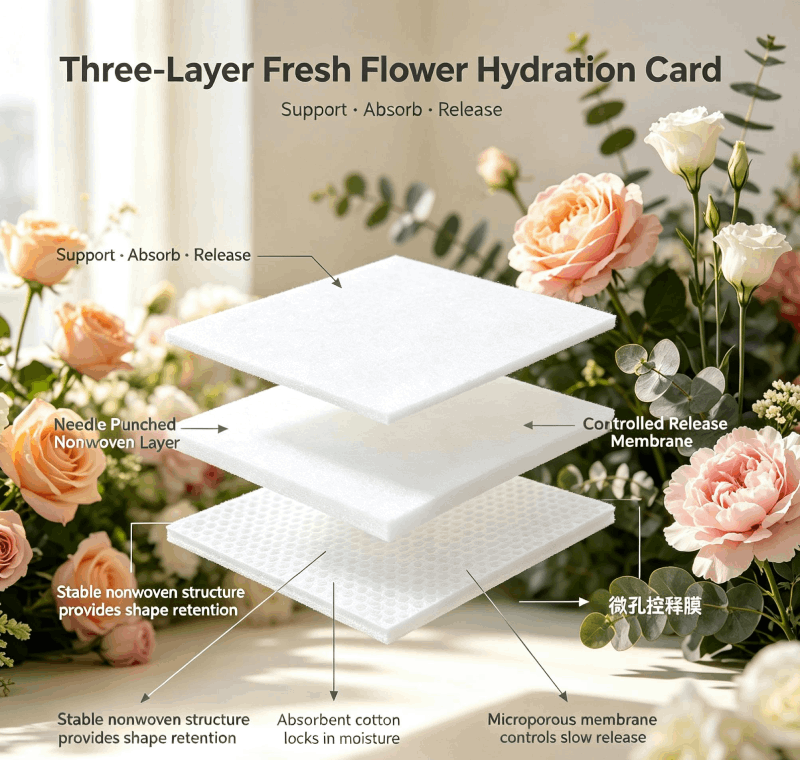
A high-performance flower preservation card is not simply a combination of absorbent material and preservation liquid. Different functional layers work together to achieve moisture absorption, storage, and controlled release.
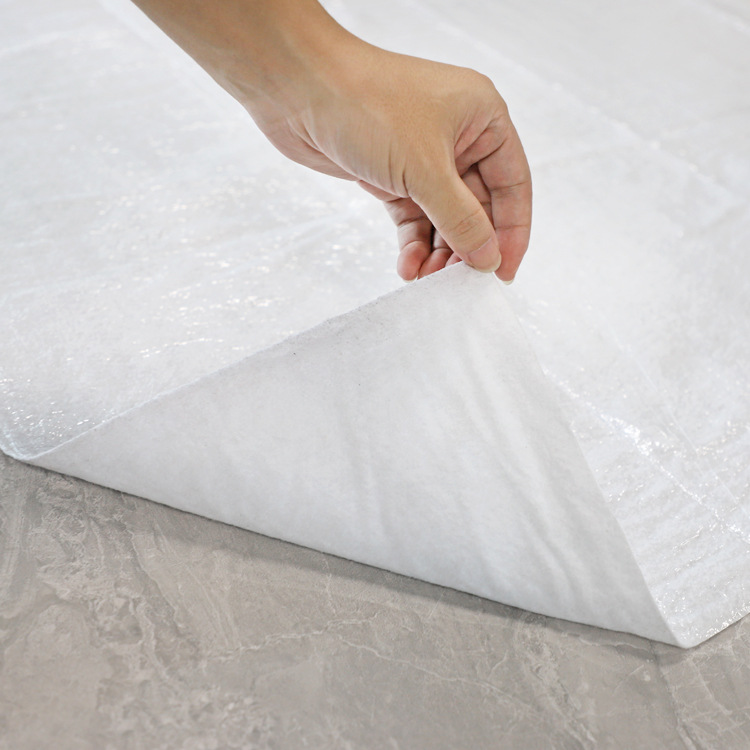
Layer 1: The Moisture-Locking Shield — Thick Needle Punched Nonwoven
The outer layer normally needs to provide structural support and dimensional stability.
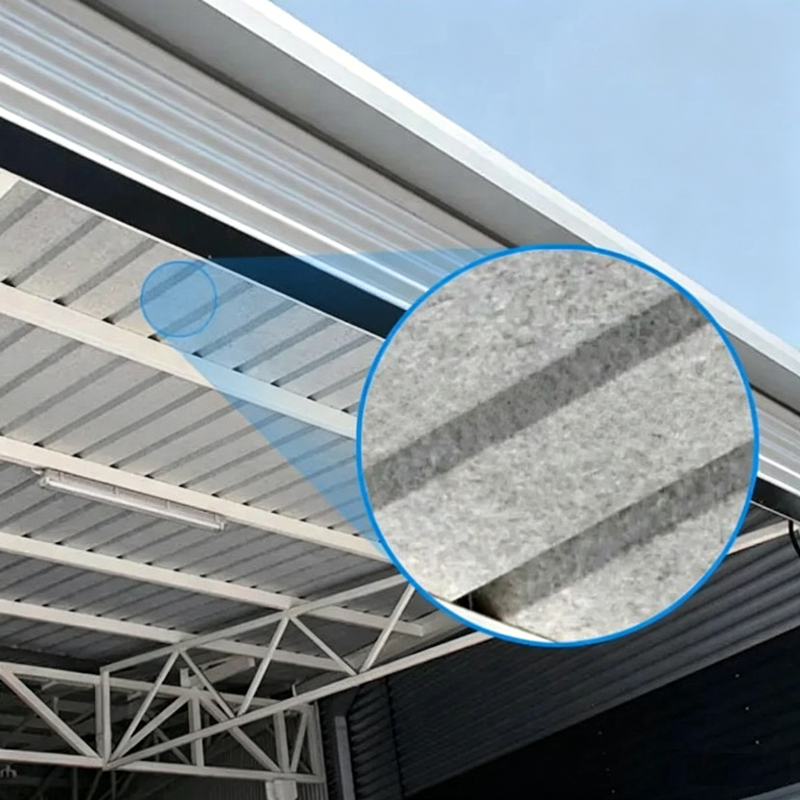
Needle punched nonwoven is produced by mechanically entangling fibers to create a stable three-dimensional structure. It can provide support for the internal absorbent layer while maintaining good flexibility and processing performance.
For buyers of flower packaging materials, the outer material affects the overall strength of the preservation card, as well as dimensional stability, processing efficiency, and handling performance.
Therefore, a stable needle punched nonwoven structure can provide an important foundation for composite flower preservation materials.
Layer 2: The Moisture Reservoir — High-Absorbency Cotton
The internal absorbent cotton is primarily responsible for storing liquid.
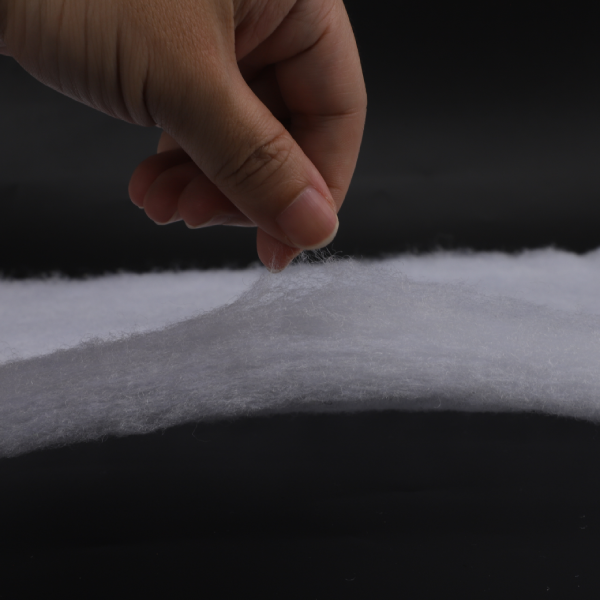
PET absorbent cotton can be processed through nonwoven technologies such as needle punching to create a fiber network with a certain thickness and internal pore structure.
Compared with a flat material, the three-dimensional fiber structure provides more internal space for liquid to enter and remain within the material.
Therefore, absorbent cotton does not simply hold water on its surface. Instead, liquid can enter the internal fiber network and be retained within the material structure.
For flower preservation cards, this structure helps distribute preservation liquid more evenly and provides a foundation for subsequent moisture release.
Layer 3: The Controlled-Release Film — Microporous Release Structure
If absorbent cotton is used without an appropriate release structure, liquid may be released too quickly and fail to meet the requirements of long-distance transportation.
For this reason, some flower preservation cards combine a microporous membrane or other controlled-release structures to regulate the release of moisture and preservation liquid.
In simple terms, the three layers can be understood as follows:
The needle punched nonwoven provides support, the absorbent cotton stores liquid, and the controlled-release structure regulates moisture release.
Together, these layers create a more complete flower moisture-retention system.
Why Can Absorbent Cotton Store a Large Amount of Liquid?
From a material-structure perspective, the performance of absorbent cotton depends not only on the fiber itself but also on the internal structure created between the fibers.
During the needle punching process, numerous fibers become mechanically entangled to form a stable nonwoven structure with a certain thickness and pore volume.
When liquid enters the material, it can spread through and remain within the microscopic spaces between the fibers.
Therefore, factors affecting the water absorption capacity of absorbent cotton may include fiber composition, fiber fineness, fiber length, GSM, thickness, needle punching density, and subsequent processing technology.
For buyers, it is not accurate to assume that “higher GSM always means better water absorption.”
The actual performance depends on how the material structure matches the intended application.
Does Faster Water Absorption Always Mean Better Absorbent Cotton?
This is an important misunderstanding when purchasing flower moisture-retention materials.
For a flower preservation card, rapid absorption is useful, but “absorbs quickly” does not necessarily mean “performs better.”
If the material absorbs liquid extremely quickly but has insufficient internal liquid-retention capacity, the preservation liquid may not remain stable inside the material.
On the other hand, if the material has strong liquid-retention capacity but releases moisture too slowly, it may not provide sufficient moisture to flower stems during transportation.
Therefore, suitable absorbent nonwoven material for flower preservation cards should be evaluated according to several factors, including absorption speed, liquid-storage capacity, moisture distribution, and subsequent release performance.
This is why professional buyers should match the material with the flower type, packaging design, and transportation duration.
Why Do Different Flower Packaging Solutions Require Different Absorbent Cotton Specifications?
Roses, lilies, carnations, and other flowers have different stem structures, moisture requirements, and transportation conditions.
At the same time, flower preservation cards can vary in size, preservation-liquid volume, and packaging design.
Therefore, buyers need to consider GSM, thickness, width, dimensions, and liquid absorption capacity when purchasing absorbent cotton.
For small flower bouquet packaging, a lightweight absorbent material may be sufficient.
For long-distance transportation or packaging systems designed to store more preservation liquid, a higher-GSM or thicker absorbent cotton may be more appropriate.
For flower packaging manufacturers, selecting the correct material specification can help avoid unnecessary material consumption while improving packaging efficiency.
What Other Applications Can Absorbent Cotton Have Besides Flower Preservation Cards?
In addition to flower preservation cards, PET absorbent cotton can be processed into different material structures for applications that require liquid absorption and retention.
Potential applications include flower packaging, bouquet moisture-retention materials, plant transportation moisture-control materials, filter-related absorbent structures, and certain fresh-product packaging solutions.
For buyers, the same basic absorbent material can be developed into different end products through adjustments to GSM, thickness, dimensions, and composite structures.
This flexibility is one of the advantages of nonwoven materials.
Why Choose Needle Punched Technology for Absorbent Cotton?
Unlike traditional woven manufacturing, the needle punched nonwoven process uses mechanical needles to entangle fibers and form a stable fiber web.
This manufacturing method provides flexibility in adjusting GSM, thickness, width, and material structure according to customer requirements.
For long-term buyers, production consistency is particularly important.
If different batches have significant variations in thickness, GSM, or absorption performance, the final performance of the flower preservation card may also be affected.
Therefore, choosing an experienced needle punched felt manufacturer can be more important than simply comparing the purchase price.
What Should Buyers Look for When Purchasing Absorbent Cotton in Bulk?
For flower packaging manufacturers and preservation-card producers, purchasing absorbent cotton should involve more than comparing unit prices.
First, buyers should confirm whether the material's liquid absorption performance meets the actual application requirements.
Second, they should evaluate batch-to-batch consistency.
Third, buyers should confirm whether the supplier can consistently provide the required GSM, thickness, width, and dimensions.
If the material needs to be laminated or combined with other materials, its processing compatibility should also be evaluated in advance.
For importers, wholesalers, distributors, and packaging-material suppliers looking for long-term cooperation, stable production capacity is equally important.
As order volumes increase, the real purchasing cost is not determined only by the price per roll. Material consistency, delivery reliability, and batch stability can have a significant impact on overall procurement efficiency.
How Can a Professional Nonwoven Manufacturer Help Develop Absorbent Materials?
HUIZHOU JINHAOCHENG NONWOVENS CO., LTD. has more than 20 years of experience in nonwoven manufacturing and operates a production facility covering approximately 26,000 square meters with 15 automated needle punched nonwoven production lines.
The company provides integrated nonwoven manufacturing and customized solutions for different industries and applications.
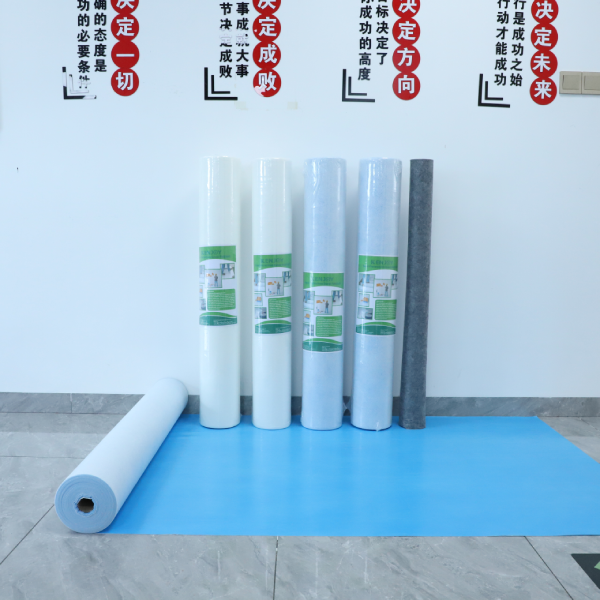
For flower preservation cards, absorbent cotton, flower water retention fleece, and other liquid-absorbent nonwoven materials, specifications such as GSM, thickness, width, dimensions, and material structure can be adjusted according to customer requirements.
For importers, wholesalers, packaging-material suppliers, and OEM customers, stable production capacity can help reduce the risk of batch variations during long-term procurement.
From “Water Absorption” to “Moisture Retention”: The Real Value of Flower Preservation Cards
The value of a flower preservation card is not simply adding a piece of “wet cotton” to flower packaging.
An effective flower moisture-retention solution needs to address four key functions: how liquid is absorbed, how it is stored, how it is distributed, and how it is released.
The absorbent cotton provides important liquid-storage capabilities, while the needle punched nonwoven and controlled-release structure can work together to create a more complete composite system.
For flower e-commerce companies, florists, flower wholesalers, and flower packaging buyers, selecting the right absorbent nonwoven material can provide a more stable material foundation for fresh flower transportation and packaging.
If you are looking for an absorbent nonwoven manufacturer, needle punched felt manufacturer, nonwoven felt manufacturer, or nonwoven manufacturer China for flower water-retention fleece, absorbent cotton, flower preservation cards, or customized nonwoven materials, contact Jinhaocheng Nonwovens to discuss your requirements.