
Foam-Backed Fabric for Automotive Door Panels: How to Select Upholstery Layers and Cushioning Structures
Automotive door panels are not simply components made of a single decorative fabric layer. For buyers sourcing door panel materials, the key questions are which material should be used for the outer upholstery layer, whether it needs to be laminated with foam, where the foam should be positioned within the overall structure, and whether the laminated material can meet subsequent cutting, sewing, wrapping, and assembly requirements.
In automotive door panel projects, Door Trim Fabric generally refers to the fabric used for the decorative surface of a door panel, while Foam Backed Fabric refers to a composite material made by combining fabric with foam. They are not exactly the same purchasing item. Door trim fabric can be supplied as a standalone fabric, whereas foam backed fabric includes an additional foam layer to create a composite structure with a certain thickness and softness.
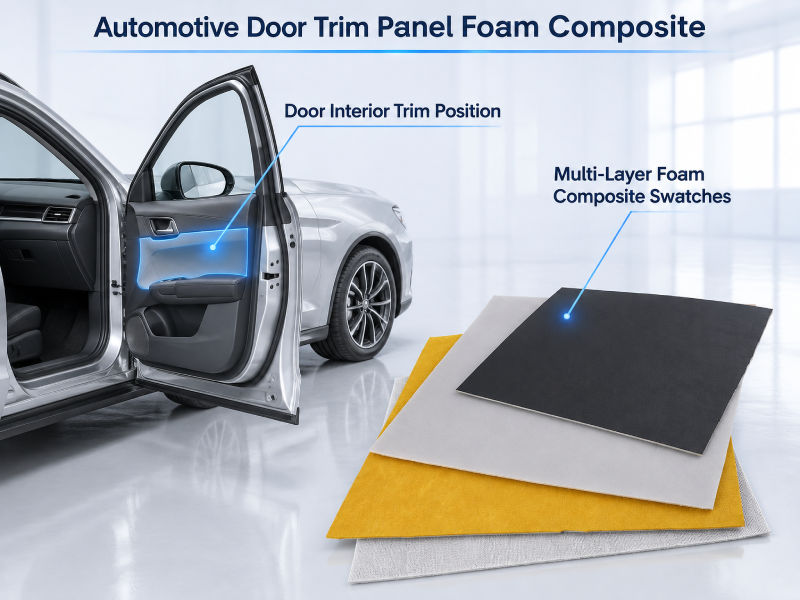
In addition, foam laminated fabric is not the same as a complete automotive door panel assembly. The internal door panel structure may also include a plastic substrate, structural supports, clips, connectors, and other auxiliary materials. Buyers should first identify the exact position of the material within the door panel structure before deciding how the fabric, foam, and other layers should be combined.
What Functions Do the Different Material Layers Serve in an Automotive Door Panel?
An automotive door panel is an interior decorative and functional component of a vehicle's side door. Door panel structures can vary considerably between vehicle models, but they generally require a distinction between the visible upholstery layer, flexible cushioning layer, and internal supporting structure.
Door trim fabric is the surface material that passengers can directly see or touch. It influences the door panel's color, texture, hand feel, and overall decorative appearance. The fiber composition, fabric construction, GSM, and surface characteristics can all affect the final appearance and subsequent processing performance.
A foam layer may be positioned between the decorative fabric and other door panel structures as a flexible cushioning layer. Foam affects the composite material's thickness, softness, and compression behavior. Its specific function depends on the foam material, thickness, density, and installation position within the door panel.
The door panel substrate generally provides structural support and a mounting base for other components. It may be made from plastic or other materials suitable for the door panel design. Its purpose is to maintain the overall shape and provide mounting support for clips, armrests, and other components. It is a different material from flexible foam-backed fabric.
Backing or lining materials may also be used in certain door panel designs for localized cushioning, separation, connection, or other supporting purposes. The materials and installation positions vary between projects, so their specific functions should not be assumed based on material names alone.
It is important to understand that not every automotive door panel uses the same material layers. Some areas may use decorative fabric directly, while others may require foam-backed fabric or additional lining and auxiliary materials.
Before requesting a quotation, buyers should therefore clarify whether the material is intended for the visible decorative layer, the flexible cushioning composite layer, or another internal supporting position. Foam-backed fabric cannot replace the plastic door panel substrate or structural support components, and it should not be described as a complete door panel assembly.
What Is the Difference Between Door Trim Fabric and Foam Backed Fabric?
Door Trim Fabric and Foam Backed Fabric are both commonly mentioned when sourcing automotive door panel materials, but they do not describe the same material structure.
Door Trim Fabric mainly describes the material's application: fabric used for automotive door panel upholstery. It may be knitted fabric, woven fabric, mesh fabric, or another material suitable for the door panel's surface requirements. Whether it includes a foam layer depends on the specific product structure.
Foam Backed Fabric, on the other hand, describes a composite structure in which fabric is bonded with foam. In addition to the fabric layer, it includes a foam layer, so its overall thickness, softness, and processing characteristics may differ from those of standalone fabric.
For example, buyers may need one of the following structures:
Fabric
A single decorative fabric layer without pre-laminated foam. Whether foam needs to be added later depends on the door panel manufacturer's own production process.
Fabric + Foam
Fabric laminated with foam to create a two-layer composite material. Buyers receive a semi-finished material that has already undergone foam lamination and can subsequently be cut, wrapped, or processed according to the door panel design.
Fabric + Foam + Backing Layer
An additional backing layer is added to the fabric and foam, creating a multi-layer composite structure. Whether this extra layer is necessary depends on the door panel design and subsequent processing requirements.
These three purchasing options have different material compositions and processing responsibilities. Buyers should not simply tell a supplier that they need Automotive Door Trim Fabric and assume the supplier will automatically know whether foam is required, which side the foam should be bonded to, or whether an additional backing layer is needed.
If the door panel manufacturer already has an established material structure, it is best to provide an existing material cross-section or sample. If the project is still under development, buyers should explain whether they need standalone fabric or pre-laminated foam-backed material.
This helps prevent suppliers from quoting the wrong layer structure and reduces repeated adjustments during sample development.
How Should PU Foam Be Combined with Different Fabric Substrates?
Different fabric substrates can be evaluated for combination with foam in automotive door panel laminated materials, depending on project requirements. Common candidate substrates include knitted fabric, woven fabric, mesh fabric, and synthetic leather. However, no single combination should be considered suitable for every door panel project based on material category alone.
Knitted Fabric can be considered when softness, surface texture, and a certain degree of stretch are important. Different knitted constructions may have different stretching, recovery, and surface characteristics. If the door panel design involves curved-surface wrapping or localized bending, the overall performance of the fabric after foam lamination should be carefully evaluated.
Woven Fabric is constructed by interlacing warp and weft yarns and is available in different fabric constructions and surface textures. Some woven structures may be suitable for projects with specific requirements for surface appearance and dimensional stability. However, actual performance still depends on the fiber, yarn density, weave construction, and finishing process. Buyers should evaluate the material according to the door panel's appearance and processing requirements.
Mesh Fabric has an open, net-like structure and can be considered for certain material combinations requiring a specific surface construction. However, the mesh opening, yarn material, and overall strength can affect the performance of the laminated material. Its suitability cannot be determined by the term mesh fabric alone.
Synthetic Leather can be used in certain door panel areas where specific surface textures, hand feel, and decorative effects are required. When laminated with foam, buyers should consider the compatibility between the synthetic leather substrate and the foam, as well as the material's performance during bending, wrapping, and sewing.
For the foam layer, PU Foam can be evaluated as a flexible cushioning material. Buyers need to confirm the foam thickness, density, hardness, and other project-specific requirements. Different grades of PU foam may have different softness and compression characteristics. The final result cannot be determined by the material name PU alone.
During product development, fabric and foam should be evaluated as one complete structure. The same foam laminated with different fabrics may result in different surface conditions, overall thickness, flexibility, and processing performance.
Suppliers therefore need to understand the fabric type, fiber composition, GSM, surface requirements, foam specifications, and final application rather than receiving only a product name such as "PU foam laminated fabric."
What Requirements Does Foam-Backed Fabric Need to Meet in Different Door Panel Areas?
Different areas of an automotive door panel may have different usage conditions and structural requirements. Therefore, one foam thickness or one fabric combination should not automatically be assumed suitable for the entire door panel.
Upper Door Trim Area generally places greater emphasis on the appearance, color, texture, and overall coordination of the visible surface. If foam-backed fabric is used in this area, buyers should also confirm whether the surface condition and laminated material thickness meet the door panel design requirements.
Middle Door Trim Area may involve larger surface coverage or localized decorative sections. Buyers should evaluate the fabric's flexibility and the overall thickness after foam lamination according to the door panel contour, wrapping method, and subsequent processing requirements.
Armrest Area may require consideration of softness during passenger contact and localized thickness requirements. If a foam-backed structure is used, the foam specifications should be confirmed according to the actual armrest shape, supporting structure, and usage requirements. Material specifications used in other areas should not simply be applied to the armrest.
Localized Upholstered Areas may involve different curvatures, edges, and connection positions. For these areas, the bending behavior of the laminated fabric, cutting edges, and connection methods all need to be evaluated using the actual component.
These areas are examples to help buyers understand the potential material requirements of different door panel positions. They do not mean that every door panel uses exactly the same area divisions or material combinations. The actual structure should follow the vehicle design, door panel drawings, and customer technical requirements.
For door panel projects, buyers should identify the specific application area and explain whether the material is intended for large decorative surfaces, armrest wrapping, or localized decorative components. Only when the installation position and function are clear can suppliers evaluate whether foam is needed and which laminated structure should be used.
How Can Foam-Backed Fabric Be Adapted to Cutting, Sewing, and Door Panel Assembly?
After lamination, foam-backed fabric usually needs to go through further processing at the door panel manufacturer's facility. Whether the material is suitable for cutting, sewing, and assembly is therefore an important purchasing consideration.
Cutting Requirements affect material dimensions, edge conditions, and material utilization. If the door panel component has a complex outline, buyers should confirm whether the composite material can be cut into the required shape and whether the fabric, foam, and auxiliary layers maintain an appropriate condition after cutting.
Sewing Requirements mainly relate to whether door panel upholstery components need to be stitched, joined, or finished with specific decorative seams. Foam thickness, fabric construction, and the overall thickness of the laminated material may all affect sewing operations. For projects requiring sewing, actual samples should be used to confirm needle and thread positions, material thickness, and the appearance after stitching.
Wrapping Requirements are related to the curved surfaces, corners, and edge structures of the door panel. After fabric and foam are laminated, the material needs to be evaluated to determine whether it can accommodate the bending and wrapping conditions of the target component. Good performance on a flat sample does not necessarily mean the material will be suitable for complex curved surfaces.
Assembly Requirements involve compatibility between the laminated material and the door panel substrate, clips, connectors, and other components. Buyers should clarify the material's installation position, fixing method, and connection requirements in the final door panel to avoid judging suitability based only on the material's softness.
It is also important to distinguish foam-backed fabric from localized self-adhesive felt. Self-adhesive felt can be used at localized contact points between plastic parts, metal brackets, wiring harnesses, and other components as a contact-separation material to help reduce certain friction-related noises.
If a project requires localized anti-rattle material, buyers can refer to self-adhesive felt for localized automotive anti-rattle applications. However, ordinary foam-backed fabric should not be promoted as a material that can solve all automotive door panel noise problems. Door panel noise may also involve clip fit, structural gaps, vibration, and other assembly factors, which need to be evaluated according to the specific problem.
How Can Material Structures Be Confirmed Through Door Panel Samples and Drawings?
Automotive door panel foam laminated materials cannot be confirmed solely through product names, pictures, or a single thickness specification. For customized projects, suppliers need to understand the actual door panel structure and verify the material combination through samples.
First, buyers can provide an existing door panel material sample. If the current material is already in mass production, it is recommended to provide a representative sample while preserving the complete material cross-section whenever possible. The cross-section helps identify the arrangement of the fabric, foam, and auxiliary backing layers.
Second, provide a material layer structure description. If the project requires Fabric + Foam, buyers should explain the layer sequence and specify which side of the fabric the foam needs to be bonded to. If an additional backing layer is required, its material type and position should also be clearly identified.
Third, provide door panel component drawings or photographs. The information should show the material application area, component dimensions, curved contours, edge structures, and connection positions with the door panel substrate as clearly as possible. For projects requiring wrapping or sewing, the corresponding processing methods should also be explained.
Fourth, define the sample evaluation items. Depending on the actual application, buyers can check fabric appearance, foam thickness, total laminated thickness, weight per unit area, flexibility, interlayer bonding, cutting edges, sewing performance, and wrapping suitability.
If the automotive project involves specific OEM technical standards, buyers should also provide the corresponding test methods and acceptance criteria. Requirements such as flame retardancy, VOC, odor, fogging, heat aging, dimensional stability, and other project-specific properties should all be based on the standards specified by the customer. Compliance with these requirements cannot be determined solely from the material name or the appearance of an ordinary sample.
Similarly, foam-backed fabric for door panels should not be used to make unsupported guarantees about crash safety, NVH, or complete vehicle performance. These requirements may involve the complete door panel structure, installation method, and vehicle-level system validation. They cannot be demonstrated by a single layer of flexible laminated fabric.
The purpose of sample evaluation is to determine whether a specific material combination is suitable for the target door panel component, not to prove that it can be directly applied to every vehicle model or door panel design.
What Information Should Buyers Provide Before Requesting a Quote for Automotive Door Panel Foam-Backed Fabric?
To help suppliers evaluate material combinations more accurately and provide quotations, automotive door panel manufacturers are advised to include the following information in their RFQ.
Final Application Position: Specify whether the material will be used in the upper door trim area, middle door trim area, armrest area, or another localized upholstered section.
Material Structure: Clarify whether you need standalone Door Trim Fabric or pre-laminated Foam Backed Fabric. If a multi-layer structure is required, provide the arrangement and sequence of each material layer.
Fabric Specifications: Provide the substrate type, such as knitted fabric, woven fabric, mesh fabric, or synthetic leather, together with fiber composition, color, GSM, thickness, surface texture, and other appearance requirements.
Foam Specifications: Provide the specified foam type, such as PU foam or another designated foam material, together with thickness, density, hardness, and other confirmed parameters. If the foam specifications have not yet been determined, explain the actual application and desired material performance so the supplier can evaluate possible combinations.
Laminated Material Dimensions: Provide the total laminated thickness, width, weight per unit area, and allowable tolerances. In particular, clarify whether these specifications apply to the standalone fabric, foam, or finished laminated material.
Further Processing Requirements: Explain whether the material needs cutting, die cutting, sewing, wrapping, bonding, or other processing. Provide the corresponding drawings or processing requirements where available.
Performance and Compliance Requirements: Provide the applicable automotive OEM standards, test items, and acceptance criteria. If flame retardancy, VOC, odor, fogging, heat aging, or dimensional stability is required, specify the exact test method and test specimen.
Sample and Order Information: Provide existing door panel material samples, the required quantity for development samples, estimated bulk order volume, delivery format, and packaging requirements.
If the project is still at the development stage, buyers do not need to determine every specification independently before requesting a quotation. Providing an existing door panel sample, material cross-section, component photographs, and basic processing requirements is usually more helpful to suppliers than sending only a material name.
For foam composite material projects, HuiZhou JinHaoCheng Nonwovens Co., Ltd. has project experience in laminating PU and EVA foam with different materials. The processes involved include flame lamination, adhesive lamination, and hot-melt lamination. Different projects may use in-house processing or outsourced processing arrangements. The specific fabric, foam combination, and processing method still need to be confirmed according to project requirements. These general lamination capabilities alone do not establish that a particular material combination has already been validated for a specific automotive door panel project.
Therefore, before purchasing, automotive door panel manufacturers should first clarify the relationship between the decorative fabric, foam layer, and door panel supporting structure, and then provide actual samples and processing requirements. After evaluating the specific material combination and confirming its structure, specifications, and suitability for subsequent processing, the project can move forward to bulk purchasing.




