
How to Specify Foam Laminated Fabric for Orthopedic Braces and Rehabilitation Supports
When developing orthopedic braces and rehabilitation supports, manufacturers need to select materials according to the shape of different body parts, support structures, and intended applications. Unlike ordinary filling materials, foam laminated fabric used in these products must meet not only basic thickness and softness requirements but also the processing requirements of cutting, sewing, bending, and final assembly.
For example, knee braces, wrist supports, ankle braces, back support belts, and other rehabilitation products may require different combinations of foam and fabric materials. Even when the same type of foam is used, changes in fabric construction, lamination structure, or material thickness can affect the appearance, flexibility, and processing suitability of the finished product.
Therefore, manufacturers should not specify a material based only on its foam thickness or general material name. Instead, they should define the material specifications according to the actual product structure and verify its suitability through sample processing before confirming bulk orders.
This article explains the key considerations for selecting orthopedic foam laminated fabric, including material structure, fabric selection, processing compatibility, bonding quality, cleaning requirements, and batch inspection.
What Role Does Foam Laminated Fabric Play in Orthopedic Braces?
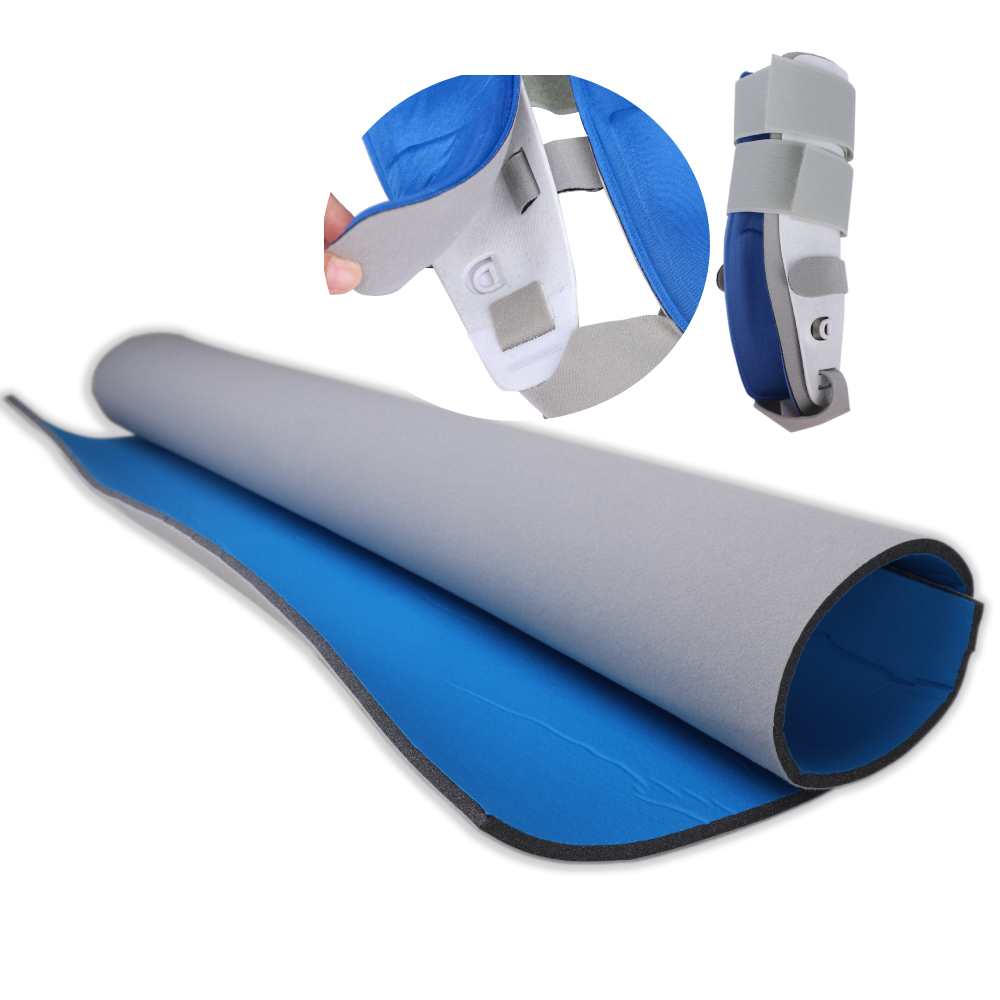
Foam laminated fabric is generally made by combining foam with one or more layers of fabric, nonwoven material, or other functional materials. Different layers can serve different purposes, and the final structure should be determined according to the design of the finished product.
In orthopedic and rehabilitation support products, foam is commonly used to provide thickness, cushioning, and padding. The fabric layer influences the surface feel, appearance, flexibility, and suitability for subsequent sewing and processing.
For example, a knee brace may require foam material that accommodates the bending structure around the knee, while a wrist support may place greater emphasis on material thickness, fit, and sewing requirements. For products designed for extended wear, manufacturers also need to consider the contact surface, cleaning method, and requirements of the finished product.
Buyers should first identify the specific position and function of the material within the finished product.
If the foam laminated fabric is used on the inner surface of the product, the fabric composition, surface construction, and contact requirements should be confirmed.
If the material is used for external support or padding, its thickness, structure, and processing requirements should be determined according to the product design.
If the material needs to be sewn together with other fabrics, webbing, or support components, its overall thickness and compatibility with the actual production process should also be evaluated.
These requirements cannot be determined simply by looking at the material name. Suppliers need to understand the intended application before recommending an appropriate material combination.
How Should Buyers Select the Foam and Fabric Structure?
The performance of foam laminated fabric depends on the combination of foam, fabric, and lamination structure.
Buyers should not focus only on the foam itself. Fabric type, number of layers, total thickness, and the position of each material layer in the finished product also need to be considered.
Foam Type and Thickness
PU foam and EVA foam are two possible foam material options, but they should not be considered completely interchangeable.
Different foam materials may have different characteristics in terms of softness, compression response, resilience, and flexibility. Their actual performance can also be affected by foam formulation, density, thickness, and processing conditions.
For orthopedic support manufacturers, the following information should be confirmed when selecting foam:
Foam material type.
Foam thickness and allowable tolerance.
Foam density and its corresponding measurement method.
Required softness or firmness.
The specific function of the foam in the finished product.
Whether compression, resilience, or other performance requirements apply.
It is important to understand that foam thickness alone does not determine the supporting performance of a material. Two foam materials with the same nominal thickness may have different compression characteristics because of differences in density and material structure.
Therefore, buyers should provide reference samples or specific performance requirements instead of selecting materials based only on thickness.
Fabric Surface and Contact Requirements
Fabric is an important component of foam laminated fabric, particularly when the finished rehabilitation support comes into contact with human skin.
Different fabric constructions may influence surface feel, flexibility, breathability pathways, and subsequent processing methods.
Buyers should confirm the following information:
Fiber composition.
Whether the fabric is knitted, woven, nonwoven, or mesh.
Fabric weight and thickness.
Surface texture and color requirements.
Whether the material will come into direct contact with skin.
Whether specific breathability or cleaning requirements apply.
If the finished product is intended for prolonged skin contact, buyers should clearly specify the contact area, contact duration, and applicable material safety requirements in the target market.
A fabric that feels soft to the touch should not automatically be considered compliant with all skin-contact or medical material requirements.
Single-Sided or Double-Sided Lamination?
Foam laminated fabric can be produced with different layer arrangements according to the product structure.
Common structures include:
Foam + Fabric: One fabric layer is laminated to one side of the foam, while the other side retains the foam surface.
Fabric + Foam + Fabric: The foam is positioned between two fabric layers.
Foam + Fabric + Functional Layer: Additional functional materials are incorporated according to the product design.
There is no universally superior structure. The appropriate option depends on the requirements of the finished product.
If the rehabilitation support only requires a fabric surface on one side, a single-sided lamination structure may be considered.
If both sides of the product require fabric coverage, a double-sided lamination structure may be evaluated.
If the product has additional functional requirements, other material layers may need to be incorporated.
Buyers should first identify the function of each material layer in the finished product before discussing the specific lamination structure with the supplier.
What Should Be Confirmed Before Cutting and Sewing?
After delivery, foam laminated fabric usually needs to undergo further processing, such as cutting, sewing, edge binding, or other converting operations.
For orthopedic and rehabilitation support manufacturers, meeting the material specifications does not necessarily mean that the material is suitable for the actual production process.
Therefore, sample evaluation should be carried out together with the product drawings and actual processing methods.
Material Thickness and Cutting Patterns
Buyers should confirm the total thickness of the laminated material rather than specifying only the thickness of the foam itself.
For example, the final thickness of a composite material may differ considerably from the original foam thickness after fabric, foam, and backing materials are combined.
If the material needs to be cut into specific shapes, buyers are advised to provide product drawings, cutting templates, or existing finished product samples.
The following points should be checked:
Whether the cut dimensions meet the drawing requirements.
Whether the cut edges show obvious irregularities.
Whether the foam edges become noticeably compressed or deformed.
Whether the fabric and foam layers shift relative to each other.
Whether the different material layers maintain their intended structure.
For curved, rounded, or irregularly shaped support components, particular attention should be paid to whether the cut edges are suitable for subsequent sewing and assembly.
Bending Areas and Sewing Positions
Orthopedic support products generally have three-dimensional structures, and different areas may require different bending and sewing configurations.
For example, knee supports may need to bend at specific positions, while wrist and ankle supports may need to accommodate different wrapping shapes.
Buyers should provide information about the bending direction, sewing positions, and connection methods of the material within the finished product.
During sample processing, the following points can be evaluated:
Whether obvious wrinkles appear after bending.
Whether localized separation occurs between the foam and fabric.
Whether noticeable layer misalignment appears in sewn areas.
Whether needle penetration causes material damage beyond the agreed requirements.
Whether the processed product shape meets the design specifications.
Different sewing machines, needle types, threads, and processing parameters may produce different results. Therefore, one particular processing setting should not be treated as a universal standard for all foam laminated fabrics.
Edge Binding and Edge Structure
If the finished product requires edge binding or folding, the condition of the composite material at the edges should also be confirmed.
Material thickness, foam flexibility, and fabric construction can all affect edge finishing results.
Buyers can use actual product samples to inspect whether the bound areas show obvious unevenness, excessive material buildup, foam deformation, or layer displacement.
If the material needs to be connected with webbing, hook-and-loop fasteners, or other support components, these connection areas should also be checked for compatibility with the overall material structure.
These inspections should be based on the actual finished product structure rather than evaluating only a flat material sample.
How Should Buyers Verify Bonding and Structural Stability?
The bonding stability between foam and fabric is an important quality consideration when purchasing foam laminated fabric.
If the bonding is unstable, the material may develop localized separation during subsequent cutting, bending, sewing, or use.
However, a smooth-looking surface does not necessarily mean that the bonding condition is acceptable across every area of the material.
Buyers can evaluate bonding quality through several steps.
First, inspect the laminated surface for obvious bubbles, localized bulges, wrinkles, or unbonded areas.
Second, check the material edges for noticeable lifting or separation between layers.
Then, according to the actual material structure and purchasing requirements, determine whether peel testing or other bonding performance tests are necessary.
For projects requiring quantitative bonding performance, buyers should confirm the specimen dimensions, testing method, testing conditions, and acceptance criteria with the supplier in advance.
Different combinations of foam and fabric may have different tensile, tearing, and peeling behaviors. Therefore, numerical test results from other laminated materials should not automatically be used as universal requirements for the current project.
It is also important to distinguish between interfacial delamination and substrate failure during testing.
If the foam itself tears during testing, or the fabric fails before the bonding interface separates, the result should not simply be interpreted as the peel strength of the laminated interface.
For specific peel testing methods and quality acceptance procedures, buyers can also refer to JHC's existing guide on laminated material bonding strength and peel testing.
How Should Cleaning and Repeated Use Requirements Be Validated?
Some orthopedic and rehabilitation support products require regular cleaning. The actual cleaning method depends on the product design, instructions for use, and requirements of the finished product manufacturer.
Buyers should not simply ask whether a material is washable. Instead, they should specify the actual cleaning method required for the finished product.
For example, different products may require spot cleaning, hand washing, or machine washing. These methods do not necessarily place the same requirements on laminated materials.
If the material needs to undergo washing, buyers should confirm the following information in advance:
The type of cleaning agent or detergent.
Water temperature and cleaning conditions.
Whether machine washing is required.
Whether drying is necessary.
Whether repeated cleaning is required.
Whether the original dimensions and structure need to be maintained after cleaning.
The supplier should provide material samples according to the conditions agreed upon by both parties. Buyers can then evaluate the samples using the actual cleaning method intended for the finished product.
After cleaning, the fabric surface, foam structure, interlayer bonding, dimensional changes, and overall appearance can be inspected.
If repeated cleaning is required, buyers should define the number of cleaning cycles and acceptance criteria, then establish supporting evidence through appropriate testing.
Without actual test results, suppliers should not promise long-term repeated washability or unchanged performance based only on the material name or appearance after a single cleaning cycle.
What Material Quality Documents Should Be Confirmed for Orthopedic Supports?
Documentation requirements for medical or rehabilitation applications should be determined according to the intended use of the finished product, target market, and applicable regulatory requirements.
When requesting documents from material suppliers, buyers need to distinguish between factory quality management system certificates, material test reports, and finished product compliance documentation.
Material Specification
Buyers should first confirm the material specification sheet, which should include:
Material name and composition.
Foam type.
Fabric type and fiber composition.
Layer arrangement.
Total basis weight and thickness.
Product color and dimensions.
Allowable specification tolerances.
This information helps buyers confirm whether the samples and bulk orders use the same material structure.
Material Test Reports
If the finished product has specific material performance requirements, buyers can request relevant testing documentation from the supplier.
For example, projects may involve:
Foam density and thickness.
Interlayer bonding performance.
Compression and resilience.
Dimensional stability.
Material changes after cleaning or washing.
Skin-contact-related testing.
The specific testing items should be determined according to the product design and target-market requirements.
It is important to understand that test reports for other materials or products cannot automatically prove that the current foam laminated fabric has passed the same tests.
Buyers should check the sample name, material composition, test items, testing methods, and applicable scope stated in each report.
Factory Quality System Certification and Product Compliance
Factory quality management system certification can help buyers understand a supplier's quality management capabilities. However, it does not mean that a particular foam laminated fabric has obtained all the testing results or regulatory approvals required for medical products.
For example, ISO 13485 is a quality management system standard related to medical devices.
It does not independently prove that a specific foam laminated fabric has passed ISO 10993 biocompatibility testing, nor does it replace the registration or regulatory assessment of the final medical device.
If the product requires a biocompatibility evaluation, the applicable evaluation plan should be determined according to the contact characteristics, contact duration, and target-market requirements of the finished product.
If the product requires sterilization, buyers should also clarify whether the material needs to be included in the final sterilization validation process.
Ordinary non-sterile materials must not be described as sterile medical materials simply because they are intended for medical or rehabilitation applications.
How Should Sample Approval and Bulk Production Quality Acceptance Be Arranged?
For customized foam laminated fabric, sample approval should involve more than checking appearance and hand feel.
Buyers should convert the sample evaluation results into quality requirements that can be applied to subsequent bulk production.
Stage One: Confirm Sample Specifications
Both parties should confirm the foam type, fabric composition, number of layers, lamination structure, total thickness, basis weight, width, and color.
If the material requires specific softness, compression performance, or bonding performance, the corresponding evaluation methods should also be agreed upon in advance.
Stage Two: Verify Actual Processing Compatibility
Buyers should use the samples for actual cutting, sewing, bending, and assembly.
If the finished product requires cleaning or washing, the relevant evaluation should also be completed under conditions agreed upon by both parties.
Processing and testing results should be documented to avoid relying only on verbal confirmation.
Stage Three: Establish Bulk Batch Acceptance Criteria
During bulk production, the delivered material should be compared with the approved sample.
Key inspection items include:
Whether the material structure remains consistent.
Whether the foam type and fabric composition remain consistent.
Whether basis weight and thickness meet the agreed specifications.
Whether appearance and color meet the requirements.
Whether the laminated layers show obvious abnormalities.
Whether batch inspection results meet the agreed criteria.
If noticeable differences occur between rolls or production batches, further evaluation should be carried out according to the agreed sampling and acceptance procedures.
For long-term projects, buyers are advised to retain approved samples, specification sheets, test reports, and batch quality records as references for subsequent orders.
What Information Should Orthopedic Support Manufacturers Provide When Requesting a Quotation?
If buyers want suppliers to accurately evaluate the material structure and provide quotations, simply providing a product name such as Orthopedic Foam or Medical Foam is usually insufficient.
The following information is recommended:
Purchasing Information | Recommended Details |
Finished Product | Knee braces, wrist supports, ankle braces, back support belts, or other rehabilitation supports |
Material Application | The position and specific function of the material in the finished product |
Foam Specifications | Foam type, thickness, density, and firmness requirements |
Fabric Specifications | Fiber composition, fabric construction, GSM, and color |
Lamination Structure | Single-sided lamination, double-sided lamination, or other multilayer structures |
Processing Methods | Cutting, sewing, edge binding, and assembly requirements |
Cleaning Requirements | Specific conditions for wiping, hand washing, or machine washing |
Quality Requirements | Bonding, dimensions, appearance, and other testing items |
Order Quantity | Sample requirements, initial order quantity, and estimated long-term demand |
Documentation Requirements | Material test reports and compliance documents applicable to the target market |
If buyers can provide existing material samples, finished product pictures, or technical drawings, suppliers can better understand the specific requirements of the project.
For projects requiring special performance characteristics, testing standards and acceptance criteria should be clearly defined during the quotation stage. This helps prevent specification misunderstandings after the materials have already been produced.
Conclusion: Confirm the Finished Product Requirements Before Defining Foam Laminated Fabric Specifications
Purchasing foam laminated fabric for orthopedic braces and rehabilitation supports should not be based only on foam type, thickness, or price.
Whether the material structure suits the product design, whether the fabric meets contact requirements, whether the laminated layers can withstand subsequent processing, and whether the material condition after cleaning meets the product requirements are all important considerations before sample approval and bulk production.
For material suppliers, understanding the final product application, material structure, and processing methods is equally important.
Before confirming a specific material combination, buyers are advised to provide the product application, material specifications, processing drawings, and quality requirements. The material's suitability can then be evaluated through actual sample verification.
By establishing clear technical specifications, sample approval procedures, and batch acceptance requirements, buyers and suppliers can reduce misunderstandings about material requirements and create a clearer quality basis for long-term purchasing.



