What Determines the Water Absorption of Needle Punched Felt? A Buyer’s Guide
Short Description:
The water absorption of needle punched felt depends on more than weight or thickness. Fiber type, fiber structure, basis weight, thickness, porosity, needle punching density, finishing treatments, and testing conditions can all affect absorption performance. This guide helps importers, wholesalers, distributors, and industrial buyers select the right absorbent needle punched nonwoven material.
Why Does Needle Punched Felt Absorb Water?
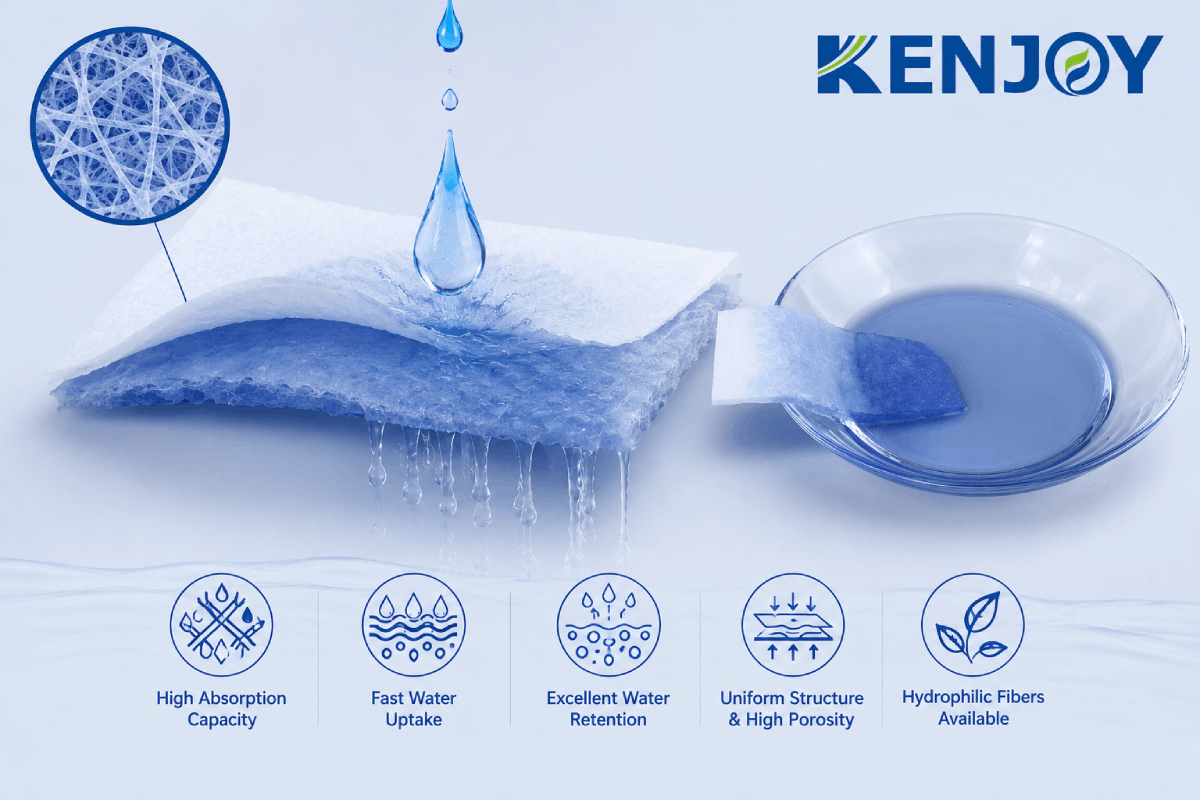
Needle punched felt is a type of needle punched nonwoven material. Its water absorption performance mainly comes from two mechanisms: the ability of the fibers themselves to interact with water and the internal pores of the material that hold water.
This is why two needle punched felt products with the same weight and thickness can deliver noticeably different results in actual use.
For buyers, simply asking a supplier for a specific GSM is usually not enough. The final absorption performance depends on how the raw material, fiber structure, and manufacturing process work together.
When sourcing absorbent felt for a new product, it is therefore important to evaluate the complete material structure rather than focusing on one specification.
What Factors Affect the Water Absorption of Needle Punched Felt?
1. Fiber Material Is One of the Most Important Factors
The raw material used to produce needle punched felt has a major influence on its water absorption properties.
Different fibers have different levels of affinity for water. As a result, two products manufactured at the same basis weight can perform very differently when exposed to water.
Hydrophilic vs. Hydrophobic Fibers
Hydrophilic fibers such as viscose, cotton, and modal have a natural affinity for water. Their molecular structure allows the fibers themselves to absorb and retain moisture.
By comparison, hydrophobic fibers such as polyester and polypropylene have very limited intrinsic water absorption. In these materials, water is mainly held within the spaces between the fibers rather than absorbed by the fibers themselves.
Therefore, under similar basis-weight and structural conditions, needle punched felt made with hydrophilic fibers can generally achieve a higher overall water absorption capacity than polyester-based felt.
This is why buyers looking for absorbent needle punched felt should confirm the fiber composition and material ratio, rather than comparing suppliers only by GSM.
2. Fiber Cross-Section Can Affect Capillary Action
Fiber geometry is another factor that can influence water movement through nonwoven materials.
Compared with conventional round fibers, fibers with cross-shaped, hollow, grooved, or other modified cross-sections can create different capillary pathways between fibers.
These structures may improve the movement of water through the material and help increase both absorption speed and moisture retention.
For applications where buyers need not only a high absorption capacity but also fast water uptake, fiber structure should be considered alongside the basic fiber material.
3. Fiber Fineness Affects Water Movement
Fiber diameter also plays a role in the absorption behavior of needle punched felt.
Fine fibers generally provide a larger surface area per unit weight and can create stronger capillary effects. This can help water spread through the material more quickly.
Coarser fibers can create relatively larger internal spaces, which may accommodate more free water under certain structural designs, but this does not necessarily mean that water will enter the material faster.
Therefore, there is no simple rule that finer fibers are always better. The right fiber fineness depends on whether the application prioritizes fast absorption, total absorption capacity, or moisture retention.
How Does the Needle Punching Process Affect Water Absorption?
Raw materials establish the basic absorption characteristics of the felt, while the needle punching process determines much of its internal fiber structure.
During needle punching, barbed needles repeatedly penetrate the fiber web and mechanically entangle the fibers. Changes in needle density and processing conditions can therefore affect the finished material's thickness, density, loft, and internal pore structure.
Does Higher GSM Always Mean Higher Water Absorption?
When the raw material and manufacturing process remain similar, increasing the basis weight means that more fibers are present per unit area.
This generally creates a greater overall volume of fiber-to-fiber spaces, so the total amount of water that the material can hold may increase.
However, a higher GSM does not automatically mean that the absorption capacity per unit weight will increase proportionally.
If the material becomes excessively compacted as the basis weight increases, the effective storage space inside the felt can be reduced.
For wholesalers and industrial buyers who need to control material costs, selecting an appropriate GSM is often more effective than simply choosing the heaviest available felt.
Thickness and Porosity Matter
The thickness and porosity of needle punched felt directly influence the amount of space available for water storage.
A material with a suitable open and interconnected pore structure allows water to enter and remain within the fiber network.
However, excessive needle punching can compact the fibers and reduce the size of internal pores. The material may become denser and firmer, while water movement and storage capacity can be affected.
For absorbent needle punched felt, manufacturers therefore need to balance thickness, density, porosity, and structural stability.
How Does Loft Affect Absorption?
The loft of needle punched felt is another important consideration.
A relatively lofty fiber structure normally contains more interconnected spaces between fibers, providing additional room for water storage.
When the material is excessively compressed, its internal structure becomes less open and the effective pore volume can decrease.
For this reason, buyers should not judge absorption performance only by the visible thickness of the material. The internal fiber structure is equally important.
Can Finishing Treatments Change Water Absorption?
Yes. Finishing treatments can significantly influence how needle punched felt interacts with water.
For hydrophobic materials such as polyester felt, a hydrophilic treatment can improve the surface wettability of the fibers, allowing water to enter the material more easily.
In contrast, water-repellent treatments or coatings can make it more difficult for water to penetrate the fiber structure and may reduce water absorption.
Certain chemical modification techniques can also introduce hydrophilic functional groups onto the fiber surface, improving moisture uptake and retention.
For customized projects, buyers should therefore communicate their requirements for hydrophilic treatment, water-repellent treatment, or other functional finishes before production begins.
Why Can Actual Absorption Results Differ From Laboratory Tests?
Some buyers find that the absorption performance of a needle punched felt sample differs between laboratory testing and actual application.
This does not necessarily mean that the material has a quality problem. Different test conditions can produce different results.
Water Contact Method
Fully immersing a piece of needle punched felt in water is different from testing it through dripping, spraying, or one-sided contact.
During immersion, water can enter the material from multiple directions. In an actual application, however, water may only contact one surface.
The testing method can therefore have a significant effect on the measured result.
Pressure
Pressure can compress the internal pores of the felt.
When needle punched felt is used under compression, some of the water stored inside the material may be forced out, reducing its effective water-holding capacity.
For applications involving pressure, buyers should consider not only the static absorption capacity but also water retention and drainage performance under compression.
Temperature
Water temperature can affect the rate at which water wets and penetrates the fiber structure.
In general, higher temperatures can change the wetting and absorption process, although the effect on the material's maximum water-holding capacity may be relatively limited.
For meaningful supplier comparisons, buyers should keep the testing method, temperature, pressure, water volume, and testing time as consistent as possible.
What Is the Difference Between Water Absorption Capacity and Absorption Speed?
These two terms are often confused during material sourcing.
Water absorption capacity describes how much water a given amount of needle punched felt can absorb. A common way of expressing this is g/g, which compares the mass of absorbed water with the original mass of the material.
Water absorption speed describes how quickly water enters and spreads through the material.
Absorption speed is strongly influenced by factors such as fiber wettability, fiber fineness, capillary action, and internal pore structure.
Therefore, a felt with a high final absorption capacity does not necessarily absorb water faster than another material.
Before requesting samples, buyers should determine whether their application requires high absorption capacity, rapid water uptake, strong water retention, or a balanced combination of these properties.
What Should Buyers Ask When Sourcing Absorbent Needle Punched Felt?
For importers, wholesalers, distributors, and manufacturers, asking only “What is the price per kilogram?” is usually not enough to identify the right material.
A more effective approach is to provide the supplier with the actual application and performance requirements.
If the priority is high water absorption, buyers should pay particular attention to fiber type, fiber ratio, basis weight, thickness, and porosity.
If rapid water uptake is more important, the discussion should include fiber wettability, fiber fineness, capillary structure, and needle punching parameters.
If the finished product needs both absorption and structural stability, the manufacturer may need to balance absorption performance with needle punching density and material firmness.
For large-volume purchasing, it is also recommended to test samples before confirming the final specification. This helps avoid selecting a standard product that does not perform well in the actual application.
How Can a Professional Needle Punched Felt Manufacturer Improve Absorption Performance?
Water absorption is rarely solved by changing only one specification.
For example, increasing GSM may not solve poor absorption if the raw material has insufficient affinity for water. Likewise, even a hydrophilic fiber may not provide the expected performance if excessive needle punching compresses the internal pore structure.
A capable manufacturer should therefore evaluate several factors together, including raw material selection, fiber ratio, fiber structure, basis weight, thickness, needle punching density, porosity, and finishing treatment.
With more than 20 years of experience in needle punched felt and nonwoven material manufacturing, Kenjoy can develop customized materials according to different application requirements.
As a needle punched nonwoven felt manufacturer, we can adjust specifications such as GSM, thickness, width, firmness, surface characteristics, and material structure according to the customer's requirements.
Our capabilities also support OEM and ODM projects for importers, wholesalers, distributors, and industrial buyers looking for stable customized nonwoven materials.
If you are searching for a reliable needle punched felt manufacturer, custom nonwoven felt manufacturer, or nonwoven felt manufacturer China, providing your application, target absorption capacity, absorption speed, and sample specifications can help the manufacturer develop a more suitable solution.
Conclusion: Water Absorption Depends on More Than GSM
The water absorption performance of needle punched felt is the result of both fiber-level water interaction and water storage within the material's internal pore structure.
Fiber type, fiber fineness, cross-sectional structure, basis weight, thickness, porosity, loft, needle punching density, and finishing treatments can all influence the final performance.
For buyers, this means that choosing absorbent needle punched felt should not be based solely on price, GSM, or thickness. The material should be selected according to the actual application and required performance.
If you are sourcing absorbent needle punched felt, customized needle punched felt, or needle punched nonwoven materials, working with an experienced manufacturer can help you develop the right combination of raw materials and processing parameters for your application.