Why Is Pet Filter Cotton Draining Slowly? Causes & Solutions
Short Description:
Slow water flow through pet filter cotton can affect filtration performance and the overall efficiency of a filter system. This guide explains how raw materials, fiber ratios, GSM, density and heat-setting affect drainage speed, while helping importers, wholesalers and pet product manufacturers choose the right filter cotton supplier.
Why Does Pet Filter Cotton Drain So Slowly?
A common problem reported by buyers of pet filter cotton is that the material drains water too slowly. In some cases, the filter cotton works normally at first, but water flow gradually becomes restricted during use, affecting the performance of the entire filtration system.
Some buyers also find that pet filter cotton from different suppliers can look almost identical but perform very differently during actual testing.
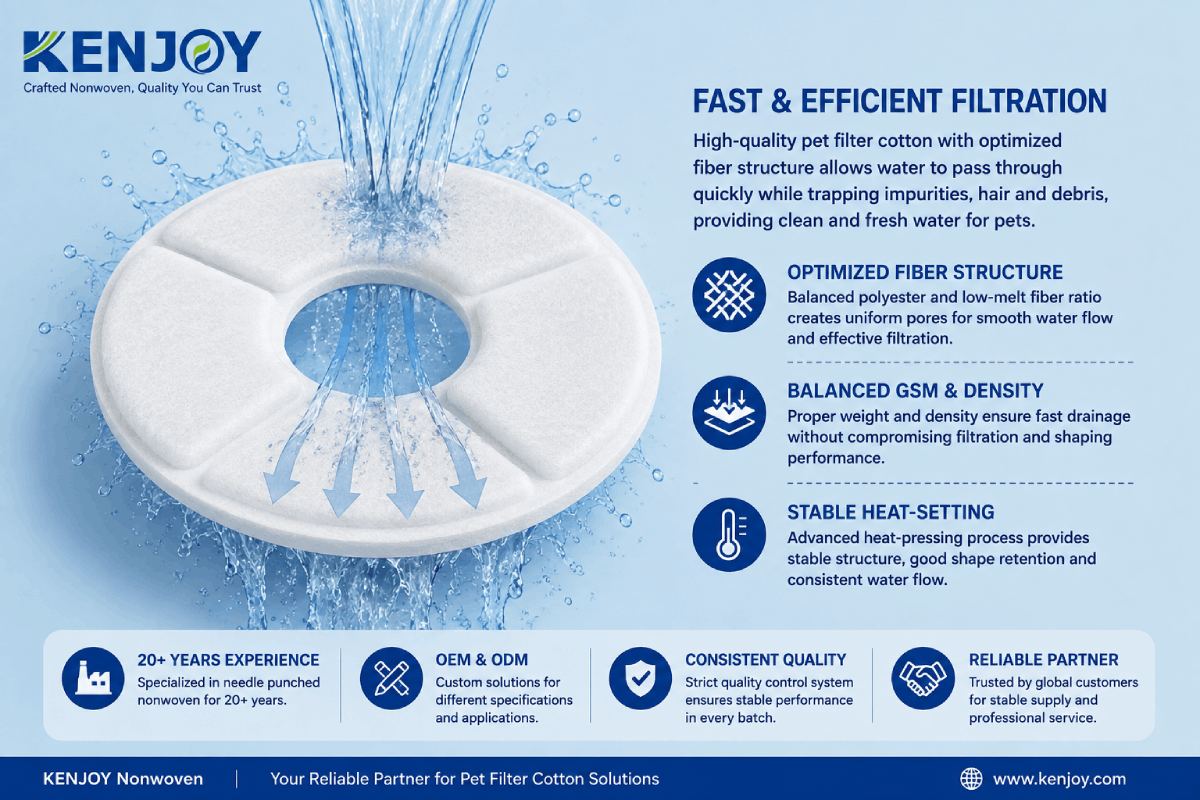
The reason is that the performance of pet filter cotton is not determined by appearance alone. Raw material quality, fiber ratio, GSM, thickness, density, fiber structure and heat-setting conditions can all affect how quickly water passes through the material.
For importers, wholesalers and pet product manufacturers, understanding these factors is important when selecting a reliable filter cotton supplier.
What Causes Pet Filter Cotton to Drain Slowly?
Slow drainage is usually related to the internal fiber structure of the material. When pet filter cotton needs to provide both filtration and a stable molded shape, several material parameters need to be properly balanced.
The Raw Material Ratio Can Affect Water Flow
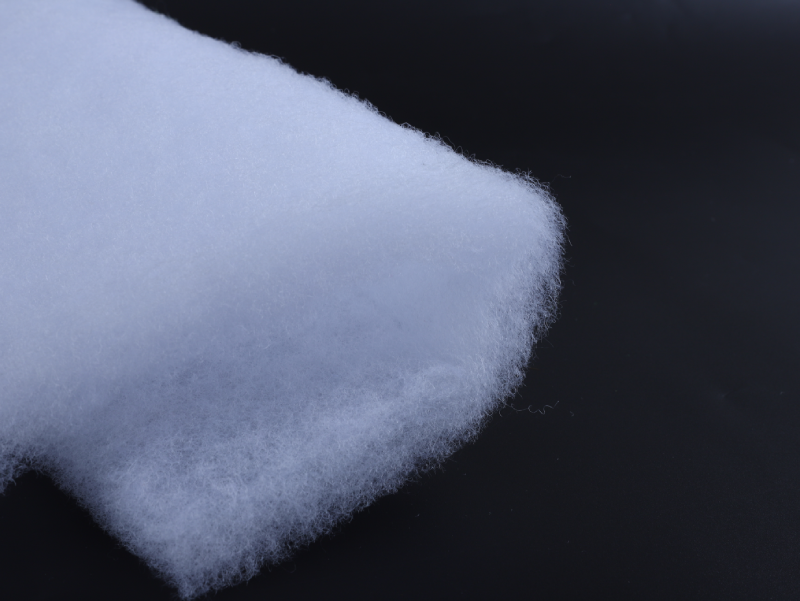
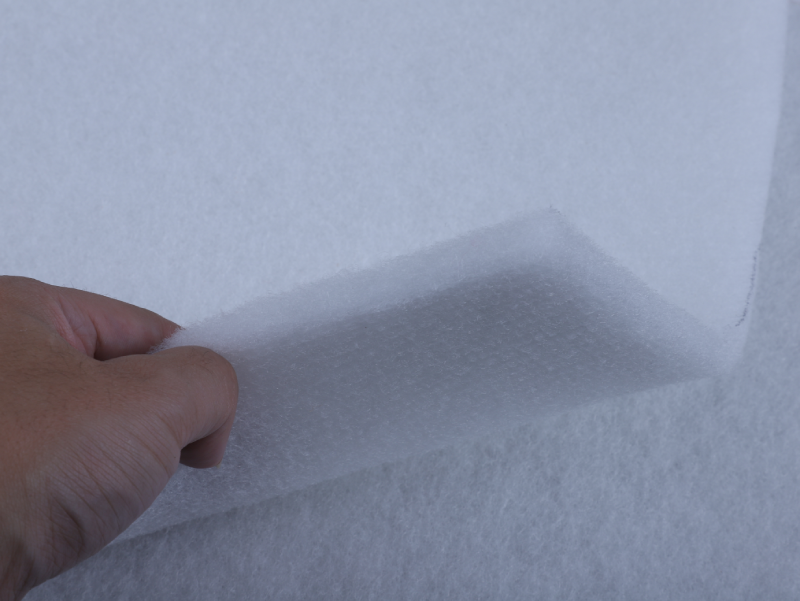
Pet filter cotton is commonly produced mainly from polyester fiber, with a certain amount of low-melting fiber added according to the required forming and heat-setting performance.
Polyester fiber provides the main fiber structure of the material, while low-melting fiber can soften or melt during heating and help stabilize the final shape.
However, simply using these two materials does not guarantee the same performance.
If the ratio between polyester fiber and low-melting fiber is not properly controlled, the internal structure of the filter cotton may become too compact after heat-setting. This can increase resistance to water flow and result in slower drainage.
This is one reason why pet filter cotton produced by different manufacturers can have noticeably different water-flow performance even when the products appear similar.
For buyers comparing suppliers, it is therefore important to consider not only the product specifications but also the raw material quality and fiber formulation behind the product.
Excessive GSM Can Reduce Drainage Speed
Another important factor is GSM, or fabric weight per square meter.
Generally, a higher GSM means more fiber material within the same area. Depending on the thickness and manufacturing process, a higher GSM can result in a denser structure and greater resistance to water flow.
For pet filter cotton that needs to be heat-formed, using an excessively high GSM may make the material thicker and more compact. Water then has to pass through a denser fiber network, which can reduce drainage speed.
However, choosing the lowest possible GSM is not the right solution either.
If the GSM is too low, the filter cotton may not provide sufficient thickness, support or forming performance. After heat-setting, the molded product may lack fullness and structural stability.
Therefore, drainage speed and forming performance need to be balanced according to the final application.
Fiber Density Also Affects Filtration Performance
GSM alone does not determine how fast water can pass through pet filter cotton.
Two materials with similar GSM can still have different drainage performance if their thickness, fiber arrangement and internal density are different.
When fibers are packed too tightly, the available pathways for water become more restricted, increasing flow resistance.
A properly controlled fiber structure can provide sufficient filtration while still allowing water to pass through efficiently.
This is why an experienced needle punched felt manufacturer needs to adjust the material structure according to the intended application rather than simply producing every product at a fixed GSM.
Why Does Pet Filter Cotton From Different Suppliers Perform Differently?
This is an important question for buyers sourcing pet filter cotton.
Many products on the market look similar when viewed from the outside, but their actual performance can vary significantly during testing.
One supplier's product may provide faster drainage, while another may drain much more slowly. Some products maintain a full and stable shape after heat-setting, while others may become loose or poorly formed.
There can also be differences in heat-welding performance, thickness consistency and dimensional stability.
These differences are often related to raw material quality, fiber formulation, GSM control, needle punching density, heat-setting technology and production equipment.
For buyers purchasing in large quantities, this is particularly important. A sample may perform well during initial testing, but inconsistent mass production can create additional production costs and quality issues.
Working with an experienced custom nonwoven felt manufacturer can help reduce this risk.
How Should Buyers Choose the Right GSM for Pet Filter Cotton?
There is no single GSM that is suitable for every pet filter cotton application.
The appropriate specification depends on the filtration system, product structure, required drainage speed and forming process.
If fast water flow is the priority, buyers should pay close attention to the internal fiber structure and density.
If the product needs to be heat-formed, the ratio of polyester fiber to low-melting fiber and the heat-setting conditions should also be considered.
If the final product needs to maintain a full three-dimensional shape, GSM, thickness and stiffness need to be balanced together.
For this reason, an experienced supplier should recommend specifications based on the customer's actual application rather than simply offering a standard GSM and price.
What Other Problems Can Occur With Pet Filter Cotton?
Slow drainage is not the only issue buyers may encounter.
Some customers may also experience poor forming performance, loose structures, poor bonding during heat welding or inconsistent thickness.
These problems can also be related to raw materials and manufacturing processes.
For example, inconsistent material density can lead to variations in thickness across the same product. An unsuitable fiber ratio can affect the final forming performance, while an inappropriate amount of low-melting fiber or unsuitable heat-setting conditions can affect bonding during secondary processing.
Therefore, when purchasing pet filter cotton for further processing, buyers should evaluate more than water flow speed.
Thickness consistency, forming performance, heat-setting stability and heat-welding performance should also be tested before mass production.
How Can Kenjoy Improve the Performance of Pet Filter Cotton?
Kenjoy has more than 20 years of experience in needle punched nonwoven production and custom material development.
For pet filter cotton, we can adjust raw materials, fiber ratios, GSM, thickness and material structure according to the customer's actual application requirements.
For common issues such as slow drainage, poor forming, loose structures, weak heat-welding performance and uneven thickness, different material and production parameters can be evaluated and adjusted during product development.
As an experienced needle punched nonwoven felt manufacturer, Kenjoy provides both standard specifications and customized nonwoven solutions.
For importers, wholesalers, distributors and pet product manufacturers with long-term purchasing requirements, stable raw materials and controlled production processes can help reduce performance variations between different production batches.
Why Work With an Experienced Needle Punched Nonwoven Manufacturer?
Pet filter cotton may look like a relatively simple material, but when buyers require specific drainage speed, forming performance and bonding characteristics, manufacturing experience becomes particularly important.
A professional needle punched felt manufacturer needs to have capabilities in raw material selection, fiber blending, needle punching, heat-setting and quality control.
As a nonwoven felt manufacturer in China, Kenjoy has established production capabilities for needle punched nonwoven materials and provides OEM/ODM and customized manufacturing services.
Our product range includes pet filter cotton, floor protection materials, Painter Felt, Painter Cover Fleece and other needle punched nonwoven materials for different applications.
For long-term buyers, working directly with an experienced needle punched felt factory in China can simplify product development, specification adjustments and quality management.
What Should Buyers Confirm When Sourcing Pet Filter Cotton?
If you are sourcing pet filter cotton, providing only the product dimensions and order quantity may not be enough to identify the right material.
It is better to provide information about the application, required drainage speed, heat-setting process, heat-welding method and target thickness.
If you already have an existing product or sample, providing it to the manufacturer for comparison can also make product development more efficient.
Based on the sample and application requirements, the supplier can evaluate the appropriate raw material, GSM, thickness, density and heat-setting parameters.
This approach is generally more effective than comparing suppliers based only on product photos, names or unit prices.
Conclusion: Drainage Speed Depends on More Than One Factor
Slow drainage in pet filter cotton is not necessarily caused by excessive thickness alone. Raw material ratios, GSM, fiber density, internal structure and heat-setting conditions can all influence water-flow performance.
For importers, wholesalers and pet product manufacturers, the key is to evaluate whether the overall material performance meets the requirements of the final application rather than simply comparing price or GSM.
With more than 20 years of experience in needle punched nonwoven manufacturing and customization, Kenjoy can develop pet filter cotton according to requirements for drainage speed, forming performance, heat-welding performance and thickness consistency.
If you are looking for a reliable custom nonwoven felt manufacturer for pet filter cotton, needle punched filter materials or other nonwoven products, contact Kenjoy for sample testing and specification development.