What Are the Main Nonwoven Fabric Manufacturing Processes? Principles, Features and Applications
When sourcing nonwoven materials for floor protection, painting, construction, automotive or industrial applications, buyers often focus first on GSM, thickness and price.
However, one factor is often overlooked: the manufacturing process behind the nonwoven fabric.
Why is one nonwoven material soft and highly absorbent while another is strong and abrasion resistant? Why are some products suitable for filtration, while others are designed for floor protection or automotive applications?
The answer is largely related to the fiber type, web formation method and bonding technology used during production.
Unlike traditional woven fabrics, nonwoven materials do not require yarn production and conventional weaving. Instead, fibers or filaments are formed into a web and then consolidated through mechanical, thermal, chemical or other methods.
For importers, wholesalers and distributors, understanding these manufacturing processes can help avoid choosing a material based only on price and instead select a product that matches the actual application.
Why Are There Different Nonwoven Fabric Manufacturing Processes?
Nonwoven fabric is not a single standardized material.
Different applications require different performance characteristics. A floor protection material may need abrasion resistance, strength and cushioning, while a wipe may prioritize softness and absorbency.
Automotive materials may require strength, insulation or sound absorption, while filtration products require a specific fiber structure and pore distribution.
As a result, the nonwoven industry has developed multiple manufacturing technologies.
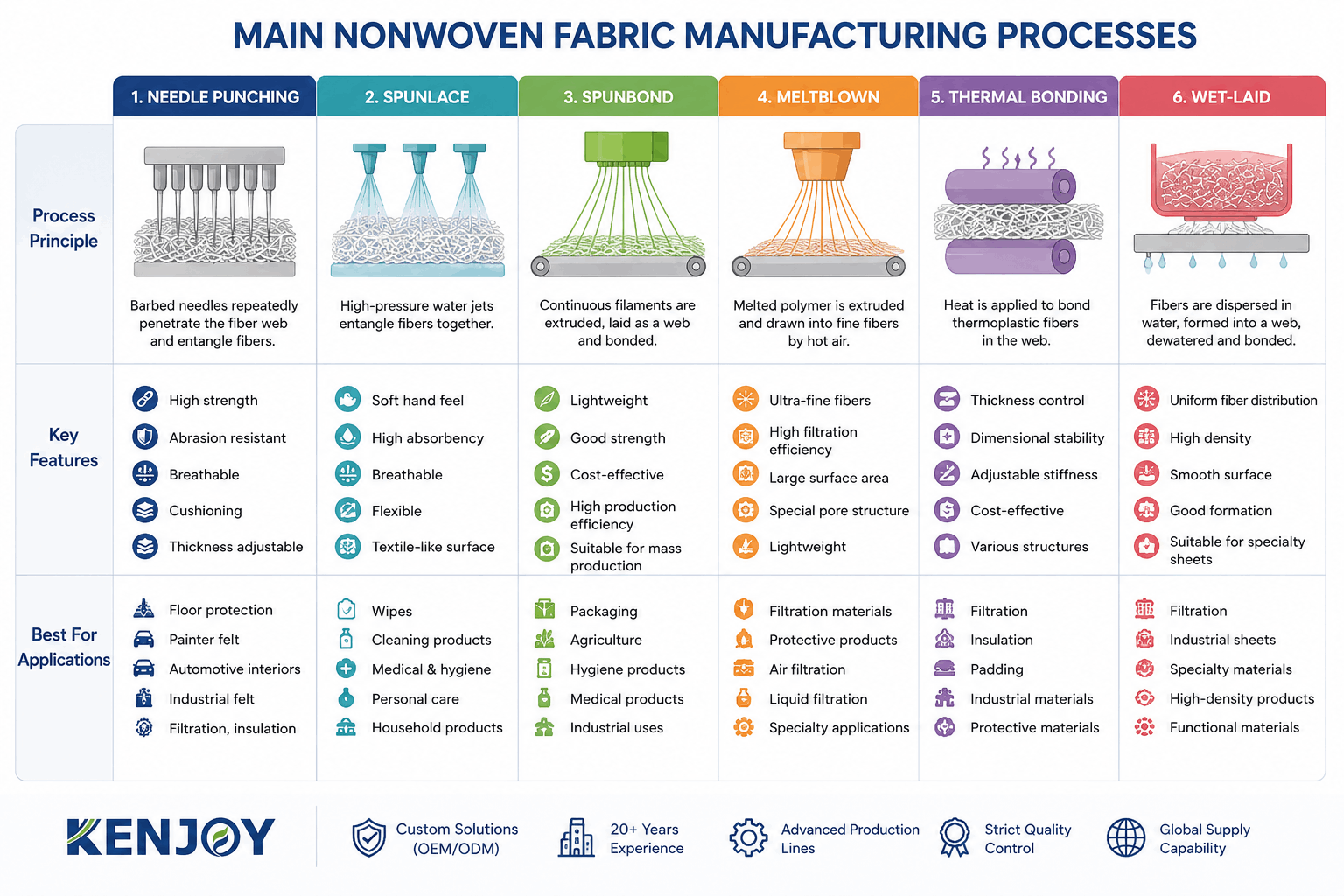
The major processes include:
Needle punching
Spunlace
Spunbond
Meltblown
Thermal bonding
Wet-laid
There is no universally "best" process. The right choice depends on the end use, required performance, material composition and target specifications.
1. Needle Punched Nonwoven: Mechanical Fiber Entanglement
How Does Needle Punching Work?
Needle punching is a mechanical process that uses barbed needles to repeatedly penetrate a fiber web and entangle the fibers with each other.
As the needles move through the web, individual fibers are pushed through different layers and become mechanically interlocked.
The final structure can be adjusted by controlling factors such as fiber type, fiber length, web weight, needle density, punching depth and production parameters.
This makes needle punching particularly flexible for products that require different GSM and thickness specifications.
Key Features of Needle Punched Nonwoven
Depending on the raw material and production parameters, needle punched nonwoven can provide:
Good mechanical strength
High abrasion resistance
Breathability
Flexibility
Cushioning performance
Moisture absorption
Adjustable thickness and GSM
Additional finishing or treatment can also be used when specific requirements such as flame resistance, water absorption or liquid protection are needed.
Where Is Needle Punched Nonwoven Used?
Needle punched materials are widely used in applications where durability and mechanical performance are important.
Typical applications include:
Floor protection rolls
Painter felt
Painter cover fleece
Automotive interior materials
Construction materials
Industrial felt
Filtration materials
Insulation and sound-absorbing materials
For buyers requiring customized GSM, thickness, width or other specifications, working directly with a custom nonwoven felt manufacturer can provide greater control over the final product.
2. Spunlace Nonwoven: High-Pressure Water Entanglement
How Does Spunlace Work?
Spunlace, also known as hydroentanglement, uses high-pressure water jets to entangle fibers within a web.
The water jets penetrate the fiber layer from different directions, causing the fibers to move, rearrange and become mechanically entangled.
Unlike needle punching, which relies on barbed needles, spunlace primarily uses high-pressure water streams to create the fiber structure.
Key Features of Spunlace Nonwoven
Spunlace materials are generally associated with:
Soft hand feel
Good absorbency
Breathability
Flexibility
Textile-like surface characteristics
These characteristics make spunlace suitable for applications where softness and liquid absorption are important.
Common Applications
Typical applications include:
Wipes
Cleaning products
Medical and hygiene products
Personal care products
Household products
Therefore, if a buyer requires a soft and absorbent nonwoven material, spunlace may be more appropriate than needle punched material.
3. Spunbond Nonwoven: Continuous Filament Web Formation
How Does Spunbond Work?
Spunbond production generally uses polymer materials that are melted and extruded into continuous filaments.
The filaments are stretched, laid into a web and then bonded to form the finished nonwoven material.
Unlike processes that primarily use short fibers, spunbond technology uses continuous filaments.
Key Features of Spunbond Nonwoven
Spunbond materials commonly offer:
Lightweight construction
Good tensile strength
High production efficiency
Suitable for large-volume manufacturing
They are widely used in packaging, agriculture, hygiene products and various industrial applications.
4. Meltblown Nonwoven: Fine Fiber Structure
How Does Meltblown Work?
Meltblown technology also uses polymer materials as the primary raw material.
After melting and extrusion, high-speed hot air stretches the polymer into extremely fine fibers. These fibers are collected to form a nonwoven web.
Because the fibers can be very fine, the resulting material can have a specialized pore structure.
Key Features of Meltblown Nonwoven
Important characteristics include:
Fine fiber diameter
Large specific surface area
Fine fiber structure
Suitable filtration characteristics
Meltblown materials are therefore commonly used in filtration and other specialized applications.
5. Thermal Bonding: Heat-Based Fiber Consolidation
How Does Thermal Bonding Work?
Thermal bonding uses heat to create bonding points between thermoplastic fibers or components within the fiber web.
Depending on the product design, manufacturers can use heating and thermal compression to create the required structure.
Key Features of Thermally Bonded Nonwoven
This process can be used to control:
Thickness
Stiffness
Density
Dimensional stability
Thermally bonded nonwovens can be found in certain filtration, insulation, padding and industrial applications.
6. Wet-Laid Nonwoven: Fiber Formation in a Liquid Medium
How Does Wet-Laid Nonwoven Work?
Wet-laid technology has similarities to papermaking.
Fibers are dispersed in a liquid medium to create a fiber suspension. The fibers are then formed into a web, followed by water removal and subsequent bonding or consolidation.
Key Features of Wet-Laid Nonwoven
One important advantage of wet-laid production is the ability to achieve relatively uniform fiber distribution.
It can therefore be used for selected filtration, industrial and specialty sheet materials where consistent fiber distribution is important.
How Should Buyers Choose Between Different Nonwoven Processes?
For professional buyers, asking "Which nonwoven process is the best?" is usually not the right starting point.
A better question is:
"What performance does my application require?"
The selection should consider:
End application
Required GSM
Thickness
Fiber composition
Strength
Abrasion resistance
Absorbency
Breathability
Surface characteristics
Special treatments
For example, a floor protection buyer may prioritize durability and cushioning, while a cleaning product manufacturer may place greater importance on softness and absorbency.
Which Nonwoven Process Is Suitable for Floor Protection and Painter Felt?
Construction and renovation projects can expose protective materials to continuous foot traffic, tools, dust, paint and friction.
Therefore, floor protection products generally need a combination of:
Abrasion resistance
Tensile strength
Cushioning
Surface protection
Absorption
Needle punched nonwoven is particularly suitable for these requirements because the fiber structure can be engineered for different GSM, thickness and density.
For painter felt and painter cover fleece, a PE backing can also be added when stronger resistance against paint, water and other liquids is required.
This structure makes PE-backed cover fleece a practical option for painting contractors, renovation suppliers and professional distributors.
Don't Compare Nonwoven Suppliers by Price Alone
For importers, wholesalers and distributors, the lowest quotation does not necessarily mean the lowest overall purchasing cost.
If the finished product has inconsistent thickness, insufficient strength, poor abrasion resistance or unstable GSM, customers may experience:
Product complaints
Returns
Difficult installation
Higher material consumption
Inconsistent project performance
Long-term supplier problems
Before placing a bulk order, professional buyers should therefore confirm:
Raw material
Manufacturing process
GSM
Thickness
Strength
Roll width and length
Packaging
Production capacity
Quality control
A complete evaluation provides a much clearer picture of the actual value offered by a supplier.
Why Choose Jinhaocheng as Your Needle Punched Felt Manufacturer?
HUIZHOU JINHAOCHENG NONWOVENS CO., LTD has more than 20 years of experience in nonwoven manufacturing.
Our manufacturing facility in Guangdong, China covers approximately 26,000㎡, with 15 automated production lines and an annual production capacity exceeding 10,000 tons.
Our main products include:
Needle punched nonwoven felt
Floor protection rolls
Painter felt
Painter cover fleece
Industrial felt
Customized nonwoven products
We provide OEM, ODM and customized manufacturing solutions for importers, wholesalers, distributors and industrial customers.
As a professional needle punched nonwoven felt manufacturer, we can adjust product specifications according to different applications, including GSM, thickness, width, roll length, fiber composition and other requirements.
Our certification and compliance portfolio includes OEKO-TEX STANDARD 100, ISO9001, ISO13485, ISO14001, ISO45001, IATF16949, GRS and BSCI, along with UL94, REACH, RoHS and MSDS related requirements.
For buyers looking for a reliable needle punched felt factory in China, stable production capacity, consistent specifications and customization capability can be more valuable than simply choosing the lowest unit price.
Conclusion
Different nonwoven manufacturing processes create different fiber structures and performance characteristics. Needle punching, spunlace, spunbond, meltblown, thermal bonding and wet-laid processes each have their own advantages and applications.
If you are sourcing nonwoven materials for floor protection, painting, construction, automotive or industrial applications, understanding the production process can help you select a more suitable product.
For customized needle punched nonwoven felt, Jinhaocheng provides OEM, ODM and factory-direct manufacturing solutions for global buyers.
Contact Jinhaocheng for customized nonwoven felt and floor protection solutions.