
What Project Information Is Needed When Requesting a Nonwoven Geotextile Quote?
In road construction, drainage systems, soil separation, and infrastructure projects, purchasing nonwoven geotextiles is not simply a matter of specifying a weight and an order quantity.
For engineering buyers, the more important considerations are whether the material meets the project's design requirements, performs as expected under actual site conditions, and satisfies the required technical performance criteria.
However, not every buyer has a complete technical specification sheet before requesting a quotation. Some buyers only know the intended application and estimated order quantity. Others have engineering drawings but have not yet finalized the material specifications. Some are still looking for suitable materials based on their existing project requirements.
In these situations, buyers can still request quotations from suppliers, provided they share enough project information and any technical requirements that have already been confirmed.
This article explains what information buyers should prepare before requesting a nonwoven geotextile quotation, covering project applications, design specifications, material performance, roll dimensions, order quantities, and documentation requirements. It also explains how to communicate with suppliers when some technical specifications are not yet available.
Why Are Geotextile Weight and Order Quantity Not Enough for a Quotation?
GSM is one of the common specifications used when purchasing geotextiles, but it cannot independently determine whether a material is suitable for a particular engineering project.
Even when two geotextiles have the same mass per unit area, they may differ in tensile strength, puncture resistance, thickness, apparent opening size, and water permeability.
These differences can affect how the materials perform in actual engineering applications.
For example, one project may primarily use geotextiles for soil separation, while another requires filtration and drainage functions. Although both projects may require needle-punched nonwoven geotextiles, their performance requirements may be quite different.
If buyers only provide GSM and order quantity without explaining the intended application, suppliers may quote based on different material assumptions.
Therefore, the first step in requesting a quotation should be to clarify the project requirements rather than immediately focusing on a particular material specification.
Clarify the Engineering Application Before Requesting a Quote
The intended application is essential for suppliers to understand what buyers actually need.
When requesting a quotation, buyers should explain where the geotextile will be used and what function it is expected to perform within the project.
Common applications include the following.
Road and Subgrade Construction
In road construction, geotextiles may be used for separation, filtration, or drainage between different structural layers.
Buyers should explain the intended installation position, such as whether the material will be placed between the subgrade and gravel layers, within the road base, or in another structural section.
If the project design documents already specify the application, buyers should provide the relevant drawings or design descriptions.
Drainage Systems
In drainage ditches, around drainage pipes, and in underground drainage systems, geotextiles may serve as filtration materials.
For these applications, particular attention should be given to the apparent opening size, water permeability, and relevant clogging resistance requirements.
Buyers should explain what materials the geotextile will come into contact with, such as sand, gravel, soil, or drainage pipe backfill materials.
This information helps suppliers understand the filtration and water-flow requirements of the application.
Soil Separation Projects
Geotextiles may be installed between different soil layers or filling materials to reduce intermixing and help maintain the separation of different structural layers.
For these applications, material requirements should be determined based on ground conditions, filling materials, and project load requirements.
Buyers can provide the installation location, contact materials, and engineering design requirements without having to independently determine every technical specification.
Slope Protection and Other Soil Protection Applications
In slopes, embankments, and other soil protection projects, geotextiles may be used for filtration, separation, or in combination with other engineering materials.
Buyers should explain the slope structure, installation position, and whether the material will be exposed to sunlight for extended periods, covered, or subjected to other special environmental conditions.
It is important to understand that design requirements can vary considerably between engineering projects. A standard geotextile specification cannot be determined simply from the application name.
Which Technical Specifications Should Buyers Provide?
After clarifying the engineering application, buyers should organize the material requirements that have already been confirmed.
If the project has an official technical specification, it should take priority over general product specifications suggested by suppliers.
Raw Material and Geotextile Type
Buyers can specify the material type required by the project, such as polypropylene (PP) or polyester (PET), if this information is included in the design documents.
If the project specifically requires needle-punched nonwoven geotextiles, this should also be stated in the inquiry.
If the material type has not yet been determined, buyers can first provide the engineering application and design requirements so that suppliers can evaluate suitable material options.
Without sufficient engineering information, one particular raw material should not automatically be considered the best choice for every project.
GSM and Thickness
GSM, or grams per square meter, is a common specification used to describe the mass per unit area of geotextile materials.
Thickness describes the material's thickness under specified measurement conditions.
Buyers should clarify whether the project requires a target GSM, a target thickness, or specific limits for both.
If the design documents specify allowable tolerances, these should also be included.
It is important to understand that GSM and thickness cannot replace other engineering performance indicators. Two geotextiles with the same GSM do not necessarily have the same tensile strength, puncture resistance, or water permeability.
If the required GSM has not yet been determined, buyers can provide the project design requirements first rather than entering an arbitrary value simply to complete an inquiry form.
Tensile Strength and Elongation
Tensile strength measures the material's ability to withstand tensile forces.
For projects involving construction loads, soil forces, or structural stability requirements, tensile performance may be an important technical consideration.
Buyers should check whether the project specifications define tensile strength, test direction, and elongation at break.
If the project requires a specific test method, the corresponding standard should also be provided to the supplier.
Providing only a tensile strength value without specifying the test method may cause confusion because results obtained using different test methods are not necessarily directly comparable.
Puncture Resistance and Tear Resistance
During installation and service, geotextiles may be exposed to gravel, sharp objects, or other external forces.
For this reason, some engineering projects specify requirements for puncture resistance and tear resistance.
Buyers should provide the relevant performance indicators and testing standards according to the actual project conditions.
If the design documents do not specify these requirements, buyers should avoid setting unverified performance values independently.
Apparent Opening Size and Water Permeability
For filtration and drainage applications, apparent opening size and water permeability are important parameters to consider.
Apparent Opening Size (AOS) describes a characteristic of the material's openings, while water permeability evaluates the ability of water to pass through the material.
Depending on the project requirements, buyers should provide relevant parameters such as AOS, permittivity, or other specified hydraulic performance indicators.
It is important to understand that apparent opening size and water permeability are not interchangeable. Buyers should follow the engineering design requirements rather than providing only a general statement that the material needs to be permeable.
Durability and Other Special Performance Requirements
For geotextiles used in specific environments over extended periods, additional requirements may involve UV resistance, chemical compatibility, or other durability properties.
For example, whether the material will remain exposed to sunlight during construction or come into contact with particular soil or chemical environments may affect the required material performance.
These requirements are not necessary for every project. Buyers should determine whether they need to be included based on actual site conditions and project specifications.
What Should Buyers Do If They Do Not Have a Complete Technical Specification Sheet?
For new projects, material replacement projects, or engineering projects still in the design stage, buyers may not have a complete geotextile specification sheet.
However, this does not mean that they cannot start requesting quotations.
The key is to distinguish between information that has already been confirmed and information that still needs to be determined.
If a complete specification sheet is unavailable, buyers can prepare the following information first.
Available Information | How It Helps Suppliers |
Project name and application | Understand the actual application |
Engineering drawings | Identify installation positions and structural details |
Project technical specifications | Confirm required technical performance |
Existing material samples | Provide a reference for material appearance and specifications |
Site photographs | Understand installation conditions and the working environment |
Reference product information | Understand the buyer's expected product requirements |
Estimated order quantity | Evaluate the approximate project volume |
If buyers only have the intended application and project photographs, they can still send these materials to suppliers as an initial reference.
For example, instead of simply telling a supplier that geotextiles are needed for a road construction project, buyers should explain whether the material will be installed between the subgrade and gravel layers, whether its primary function is separation or filtration, and whether engineering design documents are available.
This information is more useful for evaluating the material requirements than providing a GSM value alone.
For technical parameters that have not yet been finalized, buyers can mark them as pending confirmation and ask suppliers to explain which material specifications can be evaluated based on the available project information.
However, supplier-recommended specifications should not automatically replace approval from the project's design engineers. Technical parameters related to engineering safety and compliance must ultimately be confirmed by the relevant project professionals.
What Should Be Confirmed About Order Quantity and Roll Dimensions?
In addition to technical specifications, order quantity and delivery format also affect the quotation.
If buyers only provide the total project area without explaining roll dimensions and installation requirements, suppliers may find it difficult to estimate the actual supply quantity accurately.
Total Project Area and Order Quantity
Buyers should provide the estimated coverage area whenever possible and clarify whether this refers to the net installation area or the purchasing quantity that already includes installation allowances.
For geotextile projects, additional material may be required for overlaps, edge finishing, cutting, and on-site installation.
Therefore, the net project area is not necessarily the same as the final purchasing quantity.
If construction drawings are available, the material requirement can be calculated based on the drawings and installation plan.
If the quantity calculation has not yet been completed, buyers can provide an estimated area and indicate that the final quantity still needs to be confirmed according to the construction plan.
Roll Width and Length
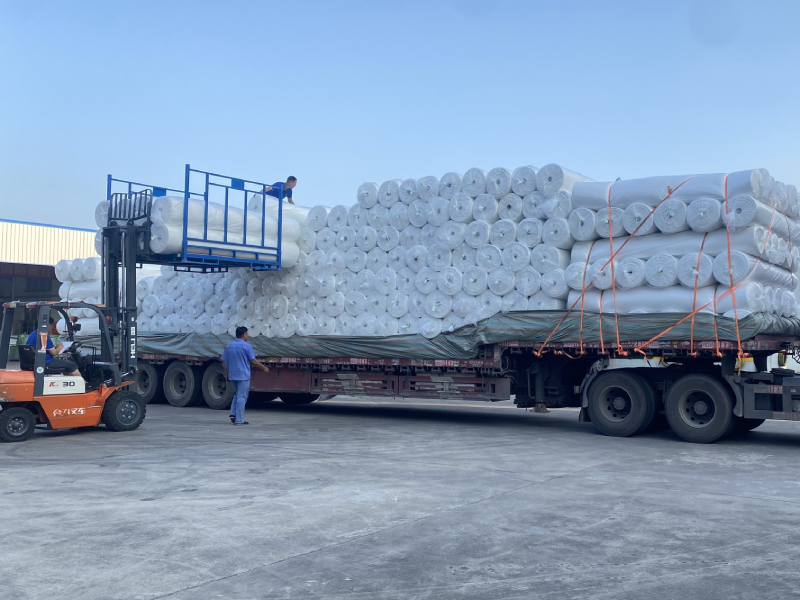
Geotextiles are commonly supplied in rolls.
When requesting a quotation, buyers should clarify the following information.
Item | Information to Confirm |
Roll width | Required width of each roll |
Roll length | Required length per roll |
Number of rolls | Estimated purchasing quantity |
Packaging requirements | Moisture protection, contamination protection, or other packaging requirements |
Labeling requirements | Product specifications, roll numbers, or batch information |
For large engineering projects, roll width affects not only the supply specifications but also on-site installation and overlap arrangements.
If the project already has specific installation dimensions, buyers should provide the relevant drawings or roll size requirements directly.
Purchasing Schedule and Delivery Arrangements
In addition to the total order quantity, buyers should provide the expected purchasing date, whether deliveries will be made in batches, and the project destination.
This information helps suppliers understand the project's delivery arrangements.
For long-term projects, buyers can also explain their expected future purchasing plans, while clearly distinguishing confirmed order quantities from estimated future demand.
What Testing and Technical Documents Should Be Provided to Suppliers?
Engineering material procurement is not only about comparing product prices. Buyers also need to confirm whether the materials comply with the technical standards specified by the project.
Therefore, when requesting a quotation, buyers should explain whether the project requires specific testing methods, third-party testing, or particular documentation.
Common requirements include the following.
Project-Specified Testing Standards
If the project follows ASTM, ISO, or other national or industry standards, buyers should provide the specific standard numbers and applicable versions.
Common geotextile testing items include mass per unit area, tensile properties, tear resistance, puncture resistance, apparent opening size, water permeability, and UV resistance.
Different testing items may correspond to different test methods.
For example, ASTM D5261 covers the determination of mass per unit area of geotextiles. ASTM D4632 covers grab tensile strength and elongation. ASTM D4751 covers apparent opening size, while ASTM D4491 covers water permeability.
These standards are provided as examples of commonly referenced testing methods. They do not mean that every engineering project must require all of them.
Buyers should follow the actual requirements stated in project contracts and design specifications.
Product Technical Documents
If the project requires suppliers to provide technical documentation, buyers should specify which documents are needed in advance.
Examples include:
Document | Purpose |
Product technical data sheet | Provides basic product specifications and performance information |
Product specification sheet | Describes material type and dimensions |
Relevant performance test reports | Provides testing results for specified properties |
Certificate of conformity | Provides evidence of product conformity where applicable |
Raw material or product compliance declaration | Supports specified material or compliance requirements |
Batch and roll identification records | Helps identify supplied materials |
It is important to distinguish between having a product technical data sheet and having all the third-party testing reports required by a project.
If an engineering project requires testing by a particular laboratory, a specific test method, or a particular report format, these requirements should be communicated before requesting a quotation.
Certification and Other Compliance Requirements
Some engineering projects may have specific certification, material sourcing, or compliance requirements.
If the buyer's country, project owner, or construction contractor specifies particular documents, the exact names and requirements should be provided.
Instead of simply stating that international certifications are required, buyers should identify the specific certification or compliance requirements.
Documentation requirements can vary depending on the country, engineering project, and purchasing contract. Suppliers need the actual requirements to determine whether they can meet them.
How Can Buyers Ensure That Quotations from Different Suppliers Are Comparable?
After receiving multiple quotations, buyers should not compare suppliers only by price per square meter or price per roll.
If different suppliers quote different material types, GSM values, performance requirements, or roll dimensions, their prices cannot be directly compared simply because they use the same quotation unit.
It is recommended that buyers standardize the following items when requesting quotations.
Comparison Item | Information to Standardize |
Material type | Raw material and geotextile type |
Project application | Separation, filtration, drainage, or other functions |
GSM | Target mass per unit area and allowable tolerance |
Thickness | Target thickness and measurement requirements |
Tensile performance | Required values, test direction, and test method |
Puncture resistance | Required values and test method |
AOS and water permeability | Relevant performance indicators and test methods |
Roll dimensions | Width, length, and number of rolls |
Order quantity | Total area or number of rolls |
Documentation requirements | Test reports, technical documents, and compliance documents |
Delivery requirements | Destination, shipping method, and delivery schedule |
If some technical parameters have not yet been finalized, buyers should ask suppliers to clearly state the material specifications used as the basis for their quotations and identify which details are still provisional.
This helps prevent situations where different suppliers quote based on different material specifications, making it difficult for buyers to compare the actual costs.
A meaningful quotation should be based on the same project requirements and clearly defined technical specifications.
Conclusion: An Effective Geotextile Inquiry Does Not Require Every Parameter to Be Finalized in Advance
For engineering buyers, preparing a geotextile inquiry is not about filling in as many technical parameters as possible. The main objective is to help suppliers understand the actual project requirements.
Even without a complete material specification sheet, buyers can start by providing the engineering application, design drawings, project technical specifications, estimated purchasing area, roll dimension requirements, and delivery destination.
Confirmed specifications should be clearly stated, while parameters that have not yet been determined should be marked as pending confirmation, together with an explanation of whether material specification recommendations are required from the supplier.
In particular, engineering performance indicators such as tensile strength, puncture resistance, apparent opening size, and water permeability should be determined according to the actual project requirements rather than judged solely by GSM or a supplier's standard product specifications.
When different suppliers prepare quotations based on the same project requirements and technical standards, buyers can compare material performance, supply specifications, and purchasing costs more effectively, reducing repeated clarification and problems caused by inconsistent specifications.




