
Shoe Tongue and Collar Foam: Padding Structures for Sneakers and Athletic Footwear
Shoe tongues and collars are two important areas of footwear construction that require different padding considerations. Although both may use foam laminated materials, their positions, shapes, contact areas, and manufacturing requirements are not the same.
For footwear manufacturers, selecting suitable shoe tongue padding material or shoe collar foam involves more than choosing a foam type. Foam thickness, density, firmness, fabric substrate, lamination structure, and subsequent cutting and sewing processes all need to be considered.
This guide explains how to evaluate foam laminated materials for shoe tongues and collars, helping footwear manufacturers define suitable material structures before requesting samples and placing bulk orders.
What Roles Do Shoe Tongues and Collars Play in Footwear Construction?
The shoe tongue and shoe collar are located in different parts of a shoe and serve different functions. Their positions directly affect the material structure and padding requirements.
The shoe tongue is positioned beneath the lacing system and covers the upper part of the foot. Its padding structure needs to be considered alongside the shoe upper, lace arrangement, and stitching positions. The material should also be suitable for the tongue's shape and the cutting and sewing processes used during production.
The shoe collar surrounds the opening of the shoe and comes into contact with the area around the ankle. Its shape is usually curved, so the padding material needs to accommodate the collar's outline and the way it is assembled with other upper components.
Although both components may use foam padding, they should not automatically share the same material specifications. A structure suitable for a shoe tongue may not be suitable for a collar because their shapes, contact areas, and processing requirements differ.
It is also important to distinguish tongue and collar padding from insole materials. Insoles are positioned inside the bottom of the shoe, while tongue and collar padding are used in the upper construction. Their applications and material requirements are therefore different.
How Do the Material Requirements for Shoe Tongue Foam and Shoe Collar Foam Differ?
The main difference between shoe tongue foam and shoe collar foam comes from their positions and construction methods.
For shoe tongue padding, manufacturers should consider the available space beneath the laces, the required finished thickness, and how the foam laminated material will behave during cutting and stitching. The material should fit the tongue pattern without creating unnecessary bulk around the lace area.
For shoe collar padding, the material needs to follow the curved shape around the shoe opening. Manufacturers should evaluate whether the foam and fabric combination can accommodate the required shape and remain suitable for the sewing and assembly process.
The following comparison highlights the main points to consider:
Evaluation area | Shoe tongue padding | Shoe collar padding |
Position | Beneath the lacing system, covering the upper part of the foot | Around the shoe opening, near the ankle |
Main structural consideration | Tongue pattern, lacing area, and stitching positions | Curved outline, collar shape, and assembly |
Material evaluation | Thickness, foam structure, fabric compatibility, and cutting | Thickness, flexibility, fabric compatibility, and curved construction |
Processing considerations | Cutting, stitching, and fitting into the tongue structure | Cutting, curved shaping, stitching, and assembly |
These are general evaluation points rather than fixed specifications. The final material structure should be determined according to the actual shoe design, component drawings, and production requirements.
A footwear manufacturer should provide separate specifications for the tongue and collar when the two components require different padding structures. This helps avoid selecting one material based only on the assumption that both parts need cushioning.
How Should PU Foam and High-Resilience PU Foam Be Evaluated?
PU foam and high-resilience PU foam (HR PU foam) can be considered when developing foam padding materials for footwear. However, their suitability should be evaluated according to the actual requirements of the shoe tongue or collar rather than their names alone.
PU foam is a potential cushioning layer for foam laminated fabric. When selecting it, manufacturers should confirm the foam type, thickness, density, firmness, and other relevant technical properties.
High-resilience PU foam may also be considered when the project requires particular compression and recovery characteristics. However, the term "high resilience" does not provide enough information to determine whether a specific foam is suitable for a footwear component. Its actual performance and technical specifications still need to be verified.
Several parameters should be distinguished during material evaluation:
Parameter | What it describes | What buyers should confirm |
Foam thickness | The physical thickness of the foam layer | Required thickness and tolerance |
Foam density | The mass of foam per unit volume | Density specification of the foam itself |
Firmness | The resistance of foam to compression under specified conditions | Test method and required result |
Resilience | The foam's ability to recover after deformation | Relevant technical data and test method |
Foam density, firmness, and resilience are not interchangeable properties. A higher density does not automatically mean that the foam is firmer, more comfortable, or more resilient.
Buyers should also distinguish the density of the foam itself from the overall density or weight of a laminated composite. Fabric layers and other materials should not be included when specifying the foam's density unless the measurement is explicitly defined as a property of the complete composite.
For this reason, footwear manufacturers should request the relevant technical specifications and evaluate samples before confirming the material for production. The final choice should be based on the actual component requirements rather than a general assumption that one foam type is suitable for every shoe tongue or collar.
How Should Mesh, Knitted Fabric, and Tricot Be Selected?
The fabric substrate is another important part of a footwear foam laminated fabric structure. It affects the surface, flexibility, construction, and suitability of the composite for subsequent footwear processing.
Different fabric substrates may be considered according to the shoe design and the required material structure.
Mesh fabric may be considered when the design requires an open fabric structure. However, mesh is a broad description rather than one specific fabric construction. Its actual structure, fiber composition, weight, and thickness need to be confirmed.
Knitted fabric provides another substrate option for foam lamination. Its construction and surface characteristics should be evaluated together with the foam layer and the requirements of the finished footwear component.
Tricot fabric is a type of warp-knitted fabric. It may be considered when a particular surface and fabric construction are required. Buyers should confirm its weight, thickness, material composition, and compatibility with the selected foam.
The following points should be checked when comparing different substrates:
Fabric substrate | Key evaluation points |
Mesh fabric | Mesh structure, fiber composition, GSM, thickness, and surface condition |
Knitted fabric | Fabric construction, stretch characteristics, GSM, thickness, and sewing compatibility |
Tricot fabric | Warp-knitted structure, surface characteristics, GSM, thickness, and lamination compatibility |
The selection should not be based on the fabric name alone. Two materials described as mesh or knitted fabric may have different constructions and processing behavior.
Footwear manufacturers should confirm the actual fabric specification and evaluate the laminated sample in the intended tongue or collar application. The fabric and foam need to be considered as one composite structure, especially when the material will be cut, sewn, or shaped during production.
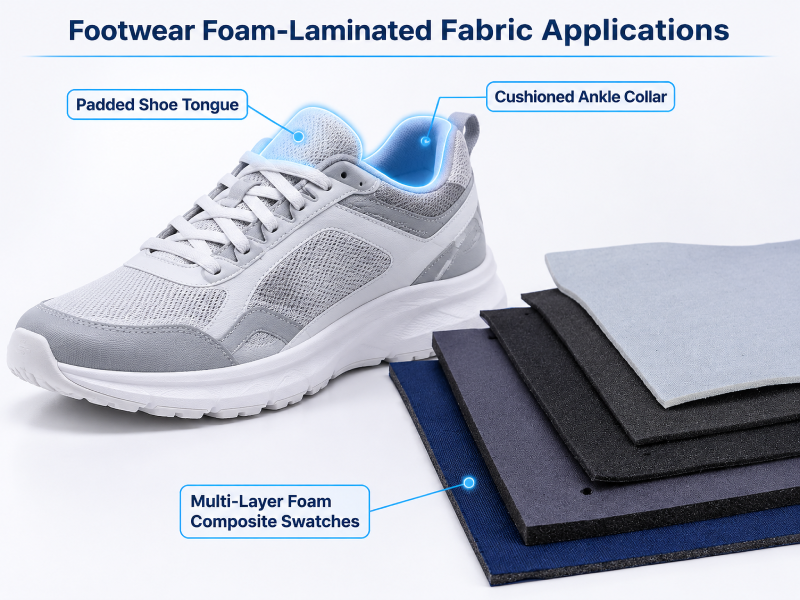
Which Structure Is More Suitable: Foam + Fabric or Fabric + Foam + Fabric?
Foam laminated materials can be developed with different layer arrangements. Two common structures to consider are Foam + Fabric and Fabric + Foam + Fabric.
In a Foam + Fabric structure, one fabric layer is laminated with a foam layer. This provides a relatively straightforward composite structure. It may be considered when the component requires a fabric surface on one side and foam padding behind it.
In a Fabric + Foam + Fabric structure, the foam layer is positioned between two fabric layers. This arrangement provides fabric surfaces on both sides of the composite and may be considered when the component design requires a covered surface on each side.
The two structures are different in terms of layer arrangement and surface requirements. Neither structure is automatically better for every footwear application.
Composite structure | Layer arrangement | Main consideration |
Foam + Fabric | One foam layer and one fabric layer | Suitable when the required construction uses a fabric surface on one side |
Fabric + Foam + Fabric | Fabric layers on both sides of the foam | Suitable when both sides of the composite require fabric layers |
When choosing between these structures, manufacturers should first identify which side of the material will be visible, which side will face other shoe components, and whether both sides require fabric coverage.
The required thickness, fabric type, foam properties, and subsequent sewing or assembly process should also be considered. A three-layer structure does not necessarily provide a better result than a two-layer structure. The appropriate choice depends on the actual component design.
For customized laminated foam fabric materials, manufacturers can discuss the required layer arrangement, foam type, and fabric substrate according to their shoe tongue or collar drawings.
How Should Shoe Tongue and Collar Foam Laminates Fit Cutting and Sewing Processes?
A foam laminated material is an intermediate material used in footwear manufacturing. It is not a finished shoe tongue or collar. After lamination, it may still need to go through cutting, sewing, shaping, and assembly.
Therefore, material selection should consider not only the laminated structure but also how the material will perform during subsequent processing.
During cutting, manufacturers should check the overall composite thickness, foam condition, fabric surface, and cut-edge appearance. The material should be evaluated using the actual component pattern to identify whether the structure is suitable for the required shape and dimensions.
During sewing, the relationship between the fabric and foam layers should be considered. Manufacturers should check whether the material can be handled according to the intended stitching positions and whether the composite remains properly aligned during processing.
For shoe tongues, attention should be paid to the tongue outline, lace area, and stitching positions. For shoe collars, the curved shape and assembly around the shoe opening should be considered.
Sample evaluation should include the following points:
Processing stage | What to check |
Cutting | Finished thickness, cut-edge condition, foam deformation, and pattern fit |
Sewing | Layer alignment, stitching positions, material handling, and finished appearance |
Shaping and assembly | Flexibility, curved construction, component fit, and compatibility with the shoe design |
The actual results depend on the foam type, fabric construction, lamination structure, and processing conditions. A material that looks suitable in an unprocessed sample may behave differently after cutting and sewing.
For this reason, footwear manufacturers should test the laminated material using their actual production methods before confirming bulk specifications. The sample used for approval should have the same material structure as the intended bulk order.
What Should Footwear Manufacturers Confirm Before Purchasing Shoe Tongue and Collar Padding Materials?
Before requesting a quotation, footwear manufacturers should provide sufficient information about the intended application and material requirements. Clear specifications help suppliers evaluate the required structure and prepare suitable samples.
The following information should be confirmed:
Information required | Details to provide |
Application | Shoe tongue, shoe collar, or another footwear component |
Foam type | PU foam, high-resilience PU foam, or another specified foam type |
Foam specifications | Thickness, density, firmness, and relevant technical requirements |
Fabric substrate | Mesh, knitted fabric, Tricot, or another specified fabric |
Fabric specifications | Fiber composition, GSM, thickness, color, and surface requirements |
Composite structure | Foam + Fabric or Fabric + Foam + Fabric |
Component dimensions | Drawings, patterns, measurements, or reference samples |
Processing requirements | Cutting, sewing, shaping, and assembly requirements |
Supply format | Roll materials, sheets, or other agreed formats |
Order information | Sample quantity, trial order quantity, estimated bulk quantity, and delivery requirements |
Acceptance requirements | Inspection criteria and any applicable test methods or standards |
A reference sample, technical drawing, or clear component photograph can help suppliers understand the actual application. If the tongue and collar use different structures, their requirements should be provided separately.
For customized projects, HuiZhou JinHaoCheng Nonwovens Co., Ltd. has experience in laminating PU/EVA foam with different materials. Related projects may involve flame lamination, adhesive lamination, or hot-melt lamination, depending on the material combination and project requirements. Some processing is handled internally, while other project requirements may involve external processing.
This experience does not mean that every footwear-specific structure or downstream cutting and sewing process is automatically available as a standard service. The actual material combination, processing requirements, and sample feasibility need to be evaluated for each project.
Before placing a bulk order, manufacturers should confirm the foam specifications, fabric substrate, layer arrangement, finished thickness, and processing results through sample evaluation. Clear communication at this stage helps ensure that the selected shoe tongue padding material or shoe collar foam matches the intended footwear construction.




