What Is the Difference Between 1–5 Second and 7–15 Second Self-Extinguishing? How to Choose Fire Resistant Felt
When selecting needle punched fire resistant felt, flame retardant felt, or fireproof nonwoven felt, customers often encounter specifications such as:
1–5 second self-extinguishing
7–15 second self-extinguishing
What do these numbers actually mean?
Does a shorter self-extinguishing time always indicate a better fire resistant felt?
For industrial insulation, welding protection, automotive interiors, emergency fire blankets, and other flame-retardant applications, this is an important question.
The key point is that self-extinguishing time is not an isolated number. It describes how long a material continues to burn after the ignition source is removed under specific testing conditions. Whether a material is suitable for a project also depends on its fiber composition, thickness, GSM, density, flame-retardant system, application environment, and testing standard.
The real question is not simply “Which is better: 1–5 seconds or 7–15 seconds?” but rather:
Which flame-retardant performance is appropriate for my application?
What Does “Self-Extinguishing Time” Mean for Fire Resistant Felt?
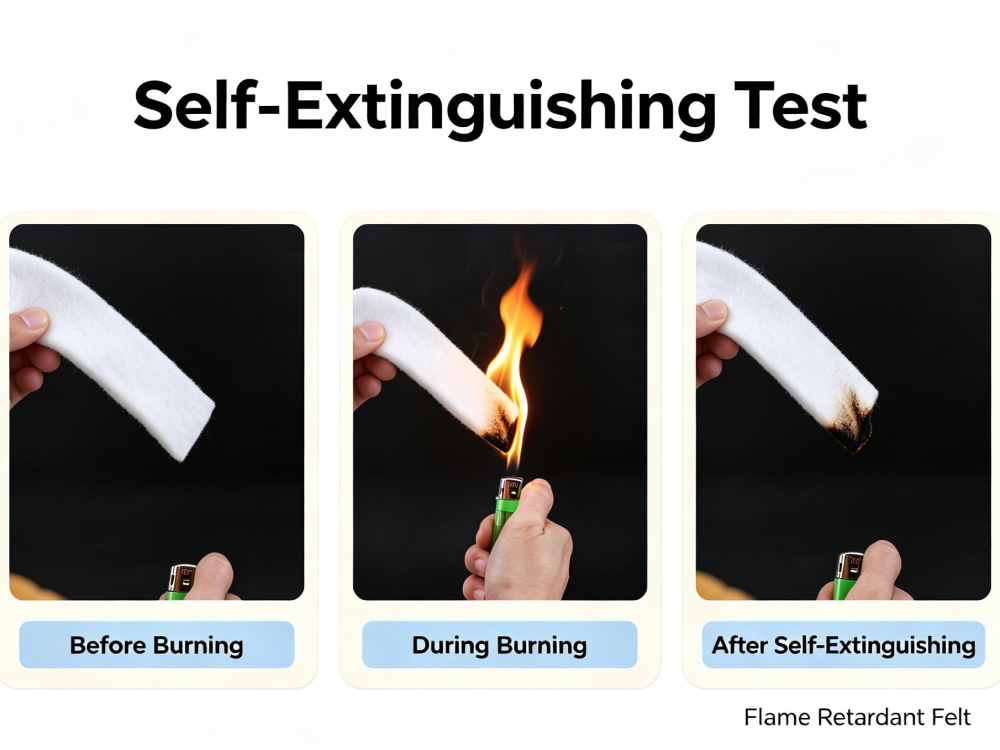
Self-extinguishing time generally refers to the period during which a material continues to burn after an external flame has been removed.
In different flame-retardant tests, this may correspond to after-flame time, while some testing methods also evaluate afterglow, dripping behavior, and flame spread.
For needle punched fire resistant felt, the terms 1–5 seconds and 7–15 seconds are better understood as customized performance targets for specific projects, rather than universal flame-retardant grades.
The actual result must always be evaluated according to the applicable testing method and material specification.
What Is the Main Difference Between 1–5 Second and 7–15 Second Self-Extinguishing?
The most direct difference is the amount of time the material continues to burn after the ignition source is removed.
Under the same testing conditions:
1–5 second self-extinguishing means the flame disappears within a relatively short period after the external flame is removed.
7–15 second self-extinguishing means the material continues burning for a longer period under the same conditions.
From the perspective of after-flame time alone, 1–5 seconds represents a shorter flame duration.
However, this does not mean every 1–5 second material is automatically better than every 7–15 second material. Different testing methods, fiber systems, thicknesses, and material structures can all influence the result.
A professional comparison should always consider:
Testing Standard → Test Conditions → Material Structure → Fiber Composition → GSM → Thickness
rather than comparing only the number of seconds.
Is 1–5 Second Self-Extinguishing Always Better?
Not necessarily.
If two materials are tested using the same standard, identical thickness, and identical conditions, a shorter self-extinguishing time generally indicates a shorter after-flame period.
However, if the materials differ in testing method, fiber composition, or structural design, comparing only the number of seconds has very limited practical value.
For industrial applications, the more meaningful evaluation process is:
Testing Standard → Material Structure → GSM → Thickness → Flame Performance → Actual Application
rather than simply assuming:
1–5 Seconds = Better Material
Why Do Different Applications Require Different Self-Extinguishing Performance?
Different products face different fire risks, so their flame-retardant requirements are not the same.
Industrial Equipment Insulation
Industrial equipment focuses on continuous operating temperature, thermal radiation, structural stability, and insulation efficiency.
For these applications, heat resistance and thermal insulation are often just as important as self-extinguishing performance.
Welding Protection
Welding environments involve sparks, molten metal, and short-term high-temperature exposure.
A suitable welding fire mat must balance flame retardancy, heat resistance, burn-through resistance, structural stability, and abrasion resistance.
Automotive Interiors
Automotive materials must also consider weight, thickness, odor, dimensional stability, processing performance, and long-term production consistency.
A shorter self-extinguishing time alone does not determine whether a material is suitable for automotive applications.
Emergency Fire Blankets
Emergency fire blanket materials focus on overall fire protection rather than a single performance indicator.
In addition to self-extinguishing time, engineers also evaluate flame spread, afterglow, dripping behavior, and the performance of the material at its actual production thickness.
When Is 1–5 Second Self-Extinguishing Typically Preferred?
Where projects require a relatively short after-flame time, 1–5 second self-extinguishing needle punched fire resistant felt can serve as a higher-performance material target.
Typical applications include:
Industrial fire protection materials
High-performance welding protection
Flame-retardant automotive interior materials
Certain emergency fire protection products
OEM projects with specific flame-retardant performance requirements
However, whether a material is suitable must always be verified according to the required testing standard rather than the self-extinguishing time alone.
Does 7–15 Second Self-Extinguishing Mean Lower Quality?
Not at all.
If a project allows a longer after-flame time, 7–15 second self-extinguishing felt may still be entirely appropriate.
Many industrial insulation and equipment protection applications place greater emphasis on:
Thermal stability
Insulation performance
Material thickness
Flexibility
Dimensional stability
Mechanical strength
Cost efficiency
If the material satisfies the required flame-retardant specification, selecting a more expensive material simply to reduce after-flame time may not provide additional practical value.
The key question is always:
Does the material meet the technical requirements of the final application?
Why Should Fire Resistant Felt Never Be Evaluated by Self-Extinguishing Time Alone?
Self-extinguishing time is only one indicator within a complete flame-retardant evaluation system.
Industrial projects should also consider:
Flame-retardant grade
Testing method
Testing conditions
GSM
Thickness
Density
Fiber type
Flame exposure method
Dripping behavior
Afterglow performance
Dimensional stability
Mechanical strength
If a supplier simply states:
“Our felt self-extinguishes in 5 seconds.”
that information is not sufficient.
A more important question is:
Which testing standard was used?
What thickness was tested?
Which fiber structure was used?
Which exact product specification was evaluated?
Will mass production use the same material structure?
Why Can the Same Fire Resistant Felt Show Different Self-Extinguishing Performance?
Even products from the same manufacturer may vary if production conditions change.
Several factors influence flame performance:
Fiber type – Different flame-retardant fibers behave differently under heat.
Fiber blend – The proportion of blended fibers affects burning behavior.
GSM and thickness – Different material weights and thicknesses can change flame performance.
Needle punched structure – Fiber distribution and needle density influence the internal structure.
Production consistency – Changes in raw materials or manufacturing parameters may affect the finished product.
Therefore, maintaining stable flame-retardant performance requires consistent control throughout the entire manufacturing process.
Why Can a 1–5 Second Sample Become 7–15 Seconds in Mass Production?
This is one of the most important concerns in bulk industrial purchasing.
A sample may perform well, but production batches may differ because of:
Raw material variations
Changes in fiber blend
GSM deviation
Thickness variation
Needle punching adjustments
Production equipment conditions
Finishing process changes
Without stable production control, a successful sample does not guarantee identical mass-production performance.
For long-term fire resistant felt projects, the critical process is:
Sample Performance → Approved Specification → Mass Production → Batch Consistency
How Should You Choose Between 1–5 Seconds and 7–15 Seconds?
Instead of asking “Which one is better?”, begin with the actual application.
Step 1: Identify the application.
Industrial insulation, welding protection, automotive interiors, or emergency fire products?
Step 2: Evaluate the fire risk.
Will the material face direct flame, thermal radiation, sparks, or molten metal?
Step 3: Confirm the testing standard.
Different industries and countries require different flame-retardant methods.
Step 4: Confirm GSM and thickness.
Self-extinguishing performance should always be discussed together with the material specification.
Step 5: Select the appropriate fiber system.
Flame-retardant polyester, oxidized PAN, fiberglass, wool, or another fire resistant fiber?
Step 6: Verify batch consistency.
Ensure the tested sample and the production material use the same structure.
Step 7: Consider secondary processing.
Die cutting, lamination, and other processing methods may also influence the final product.
Why Is Needle Punched Fire Resistant Felt Ideal for Customized Flame-Retardant Materials?
The needle punching process allows excellent flexibility in material development.
By adjusting fiber type, fiber blend, GSM, thickness, density, and needle punching parameters, manufacturers can create different flame-retardant performance levels.
Industrial customers can therefore develop customized materials such as:
1–5 second self-extinguishing fire resistant felt
7–15 second self-extinguishing fire resistant felt
Higher-performance flame-retardant felt
Different GSM and thickness specifications
Different fiber systems
Custom sheet sizes and roll formats
The actual performance should always be verified through the applicable testing method rather than product descriptions alone.
Why Are Stable Manufacturers More Important for Long-Term Projects?
For small purchases, customers often focus on price.
For industrial manufacturing, automotive projects, emergency fire products, and OEM applications, batch consistency is usually more valuable.
If the first shipment provides 1–5 second performance but later batches change to 7–15 seconds, the finished product may require additional validation.
This increases:
Retesting costs
Product redevelopment costs
Production delays
Customer complaints
Delivery risks
A professional needle punched felt manufacturer should consistently control:
Raw materials
Fiber blends
GSM
Thickness
Needle punching parameters
Production speed
Finished product specifications
Batch-to-batch consistency
How Does Jinhaocheng Provide Customized Flame-Retardant Needle Punched Felt?
HUIZHOU JINHAOCHENG NONWOVENS CO., LTD has more than 20 years of nonwoven manufacturing experience, with an approximately 26,000 m² production facility and 15 automated needle punching production lines.
As a professional needle punched felt manufacturer, fire resistant felt manufacturer, and nonwoven felt manufacturer China, we customize fiber systems, GSM, thickness, density, flame-retardant performance, and product specifications according to different industrial applications.
We support the development of:
1–5 second self-extinguishing needle punched fire resistant felt
7–15 second self-extinguishing needle punched fire resistant felt
High flame-retardant industrial felt
Heat resistant insulation felt
Industrial fire resistant felt
Welding protection felt
OEM & ODM customized nonwoven materials
From fiber selection and needle punching to finished product inspection, we help customers establish stable material specifications for long-term industrial projects.
Conclusion: There Is No Absolute Winner Between 1–5 Seconds and 7–15 Seconds
The most direct difference between 1–5 second and 7–15 second self-extinguishing felt is the after-flame duration under the same testing conditions.
A shorter self-extinguishing time generally means the flame disappears more quickly.
However, this does not mean 1–5 seconds is always the better choice.
The correct selection process should always follow:
Application → Fire Risk → Testing Standard → Fiber System → GSM → Thickness → Flame Performance → Sample Testing → Mass Production Consistency
For industrial equipment, automotive interiors, welding protection, emergency fire products, and OEM applications, selecting a needle punched fire resistant felt manufacturer capable of maintaining stable material structures and consistent bulk production is often more valuable than simply choosing the shortest self-extinguishing time.
If your project requires 1–5 second, 7–15 second, or another customized flame-retardant performance level, the material should be developed according to the required application, fiber system, GSM, thickness, and testing specification.