
Adhesive Backed Felt for Industrial Components: Protecting Surfaces During Assembly and Handling
During the assembly, handling and storage of industrial components, direct contact between two parts can cause surface scratches, friction marks or cosmetic damage. For components such as metal housings, painted parts, plastic components and other products with appearance requirements, this type of damage can affect product quality and subsequent assembly.
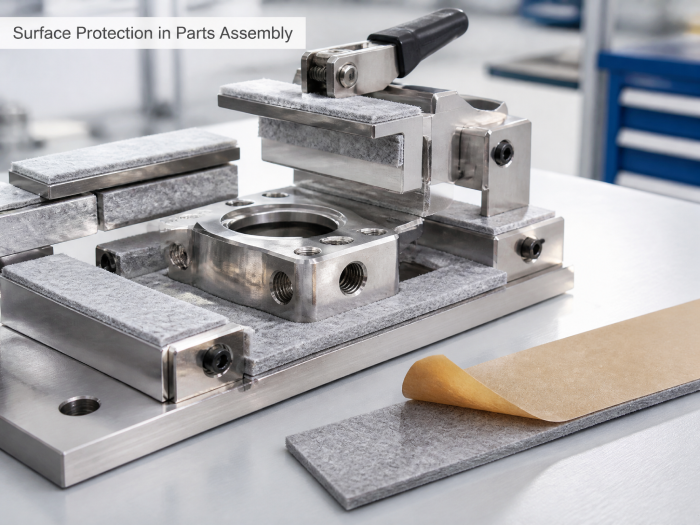
One solution worth evaluating is to apply adhesive backed polyester needle punched felt to the contact area of one component. The felt layer creates a flexible separation between the two components.
Compared with ordinary protective film or loose cushioning pads, adhesive backed felt can be fixed in a designated position, reducing the possibility of the protective material shifting during assembly and handling. However, it cannot prevent every type of scratch, nor can it replace rigid protective structures designed for load-bearing or impact protection. Its actual performance depends on the felt structure, adhesive, contact pressure, relative movement and operating environment.
For industrial component manufacturers and buyers, the key is not simply to choose a soft material. It is to determine whether the felt is suitable for the actual contact area and assembly conditions.
Why Do Industrial Components Need a Flexible Protective Layer?
During manufacturing, assembly, packaging and storage, industrial components may come into contact through stacking, sliding, positioning or surface-to-surface contact.
When two components touch directly, surface damage can occur for several reasons.
The first is direct friction between materials. For example, when a metal housing comes into contact with another metal part during handling, relative movement between the surfaces may cause scratches or friction marks.
The second is localized pressure. Even without noticeable sliding, two components with a small contact area, hard edges or concentrated pressure may develop dents or surface damage.
In addition, small particles, metal fragments or other contaminants may be present during assembly. If these particles become trapped between two contact surfaces, adding a flexible protective material does not necessarily prevent scratching.
Therefore, the main purpose of a flexible protective layer is to reduce direct contact between components and provide surface separation and limited cushioning under suitable application conditions.
Adhesive backed felt is generally attached to a designated area of one component using its adhesive backing. The other component then comes into contact with the felt surface. This can reduce the possibility of the protective material shifting during handling or assembly.
However, three different protection functions need to be distinguished:
Protection requirement | Potential function of adhesive backed felt | Important limitation |
Surface separation | Creates a flexible contact layer between two components | Cannot guarantee protection against every sharp object |
Limited cushioning | May soften some contact under suitable thickness and pressure conditions | Is not equivalent to a dedicated shock-absorbing or impact-protection structure |
Structural support | Generally not its primary function | Cannot replace rigid supports or load-bearing structures |
Before selecting the material, buyers should identify whether the main problem is surface friction, localized contact, impact or load-bearing. Different problems require different protective structures.
How Can Adhesive Backed Felt Help Reduce Direct Contact Between Metal Components?
Metal-to-metal contact is a common application scenario in industrial surface protection.
For example, metal housings, sheet metal parts, equipment panels, metal brackets and other fabricated components may touch, stack or slide against each other during assembly or storage. When two metal surfaces come into direct contact, friction may affect coatings, finished surfaces or visible exterior areas.
In these situations, self adhesive polyester needle punched felt can be evaluated for application to the contact area of one metal component.
The adhesive layer fixes the felt to the designated component, while the polyester needle punched felt surface acts as the contact interface between the two parts. Compared with a loose piece of felt, this arrangement can help keep the protective material in position, particularly when components need to be repeatedly assembled or handled.
Buyers should pay particular attention to the following conditions.
Whether the contact area is clearly defined. If two metal parts only touch at several localized points, small felt pads may be more suitable than covering the entire component surface.
Whether sliding occurs during contact. Static contact is different from repeated sliding during assembly. The latter requires closer evaluation of surface wear, fiber shedding and changes in the felt's position.
Whether the metal surface is suitable for adhesive application. Painted metal, plated metal, bare metal and surfaces contaminated with processing oil may have different adhesive bonding conditions. Successful adhesion to one metal surface does not guarantee suitability for every metal surface.
Whether the felt affects the assembly clearance. If the gap between components is small, adding felt thickness may affect assembly dimensions, positioning or the fit between parts.
Therefore, when using adhesive backed felt for metal components, buyers should consider surface protection requirements, contact pressure, assembly clearance and adhesive compatibility rather than focusing on felt thickness alone.
How Should Buyers Select Contact Protection Between Metal and Plastic Components?
Contact protection between metal and plastic components requires consideration of the characteristics of both surfaces.
Metal parts may have hard edges or machined surfaces, while plastic components may have coatings, textures, decorative finishes or appearance areas that are sensitive to pressure.
For example, equipment housings, plastic panels, electronic equipment structural parts and metal fasteners may experience edge contact or localized friction during assembly. For plastic surfaces with appearance requirements, a flexible felt layer can be evaluated to separate the areas that would otherwise come into direct contact.
In these applications, the adhesive attachment position is particularly important. Buyers generally need to determine which component is suitable for adhesive application before allowing the other component to contact the felt surface.
If the plastic surface has a coating, texture or special finish, the compatibility of the adhesive with that surface should be verified first. Some materials may be sensitive to adhesives, so buyers should also check for surface changes, adhesive residue or other undesirable effects after application.
The available assembly space and component shape can also affect the felt pad design. For small contact areas, pre-cut die-cut pads may be easier to position and size consistently than material cut from a roll.
Buyers should not determine felt thickness and adhesive type based only on whether the component is metal or plastic. A more reliable approach is to provide the actual contact surface material, surface finish, contact area and assembly conditions, then verify suitability through sample testing.
Is Adhesive Backed Felt Suitable for Glass, Coated and Other Scratch-Sensitive Surfaces?
Glass, painted panels, polished metal and other appearance-sensitive surfaces require more careful selection of contact protection materials.
Adhesive backed felt can be evaluated as a flexible separation material, but its softness alone does not prove that it is suitable for every sensitive surface.
For example, glass panels, glass components, decorative panels and parts with special coatings may need protection from direct contact with harder components during handling and assembly. For these applications, appropriately sized felt pads can be considered for fixed contact points.
However, the potential risk does not come from the felt layer alone.
If metal particles, sand or other hard contaminants become trapped in the felt surface, pressure or relative movement may still cause scratches on glass and coated surfaces.
Therefore, buyers should pay attention to surface cleanliness, fiber shedding and actual friction conditions. For high-appearance-quality or precision surfaces, they should also check for fiber residue, color transfer or other surface changes.
During sample testing, it is advisable to use the actual glass, coated panel or target component rather than conducting a simple adhesion test on an ordinary metal plate.
If the product surface has a special coating or precision finishing requirements, the acceptance criteria should also be determined according to the final product's appearance standards and assembly requirements.
How Can Adhesive Backed Felt Protect Contact Areas on Equipment Housings and Enclosures?
Equipment housings, enclosures, control cabinets and industrial equipment components often have multiple contact areas, such as panel edges, cover contact surfaces, internal support positions and localized assembly gaps.
At these locations, felt pads can be evaluated as flexible separation materials.
For example, a cabinet cover may come into localized contact with its frame, while an equipment housing may rub against another structural component during handling. For contact areas that do not need to carry the main structural load, adhesive backed felt pads can be considered for attachment to one of the components.
During design, the first step is to determine exactly where the protective material will be installed.
If the felt pad is used between two components, buyers should confirm that it will not interfere with screws, snap-fit closures, sealing structures or other assembly functions.
If the felt pad is applied to a housing edge, its dimensions and position should be checked to prevent it from extending beyond the contact area or affecting the component's appearance.
If the equipment is subject to continuous vibration or repeated movement during operation, buyers should also check whether the pad may lift at the edges, shift position or wear on the surface. For components subject to continuous mechanical movement, static adhesion results alone cannot establish long-term suitability.
It is important to emphasize that adhesive backed felt is primarily used for surface separation and limited contact protection. For areas exposed to significant impact, heavy loads or continuous mechanical pressure, appropriate rigid protective parts or support materials should be selected according to the structural design.
What Is the Difference Between Adhesive Felt Rolls and Pre-Cut Die-Cut Felt Pads?
For industrial purchasing, adhesive backed felt can be supplied in rolls or as pre-cut pads, depending on the final application. The main differences relate to processing methods, installation locations and dimensional control requirements.
Adhesive felt rolls are suitable for projects that require in-house cutting or further processing. Buyers can cut the material into the required lengths, widths or shapes according to the actual component dimensions. Roll material offers flexibility for projects involving multiple sizes, small-batch trials or additional downstream processing.
Pre-cut die-cut felt pads are more suitable for products with clearly defined contact areas, fixed dimensions or repeated assembly requirements. The pads can be manufactured to specified shapes and dimensions, reducing on-site cutting work and helping maintain consistent installation positions.
Comparison | Adhesive felt rolls | Pre-cut die-cut felt pads |
Supply format | Continuous rolls | Individual or grouped pads in specified shapes |
Application method | Cut or further process according to requirements | Apply directly to designated positions |
Dimensional control | Cutting dimensions must be controlled by the buyer or downstream processor | Can be produced according to approved drawings or samples |
Suitable applications | Multiple sizes, further processing or flexible cutting requirements | Fixed contact positions and standardized assembly |
Key purchasing considerations | Roll width, length, thickness, adhesive and release liner | Shape, dimensions, die-cut accuracy, adhesive position and release liner |
If the contact position and dimensions have not yet been finalized, buyers can first evaluate roll material, confirm the material structure and then determine whether die-cut processing is needed.
If the components already have clear drawings, installation positions and dimensional requirements, buyers can provide the drawings or physical samples to discuss the feasibility of pre-cut felt pads.
Regardless of the supply format, the felt substrate, adhesive structure and release liner should all be confirmed against the final application requirements.
How Should Buyers Determine Adhesive Felt Specifications Based on Contact Area, Pressure and Installation Position?
When purchasing adhesive backed felt, specifying only a thickness or GSM value is usually insufficient. Suitability also depends on the contact area, loading conditions, installation position and clearance between components.
First, confirm the contact area and shape.
If two components only touch at an edge or a localized position, small felt pads may be considered. If the contact area is larger, buyers need to confirm the required coverage and whether the material will interfere with other assembly structures.
Next, confirm the contact pressure and assembly clearance.
Felt is flexible, but it may compress under pressure. For components with narrow gaps or strict dimensional tolerances, excessive felt thickness may affect assembly fit. Therefore, thickness selection should be verified through samples under the actual clearance and loading conditions.
Then, confirm the contact method and movement conditions.
Static contact, brief friction during assembly, occasional sliding during handling and continuous friction during equipment operation are different application conditions. A static adhesion test cannot replace validation under every friction condition.
Finally, define the adhesive and release liner structure.
The adhesive fixes the felt to the designated component, while the release liner protects the adhesive surface during storage and transportation. Buyers should confirm whether the adhesive is suitable for the target surface, whether easy liner removal is required, whether the material will be supplied in rolls and whether the liner needs to remain in place during downstream processing.
Purchasing specifications can be organized as follows:
Specification item | Information buyers should provide |
Substrate | Polyester needle punched felt or another specified fiber material |
Basis weight (GSM) | Target GSM or acceptable range |
Thickness | Target thickness and measurement conditions |
Color | White, grey, black or another specified color |
Supply format | Adhesive felt rolls or pre-cut die-cut pads |
Adhesive requirements | Adhesive type, target bonding surface and application conditions |
Release liner | Kraft paper release liner or another specified protective liner |
Dimensions | Roll width, roll length, individual pad dimensions or die-cut drawings |
Operating conditions | Contact pressure, relative movement, temperature and environment |
Surface requirements | Low fiber shedding, appearance protection, adhesive residue limits or other requirements |
For customized projects, buyers are advised to provide actual component photos, drawings showing the contact areas or samples of the existing material. This helps reduce errors caused by selecting material based only on its name or a single thickness specification.
How Should Buyers Validate Adhesive Backed Felt Samples Before Bulk Purchasing?
For industrial component protection projects, sample evaluation should reflect the actual application conditions as closely as possible. Checking only the felt's appearance or whether it can be manually attached is usually insufficient to determine whether it will meet assembly and handling requirements.
The following aspects should be evaluated.
Check the material structure. Confirm that the polyester needle punched felt surface, thickness, basis weight and overall structure meet the purchasing requirements. Also check whether the adhesive and release liner match the approved sample.
Check adhesion on the target surface. Use actual metal, plastic, glass or coated components to evaluate whether the adhesive can maintain stable contact at the designated position. Different surface finishes should be tested separately.
Check assembly clearance. Place the components with the felt attached into the actual assembly position. Confirm whether the felt thickness affects positioning, closure, screw fastening or other assembly operations.
Check changes after friction and handling. If the actual application involves sliding, vibration or repeated contact, conduct simulations based on the real operating conditions. Observe whether the felt shows surface wear, fiber shedding, edge lifting or position changes.
Check the surface after removal. For projects where the protective material needs to be removed later, confirm whether adhesive residue, surface changes or other undesirable effects remain. No claim should be made that every adhesive will leave no residue without actual testing.
Confirm consistency between the approved sample and bulk specifications. After sample approval, retain the confirmed sample and specification documents. Clearly define the substrate, basis weight, thickness, adhesive, release liner, dimensions and acceptance requirements. Subsequent bulk production should follow the specifications approved by both parties.
HuiZhou JinHaoCheng Nonwovens Co., Ltd. has long been engaged in the development and manufacturing of needle punched nonwoven materials and felt products. For industrial component protection projects requiring adhesive backing, release liners or die-cut finished pads, buyers should provide the actual application surface, contact position and assembly conditions so that the product structure and sample validation requirements can be further evaluated.
For applications involving heavy loads, sharp edges, strong impact or continuous high-speed friction, buyers should also evaluate whether additional rigid protective structures are required rather than relying solely on flexible adhesive backed felt.
Ultimately, selecting industrial adhesive backed felt should start with the actual contact interface: which surface needs protection, where the material will be attached, how the two components will come into contact and whether the protective layer will affect final assembly. Only after these conditions are clear can basis weight, thickness, adhesive and die-cut dimensions become meaningful purchasing specifications.




