
Self-Adhesive Felt for Furniture and Cabinet Manufacturing: Pads, Liners and Protective Strips
Furniture and cabinet manufacturers use self-adhesive felt as a secondary protective material in areas where furniture components come into contact with floors, walls, other components, or finished surfaces. Depending on the application, it can be supplied as pre-cut felt pads, continuous rolls, protective liners, adhesive strips, or custom-shaped pieces.
The right format depends on where the felt will be installed, the dimensions of the contact area, the required cushioning, and the compatibility between the adhesive and the target surface. Before placing a bulk order, manufacturers should also check the felt's thickness, density, softness, adhesive performance, and consistency between samples and production batches.
For furniture and cabinet manufacturers sourcing self-adhesive polyester felt, understanding these differences helps prevent problems such as poor adhesion, edge lifting, unsuitable dimensions, and potential surface damage during removal.
Which Areas of Furniture and Cabinets Need Self-Adhesive Felt?
Self-adhesive felt is generally used at specific contact points where two surfaces may rub against each other or where a finished surface needs an additional protective layer. It is not intended to replace the main structural materials or load-bearing components of furniture.
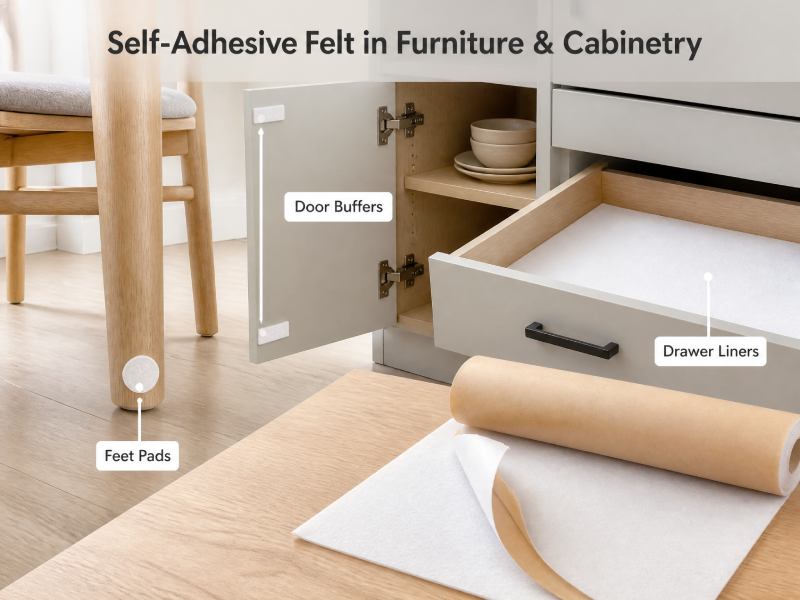
Common application areas include furniture feet, chair and table bases, cabinet bottoms, drawer interiors, cabinet inner walls, door contact points, and areas where furniture components meet.
For example, felt pads can be attached to the bottom of chair or table legs to reduce direct contact with the floor. Felt liners can be placed inside drawers or cabinets to provide a softer contact surface for stored items. Narrow felt strips may also be used between components to help reduce direct friction.
The required felt format varies according to the installation position. Small contact points may need pre-cut pads, while larger or continuous surfaces may require felt rolls or liners. For irregular structures, custom-cut pieces may be more suitable.
Manufacturers should identify the exact installation position and contact area before selecting a material. This helps determine the required dimensions, thickness, felt structure, and adhesive configuration.
How Should Manufacturers Choose Self-Adhesive Felt Pads for Furniture Feet and Cabinet Contact Surfaces?
Adhesive felt pads are commonly used on the bottom of chair legs, table legs, furniture bases, and other small contact areas. Their main purpose is to create a felt layer between the furniture and the surface beneath it.
When selecting felt pads for furniture feet, manufacturers should consider the shape and dimensions of the contact area. The pad should cover the intended contact surface without extending excessively beyond the edge or interfering with the furniture's appearance.
The shape of the pad should also match the furniture design. Round and square pads may suit common furniture feet, while rectangular or specially shaped pads may be needed for non-standard components.
For cabinet bases and other furniture contact surfaces, the pad dimensions should be determined by the actual contact area rather than selected only by appearance.
It is also important to distinguish ordinary felt pads from professional furniture glides or sliders. Felt pads provide a protective felt contact layer, but they do not automatically replace load-bearing hardware or specialized sliding components. If the furniture requires a specific load capacity or sliding performance, the complete component design must be evaluated separately.
Before bulk purchasing, manufacturers should confirm the pad's dimensions, thickness, adhesive performance, and suitability for the intended furniture surface.
Why Do Manufacturers Use Self-Adhesive Felt Liners Inside Drawers and Cabinets?
Inside drawers and cabinets, self-adhesive felt liners can provide a softer contact surface between stored items and the furniture's interior panels.
Drawers, cabinet shelves, and inner walls may come into contact with household items, accessories, tools, or other products during daily use. A felt liner can help reduce direct contact between these objects and the finished furniture surface.
For larger areas, a continuous felt roll or sheet may be more practical than using multiple small pads. Manufacturers can cut the material to match the dimensions of the drawer bottom, cabinet shelf, or inner panel.
When selecting a liner, buyers should consider the surface area, installation method, felt thickness, and whether the material can be cut cleanly to the required dimensions.
The adhesive must also be suitable for the surface where the liner will be installed. A material that adheres well to one type of panel may not perform the same way on another surface, particularly when the surface has a special coating or finish.
For this reason, manufacturers should test the felt liner on the actual furniture material before confirming a large production order.
How Can Self-Adhesive Felt Reduce Direct Contact Between Cabinet Doors, Shelves, and Furniture Components?
Furniture components may come into repeated contact during opening, closing, assembly, or everyday use. Examples include cabinet doors meeting cabinet frames, drawers contacting their surrounding structures, and shelves or internal components touching adjacent panels.
In these positions, adhesive felt strips or small felt pads can provide an additional cushioning layer between the contacting surfaces.
The appropriate format depends on the contact area and component design. Small contact points may be suitable for individual felt pads, while longer or continuous contact areas may require narrow felt strips.
For irregular contact positions, manufacturers may need custom-shaped felt pieces that follow the dimensions of the component.
However, felt should not be treated as a universal solution for every type of furniture noise or mechanical contact. The final result depends on the contact pressure, component movement, felt thickness, adhesive strength, and overall furniture construction.
Manufacturers should confirm the intended function of the felt before selecting the material. If the component requires a specific mechanical buffer, sealing function, or structural support, additional design requirements may need to be considered.
What Is the Difference Between Self-Adhesive Felt Pads, Non-Adhesive Felt Pads, and Self-Adhesive Felt Rolls?
Furniture manufacturers can source felt in several formats. The most suitable option depends on the installation position, production process, and whether the material needs to be attached directly to the furniture surface.
Product format | Typical application | Main consideration |
Self-adhesive felt pads | Chair feet, table feet, small contact points | Pad shape, dimensions, adhesive performance |
Non-adhesive felt pads | Components where mechanical fixing or another bonding method is used | Fixing method and component design |
Self-adhesive felt rolls | Drawer bottoms, cabinet interiors, larger continuous surfaces | Roll width, length, cutting requirements |
Self-adhesive felt strips | Long and narrow contact areas, component edges | Strip width, thickness, and installation position |
Custom die-cut felt pieces | Irregular furniture components and specific product designs | Drawings, dimensions, shape accuracy, and production feasibility |
Self-adhesive felt pads are convenient when manufacturers need ready-to-apply pieces for defined contact points. Non-adhesive pads may be more appropriate when the furniture design already includes another fixing method.
For larger surfaces, self-adhesive felt rolls can provide a continuous material supply that can be cut according to the required dimensions. This may be useful for manufacturers processing multiple furniture sizes or designs.
Felt strips are suitable for narrow contact areas where a long, consistent protective layer is required. Custom die-cut pieces may be considered when standard shapes cannot match the component design.
The choice should be based on the furniture structure and production requirements rather than assuming that one format is suitable for every application.
How Do Thickness, Density, and Softness Affect Self-Adhesive Felt Selection?
When purchasing self-adhesive polyester felt, manufacturers should not evaluate the material by GSM alone. Thickness, density, and softness are different properties, and each can affect how the felt performs in its intended position.
Thickness determines the physical depth of the felt layer. It should be selected according to the available installation space and the required separation between contacting surfaces. Excessive thickness may affect component clearance or assembly, while insufficient thickness may not provide the intended contact layer.
GSM refers to the material's weight per unit area. It is useful when comparing material specifications, but it does not independently define the finished felt's thickness, density, or softness.
Density describes how compact the felt structure is. A more compact structure and a softer structure may behave differently under compression and repeated contact. The appropriate choice depends on the furniture component and its working conditions.
Softness affects the material's hand feel and how it conforms to the contact surface. A softer felt may be suitable for certain interior lining applications, while a firmer structure may be preferred where the material needs to maintain its shape.
Manufacturers should therefore evaluate these specifications together. The correct combination should be determined by the actual application, installation space, contact pressure, and required performance.
Should Irregular Furniture Structures Use Self-Adhesive Felt Strips or Custom Die-Cut Felt Parts?
Standard felt pads and rolls may not fit every furniture design. Some components have curved edges, narrow contact areas, special corners, or irregular shapes that require more precise material conversion.
For long and narrow contact areas, self-adhesive felt strips may be a practical option. They can be cut to the required length and applied along the intended contact position.
For components with specific outlines, custom die-cut felt parts may offer a closer fit. The shape and dimensions can be developed according to the furniture drawing or an approved physical sample.
Before selecting a conversion method, manufacturers should provide the required dimensions, drawings, material thickness, adhesive requirements, and expected production quantity.
The feasibility of producing a specific shape depends on the material structure, cutting method, dimensions, tolerances, and order requirements. It should be confirmed with the manufacturer before the design is finalized.
As a nonwoven manufacturer with needle-punched felt production and related processing capabilities, HuiZhou JinHaoCheng Nonwovens Co., Ltd. can discuss material and processing requirements for customized felt projects. The feasibility of a particular adhesive-backed furniture component, including its shape and production method, should be confirmed against the actual drawings and specifications.
How Should Manufacturers Check Adhesive Compatibility with Furniture Surfaces?
Adhesive compatibility is one of the most important considerations when selecting custom adhesive backed felt for furniture and cabinet manufacturing.
Furniture surfaces are not all made or finished in the same way. Common substrates may include solid wood, wood veneer, melamine-faced panels, painted surfaces, metal, plastics, and composite materials. Different surface treatments can affect how an adhesive bonds to the material.
A self-adhesive felt product that performs well on one surface may not provide the same adhesion on another. Surface texture, cleanliness, coating type, and the condition of the finish can all influence the result.
Manufacturers should also distinguish between the felt material and its adhesive backing. The felt provides the protective contact layer, while the adhesive is responsible for attaching it to the target surface. Both need to be suitable for the intended application.
Special attention is required for high-value veneers, delicate coatings, newly finished furniture, and surfaces that may be sensitive to adhesive removal. Buyers should not assume that every adhesive-backed felt product can be removed without residue or surface changes.
The phrase felt with kraft paper backing should also be clarified before ordering. It may refer to a kraft paper release liner that covers the adhesive before application, or it may refer to a permanent paper backing that forms part of the product construction. These are different structures and should not be treated as interchangeable.
Before confirming the adhesive specification, manufacturers should test the actual felt sample on the actual furniture surface. The test should consider initial adhesion, edge lifting, stability during use, removal behavior, and any possible residue or changes to the surface finish.
How Should Manufacturers Approve Self-Adhesive Felt Samples Before Bulk Purchasing?
Sample approval is an important step before placing a bulk order for self-adhesive felt for furniture. A sample should be evaluated under conditions that are as close as possible to the intended production and application environment.
First, manufacturers should confirm that the sample matches the required material specifications, including fiber composition, GSM, thickness, density, color, and dimensions.
Next, the sample should be applied to the actual target surface. Testing on a different material may not provide a reliable indication of how the adhesive will perform on the final furniture component.
During evaluation, buyers should check whether the felt covers the intended contact area, whether the edges remain attached, and whether the material interferes with assembly or component clearance.
For drawer liners and cabinet liners, manufacturers should check whether the material can be cut to the required dimensions and installed evenly. For furniture feet and contact pads, they should confirm the pad shape, position, and adhesion under the expected conditions.
Removal should also be evaluated where the furniture surface may be sensitive. Buyers should check for adhesive residue, coating changes, or other visible surface effects rather than assuming that the adhesive will be suitable for every finish.
Finally, the approved sample should become the reference for bulk production. Manufacturers and suppliers should confirm the agreed specifications and check that mass-produced material remains consistent with the approved sample.
A clear sample approval process helps reduce the risk of ordering a felt product that looks suitable in a specification sheet but does not perform as expected on the finished furniture.




