
Adhesive Felt for Protective Packaging: How to Use Self-Adhesive Liners and Pads
Inside equipment cases, toolboxes, and packaging for high-value products, the internal packaging structure needs to do more than fill empty space. It should also consider whether the product may come into direct contact with the inner walls or other components during placement, removal, and transportation.
For packaging designs that do not require a specialized shock-absorbing structure but need to reduce surface scratching or localized friction, adhesive-backed needle-punched felt can be considered for selected contact areas. It can serve as a flexible contact layer attached to the inner wall of a package, a divider, or a designated component surface, preventing the product from coming into direct contact with a harder packaging material.
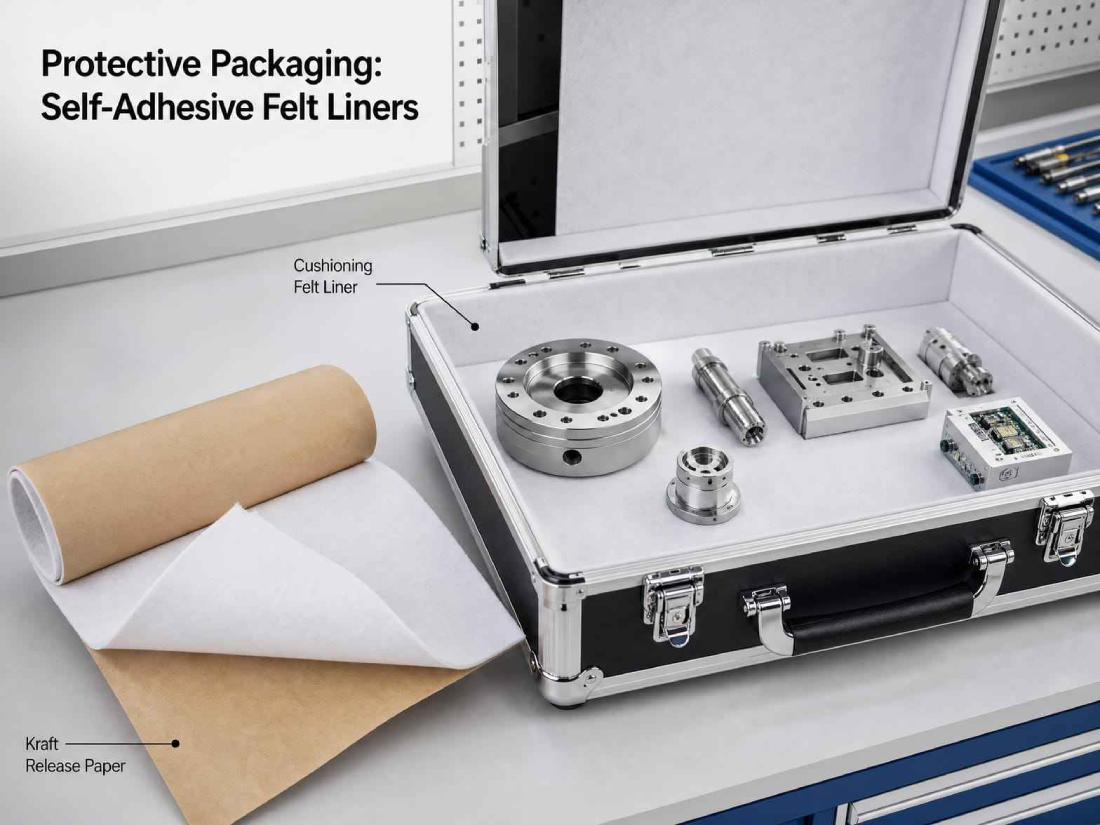
Self-adhesive felt with a kraft paper release liner combines a needle-punched felt base, an adhesive layer, and a release liner. Depending on the packaging structure, buyers can consider rolls, sheets, strips, or die-cut pieces, then verify the dimensions, installation positions, and actual performance using packaging samples.
Why Does Protective Packaging Need a Flexible Felt Layer?
Paperboard, plastic, metal, and wood are commonly used in product packaging, equipment cases, and transport containers. These materials can provide external support, but their internal contact surfaces are not always suitable for direct contact with the product.
When a product is placed into or removed from a package, or moves slightly inside it, its surface may rub against the inner wall, divider edges, or positioning structures. For metal parts with surface treatments, finished components, tools, and consumer products, this type of contact may affect their appearance.
In these situations, packaging designers can consider adding a flexible felt layer to selected contact areas.
Compared with direct contact against a hard packaging surface, the fibrous structure of needle-punched felt provides a softer contact surface. Depending on its thickness, density, and construction, it can also provide some cushioning space at localized contact points.
However, contact protection and transportation shock protection are two different requirements. Ordinary self-adhesive felt should primarily be evaluated as a flexible contact protection material. Its thickness alone does not prove that it can meet the drop, impact, or transportation shock requirements of precision products.
Packaging buyers should therefore first identify what needs to be protected: the product surface, the inner packaging wall, or the contact area between two components. Different protection objectives will affect the felt installation method and material specifications.
How Does Self-Adhesive Felt Protect the Contact Area Between a Product and the Packaging Interior?
Self-adhesive needle-punched felt generally consists of three parts: a needle-punched felt base, an adhesive layer, and a release liner.
The felt base faces the contact surface and provides a flexible fibrous layer. The adhesive layer fixes the felt in the required position. The kraft paper release liner covers the adhesive before installation, keeping the adhesive surface separated from external contact.
This construction is suitable for packaging designs that require the protective material to be fixed at a specific location inside the package.
For example, when a product is placed inside a package with a hard inner wall, a felt pad can be attached to the inner wall or a designated contact area according to the product's shape. The product then comes into contact with the felt surface rather than only the original paperboard, plastic, or metal substrate.
If only certain areas inside the package need protection, it may not be necessary to cover the entire inner wall. Localized felt pads or narrow strips can be designed according to the actual contact points between the product and the packaging.
This localized installation approach can reduce unnecessary material coverage and allow packaging designers to adjust the protected areas according to the product structure.
It is important to note that adhesive bonding depends on the packaging substrate, its surface condition, and the application environment. Paperboard, coated paperboard, plastic, and metal surfaces may not be compatible with the same adhesive solution. Before mass production, adhesion should be tested on the actual packaging material.
Which Areas in Equipment Cases, Toolboxes, and Product Packaging Can Use Self-Adhesive Felt?
The installation position of self-adhesive felt should be determined by the actual contact relationship between the product and the packaging, rather than simply by the overall dimensions of the box.
For equipment cases and instrument packaging, first check which parts of the product come into contact with the inner walls, lining panels, or support structures after being placed inside the package. If certain areas have clearly defined contact points, localized felt pads can be considered.
For toolboxes, tools may come into contact with internal dividers, storage areas, or neighboring tools. Depending on the shape of the tools and how they are positioned, felt strips or sheets can be evaluated for selected contact areas.
For high-value product packaging, such as display products, finished components, or items that need to maintain their surface appearance, packaging designers can consider adding a flexible felt layer to the inner wall or specific contact areas according to the product's shape.
The following positions are worth evaluating:
Packaging Position | Possible Self-Adhesive Felt Format | Main Considerations |
Inner packaging wall | Sheets or die-cut pieces | Product contact areas and coverage |
Internal dividers | Narrow strips or localized felt pads | Whether the felt affects divider dimensions or assembly |
Product positioning areas | Die-cut felt pads | Whether the shape matches the product profile |
Tool storage areas | Strips or sheets | Whether the felt affects tool access and positioning |
Contact points between adjacent components | Localized pads | Whether direct contact can be reduced |
These are possible areas for evaluating felt protection in packaging design. They do not mean that every equipment case, toolbox, or product package requires self-adhesive felt. The final decision should be based on product dimensions, weight, fixing method, and transportation conditions.
How Can Felt Pads Provide Contact Separation Between Multiple Components in One Package?
When several parts or components are placed inside the same package, designers need to consider not only contact between the products and the packaging walls but also direct contact between the components themselves.
For example, if two different metal parts are placed in the same packaging area without sufficient separation, they may come into contact during handling. For parts with painted, plated, or otherwise treated surfaces, this contact may create a risk of surface friction or scratching.
In this situation, self-adhesive felt strips or localized felt pads can be evaluated according to the shape of the components and the available packaging space.
If the contact area is relatively narrow, strips may be suitable. If a larger area needs to be covered, sheets or die-cut pieces can be considered.
However, self-adhesive felt does not automatically replace packaging dividers, fixing brackets, or structural positioning devices. If components may move significantly inside the package or need to withstand substantial impact loads, the packaging structure itself must still provide the necessary fixing and support.
Buyers should first confirm the relative positions, clearances, and possible directions of movement between components before deciding whether felt is needed as a contact separation layer.
What Is the Difference Between Self-Adhesive Felt Liners and Separate Felt Sheets?
Packaging protection can use either self-adhesive felt or non-adhesive felt sheets. The main difference is how the material is installed and fixed in position.
Self-adhesive felt has an adhesive layer on the back. During installation, the release liner is removed and the felt is attached to the designated position. It is suitable for locations where a protective layer needs to be fixed to an inner packaging wall, divider, or another surface.
Separate felt sheets do not have an adhesive backing. They usually rely on the packaging structure, clamping, slots, or other fixing methods to stay in position. They are suitable for applications where the felt needs to be removed, replaced, or placed between two products as a separate separator.
Comparison | Self-Adhesive Felt | Separate Non-Adhesive Felt Sheets |
Fixing method | Attached with an adhesive backing | Held by the packaging structure or another fixing method |
Installation | Remove the release liner and apply | Place directly or fit into a designated position |
Common formats | Rolls, sheets, strips, or die-cut pieces | Sheets, pads, or custom shapes |
Application considerations | Needs to be fixed to an inner wall or designated surface | Needs to remain separate or be removable |
Purchasing focus | Adhesive, release liner, and substrate compatibility | Dimensions, thickness, material construction, and fixing method |
If the packaging design requires the protective layer to remain fixed in a specific position, self-adhesive felt is worth evaluating first. If the separator needs to be removed or replaced independently, non-adhesive felt sheets may be more suitable.
When choosing between the two, buyers should not compare material prices alone. They should also consider packaging assembly, installation time, material replacement, and the overall packaging design.
What Is the Role of a Kraft Paper Release Liner in Packaging Felt?
The kraft paper release liner covers the adhesive surface of self-adhesive felt and provides a protective barrier before installation during material storage, cutting, transportation, and handling.
In packaging liner converting, the release liner keeps the adhesive covered before the material is installed. Processing or assembly personnel can first determine the felt's position and shape, then remove the release liner when the material is ready to be applied.
For packaging manufacturers, this construction allows the felt to be handled and further processed while the adhesive remains covered, rather than being exposed during installation preparation.
In practice, the felt dimensions can first be determined from packaging drawings or physical samples, followed by cutting or die cutting. Before installation, the packaging surface should be checked to ensure that the bonding area is clean and dry, without obvious dust, oil, or other contaminants that may affect adhesion.
The release liner can then be removed, the felt positioned in the target area, and the material pressed into place according to the actual application process.
It is important to understand that the kraft paper release liner covers and protects the adhesive. It does not automatically provide moisture resistance, waterproofing, or a guarantee of long-term storage performance. The liner's basis weight, release properties, storage conditions, and compatibility with the adhesive should be confirmed against the actual product specifications and sample results.
How Should Buyers Determine the Adhesive Felt Position, Coverage Area, and Specifications?
For packaging liners, covering a larger area is not necessarily better. Buyers should first identify the actual contact areas between the product and the packaging, then determine the felt dimensions according to the available space and fixing method.
First, confirm the product's actual position inside the package. Product drawings, packaging structure drawings, or physical samples can be used to identify contact areas between the product and the inner walls, dividers, and other components.
Second, check whether the felt will affect packaging assembly after installation. If the felt is too thick, it may change the original internal clearance, make the product difficult to insert, or interfere with dividers, clips, and other fixing structures.
Third, consider the surface condition of the adhesive bonding area. If the inner packaging wall has a coating, texture, curved surface, or other surface treatment, adhesion should be tested on the actual packaging material. Compatibility should not be assumed based only on the general material name.
When specifying the material, buyers should confirm the following details:
Purchasing Parameter | Information to Confirm |
Base material | Polyester or another specified fiber material |
Basis weight (GSM) | Selected according to contact protection and material construction requirements |
Thickness | Determined by internal packaging clearance and assembly space |
Density or firmness | Evaluated according to product contact conditions and support requirements |
Adhesive | Confirmed according to the packaging substrate and application environment |
Release liner | Whether a kraft paper release liner is required and its specific specifications |
Dimensions | Length, width, individual sheet size, or custom profile |
Color | According to product appearance and packaging requirements |
Converting format | Roll, sheet, strip, or die-cut piece |
Quantity | Based on packaging production volume and estimated material consumption |
GSM, thickness, and density are not interchangeable specifications. Buyers should not expect a supplier to determine whether a material suits a packaging structure based on basis weight alone. It is better to provide the target dimensions, installation position, product photos, or packaging drawings.
How Should Buyers Choose Between Rolls, Sheets, and Die-Cut Felt Pieces?
Self-adhesive felt can be supplied in different formats according to the packaging manufacturer's converting and production processes. Buyers should choose based on their processing equipment, packaging assembly workflow, and the shape of each product.
Rolls are suitable for customers who need continuous material feeding, further cutting, or batch converting. Packaging manufacturers can cut the roll into different widths or lengths according to production requirements. When purchasing rolls, confirm the width, length, thickness, adhesive construction, and packaging method.
Sheets are suitable for packaging projects that require fixed-size felt pieces. Buyers can specify the length and width according to the inner wall, divider, or product contact area. Compared with rolls, sheets can be easier to handle as individual pieces during assembly, although the actual production efficiency depends on the packaging workflow.
Strips are suitable for narrow contact areas, such as internal edges, localized support positions, or contact lines that need continuous coverage. Strip width and length should be determined according to the actual contact area.
Die-cut pieces are suitable for packaging designs with fixed outlines, holes, or specific installation positions. By determining the shape according to the product or packaging structure, manufacturers may reduce repeated manual cutting during assembly. However, the die-cut shape, dimensional tolerance, edge requirements, and specific converting method should be confirmed with the supplier using drawings or samples.
For packaging manufacturers with customization requirements, HuiZhou JinHaoCheng Nonwovens Co., Ltd. can evaluate suitable material specifications and supply formats based on needle-punched felt materials and custom converting requirements. The factory has needle-punched felt production and die-cutting equipment. However, whether a specific self-adhesive felt product can meet a particular size, shape, or processing tolerance should be confirmed against the actual sample and order requirements.
Before bulk purchasing, packaging sample validation is recommended. Install the self-adhesive felt on the actual packaging substrate and check the bonding position, dimensional fit, edge condition, product insertion and removal, and any movement during use. If the packaging needs to meet transportation impact, drop-test, electrostatic control, or other special requirements, the corresponding materials and testing standards must be confirmed separately.
What Information Should Buyers Provide Before Sourcing Self-Adhesive Felt for Protective Packaging?
To reduce repeated communication, packaging manufacturers can prepare product and packaging information before requesting a quotation. Simply asking whether a supplier has self-adhesive felt is usually not enough to determine the material construction or converting format.
The following information is recommended:
Information | Details to Provide |
End application | Equipment case, toolbox, product packaging, or component packaging |
Product details | Material, shape, and surface condition of the product being protected |
Packaging structure | Inner walls, dividers, and internal space |
Installation position | Specific areas where the felt needs to be attached |
Material specifications | Target GSM, thickness, color, and fiber requirements |
Adhesive requirements | Packaging substrate type and bonding environment |
Release liner | Whether a kraft paper release liner is required |
Converting format | Roll, sheet, strip, or die-cut piece |
Order quantity | Sample requirements and estimated bulk quantity |
Special requirements | Whether ESD protection, clean packaging, moisture resistance, or transportation testing is required |
If complete material specifications are not available yet, buyers can first provide packaging drawings, product photos, existing liner samples, or target dimensions. The supplier can then discuss the material and converting options before samples are used to verify suitability for the actual packaging production process.
Finally, it is important to emphasize that self-adhesive felt with a kraft paper release liner can be evaluated as a flexible contact protection material for packaging interiors. However, it cannot automatically replace specialized cushioning structures, fixing supports, or a validated transportation protection system. Clearly identifying the actual packaging protection requirements before selecting the base material, adhesive, dimensions, and converting format helps ensure that the purchasing specifications match the final packaging structure.




