
How Is Adhesive Felt Roll Converted into Custom Strips and Die-Cut Parts?
Adhesive-backed needle-punched felt is often supplied in rolls, but many industrial applications require ready-to-use components rather than a full roll of material. Depending on the application, buyers may need fixed-size sheets, narrow felt strips, round pads, or irregularly shaped parts.
Converting an adhesive felt roll into finished components involves more than cutting the felt to a required shape. Buyers also need to consider the felt specifications, adhesive coverage, release liner protection, finished dimensions, edge quality, and packaging.
This guide explains the main converting options for adhesive-backed needle-punched felt, helping industrial buyers communicate their requirements and prepare for sample and drawing approval before bulk production.
Why Do Industrial Buyers Need to Convert Adhesive Felt Rolls into Finished Parts?
An adhesive felt roll is a practical format for material storage, transportation, and further processing. However, using a full roll directly may not be convenient when the final application requires components with specific dimensions and shapes.
For example, manufacturers may need rectangular felt pads for surface protection, narrow strips for sealing or cushioning, round adhesive pads for contact points, or custom-shaped pieces for equipment and product assembly.
Converting the roll into finished parts can make the material easier to handle during assembly and reduce the need for additional cutting at the buyer's facility. It can also help standardize component dimensions across production batches.
The appropriate converting format depends on the final application, the required part geometry, and how the components will be installed. Before selecting a cutting method, buyers should define whether they need full sheets, continuous strips, individual pieces, or parts supplied in a form that is easy to peel and apply.
Adhesive Felt Roll: What Types of Converting Are Suitable for This Material?
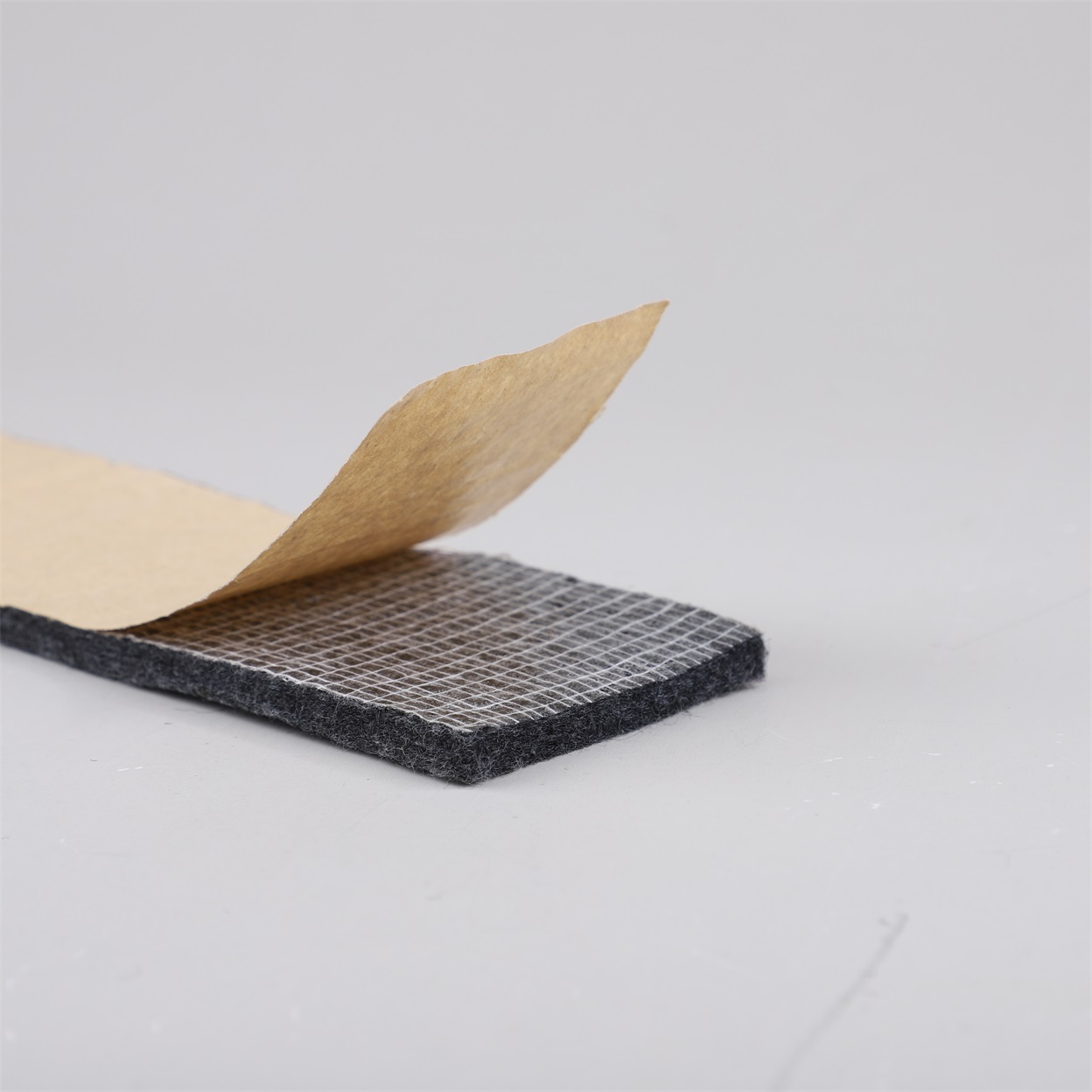
An adhesive-backed needle-punched felt roll generally consists of three functional layers: the needle-punched felt surface, a pressure-sensitive adhesive layer, and a release liner.
The felt provides the required physical properties for the application, such as cushioning, surface contact, or protection. The adhesive layer allows the material to be attached to a target surface, while the release liner protects the adhesive before installation.
These layers need to be considered together during converting. A cutting method suitable for ordinary needle-punched felt may not automatically be suitable for adhesive-backed material because the adhesive and release liner can affect cutting, handling, and finished-part separation.
Before processing, buyers should confirm the felt material, GSM, thickness, density, roll width, adhesive type, and release liner structure. They should also explain the intended application and the required finished format.
Depending on the product structure and processing requirements, the roll may be evaluated for conversion into sheets, strips, or individual die-cut components. The actual processing method should be confirmed according to the material construction, equipment, and part design.
Sheet Cutting: How Can Adhesive Felt Rolls Be Cut into Fixed-Size Sheets?
Sheet cutting converts a continuous adhesive felt roll into separate pieces with specified length and width.
This format is suitable when the application requires rectangular or square adhesive felt pieces, or when buyers need flat material sections for subsequent assembly or processing.
When specifying sheet-cut adhesive felt, buyers should provide the required sheet length and width, as well as the felt GSM, thickness, and other material requirements. They should also clarify whether all sheets need to have the same dimensions and how the finished sheets will be used.
The adhesive side and release liner should remain protected during handling and packaging. Buyers should confirm whether the liner needs to cover the entire adhesive surface and whether the finished sheets will be supplied individually or stacked.
Sheet cutting is different from die cutting. It is generally used to produce pieces with straight cutting lines and fixed dimensions, rather than complex profiles or repeated irregular shapes. The suitable cutting method and achievable dimensions need to be evaluated against the actual material and equipment.
Strip Cutting: How Can Adhesive Felt Be Converted into Continuous Strips?
Strip cutting divides a wider adhesive felt roll into narrower strips with specified widths.
This format is useful when the application requires long, narrow felt components, such as protective strips, cushioning strips, or adhesive-backed contact strips.
The key specification for strip cutting is the required width. Buyers should also confirm the strip length, whether the material should be supplied in continuous rolls or cut into individual lengths, and whether all strips need to have the same dimensions.
For adhesive-backed material, the cutting and winding process should also take the adhesive surface and release liner into account. The liner helps protect the adhesive during storage and handling, while suitable winding and packaging help prevent the finished strips from becoming contaminated or sticking to unwanted surfaces.
Before bulk production, buyers should confirm the required strip dimensions and delivery format. Whether a particular roll can be processed into the requested strip width and length depends on the material and available converting equipment.
Die Cutting: How Are Round Pads and Custom-Shaped Adhesive Felt Parts Designed?
Die cutting is used when the finished component needs a defined profile rather than a simple rectangular sheet or straight strip.
Common requirements may include round pads, small adhesive patches, irregular outlines, and other custom-shaped felt components. These parts are often used in applications where the component needs to fit a specific contact area or installation position.
To evaluate a die cut adhesive felt project, buyers should provide a drawing or sample showing the required shape and dimensions. The drawing should identify the outer profile, relevant holes or cut-outs, and any other features that affect the finished part.
The material structure also matters. The thickness and density of the felt, adhesive layer, and release liner may influence the suitable cutting method and finished-part handling.
For adhesive-backed components, buyers should clarify whether the felt, adhesive, and release liner are all intended to be cut through, or whether the release liner needs to remain continuous. These are different processing requirements and should not be treated as interchangeable.
The actual die-cutting method, achievable dimensions, and edge quality must be evaluated according to the material structure, part design, and available equipment. Buyers should not assume that every shape or dimension can be produced without a material and drawing review.
How Should Adhesive Coverage and Partial Non-Adhesive Areas Be Specified?
Adhesive coverage is an important part of the design for custom adhesive felt components.
Some applications require adhesive across the entire back surface so that the felt can be attached directly to the target substrate. Other applications may require adhesive only in selected areas, leaving part of the back surface without adhesive.
These requirements affect the material structure and converting process. Buyers should therefore explain the intended adhesive coverage before production rather than specifying only the finished felt shape.
If the component requires full-surface adhesive, this should be clearly stated in the drawing or product specification. If only certain areas need adhesive, buyers should mark the adhesive zones and non-adhesive zones on the drawing.
The adhesive-facing direction should also be identified so that the finished parts can be installed correctly. If the component has multiple sides or a particular installation orientation, this information should be included in the technical requirements.
Whether partial adhesive coverage or specific adhesive patterns can be produced depends on the product structure and confirmed processing capabilities. These requirements should be reviewed before sample production.
What Role Does a Kraft Paper Release Liner Play in Adhesive Felt Processing and Delivery?
A release liner protects the pressure-sensitive adhesive before the felt component is installed. For adhesive-backed felt supplied with a kraft paper release liner, the paper backing provides a protective layer that can be removed when the component is ready for application.
During converting, the release liner needs to be considered together with the felt and adhesive layers. The selected cutting method should be suitable for the complete material structure and the required finished format.
For example, a buyer may need individual die-cut pieces with the liner cut to the same profile as the felt. Another project may require the felt and adhesive to be cut while the release liner remains continuous. These requirements affect how the finished components are separated, stored, and removed during installation.
Buyers should specify whether the release liner needs to remain on each individual part, whether it should be continuous, and whether easy peeling is important for the application.
The liner should also remain in place during storage and transportation to help protect the adhesive surface from dust, contamination, and unwanted contact. Its condition is therefore part of finished-product quality, not simply a packaging detail.
What Should Be Checked for Finished Dimensions, Cutting Edges, Adhesive Surfaces, and Packaging?
After converting, the finished components should be checked against the agreed product specifications and approved sample.
Finished dimensions should be checked against the drawing or confirmed measurements. For sheet-cut parts, this includes length and width. For strips, it includes strip width and required length. For die-cut components, the outer profile and any specified openings or cut-outs should be reviewed.
Cutting edges should be inspected for visible damage, uneven cutting, or material deformation that could affect installation or use. The acceptable edge condition should be discussed according to the product's intended application.
Adhesive surfaces should be checked to ensure that the adhesive is protected and that there is no obvious contamination or unwanted exposure. If the project requires specific adhesive coverage, the finished parts should be checked against the approved design.
Release liners should be checked for damage, separation, or other conditions that could affect adhesive protection and removal during installation.
Packaging should be suitable for the finished format. Sheets, strips, and individual die-cut parts may require different packaging arrangements to prevent deformation, contamination, or unwanted adhesion during storage and transportation.
The inspection requirements should be agreed before bulk production. Any specific dimensional tolerances or acceptance criteria need to be confirmed for the actual project rather than assumed to be standard for every adhesive felt component.
How Should Buyers Confirm an Adhesive Felt Die-Cutting Project Through Drawings and Samples?
Before placing a bulk order, buyers should provide enough information for the supplier to evaluate the material and converting requirements.
A technical drawing is useful for confirming the finished shape, dimensions, holes, cut-outs, and adhesive coverage. If a formal drawing is unavailable, a physical sample or a clear reference image with measurements can help explain the required component.
The material specifications should include the felt type, GSM, thickness, density, adhesive requirements, and release liner structure. Buyers should also identify the required delivery format, such as sheets, continuous strips, individual die-cut parts, or another agreed arrangement.
Sample approval is an important step before bulk production. The buyer and supplier can use the sample to review the material, finished dimensions, cutting edges, adhesive coverage, release liner condition, and packaging requirements.
As a manufacturer of needle-punched nonwoven materials, HuiZhou JinHaoCheng Nonwovens Co., Ltd. has production and processing resources that include needle-punched felt manufacturing and die-cutting equipment. However, the suitable converting method and actual processing range for a specific adhesive-backed felt project must be evaluated against the material structure, equipment, and customer drawings.
For an accurate project evaluation, buyers should provide the intended application, material specifications, drawings or samples, required quantity, and preferred packaging. These details help determine whether the requested format is suitable and what needs to be confirmed before production.




