Why Does Anti-Condensation Felt Fail on Some Metal Roofs?
Many steel warehouses, agricultural buildings, and industrial facilities still experience roof dripping after installing Anti-Condensation Felt.
This does not necessarily mean that the material itself has failed.
In many projects, the problem occurs because condensation is generated faster than the material can release moisture, roof ventilation is insufficient, the environment remains highly humid for extended periods, or the installation method does not match the roof structure. For buyers, the key question is not simply whether anti-condensation felt is installed, but whether the entire roofing system can continuously manage and release moisture.
Why Is Anti-Condensation Felt Not a Permanent Water Storage Layer?
The function of anti-condensation felt is to temporarily absorb condensation that forms on the underside of the roof and gradually release the moisture when environmental conditions improve.
It is not designed to store water permanently.
When condensation forms at night and the roof has adequate ventilation and warming conditions during the day, the material can complete an absorption-drying cycle. If the material cannot dry properly for an extended period, moisture can continue to accumulate until the felt reaches its absorption limit. At that point, newly formed condensation may result in dripping.
Therefore, anti-condensation felt relies on continuous moisture release rather than unlimited water absorption.
Which Conditions Are Most Likely to Cause Anti-Condensation Felt to Reach Saturation?
Continuous high-humidity conditions are a common cause.
For example, livestock buildings, food-processing facilities, laundries, and high-humidity warehouses may maintain high indoor humidity for long periods, while significant condensation can form at night.
If the amount of condensation generated each day exceeds the amount of moisture that can evaporate from the material during the daytime, moisture can gradually accumulate.
When evaluating a project, buyers should pay particular attention to:
Whether indoor humidity remains high for extended periods
Whether there is a significant difference between day and night temperatures
Whether the roof has suitable natural drying conditions
Whether the building continuously generates moisture
These factors can be more important than simply increasing the material thickness.
Why Can Insufficient Roof Ventilation Cause Continuous Dripping?
Even when anti-condensation felt is installed, ventilation remains an important condition for moisture management in metal roofing systems.
Air entering through the eaves and exiting through the ridge can help remove humid air continuously and reduce the risk of condensation accumulation. The moisture-management performance of a metal roof depends not only on the material itself but also on airflow paths and ventilation conditions within the roof cavity.
If ventilation openings are blocked, insulation materials restrict airflow, or the ridge does not provide effective exhaust ventilation, the anti-condensation felt may absorb moisture but still be unable to dry sufficiently.
Therefore, buyers should not treat anti-condensation felt as a replacement for a ventilation system. The overall moisture-management design of the roof should also be evaluated.
Why Can Roof Pitch Affect Moisture Release Efficiency?
Roof pitch affects not only rainwater drainage but also airflow and the distribution of condensation.
Low-pitch roofs may be more likely to develop localized areas of accumulated moisture, while an appropriate roof pitch combined with continuous ridge ventilation can support natural airflow.
For low-pitch roofs or special roof structures, buyers should confirm in advance whether the roofing system includes appropriate moisture-management provisions rather than relying solely on anti-condensation felt to address all condensation problems.
Can Adhesive Delamination Cause Anti-Dripping Performance to Fail?
It can, although it is not the most common cause.
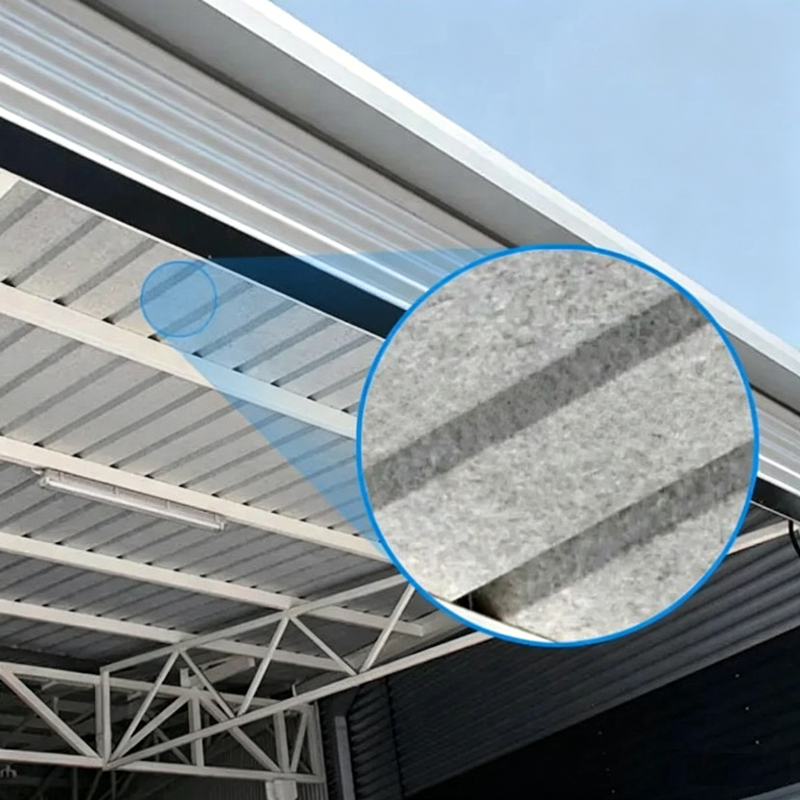
If the anti-condensation felt becomes partially detached from the metal roofing sheet, the air layer can change. Condensation may no longer be absorbed evenly in some areas, which can also affect the long-term stability of the material.
Possible causes of adhesive problems include:
Contamination on the steel sheet surface
Unstable lamination temperature control
Insufficient lamination pressure
Long-term aging under high-temperature and high-humidity conditions
For continuous roll-forming roofing manufacturers, it is more important to verify adhesive bonding strength and long-term durability during the sample stage than to deal with problems through on-site repairs later.
What Technical Conditions Should Buyers Confirm in the RFQ?
For high-humidity metal roofing projects, an RFQ should not simply state:
Need anti-condensation felt.
More complete purchasing information should include:
Roof panel type
Roll-forming method
Roof pitch
Building application
Indoor humidity conditions
Whether ridge and eave ventilation is available
Expected service life
Whether self-adhesive or laminated construction is required
This information helps suppliers recommend a more suitable anti-condensation material instead of quoting only according to GSM.
How Can JHC Support Metal Roofing Projects?
For steel structures and metal roofing projects, HuiZhou JinHaoCheng Nonwoven Co., Ltd. can provide needle-punched Anti-Condensation Felt, Roofing Nonwoven Felt, and related composite nonwoven materials, with different GSM, widths, colors, and OEM/ODM customization available.
For continuous roll-forming roofing projects, buyers can provide roof panel specifications, roll-forming structure, application environment, and ventilation conditions so that the material can be evaluated and samples can be validated according to the actual project requirements.
Conclusion
Installing anti-condensation felt does not mean that a metal roof will never experience dripping.
The actual performance of the system depends on whether absorption capacity, drying cycle, roof ventilation, roof pitch, and adhesive stability work together to create an effective moisture-management cycle.
For high-humidity buildings, buyers should evaluate the roof structure and operating environment before selecting the material, and validate the compatibility between the material and the roofing system through samples rather than comparing product specifications and prices alone.