
Anti-Condensation Felt vs Spray Coating: Which Is Better for Metal Roofs?
When choosing a condensation-control solution for a new metal roof or an existing roof refurbishment project, buyers may consider anti-condensation felt or spray coating. These two options can differ significantly in material form, installation method, substrate requirements, and project planning. Therefore, they should not be compared by material price alone, and their suitability cannot be determined simply by looking at the finished surface.
The first step is to identify the specific problem the project needs to address. Different spray coatings are designed for different purposes. Some are intended for surface protection, while others may be designed for insulation or other functions. Not every coating can directly replace anti-condensation felt. Buyers need to evaluate the roof structure, existing condition, construction stage, and intended function of the material.
For a new roof, compatibility with the roof panel manufacturing or installation process is an important consideration. For an existing roof, substrate condition, site access, and whether normal operations need to be interrupted may also influence the choice.
Therefore, when comparing anti condensation felt vs spray coating, the goal is not to declare one material universally better than the other. It is to determine which solution best matches the actual conditions of the roofing project.
Why Do These Two Solutions Need Different Evaluation Criteria?
Anti-condensation felt and spray coating are different types of materials. They should not be compared solely by product name, unit price, or finished appearance.
Anti-condensation felt is a nonwoven material that may be used for metal roof condensation management, depending on its specific construction and intended application. Its suitability needs to be evaluated in relation to its moisture absorption and release characteristics, roof structure, installation method, and the conditions available for drying.
Spray coating must be evaluated according to the specific product type. Different coatings may have different formulations, intended uses, compatible substrates, surface preparation requirements, and application conditions. If a buyer is considering a coating specifically designed for condensation management, the technical documentation should confirm that intended use. Not all spray-applied materials serve the same purpose.
A project comparison should therefore consider the following factors.
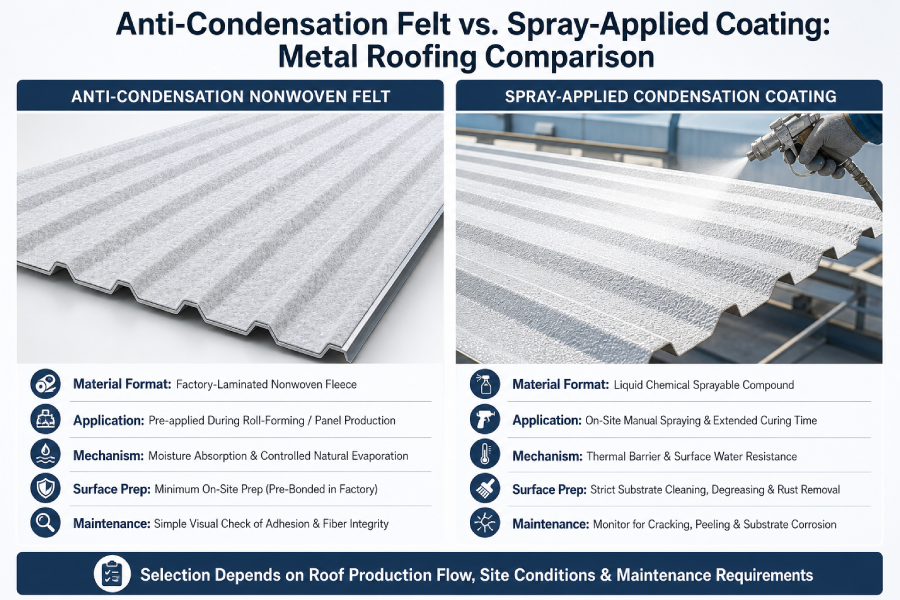
Comparison Factor | Anti-Condensation Felt | Spray Coating |
Material form | Roll or sheet nonwoven material, depending on the product specification | Liquid or spray-applied material, depending on the product type |
Main evaluation criteria | Material structure, moisture absorption and release characteristics, roof compatibility, and installation method | Intended coating function, compatible substrate, surface preparation, and application conditions |
Installation method | Installed through the specified bonding, lamination, or other installation method, depending on the product design | Applied according to the product instructions, including surface preparation, spraying, and any required curing or drying |
Substrate requirements | Roof structure, installation location, and applicable bonding or fixing requirements must be confirmed | Substrate compatibility and surface condition must be checked, including whether pretreatment is required |
New roof evaluation | Compatibility with roof panel manufacturing or installation processes must be confirmed | Application suitability, work sequence, and compatibility with the manufacturing or installation stage must be confirmed |
Existing roof refurbishment | Existing roof structure, installation conditions, and site accessibility must be evaluated | Existing coatings, corrosion, contamination, and other surface conditions must be assessed |
Ongoing maintenance | Material condition, fixing or bonding, and actual service conditions should be inspected | Coating condition and substrate condition should be inspected according to the specific product's maintenance requirements |
This table provides a framework for evaluation; it does not establish that one option is more effective for every roof. The final decision should be based on the specific product documentation, site conditions, and project requirements.
Which Option Should You Evaluate for a New Metal Roof?
For a new metal roof, buyers often have an opportunity to select materials before the roof panels are manufactured, processed, or installed. In addition to material properties, they should consider whether the chosen solution can be integrated into the existing production workflow.
When Roof Panels Are Manufactured in a Factory
For metal roofing manufacturers using continuous roll-forming processes, compatibility between the anti-condensation felt and the production line is an important purchasing consideration.
Buyers should confirm whether the material width, roll length, weight per unit area, construction, and processing requirements match the equipment and finished roof panel design. If the material needs to be laminated or bonded during production, the actual processing conditions and related quality-control requirements should also be verified.
Product samples should not be judged by appearance alone. Before bulk purchasing, manufacturers should confirm production-line requirements and validate samples under the intended manufacturing conditions.
If spray coating is being considered, buyers should confirm whether the specific coating is suitable for the metal substrate and whether spraying, surface preparation, and drying or curing requirements can be integrated into the production workflow. They should also verify that the coating provides the condensation-management function required by the project, rather than assuming that a coating intended for another type of surface protection will be suitable.
For a new metal roof, the key considerations are compatibility with the manufacturing process and whether the material's intended function meets the project requirements. The decision should not be based simply on the price of felt compared with spray coating.
When Roof Panels Are Installed on Site
For metal roofing installed on site, buyers should also consider installation sequence, available working space, access for installers, and how the material will be fixed or bonded.
Anti-condensation felt must be installed according to the specific product requirements, with its installation method and suitability for the roof structure confirmed in advance. Spray coating requires confirmation of the application environment, substrate preparation conditions, and the time needed to reach the specified condition after application.
If the project has a strict construction schedule, the time required for application and subsequent work should be included in the comparison. Without confirming the specific product requirements, buyers should not assume that spraying is always faster or that felt is always easier to install.
Which Option Should You Evaluate for an Existing Metal Roof?
Refurbishing an existing metal roof differs from constructing a new one. Instead of working with a new and controlled substrate, buyers must consider a roof structure that has already been installed and exposed to service conditions.
In this situation, material selection may be affected by the existing roof condition, site accessibility, and construction arrangements.
Inspect the Existing Roof Condition First
Before deciding between anti-condensation felt and spray coating, assess the actual roof condition. Relevant factors may include corrosion, existing coatings, surface contamination, localized damage, and other issues that could affect installation.
If spray coating is being considered, confirm that the product is suitable for the existing substrate and surface condition. Check whether old coatings need to be removed and whether cleaning, rust removal, or other surface preparation is required. The fact that a product can be sprayed does not mean it can be applied directly to every existing roof.
If anti-condensation felt is being considered, confirm whether the installation area is accessible, whether the existing roof structure meets the installation requirements, and whether additional fixing, bonding, or other work is necessary.
If the roof has structural damage, leaks, severe corrosion, or other significant defects, assess whether these problems require separate repairs first. Neither anti-condensation felt nor spray coating should automatically be treated as a universal solution for repairing every roof defect.
Assess the Impact of Site Work on Normal Operations
Refurbishment projects may involve warehouses, factories, agricultural buildings, or other facilities that remain in use. Whether construction requires restricted access, equipment relocation, protection of stored goods, or specific work schedules may affect the actual project cost.
Spray application may involve surface preparation, environmental controls, and product-specific drying or curing time. Installing anti-condensation felt requires consideration of material handling, installation access, fixing methods, and on-site working conditions.
Buyers should confirm application requirements using the specific product instructions and site conditions. Labor, equipment, site preparation, and any required downtime should be included in the evaluation.
The impact on normal operations should not be inferred from the material type alone. Different roof structures and construction conditions require an assessment based on the actual project.
What Site Conditions Can Change the Decision?
Even when two projects both involve metal roofs, they may not be suitable for the same treatment. The following factors can change the comparison between anti-condensation felt and spray coating.
Roof substrate and surface condition
New and existing roofs may differ in substrate condition, surface preparation requirements, and installation conditions. Buyers need to confirm that the specific product is suitable for the existing substrate rather than relying on the product name alone.
Intended material function
This is one of the most easily overlooked factors. Anti-condensation felt and spray coating do not inherently perform the same function. Buyers should confirm that the product's technical documentation, intended application, and stated performance match the project's objectives.
Site accessibility
If the roof structure is complex, installation space is limited, or certain work processes are difficult to carry out on site, the installation method and equipment requirements may affect feasibility.
Construction time and work sequence
Different materials may require different preparation, installation, drying, curing, or inspection procedures. The specific product instructions and project schedule should determine the comparison, rather than the assumption that one application method is always faster.
Ongoing inspection and maintenance
Buyers should understand what inspections are required during use and how to address damage, detachment, coating deterioration, or other abnormal conditions. Maintenance requirements should be based on the product documentation and included in the consideration of long-term project costs.
Total project cost
Material price is only one component. Other actual costs may include substrate preparation, labor, equipment, installation or spraying operations, required downtime, and subsequent maintenance.
If the two options have different intended functions, application requirements, or target outcomes, comparing them by unit price alone is not appropriate. First confirm that both options meet the project's basic requirements, then compare their costs.
What Should Buyers Confirm Before Choosing a Solution?
Before requesting quotations or arranging sample evaluations, buyers should organize the basic project information. This helps suppliers understand the actual application conditions and reduces the risk of selecting a product based on different interpretations of its intended use.
Information to Confirm | Why It Matters |
New roof or existing roof refurbishment | Affects the construction stage, substrate condition, and installation method |
Type of metal roof panel | Helps determine compatibility with the roof structure |
Existing roof condition | Identifies surface or structural issues that may need to be addressed first |
Specific problem to be addressed | Distinguishes condensation management from surface protection or other requirements |
Application method and site conditions | Helps assess the feasibility of installation, spraying, surface preparation, and subsequent work |
Material technical documentation | Confirms intended use, compatible substrates, and application requirements |
Maintenance and acceptance requirements | Defines how material condition and relevant results will be checked after installation |
Budget and construction schedule | Supports comparison of actual project costs and schedule compatibility |
If the project aims to reduce condensation and dripping from the underside of a metal roof, buyers should verify that the selected material is specifically suitable for that application. They should also recognize that roof condensation can be affected by indoor humidity, ventilation, temperature changes, roof construction, and other factors. Changing one material alone may not resolve every underlying issue.
For projects with defined technical requirements, sample validation methods and acceptance criteria should be established using the relevant product documentation. Final decisions should not rely solely on product names, marketing claims, or a single visual observation.
When Is Anti-Condensation Felt Worth Considering?
If a project specifically requires anti-condensation felt for a metal roof, and the material construction, installation method, and service conditions match the roof design, felt is worth including in the comparison.
For metal roof panel manufacturers, the evaluation can focus on material specifications, production-line compatibility, roll processing requirements, and consistency during bulk production. For roofing installation and refurbishment projects, buyers should focus on installation conditions, substrate compatibility, site work arrangements, and ongoing maintenance requirements.
The metal roof anti-condensation felt product page can help buyers review available material options and discuss specifications relevant to their projects.
Established in 2005, HuiZhou JinHaoCheng Nonwovens Co., Ltd. specializes in nonwoven material development and manufacturing. Depending on project requirements, the company can discuss anti-condensation felt specifications, including weight per unit area, width, color, roll dimensions, and OEM/ODM customization. Actual available specifications and processing options must be confirmed according to the product and order requirements.
For overseas buyers planning bulk purchases, providing roof panel information, application conditions, target specifications, and relevant processing requirements can help clarify the requirements before quotation. Samples and key acceptance criteria should be confirmed before bulk production.
Conclusion: Which Solution Is Better for Metal Roofs?
There is no universal answer that makes anti-condensation felt or spray coating the better choice for every metal roofing project. For a new roof, the priority is to evaluate compatibility with the manufacturing or installation process. For an existing roof refurbishment, buyers should first confirm the substrate condition, site requirements, and potential impact of construction on normal operations.
Before making a comparison, buyers must also identify the specific type and intended function of the spray coating. Not all spray-applied products serve the same purpose, and they should not automatically be considered direct substitutes for anti-condensation felt.
Buyers should first confirm that both options meet the project's basic requirements, then evaluate installation methods, scheduling, maintenance, and total project costs.
The right purchasing decision is not about finding a universally superior material. It is about selecting the solution that matches the existing roof condition, construction stage, and actual application requirements.




