
Reusable Floor Protection vs Builder Board: Which Costs Less per Project?
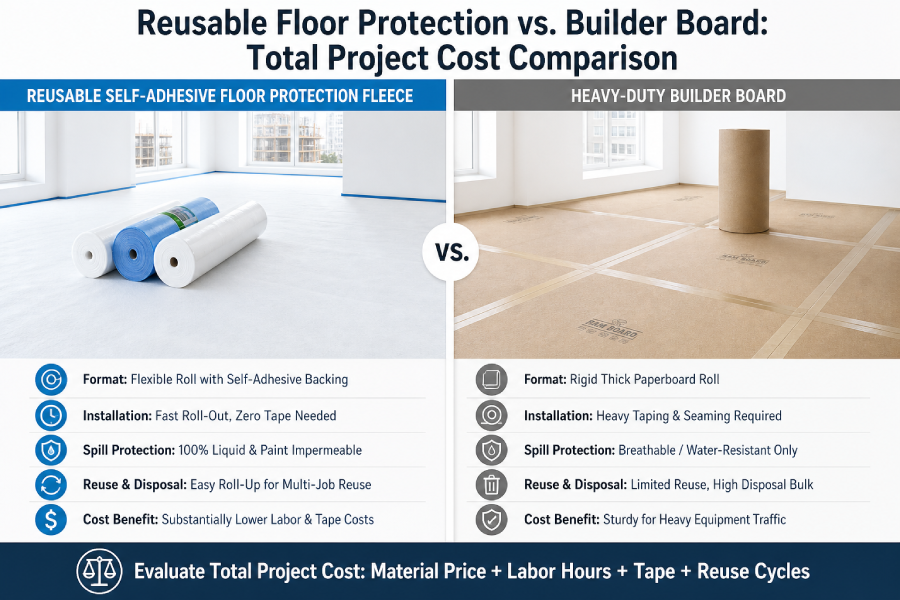
When planning floor protection for a renovation or construction project, the lowest material price does not always mean the lowest total cost. Reusable floor protection fleece and Builder Board have different cost factors, including material purchase, installation labor, removal, reuse, storage, damage, and disposal.
To compare them fairly, contractors need to evaluate both options under the same project conditions and calculate the actual cost of protecting the required floor area. Neither solution is automatically cheaper in every situation, and Builder Board should not be assumed to be single-use. Its actual reuse potential should be included in the calculation.
Why Can't You Compare Only the Material Price per Square Meter?
The purchase price per square meter is only one part of the total project cost. Two materials with different prices may also require different amounts of labor, handling, maintenance, and replacement.
For example, one solution may cost less to purchase but take longer to install or remove. Another may have a higher initial price but be recoverable and reusable on later projects. However, reuse should only be counted when the material can actually be recovered, inspected, stored, and used again.
A fair comparison of reusable floor protection vs builder board should therefore consider the full cost of completing the protection work, rather than relying on the initial material price alone.
How Do the Cost Components Differ?
The main cost categories to consider are shown below.
Cost Component | Builder Board | Reusable Floor Protection Fleece |
Material purchase | Depends on the required coverage, board price, and quantity purchased | Depends on the required coverage, roll price, specifications, and quantity purchased |
Cutting and fitting | Depends on the floor layout, cutting requirements, and waste | Depends on the floor layout, roll width, cutting requirements, and overlap |
Installation labor | Includes the time needed to lay out and secure the material as required | Includes the time needed to unroll, position, and secure the material as required |
Removal or recovery labor | Depends on how the board is installed and whether it will be recovered for reuse | Includes lifting, collecting, and preparing the fleece for storage or reuse |
Reuse and replacement | Depends on the condition of the board after use and whether it can be reused | Depends on the condition of the fleece and whether it can be recovered for another project |
Cleaning and maintenance | Include any actual cleaning or maintenance required | Include any actual cleaning or maintenance required |
Storage and handling | Depends on the storage space, handling method, and remaining material | Depends on how the rolls or recovered material are handled and stored |
Damage, loss, and disposal | Depends on damage, replacement needs, and final disposal requirements | Depends on damage, loss, remaining serviceability, and final disposal requirements |
These costs vary by project. The purpose of the comparison is not to assume that one material always performs better, but to identify which cost factors matter under the actual working conditions.
How Do You Calculate the Actual Project Cost of Builder Board?
To estimate the actual cost of Builder Board, start with the total quantity required to cover the project area. Then include the additional costs associated with preparing, installing, removing, handling, and potentially reusing the material.
Material purchase cost
Calculate the amount of Builder Board required for the specified floor area. Include cutting waste, overlaps, and any additional material needed for the actual floor layout.
Installation labor
Estimate the labor required to measure, cut, position, and secure the board. The time required may vary depending on room shapes, corners, doorways, stairs, and the installation method.
Removal and recovery labor
Include the labor needed to remove the board at the end of the protection period. If the board is intended for reuse, also account for the time needed to collect it and assess its condition.
Reuse and replacement
Do not automatically classify Builder Board as single-use. Check whether the material remains suitable for another application after the current project. If it can be reused, the cost should reflect its actual reuse potential. If damaged sections need replacement, include those costs as well.
Storage and disposal
Include storage and handling costs where applicable. If the board cannot be reused, account for the actual disposal or end-of-project processing costs.
The result is a more realistic estimate than simply multiplying the quoted material price by the floor area.
How Do You Calculate the Actual Project Cost of Reusable Floor Protection?
The calculation for reusable floor protection fleece should follow the same principle: include the costs required to complete the protection work, not just the initial purchase.
For projects using reusable floor protection fleece, start by confirming the product structure, coverage requirements, and intended working conditions. You can review available floor protection rolls to identify specifications that fit the project before comparing costs.
Material purchase cost
Calculate the purchase cost based on the required coverage area, roll dimensions, product specifications, and quantity needed. Allow for cutting waste and overlap where necessary.
Installation labor
Include the time required to position and secure the fleece. Labor requirements may depend on the floor layout, roll width, working area, and installation method.
Removal and recovery labor
Reusable material needs to be collected after use if it is intended for another project. Include the labor required to remove, gather, inspect, and prepare it for storage.
Actual reuse count
Estimate the number of times the fleece can realistically be used under the intended working conditions. Do not assume that a roll can be reused indefinitely. Its condition after each use, the type of work performed, and the feasibility of recovery all affect its practical reuse value.
Cleaning, storage, and damage
Include any actual cleaning, maintenance, storage, and handling costs. Also account for damaged sections, lost material, and replacement requirements.
A higher initial purchase price does not automatically mean a higher project cost. Equally, the ability to reuse a material does not guarantee savings. The result depends on the total costs and the number of successful uses actually achieved.
How Can You Compare Both Options Fairly Under the Same Project Conditions?
A meaningful comparison requires both materials to be evaluated against the same project requirements. Otherwise, the results may reflect differences in coverage or protection needs rather than differences in cost.
Before calculating, confirm the following conditions.
Comparison Item | What to Confirm |
Project area | Use the same actual floor area for both options |
Protection requirements | Confirm that both materials meet the project's required protection level |
Coverage | Account for cutting, overlaps, edges, and other areas requiring additional material |
Protection period | Use the same expected project duration |
Installation and removal | Include the labor required for each material under the intended installation method |
Reuse | Count only realistic, achievable reuse cycles for each material |
Maintenance and storage | Include applicable cleaning, handling, and storage costs |
Damage and replacement | Account for material that cannot be reused or must be replaced |
Final processing | Include applicable disposal or other end-of-project costs |
Use the following formulas to compare the two solutions:
Total project cost = Material purchase cost + Installation and removal labor + Maintenance cost during use + Storage and handling cost + Damage, replacement, and final processing cost
Project cost per square meter = Total project cost ÷ Actual protected floor area
Apply the same calculation method to both materials. The resulting cost per square meter represents the estimated cost of completing the protection work for the project, rather than the price of purchasing the material alone.
When comparing floor protection roll quotations, make sure the quoted specifications, coverage assumptions, and included costs are comparable. A lower quoted price may not represent a lower total project cost if additional labor, waste, or handling costs have been excluded.
Which Jobsite Conditions Can Change the Final Cost?
The final result depends on how the materials are used in the actual project. Several factors can change the cost comparison.
Project duration
A short project and a long project may create different labor, maintenance, and handling costs. Consider the expected protection period and whether the material must be moved or replaced during the work.
Floor layout and cutting requirements
Rooms with many corners, narrow sections, stairs, or irregular shapes may require more cutting and produce more waste. Roll width and board dimensions can affect how efficiently each material covers the area.
Site traffic and working conditions
The type and intensity of site traffic may affect material condition and the need for replacement. Compare both materials against the same actual working conditions and required level of protection.
Recovery and reuse
The potential for reuse matters only when the material can be collected, inspected, stored, and used again. If recovery takes significant labor or the material is damaged during use, the expected savings may be reduced.
Storage and handling
Materials that remain after a project may need space, transportation, and handling before the next use. Include these costs when they apply instead of treating reuse as cost-free.
These factors should be recorded as project-specific variables. They should not be replaced with assumptions that reusable fleece or Builder Board is always the more economical option.
A Ready-to-Use Project Cost Comparison Table
The following table can be used by contractors, purchasing teams, and project managers to compare both materials using actual project information.
Cost Item | Builder Board | Reusable Floor Protection Fleece |
Project floor area | ||
Material purchase cost | ||
Cutting and overlap waste | ||
Installation labor | ||
Removal or recovery labor | ||
Cleaning and maintenance | ||
Storage and handling | ||
Damage, replacement, and loss | ||
Final processing or disposal | ||
Other project-specific costs | ||
Total project cost | ||
Actual protected floor area | ||
Cost per square meter |
For a more accurate result, use actual quotations, labor estimates, and project records wherever possible. If reuse is expected, record the estimated number of uses separately and update the calculation when actual performance data becomes available.
The table is a comparison framework, not a predetermined result. The lower-cost option is the one that meets the project's protection requirements at the lower calculated total cost.
When Is Reusable Floor Protection Worth Considering?
Reusable floor protection fleece is worth evaluating when a contractor regularly completes similar projects, can recover the material after use, and has a practical way to inspect and store it between jobs.
It may be particularly relevant for contractors managing repeated renovation work, commercial projects, or multiple sites where the same type of floor protection is needed over time.
However, the initial material price, the expected number of successful uses, recovery labor, storage, and replacement costs should all be considered. If the material cannot be recovered or reused effectively, the expected cost advantage may not be achieved.
For buyers comparing products from different suppliers, confirm the specifications, construction, dimensions, and intended application before making a cost decision. HuiZhou JinHaoCheng Nonwovens Co., Ltd. can discuss floor protection fleece specifications and OEM/ODM customization requirements. Product samples and actual application conditions should be reviewed before estimating the cost for a specific project.
Conclusion
The comparison of reusable floor protection vs builder board should be based on total project cost, not just the purchase price per square meter.
Material costs, installation and removal labor, maintenance, realistic reuse, storage, damage, replacement, and final processing can all affect the result. Builder Board should not automatically be treated as single-use, and reusable fleece should not automatically be assumed to deliver savings.
By comparing both options against the same floor area, protection requirements, and working conditions, contractors can estimate the actual cost per square meter and choose the solution that best fits their project.




