
Sourcing Automotive Emergency Fire Blankets: What Should Buyers Confirm Before Production?
For automotive emergency equipment brands and vehicle safety product buyers, developing an automotive emergency fire blanket is not simply a matter of selecting a flame-retardant material, folding it, and placing it in a vehicle storage compartment.
A vehicle emergency fire blanket needs to be designed according to its intended vehicle application, product positioning, material properties, overall construction, folding method, and available storage space. Buyers also need to confirm whether the supplier can provide finished-product samples and handle edge binding, stitching, folding, and packaging. In addition, they should check whether the supplier can arrange relevant testing according to the target market and product requirements.
It is particularly important to understand that an ordinary automotive emergency fire blanket is not the same product as a specialized blanket designed for electric vehicle battery fire protection. These products may have significantly different design purposes, material requirements, and testing procedures. They should not be treated as interchangeable.
For brands planning to develop vehicle emergency protection products, the first step before mass production should be to define the intended application and then confirm the material, construction, vehicle storage method, and testing requirements.
What Is an Automotive Emergency Fire Blanket?
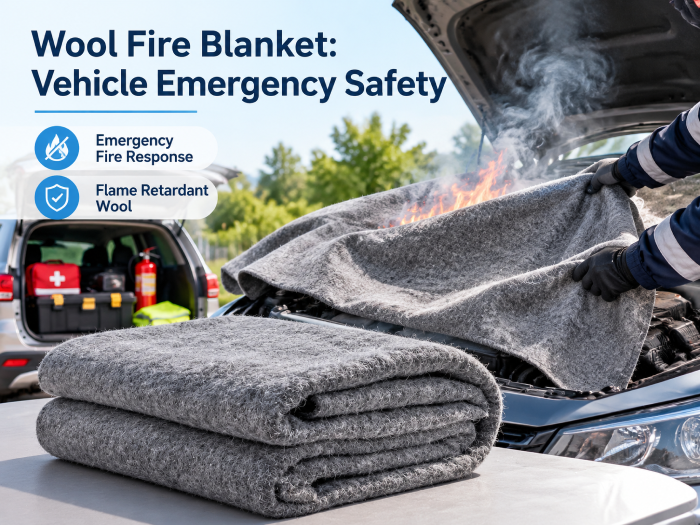
An automotive emergency fire blanket is a type of protective product developed for vehicle emergency safety applications. It needs to be designed according to the vehicle environment and intended product positioning, rather than simply adopting the specifications of an ordinary household fire blanket.
For automotive safety product brands and buyers, it is important to distinguish between two different product categories.
The first is an ordinary vehicle emergency fire blanket, developed as part of a vehicle emergency equipment range. Buyers need to consider its material, dimensions, construction, folding method, storage packaging, and applicable fire performance requirements.
The second is a specialized protection product designed for electric vehicle battery fires or thermal runaway situations. This type of product involves more specific application conditions and protection requirements. Its development requires an appropriate technical solution and relevant testing based on its intended use.
An ordinary automotive emergency fire blanket should not automatically be considered an electric vehicle battery fire protection blanket.
Even if both products use flame-retardant or heat-resistant materials, their names alone cannot establish that they provide the same level of protection.
Therefore, before requesting a quotation, buyers should clarify whether they need an ordinary vehicle emergency product or a specialized solution for battery fire protection.
This helps the supplier evaluate the material direction, product construction, and subsequent testing requirements, reducing the risk of unclear product positioning during development.
Where Are Automotive Emergency Fire Blankets Used?
The development of an automotive emergency fire blanket should be based on its specific vehicle application. Different product positions may require different dimensions, constructions, storage methods, and performance requirements.
Ordinary Vehicle Emergency Equipment
If the product is intended for ordinary vehicle emergency equipment, buyers need to consider where and how the blanket will be stored inside the vehicle or in the trunk.
Unlike flame-retardant materials permanently installed inside a vehicle, an automotive emergency fire blanket is generally stored as a separate product. Therefore, in addition to material performance, buyers should consider its folded size, packaging method, and ease of access in an emergency.
For automotive emergency equipment brands, product appearance, packaging, and brand labeling may also be important parts of retail product development.
Automotive Emergency Safety Kits
Some buyers may plan to sell fire blankets together with other automotive emergency supplies.
In this case, buyers need to confirm whether the unfolded dimensions, folded dimensions, and packaging structure are suitable for the complete emergency kit.
If the product needs to be stored together with other tools or emergency supplies, the available packaging space should be confirmed in advance to avoid size incompatibility after the finished product is developed.
Electric Vehicle-Related Protection Products
For electric vehicle-related projects, buyers must first clarify the specific protection target and intended application.
An ordinary vehicle emergency fire blanket cannot be advertised as capable of controlling electric vehicle battery thermal runaway simply because it uses flame-retardant materials. It also cannot automatically be claimed to prevent the spread of a vehicle fire.
If a project involves battery fire protection or thermal runaway scenarios, buyers need to provide clear technical requirements and an applicable testing plan. The product developer and relevant testing laboratory can then evaluate whether the proposed materials and finished-product design are suitable.
These projects should not simply adopt the material specifications and test conclusions used for ordinary vehicle emergency fire blankets.
What Material Requirements Should Buyers Confirm for Automotive Emergency Fire Blankets?
Material is the foundation of automotive emergency fire blanket development. However, buyers should not judge whether a product is suitable based only on the material name or GSM.
Different vehicle applications and product constructions may require different material properties. Material selection should be evaluated according to the intended application, finished dimensions, structural design, and customer-specified testing requirements.
Fiber Composition and Flame-Retardant Performance
Automotive emergency fire blankets can be developed using suitable flame-retardant or heat-resistant material systems according to project requirements.
If buyers are considering wool-based or wool-blend materials, they should further confirm the fiber composition, material structure, treatment method, and available test documentation.
For example, buyers may request the development of a wool fire blanket for automotive use, but the material name alone cannot establish whether it meets specific vehicle safety requirements.
For flame-retardant materials, buyers should confirm which specific material, specification, and test method are covered by the test report. Different fiber systems, material thicknesses, and product constructions may produce different test results.
If the customer has a specific flame-retardant rating or designated testing standard, these requirements should be provided during the inquiry stage so the supplier can evaluate the material selection and subsequent testing arrangements.
Material Flexibility and Thickness
An automotive emergency fire blanket needs to be folded for storage. Therefore, material flexibility and thickness directly affect the folding method and final packaging volume.
If the material is too thick or rigid, it may be difficult to fold and may result in a larger package.
If the material is too thin, its structural integrity and actual test performance need further evaluation. Weight alone cannot determine whether it meets the product requirements.
Buyers can provide the target finished dimensions, reference samples, and packaging requirements. The supplier can then evaluate the material specifications according to the actual product construction.
Material Structure and Processing Suitability
In addition to flame-retardant performance, buyers should consider whether the material is suitable for subsequent finished-product processing.
For example, requirements for edge binding, stitching, folding, or other structural treatments may influence material selection.
For projects requiring customized finished products, the supplier should consider these processing requirements during the material evaluation stage rather than simply providing a material specification sheet.
For automotive emergency fire blankets, material properties and finished-product construction need to be considered together. Material flame-retardant test results cannot directly replace finished-product performance verification.
How Should Portability, Folding, and Storage Be Designed for Automotive Emergency Fire Blankets?
Unlike automotive interior materials, an automotive emergency fire blanket is generally stored as a separate emergency product inside a vehicle.
Therefore, buyers should pay particular attention to portability, storage convenience, and ease of removal in an emergency.
Confirm the Unfolded Blanket Dimensions
Buyers should first specify the length and width of the fully unfolded fire blanket.
Different vehicle emergency products may require different dimensions. The actual specifications should be determined according to the product positioning, intended use, and applicable testing requirements.
If the brand already has a reference product, it can provide a physical sample or technical drawing to help the supplier confirm the dimensions and construction.
If the specifications have not yet been determined, the intended application should be clarified before discussing a suitable size.
Confirm the Folded Storage Dimensions
Storage space for vehicle products is often limited by the vehicle's interior layout and the design of the emergency kit.
Therefore, buyers need to confirm not only the unfolded blanket dimensions but also its folded length, width, and thickness.
Material flexibility, thickness, and folding methods all affect the final packaging volume. It is advisable to check the actual folded sample and packaging rather than relying only on theoretical measurements.
If the product is intended to be stored in the trunk, a door storage compartment, or a dedicated emergency kit, the available storage space should be confirmed in advance.
Confirm the Removal and Deployment Method
The design of an automotive emergency fire blanket should consider ease of access in an emergency.
Buyers should confirm how the packaging will be opened, how the user will grip the blanket, and whether it can be unfolded smoothly.
If the design requires pull tabs, handles, or other additional components, their construction and attachment methods should also be checked during sample development.
These details should be evaluated using physical samples rather than relying only on design drawings or product renderings.
Confirm Packaging and Branding Requirements
For automotive emergency equipment brands and importers, packaging is also an important part of product development.
Buyers should decide in advance on the type of packaging bag or box, dimensions, material, color, brand logo, and product information.
If the product is intended for the retail market, buyers should also confirm label languages, usage instructions, warning information, and any relevant markings required by the target market.
Packaging claims must match the actual product performance and test results. Material flame-retardant performance should not be directly presented as proof of vehicle fire protection capability.
What Fire Performance and Vehicle-Related Testing Are Required for Automotive Emergency Fire Blankets?
For automotive emergency fire blanket buyers, testing requirements should be clarified at the beginning of product development rather than considered only after the finished product has been manufactured.
The first step is to distinguish between material flame-retardant testing and finished-product performance testing.
Material flame-retardant testing evaluates how a specific material behaves under defined test conditions. Depending on the test method, this may include its burning behavior after ignition and whether it continues burning after the flame source is removed.
However, these test results do not automatically prove that a complete fire blanket made from the material has specific fire-extinguishing or vehicle fire protection capabilities.
Confirm Material Testing Requirements
If an automotive customer has specified a material flame-retardant standard, rating, or other technical requirement, the details should be provided during the inquiry stage.
The supplier needs to confirm whether the existing material specification matches the customer's requirements and whether the available test report applies to the material being considered for the project.
It is important that the test report corresponds to the actual material system and specification being purchased. A test report for a different fiber composition, thickness, or material construction should not be directly applied to the current product.
Confirm Finished-Product Testing Requirements
For a complete automotive emergency fire blanket, buyers also need to determine whether finished-product testing is required according to the product positioning and target market.
Finished-product testing should consider the actual product dimensions, construction, material combinations, edge finishing, and other design details.
If the product is an ordinary automotive emergency fire blanket, the applicable test items should be confirmed according to its intended use.
If the product involves specialized electric vehicle battery fire protection, the corresponding technical requirements and testing plan must be confirmed separately. An ordinary material flame-retardant report cannot replace the relevant verification.
Arrange Testing According to Customer Requirements
JHC can currently supply automotive emergency fire blanket materials and finished products, and physical samples of automotive emergency fire blankets are available.
Regarding testing documentation, HuiZhou JinHaoCheng Nonwovens Co., Ltd. currently has material flame-retardant test reports but does not yet have finished-product test reports for automotive emergency fire blankets.
If customers have specific finished-product testing requirements, JHC can discuss the testing items according to the customer's target market, product specifications, and applicable standards, and then arrange testing based on the requirements confirmed by both parties.
The specific testing standard, testing laboratory, sample quantity, cost, and lead time should be confirmed before the project begins.
Until the relevant finished-product test results are obtained, material flame-retardant test reports cannot be used as proof of finished-product fire-extinguishing performance or vehicle fire protection capability. They also cannot be used to claim that the product has passed unverified automotive industry certifications.
What Should Automotive Safety Brands Include in an RFQ?
If automotive safety product brands want suppliers to evaluate an automotive emergency fire blanket project more accurately, they should provide the following information during the RFQ stage.
Product positioning: Whether the product is an ordinary automotive emergency fire blanket, a fire blanket included in an automotive emergency kit, or a specialized product for electric vehicle battery fire protection.
Vehicle application: The target vehicle type, intended storage location, and actual product application.
Material requirements: Whether wool, wool-blend materials, or other flame-retardant materials are specified, and whether existing samples or reference materials are available.
Unfolded dimensions: The required length and width of the fully unfolded fire blanket.
Material specifications: Target GSM, thickness, number of layers, and flexibility requirements. If these specifications have not yet been determined, the supplier can evaluate them according to the product requirements.
Finished-product construction: Whether edge binding, stitching, pull tabs, or other additional structures are required.
Folding and packaging: Folding method, packaging bag or box dimensions, packaging material, and branding requirements.
Target market: The countries or regions where the product will be sold, as well as customer-specified vehicle safety or product testing requirements.
Testing requirements: Whether material flame-retardant testing, finished-product performance testing, or other specified tests are required, and whether a third-party testing laboratory or testing plan has already been selected.
Order information: Estimated order quantity, sample requirements, planned bulk order volume, and delivery time.
Documentation requirements: Whether material specifications, material flame-retardant test reports, finished-product test reports, product labels, and usage instructions are required.
If buyers have not yet finalized the complete specifications, they can also provide an existing product sample, design drawing, product photos, or competitor references.
The supplier can use this information to discuss material and finished-product development options. If further testing is required, the target market and specific testing requirements should be explained during the initial discussion so that sample preparation, testing arrangements, costs, and lead times can be confirmed in advance.
How Can Automotive Safety Brands Develop an OEM Automotive Fire Blanket?
For automotive emergency equipment brands, a practical development process is not to select a material GSM first and immediately begin mass production. Instead, the final product application should be clarified before the material and finished-product construction are gradually confirmed.
First, the brand needs to determine the product positioning, target vehicle application, finished dimensions, storage space, and applicable testing requirements.
Next, the material system should be selected according to the product requirements. Material specifications, thickness, flexibility, and suitability for subsequent processing should also be confirmed.
A physical sample can then be developed to check the unfolded dimensions, folding method, edge binding, stitching, packaging space, and overall appearance.
After sample confirmation, the material testing and finished-product testing plans should be determined according to the target market and customer requirements. If the test results do not meet expectations, the material, construction, or product design should be reassessed rather than judging finished-product performance solely from material flame-retardant test results.
For JHC's automotive emergency fire blanket projects, buyers can choose material supply or finished-product customization according to their actual requirements. JHC has physical samples of automotive emergency fire blankets and can complete finished-product folding, edge binding, stitching, and packaging.
For customized products, buyers can provide their target dimensions, material requirements, product construction, folding method, and packaging plan. Both parties can then confirm the sample and production specifications.
If finished-product testing is required, customers can also raise this during the initial discussion. The testing items and arrangements can then be confirmed according to the target market and applicable requirements.
Finally, bulk production can begin after the product specifications, samples, testing requirements, packaging information, and relevant documents have been confirmed.
For OEM and private-label projects, clarifying the product positioning and technical requirements in advance can help reduce later specification changes and repeated sampling, saving time and cost.
Conclusion: Automotive Emergency Fire Blanket Sourcing Should Start with Vehicle Applications and Finished-Product Requirements
An automotive emergency fire blanket is more than a simple piece of flame-retardant material placed inside a package. For automotive safety product brands and importers, material selection is only one part of product development.
What really needs to be confirmed is the intended vehicle application, whether the material is suitable for the final construction, whether the folded product is convenient to store, whether the packaging meets brand requirements, and whether the finished product has undergone the applicable testing.
It is particularly important to distinguish ordinary automotive emergency fire blankets from products specifically designed for electric vehicle battery fire protection. The flame-retardant performance of ordinary materials should not be treated as equivalent to protection against battery thermal runaway.
If you are developing an automotive fire blanket or another vehicle emergency protection product, you can choose material supply or finished-product customization according to your project requirements. During the inquiry stage, we recommend providing the intended application, vehicle use, material requirements, finished dimensions, folding and packaging plan, and testing requirements.
By gradually confirming product specifications through material evaluation, sample development, finished-product processing, and appropriate testing arrangements, brands can establish a clearer foundation for OEM customization, bulk purchasing, and market sales.




