When Does Breathable Floor Protection Matter for Natural Stone and Wood Floors?
During residential renovations, hotel refurbishments, and commercial fit-outs, natural stone, solid wood, and engineered wood floors often need protection while other construction work continues. When choosing temporary floor protection for these surfaces, buyers should consider more than whether the material can block water, paint, or other construction liquids. They should also consider the moisture condition of the flooring itself and whether the protective layer allows water vapor to pass through.
Water resistance and vapor permeability are two different performance characteristics. A material that blocks liquid water does not necessarily allow water vapor to pass through effectively. Likewise, a vapor-permeable material cannot prevent moisture accumulation under every condition.
When evaluating breathable floor protection fleece, buyers should first identify the flooring type, the stage of construction, whether the surface has reached the required dry condition, and the flooring manufacturer's installation and curing requirements. These factors help determine whether a breathable protective material is appropriate for the project.
1. What Is the Difference Between Liquid Water Resistance and Water Vapor Permeability?
Liquid water resistance concerns whether water or other liquids can pass through a protective material and reach the floor underneath. For example, during painting or general renovation work, a protective layer may be needed to reduce the risk of spilled liquids reaching the flooring surface.
Water vapor permeability, on the other hand, concerns the ability of water vapor to pass through a material. This property depends on the material's structure, composition, and specific technical characteristics. It cannot be determined simply by looking at whether a material is thin, feeling whether it is soft, or relying on a supplier's use of the word "breathable."
For wood flooring and certain moisture-sensitive surfaces, a covering whose vapor permeability does not suit the site conditions may make it more difficult to manage the condition of the flooring underneath. Buyers should therefore evaluate the protective material alongside the flooring's condition rather than making a decision based only on a "waterproof" label.
At the same time, vapor permeability does not mean that a material actively removes all moisture or guarantees that moisture will not accumulate underneath it. Actual performance also depends on the floor's initial moisture condition, the construction environment, the duration of coverage, ventilation, and the material's tested properties.
2. Why Should Natural Stone, Solid Wood, and Engineered Wood Floors Be Evaluated Separately?
Different flooring materials have different compositions, surface treatments, and sensitivities to moisture changes. Buyers should not assume that one protective fleece is suitable for every floor type.
Natural stone should be evaluated according to the specific stone, its surface finish, the installation system, and the relevant care or curing requirements. Although stone may feel hard and solid, that does not mean the entire flooring system has no restrictions related to moisture or covering. Particularly when stone has been newly installed, recently treated, or has not yet reached the required curing condition, buyers should confirm whether covering is permitted by the manufacturer or the responsible installation contractor.
Solid wood flooring may be affected by the wood itself, its surface coating, ambient humidity, and installation conditions. For newly installed or recently finished wood floors, a surface that feels dry does not necessarily mean the flooring is ready for prolonged coverage.
Engineered wood flooring also varies in construction and surface treatment. Different products may have different installation requirements and moisture restrictions. Experience with one engineered wood product should not automatically be applied to all others.
Before selecting a protective material, buyers should therefore identify the exact flooring type, the construction stage, and the manufacturer's requirements. Breathable floor protection is an option to evaluate, not a universal solution for all natural stone and wood floors.
3. When Should Buyers Prioritize Evaluating Breathable Floor Protection?
When a project involves flooring that may be sensitive to moisture conditions, buyers should include vapor permeability in their evaluation rather than asking only whether the material is waterproof.
For example, if natural stone or wood flooring has been installed but other interior renovation work is still underway, first confirm whether the floor has reached the installation, drying, or curing condition specified by the manufacturer. If the flooring is still in a stage where moisture conditions need to be controlled, do not cover it simply because a protective fleece is described as breathable.
For projects requiring temporary protection to remain on the floor for an extended period, buyers should also consider the expected coverage time, site temperature and humidity, and ventilation conditions when assessing whether a breathable solution is appropriate. The longer the covering remains in place, the more important it becomes to confirm that the material suits the actual environment and that the flooring is checked as required by the project.
If moisture sources may be present on site, such as wet construction work, residual cleaning moisture, a damp subfloor, or another unresolved moisture issue, the source should be addressed and evaluated first. The protective fleece should not be expected to solve the moisture problem by itself.
Conversely, if the main construction risk is liquid spills and the project specifically requires liquid water resistance, buyers still need to evaluate the relevant barrier performance. Vapor permeability cannot replace the required liquid water resistance. The two properties should be assessed separately according to the actual risks.
4. What Vapor Permeability Data Should Buyers Verify?
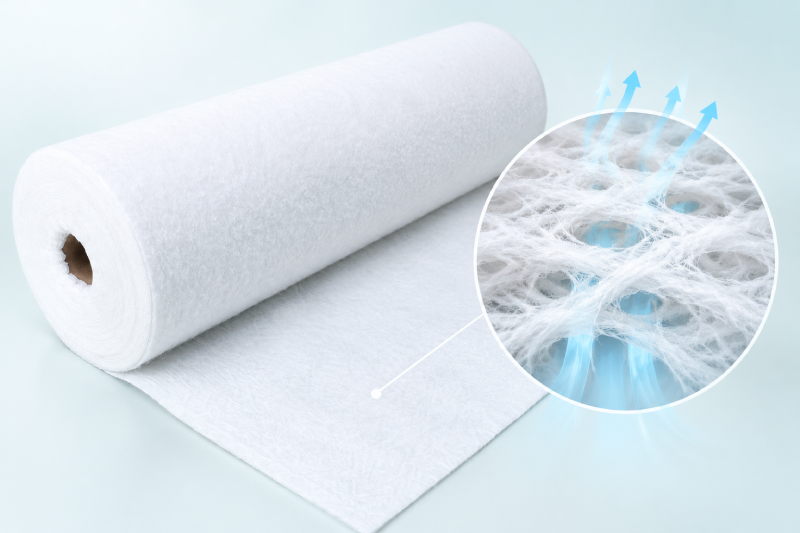
When sourcing vapor permeable floor protection, buyers should not rely solely on the product name, marketing description, or appearance. A more reliable approach is to request technical documentation for the specific product construction and confirm the basis of the reported test results.
First, clarify exactly what the supplier means by "breathable." Buyers should determine whether the product has water vapor transmission data, rather than assuming that descriptions such as "breathable," "absorbent," and "moisture-resistant" refer to the same property.
Second, review the test method and reporting conditions. Different test methods, temperatures, relative humidity levels, specimen conditions, and testing procedures can affect the results. Numbers from different products may therefore not be directly comparable. When comparing suppliers, check whether the data were obtained under comparable test conditions.
Third, confirm which product construction the data represent. If the protective fleece consists of nonwoven fabric, a film, an adhesive layer, or other composite layers, the performance of one individual layer should not be used to infer the water vapor permeability of the entire product. Buyers should verify the relevant data for the finished product being supplied.
Finally, evaluate the test data against the requirements of the intended flooring. Even when a material has documented vapor permeability, a single figure is not enough to establish that it is suitable for a particular natural stone, solid wood, or engineered wood floor. Where necessary, confirm the covering requirements with the flooring manufacturer or the project's technical representative.
5. Why Must Adhesive Compatibility with the Floor Surface Also Be Confirmed?
Some breathable floor protection products use a self-adhesive backing to help keep the material in position during installation. However, backing compatibility and vapor permeability are two separate considerations.
The floor's surface coating, finish, dryness, and manufacturer's instructions may all affect whether an adhesive is suitable. On sensitive surfaces, an unsuitable adhesive may leave residue or cause discoloration, changes to the coating, or other surface damage.
Buyers should therefore confirm two things: whether the protective material's vapor permeability meets the project requirements, and whether its backing or adhesive is suitable for the intended surface. A product should not be assumed safe for every natural stone or wood floor simply because it is described as breathable.
For self-adhesive products, provide the supplier with details of the flooring type, surface finish, and expected coverage conditions. Follow the instructions provided by both the product supplier and the flooring manufacturer. Where necessary, confirm compatibility on a representative area before applying the material over a larger surface.
For further information on adhesion, residue, and surface-damage considerations for hardwood flooring, refer to the hardwood floor self-adhesive protection compatibility testing guide. The specific testing and application requirements should still be determined according to the actual flooring and product documentation.
6. How Should Buyers Include Vapor Permeability Requirements in an RFQ?
When a project has specific vapor permeability requirements, the request for quotation (RFQ) should describe them clearly instead of simply stating that a "breathable floor protection fleece" is needed.
Buyers can identify the flooring type, such as natural stone, solid wood, or engineered wood, and specify whether the floor is newly installed, recently finished, or has already reached the condition required by the manufacturer for use.
They should also describe the construction activity, expected coverage duration, site temperature and humidity conditions, and whether the protective material may be exposed to water, paint, or other liquids during the work. This information helps the supplier identify which material properties need to be checked, but it does not replace the flooring manufacturer's technical requirements.
For product performance, request relevant water vapor transmission data, the test method, and confirmation of the product construction to which the data apply. If liquid water resistance is also required, specify it separately rather than treating it as the same property as vapor permeability.
If a self-adhesive backing is required, provide information about the target surface finish and ask about adhesive compatibility and any limitations. During sample evaluation, buyers can review the technical documentation and check whether the product is suitable for the intended conditions before proceeding with a bulk order.
For importers, wholesalers, and private-label brands that need consistent supply and customized specifications, working with a factory experienced in needle-punched nonwoven and composite material production can make it easier to discuss product construction, technical documentation, and customization requirements. HuiZhou JinHaoCheng Nonwovens Co., Ltd. provides manufacturing and customization services for nonwoven and related composite materials. However, the specific vapor permeability, adhesive compatibility, and intended applications of any product should be confirmed using its technical data, sample evaluation, and project requirements.
Conclusion: Do Not Rely on a Waterproof Label Alone
For natural stone, solid wood, and engineered wood flooring, liquid water resistance and water vapor permeability should be evaluated separately when selecting temporary floor protection. Whether breathable protection is needed depends on the flooring type, construction stage, floor moisture condition, environmental conditions, and the flooring manufacturer's requirements.
When sourcing breathable floor protection fleece, buyers should verify the water vapor transmission data for the finished product and confirm that its backing or adhesive is compatible with the intended surface. Breathability does not eliminate every risk of moisture accumulation, nor does it replace appropriate floor drying, curing, or construction management.
By evaluating the material's performance alongside the flooring conditions and actual project requirements, buyers can make a more informed decision about whether a particular protective fleece is suitable for the intended application.