
Cast Padding Rolls for Medical Converters: Width, Length and Converting Specifications
For medical consumables manufacturers, sourcing Cast Padding is not simply a matter of selecting a needle-punched nonwoven material. Roll width, length, diameter, core type, winding condition, and subsequent converting and packaging requirements can all affect whether the material fits smoothly into an existing production process.
If buyers purchase finished small rolls that have already been converted to their final dimensions, the supplier needs to focus on the finished product specifications and packaging requirements. However, if buyers source jumbo rolls or specified-width rolls for further processing, they also need to consider slitting, rewinding, length control, and equipment compatibility.
Therefore, before requesting a quotation or placing an order, medical consumables manufacturers should first define their purchasing format, equipment conditions, and finished product requirements, then confirm the material specifications and converting arrangements with the supplier.
Why Do Medical Consumables Manufacturers Source Cast Padding in Roll Form?
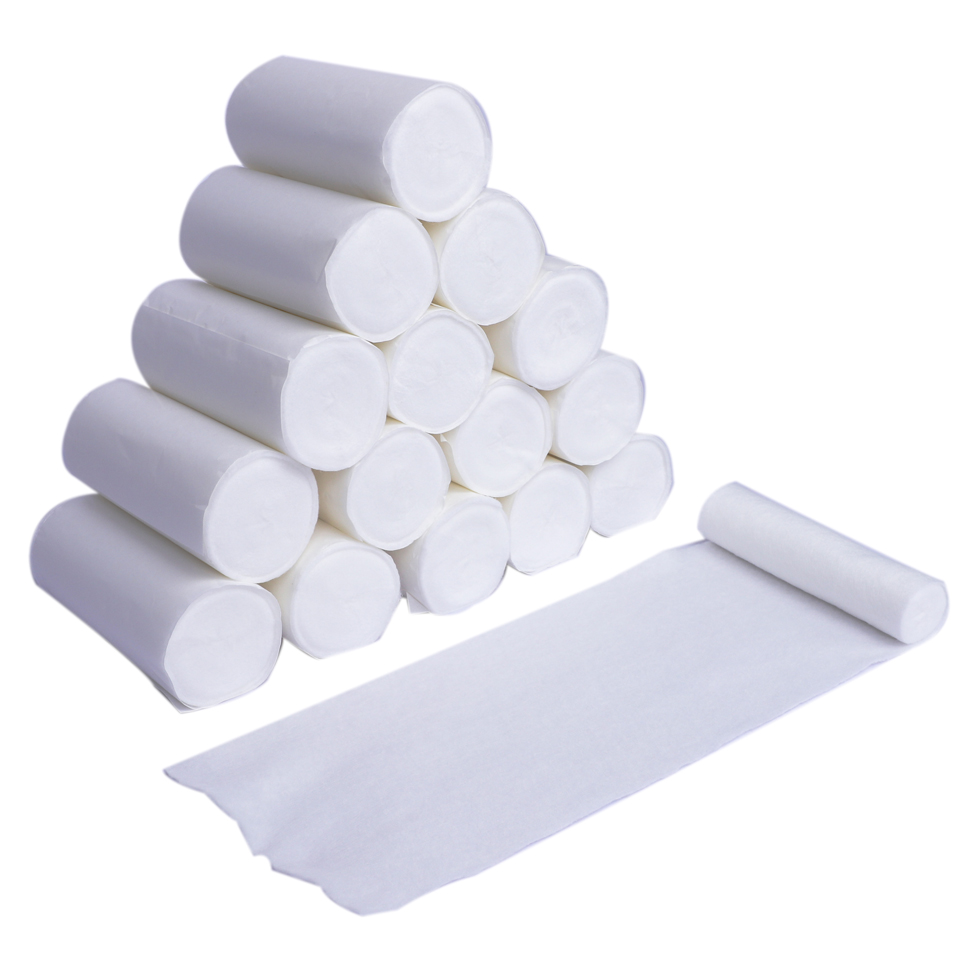
Cast Padding Rolls are a common raw material supply format in medical consumables manufacturing. For manufacturers that need continuous material feeding, slitting, or rewinding, roll-form materials can be coordinated with their downstream production processes, making it easier to arrange material usage according to the finished product design and production schedule.
Compared with purchasing finished products that have already been fully packaged, sourcing rolls usually gives buyers more flexibility to determine material dimensions and delivery formats according to their own converting processes. For example, some converters may require specified-width rolls to fit their existing equipment, while others may need larger raw material rolls for further slitting, length cutting, and packaging.
When sourcing cast padding rolls, buyers should first clarify which supply format they need instead of simply telling the supplier that they require Cast Padding Rolls.
For medical consumables manufacturers, purchasing requirements can generally be divided into the following categories.
Jumbo Rolls or Raw Material Rolls: These are suitable for buyers who plan to carry out further slitting, length cutting, rewinding, or other converting processes themselves. When requesting a quotation, buyers should provide their equipment requirements, target width, and finished product specifications.
Specified-Width Rolls: These are suitable for buyers who already know the required feeding width of their equipment or the dimensions needed for downstream processing and want the supplier to provide rolls according to project requirements.
Finished Small Rolls: These are suitable for buyers who want rolls that have already been converted according to their final product dimensions and packaging requirements. In this case, buyers should also confirm the length per roll, roll diameter, core type, weight per roll, and packaging method.
Different purchasing formats involve different converting responsibilities and inspection requirements. Buyers should clarify during the quotation stage which processing steps will be handled by the supplier and which will be completed at their own factory.
Differences Between Cast Padding Rolls and Sheets
Cast Padding can be discussed in either roll or sheet form according to customer requirements. The main differences are the delivery format and the subsequent processing arrangements. Neither format is automatically better for every buyer.
Roll-form materials are more suitable for manufacturers that require continuous material feeding, slitting, or processing according to their production schedules. For companies with roll converting equipment, roll dimensions can be planned according to equipment requirements.
Sheet-form materials are suitable for purchasing requirements where individual sheet dimensions have already been defined and the buyer wants materials that can be used directly or further packaged. Buyers can specify sheet length, width, material specifications, and packaging quantities according to the final product design.
If buyers already have slitting and rewinding equipment, sourcing rolls may better match their production arrangements. If they prefer not to carry out these processes at their own factory, they can discuss with the supplier whether rolls or sheets can be supplied according to their specified requirements.
For medical consumables manufacturers, the key is not simply to compare the prices of rolls and sheets. Buyers should also consider how many converting steps are required after the material arrives at their factory and whether these steps will increase production costs or material waste.
Roll Width, Length, Diameter, and GSM Requirements
When sourcing orthopedic padding rolls, roll specifications need to match downstream equipment and finished product requirements. Providing only the material name or a target GSM is usually not enough to define a complete purchasing specification.
Roll Width
Roll width is one of the important parameters affecting equipment compatibility. If the roll width does not match the feeding requirements of the equipment, additional slitting may be necessary, increasing processing steps and material waste.
When requesting a quotation, buyers should provide the target roll width and clarify whether it refers to the supplied raw material width or the finished product width.
For projects requiring special dimensions, buyers can discuss custom roll width and slitting options with the supplier. The supplier should confirm the achievable width and relevant processing conditions according to the order requirements.
Roll Length
Roll length affects the amount of material available per roll, roll change frequency, weight per roll, and packaging arrangements.
If buyers require finished rolls with a fixed length, they should specify the required length per roll and whether any length tolerance is acceptable. For jumbo rolls, the suitable length should be confirmed according to the production plan, equipment capacity, and weight requirements for each roll.
Roll length should not be determined separately from roll width, material GSM, and weight per roll. For customized orders, it is recommended that buyers check both the roll dimensions and the actual winding condition during sample approval.
Roll Diameter
Roll diameter is a specification that buyers may overlook, but it can directly affect equipment compatibility.
If the outside diameter of a roll exceeds the equipment's loading capacity, the roll may not fit or feed properly. If the roll diameter does not match the buyer's storage, transportation, or processing arrangements, it may also make handling more difficult.
Therefore, buyers should provide the maximum roll diameter allowed by their equipment and, when necessary, explain the available loading space and feeding method. The roll diameter can be adjusted according to customer equipment requirements. The specific arrangement should be confirmed based on material thickness, roll length, winding method, and weight per roll.
Core Size and Type
The roll core needs to match the loading structure of the buyer's equipment. Buyers should specify the core type, inner diameter, and any other installation requirements.
Paper cores and other core options can be discussed, but the actual materials, dimensions, and available choices need to be confirmed according to the order.
GSM and Thickness
In addition to roll dimensions, the material's GSM and thickness should also be included in the purchasing specifications.
GSM indicates the weight per unit area, while thickness describes the material's dimensional thickness. These two parameters are not completely interchangeable. For needle-punched nonwoven Cast Padding, fiber composition, needle-punched structure, and production conditions can also affect the final material characteristics.
Therefore, buyers should provide the target GSM, thickness, and, when necessary, a reference material sample instead of judging whether a material meets their requirements based on GSM alone.
For more information about the relationship between GSM, thickness, and material structure, please refer to Cast Padding Thickness and GSM Specifications.
Slitting, Rewinding, and Material Edge Quality
For medical consumables manufacturers that need to convert raw material rolls into specified dimensions, slitting and rewinding are important processes that should be discussed in advance.
If the supplier can support these processes, buyers can discuss roll slitting, length control, and rewinding according to their finished product dimensions and production equipment requirements.
Slitting
Slitting is mainly used to convert original rolls into specified widths. Buyers should provide the target width, required number of slit rolls, and final application requirements.
For projects involving multiple specifications, buyers should also clarify the quantity required for each size to avoid misunderstandings during production planning and packaging.
Rewinding
Rewinding can affect the final roll diameter, core type, winding condition, and weight per roll. Buyers should explain how the rolls need to be loaded onto their equipment and whether a particular winding direction or method is required.
If the finished product requires a fixed roll length, the required length per roll and acceptable tolerance should also be clarified before rewinding.
Length Control
If buyers purchase finished small rolls converted to specified lengths, they should clearly state the target length per roll, the number of rolls, and the inspection method.
For companies that require continuous processing, fixed roll lengths can help organize downstream production and packaging schedules. However, the achievable specifications still need to be confirmed according to the material and order conditions.
Edge Quality
The edge quality of slit materials also needs attention. Uneven edges, inconsistent widths, or localized damage may affect subsequent processing and the appearance of the finished product.
Therefore, buyers should define their edge quality requirements during sample approval and include roll width, edge condition, and acceptable tolerances in the inspection criteria.
For bulk orders, the supplier should carry out inspections according to the confirmed quality requirements to help ensure that delivered rolls remain consistent with the approved samples and order specifications.
Relationship Between Fiber Composition and Roll Converting
The fiber composition of Cast Padding affects the material structure and its application characteristics. It should therefore be confirmed as part of the purchasing specifications.
Common fiber options include 100% Polyester, 100% Cotton, and Polyester-Viscose. Different projects can discuss suitable material compositions and customized options according to the finished product requirements.
However, fiber composition alone cannot determine whether a roll is suitable for a particular converting machine. Thickness, GSM, material structure, winding condition, and dimensional requirements can also affect downstream processing arrangements.
For example, even if two materials use the same fiber composition, differences in thickness, density, or roll specifications may require different equipment settings or processing methods.
Therefore, buyers are advised to provide both their fiber composition requirements and roll converting specifications when requesting a quotation. If they already have a material in use, they can send a reference sample to help the supplier understand the actual material structure and target specifications.
For more information about the characteristics of different fibers, please refer to Fiber Composition Options for Orthopedic Cast Padding before finalizing the roll specifications.
What Drawings and Samples Should OEM Buyers Provide?
For OEM brands and medical consumables manufacturers, providing clear technical information helps reduce communication gaps between quotation, sampling, and bulk production.
If buyers provide only a product picture or a brief request for Cast Padding Rolls, the supplier may not be able to accurately determine the material specifications, roll dimensions, and converting requirements.
The following information is recommended during the quotation stage.
Finished Product Drawings or Dimensional Requirements
Provide the dimensions, structure, or technical drawings of the finished product so the supplier can understand how the material will ultimately be used. If the product involves multiple specifications, list the dimensions and purchasing quantities for each one separately.
Material Specifications
Specify the fiber composition, GSM, thickness, color, and any other necessary requirements. If there is an existing reference material, it is recommended that buyers provide a sample for comparison.
Roll Dimensions
Specify the target roll width, length, diameter, core type, and weight requirements per roll. If some parameters have not yet been finalized, buyers can first provide their equipment limitations so the supplier can help discuss feasible options.
Converting Requirements
Clarify whether the supplier needs to carry out slitting, rewinding, or length control, and specify the required final roll dimensions. For orders involving multiple widths or lengths, provide a clear specification list.
Equipment Information
If the rolls need to feed directly into the buyer's production equipment, provide the relevant loading and feeding requirements, such as maximum roll diameter, core dimensions, feeding width, and any other necessary limitations.
Packaging Requirements
Explain whether independent roll packaging, outer carton packaging, product labels, batch labels, or other identification information is required. For private-label orders, buyers should also provide label content and packaging requirements in advance.
The more complete the information, the easier it is for both parties to clarify material specifications, dimensions, and converting responsibilities before sampling. This can also reduce the risk of misunderstandings about specifications during bulk production.
How to Ensure Packaging and Specification Consistency in Bulk Orders
Sample approval does not mean that specification management can be omitted from bulk orders. For medical consumables manufacturers, material consistency, roll dimensions, and packaging identification should all be clearly confirmed before mass production begins.
Before placing a bulk order, buyers and suppliers are advised to confirm the following details.
Material Specification Consistency
Confirm the fiber composition, GSM, thickness, and other agreed material indicators. The approved sample or mutually confirmed technical specifications should serve as the production reference.
Roll Dimension Consistency
Confirm the required roll width, length, diameter, and core type for each specification. For customized rolls, the acceptable tolerance for each dimension should also be defined to avoid inconsistencies between different production batches.
Converting and Edge Quality
Confirm the slitting width, rewinding condition, length requirements, and edge quality inspection standards. For orders with special equipment requirements, converting samples should be checked for compatibility before bulk production begins.
Packaging and Labels
Confirm independent roll packaging, outer carton labels, batch labels, and other details according to the order requirements. Label information should correspond to the actual product specifications and order details to facilitate subsequent warehousing, identification, and batch management.
Weight per Roll and Transportation Requirements
There are practical limits on the weight of each roll. These should be calculated during order confirmation based on roll dimensions, material GSM, and packaging requirements. Weight per roll should not be determined by roll length alone, and packaging and transportation conditions should not be overlooked.
For long-term cooperation projects, it is recommended that buyers retain approved material samples, specification lists, and packaging confirmation records. Subsequent repeat orders can then be produced and inspected according to the confirmed standards.
HuiZhou JinHaoCheng Nonwovens Co., Ltd. supplies customized needle-punched nonwoven Cast Padding rolls and can discuss roll width, slitting, rewinding, length control, roll diameter, core type, and packaging arrangements according to customer project requirements. Specific specifications and converting arrangements need to be confirmed based on material requirements, equipment conditions, and order quantities.
If you are sourcing custom orthopedic cast padding rolls, it is recommended that you provide the material specifications, roll dimensions, equipment requirements, and reference samples together when requesting a quotation. This will help the supplier evaluate a more suitable customization plan.
For medical applications, buyers should also confirm material suitability according to the regulatory and application requirements of the final product. This product is supplied in non-sterile form. If a project requires sterile materials or compliance with specific medical regulations, these requirements should be confirmed separately before placing an order.




