
Medical Cast Padding Quality: Skin Contact, Linting and Sterilization Considerations
When sourcing Medical Cast Padding, medical consumables brands and importers should look beyond GSM, thickness, and price. For orthopedic padding materials that come into contact with human skin, material composition, surface condition, fiber shedding, foreign matter control, batch consistency, and the sterility status at the time of supply can all affect downstream product quality reviews and market validation.
It is particularly important to understand that materials intended for medical applications, non-sterile medical materials, and finished sterile medical products are not the same thing. Even if a supplier provides needle-punched nonwoven raw materials or non-sterile padding with a material composition suitable for a project, this does not automatically mean that the material has completed biocompatibility evaluation or sterilization validation.
For medical product manufacturers, the correct purchasing approach is to first define the intended use of the finished product, its contact conditions, and the target market. Buyers can then determine the required material quality criteria, testing items, and documentation. This helps avoid situations where the material documentation is found to be insufficient to support final product validation only after sample approval or bulk production.
The Position of Cast Padding in the Medical Supply Chain
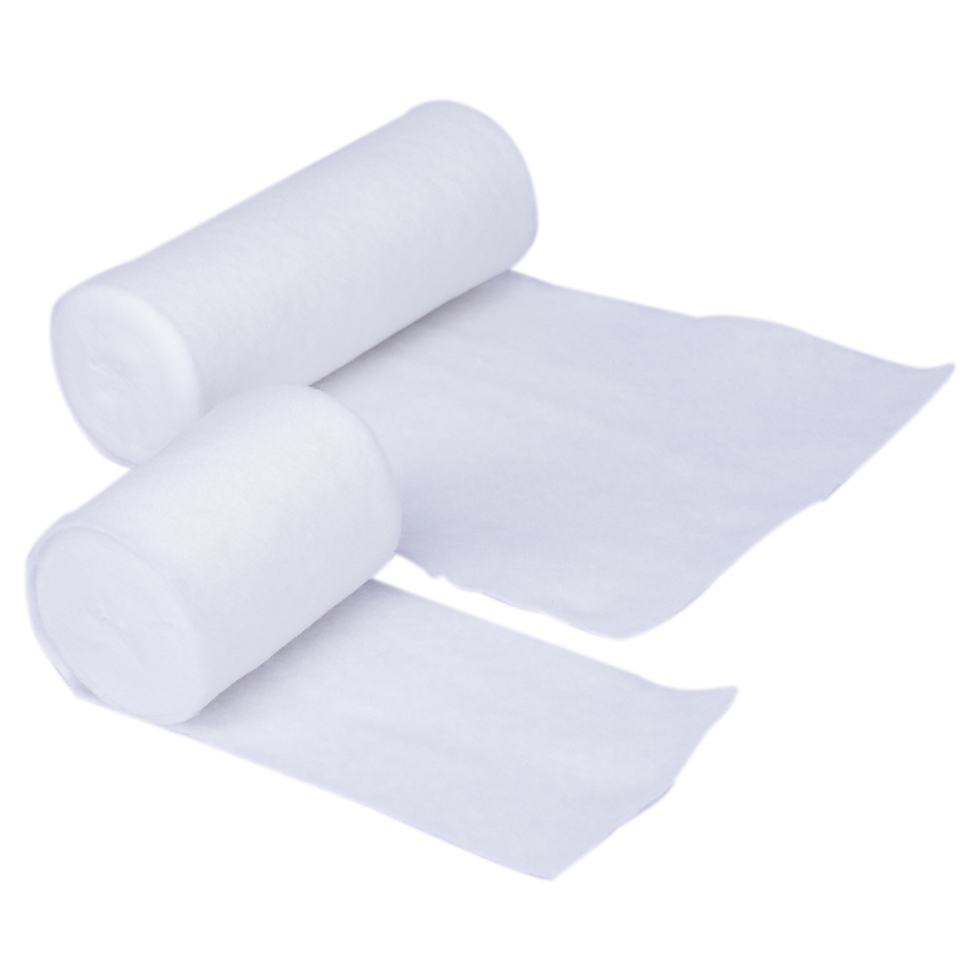
Cast Padding is a type of padding material used in plaster and fiberglass casting systems, generally serving as a cushioning layer within the casting system. For material suppliers and medical consumables converters, it is important to clarify whether the purchase involves raw materials, non-sterile semi-finished materials, or finished medical products.
These three supply chain stages do not have the same quality responsibilities.
Raw Material
Raw materials generally refer to needle-punched nonwoven materials supplied for further processing. Buyers should pay attention to fiber composition, GSM, thickness, softness, material structure, appearance, and batch consistency.
At this stage, the material specifications and quality documentation provided by the supplier can help downstream manufacturers determine whether the material meets their product design requirements. However, raw material specifications alone cannot prove that the final medical product has met all applicable biological safety and regulatory requirements.
Non-Sterile Semi-Finished Product
If the material has already undergone specified-width slitting, rewinding, length cutting, or other processing but has not undergone final product sterilization, it should still be identified and managed according to its actual supply condition.
Processed material may be closer to the dimensions and delivery format required by downstream manufacturers. However, completing these converting steps does not mean that the product is sterile or that final medical product validation has been completed.
Finished Medical Product
The finished medical product is validated by the manufacturer responsible for its design, production, and market placement according to its intended use. Relevant activities may involve material safety evaluation, product performance, packaging, sterilization, and target-market regulatory requirements.
Therefore, buyers should clarify which supply chain stage the supplier is delivering at the quotation stage. The presence of words such as Medical or Orthopedic in a product name does not mean that the material has obtained medical device registration, product certification, or sterile status.
What Basic Quality Requirements Should Be Considered for Skin-Contact Materials?
For orthopedic cast padding, skin contact conditions are an important starting point for material evaluation. However, buyers should not assume that all products have identical biological safety requirements simply because they are used in casting systems.
First, buyers need to clarify the actual position of the material in the finished product and whether it comes into direct contact with human skin.
Contact Site and Duration
Contact with intact skin, damaged skin, or wounds involves different risk assessment considerations. Contact duration, contact area, frequency of use, and the structure of the finished product can also affect the scope of material evaluation.
For example, the evaluation conditions for padding intended only for contact with intact skin differ from those for materials that directly contact wounds. If a material is designed for direct contact with damaged skin or other tissues, it needs to be assessed according to its specific intended use.
Therefore, buyers should explain the actual contact site, expected contact duration, and whether direct wound contact is involved when requesting a quotation. A general material specification provided by a supplier should not be used to assume that a product is suitable for every skin-contact application.
Fiber Composition and Material Information
Cast Padding can use different fiber compositions, such as 100% Polyester, 100% Cotton, and Polyester-Viscose, and customized compositions can also be discussed according to project requirements.
For medical material sourcing, fiber names are only basic information. Buyers also need to understand the actual material composition, relevant raw material information, and whether other additives or composite layers are present.
If the finished product requires biological safety evaluation, material composition information should be as accurate as possible and consistent with the samples submitted for testing and the materials supplied in bulk.
Surface Condition and User Comfort
The material surface should meet the agreed appearance and application requirements. Buyers can pay particular attention to obvious hard spots, localized clumping, unusually rough areas, visible foreign matter, and other abnormal conditions that may affect product use.
Softness, thickness, and material structure should also be evaluated in relation to the finished product design. A material that feels soft does not automatically mean that it has passed skin irritation, sensitization, or other biological evaluation.
Biological Safety Evaluation
For finished medical products that come into contact with the human body, biological safety evaluation should be based on risk analysis considering material composition, contact site, contact duration, and intended use.
ISO 10993-1 provides a framework for the biological evaluation of medical devices. However, this does not mean that every medical nonwoven material must undergo exactly the same set of tests. The final manufacturer needs to determine whether existing data, additional testing, or other evaluation methods are required based on applicable regulations and product risks.
Therefore, buyers should not simply ask a supplier for "ISO 10993" without further explanation. They should clarify the contact conditions of the finished product, target market, and required evaluation scope.
Why Are Linting, Foreign Matter, and Material Consistency Important?
For needle-punched nonwoven Cast Padding, material surface condition and fiber structure stability are important aspects of purchasing quality evaluation.
If a material releases noticeable fibers during handling, slitting, rewinding, or downstream processing, this may affect the appearance of finished products, the processing environment, and material cleanliness. Therefore, buyers should not only check whether samples feel soft or meet the required thickness. They should also observe how the material performs under actual handling conditions.
Fiber Shedding (Linting)
Linting refers to the release of loose fibers, fiber fragments, and other particles from a material during handling or use. For needle-punched nonwovens, buyers can conduct preliminary sample observations to check for loose surface fibers, edge shedding, and noticeable fiber release during handling.
If a project has specific linting requirements, buyers can discuss suitable test methods, sample conditions, and acceptance criteria with the supplier. For example, ISO 9073-10 is a test method used to measure lint and other particles generated by nonwoven materials in the dry state. Its suitability for a particular Cast Padding project should be confirmed according to the material structure and actual requirements.
It is important to understand that visual inspection and standardized linting tests are not the same thing. Without a test report, a statement such as "no obvious linting during visual inspection" should not be presented as proof that the material has passed a low-linting test.
Foreign Matter and Visible Contamination
Buyers should also inspect the material surface for obvious foreign matter, impurities, abnormal color spots, oil stains, or other conditions that do not meet the agreed requirements.
For medical materials that require further converting or packaging, visual inspection of raw materials can help identify some visible abnormalities. However, it cannot replace microbiological testing, particle testing, or other specialized cleanliness evaluations.
If a project has specific cleanliness requirements, buyers should define the types of contamination being evaluated, testing methods, sampling methods, and acceptance limits instead of relying only on general descriptions such as "Medical Grade" or "Clean Material."
Material Batch Consistency
For medical consumables brands with ongoing purchasing requirements, batch-to-batch material consistency is often more important than the performance of a single sample.
Buyers should focus on fiber composition, GSM, thickness, width, surface condition, softness, and other material indicators agreed upon by both parties.
If there are significant differences in fiber structure, appearance, or dimensions between batches, downstream converting and finished product consistency may be affected. Therefore, buyers should retain approved samples and technical specifications and use the confirmed requirements as the quality acceptance reference for repeat orders.
Condition After Converting
For Cast Padding that requires slitting, rewinding, or length cutting, buyers should also inspect whether converting results in loose edges, localized damage, dimensional irregularities, or other conditions that may affect use.
If the material will undergo further packaging or assembly, samples should be evaluated under conditions as close as possible to the actual production process. Raw material samples meeting the requirements does not guarantee that the material will maintain the same condition after every downstream processing step.
What Is the Difference Between Non-Sterile Supply and Finished Sterile Medical Products?
Non-Sterile Cast Padding and Sterile Cast Padding must not be treated as interchangeable terms.
Non-sterile padding supplied by a material supplier may be used as raw material or a semi-finished component in downstream medical product manufacturing. However, it cannot be labeled or promoted as sterile solely because it is intended for medical use or because the supplier operates under a quality management system.
Non-Sterile Raw Materials or Semi-Finished Materials
Non-sterile supply means that the material has not been confirmed to be in a validated sterile state at the time of delivery. Buyers should understand the actual supply condition, packaging method, and subsequent processing requirements.
If the finished product requires sterile supply, the medical product manufacturer must arrange subsequent sterilization and relevant validation according to the product design and applicable regulations.
Finished Sterile Medical Products
Finished products need to undergo the applicable sterilization process validation, packaging system validation, and necessary confirmation of storage and transportation conditions.
Different sterilization methods may affect materials in different ways. For example, after sterilization, the material's color, softness, structure, strength, or other properties may change. Therefore, test results obtained before sterilization alone cannot prove that the final sterilized product still meets its original specifications.
For projects using ethylene oxide or radiation sterilization, medical product manufacturers should determine the relevant process validation and routine control requirements according to applicable sterilization standards and target-market regulations.
Sterile Packaging and Sterile Status
Sterile status involves more than the sterilization process itself. It also depends on a packaging system capable of maintaining sterility and on packaging integrity throughout storage and transportation.
If the finished product is marketed as sterile, the manufacturer should verify the packaging system and sterilization process according to applicable regulations. Ordinary packaging provided by a raw material supplier cannot replace sterile barrier packaging validation for the finished medical product.
Therefore, buyers should clearly distinguish between three purchasing requirements: non-sterile Cast Padding raw materials, materials intended for subsequent sterilization, and finished sterile products supplied directly by the supplier.
These three requirements involve different production responsibilities and validation scopes. They should not be replaced by a general statement such as "Medical Grade" in a purchase order.
What Material and Finished Product Documents Should Medical Product Manufacturers Confirm?
When evaluating Cast Padding suppliers, medical consumables brands and importers should review not only the samples but also the quality documentation available for the actual supplied materials.
The purpose of documentation is not simply to show how many certifications a supplier holds. It is to help buyers confirm whether material identification, specifications, inspection criteria, and batch information can support their own product validation activities.
Material Specification
Buyers should confirm whether the material specification includes fiber composition, GSM, thickness, width, color, softness, and other agreed technical parameters.
For customized Cast Padding, buyers should also ensure that the material information in the specification matches the actual purchased product, rather than using a general nonwoven specification sheet as a substitute for product-specific documentation.
Material Composition Declaration
If the finished product requires biological safety evaluation, accurate material composition information is important. Buyers should confirm whether the supplier can identify the fiber composition of the supplied material and disclose any other materials or processing layers that need to be included in the evaluation.
If the product structure or raw materials change, buyers should also assess whether the relevant technical documentation needs to be updated or whether product validation needs to be repeated.
Inspection Report
According to project requirements, buyers can confirm whether the supplier can provide inspection records corresponding to the actual product.
These may include GSM, thickness, dimensions, appearance, edge quality, and other indicators agreed upon by both parties.
If buyers have specific concerns about linting, particles, or other cleanliness indicators, they should request the corresponding test method and report instead of treating ordinary visual inspection records as specialized test reports.
Product Test Report
If a supplier provides third-party test reports, buyers should check the sample name, material composition, test items, test methods, test date, and applicable scope stated in the report.
In particular, test reports for other products or different material compositions cannot automatically prove that the Cast Padding currently being purchased has passed the same tests.
If the finished medical product requires biological safety evaluation, buyers should also confirm whether the tested sample represents the actual bulk-supplied material and whether the report can support the risk evaluation of the finished product.
Batch Traceability and Quality Records
For ongoing purchasing projects, batch identification and quality traceability are also important.
Buyers can confirm whether the supplier can provide batch identification, production batch information, specification records, and relevant inspection documents according to order requirements.
If a material issue occurs later, clear batch information can help buyers and suppliers identify the affected product batches and conduct further investigation.
Quality Management System Certificates
A supplier's ISO 9001 or ISO 13485 certificate can be part of the supplier evaluation process and provide background information about its quality management system.
However, it is important to understand that ISO 13485 is a quality management system standard for medical devices. It is not a product certification for a specific Cast Padding material, and it does not independently prove that a product is sterile or has passed biocompatibility testing.
During supplier evaluation, buyers should also check the certificate holder, validity status, certification scope, and whether the relevant business activities are covered.
For product-related certifications such as OEKO-TEX STANDARD 100, buyers should verify the specific products, materials, and scope covered by the certificate. A company holding a particular certification does not automatically mean that every Cast Padding product falls within its certified scope.
Finished Product Validation Documents
Finished medical product manufacturers also need to manage the relevant product validation documentation according to product design and target-market requirements.
These documents may involve biological safety evaluation, product performance, sterilization validation, sterile packaging validation, risk management, and other applicable regulatory documentation.
Such activities generally cannot be replaced by a raw material specification sheet or the supplier's company-level quality management certificate. Buyers should clarify which documents will be provided by the raw material supplier and which need to be completed by the finished product manufacturer or its designated testing organization.
How Do Target Markets and Final Medical Applications Affect Compliance Validation?
The purchasing requirements for medical Cast Padding cannot be determined by the material name alone. The intended use of the finished product, contact site, contact duration, and target sales market all affect the required quality review and validation scope.
Different Contact Conditions Require Different Evaluation Approaches
If the padding is intended only for contact with intact skin, its material evaluation requirements differ from those for products that directly contact wounds or damaged tissue.
If the product design, material composition, or contact method changes, previous evaluation conclusions may not necessarily remain applicable. Therefore, buyers should define the final application during the early stages of product development rather than waiting until bulk production is about to begin.
Regulatory Requirements May Differ Between Markets
For medical products intended for the US market, the applicable FDA requirements should be determined according to the intended use and regulatory status of the finished product.
For medical devices intended for the EU market, the applicable EU MDR requirements should be assessed according to the intended purpose and classification of the product.
Different markets may have different requirements for product registration, technical documentation, quality management, and market placement. A supplier's ISO certificate alone cannot establish that a finished product meets all US or EU regulatory requirements.
Responsibilities Between Suppliers and Finished Product Manufacturers Must Be Defined
Material suppliers are mainly responsible for supplying materials according to the specifications and order requirements agreed upon by both parties, as well as providing the material information and quality documentation they can actually support.
Finished medical product manufacturers are responsible for completing applicable risk management, product validation, and regulatory compliance activities according to product design, intended use, and target-market requirements.
If a project requires biocompatibility testing, specific cleanliness testing, or sterilization compatibility evaluation, both parties should define the samples, test methods, acceptance criteria, and documentation responsibilities during the development stage.
For medical purchasing projects, the most effective approach is not to ask suppliers for every possible medical certification in a general quotation email. Instead, buyers should provide clear information about the product application, material contact conditions, target market, and validation requirements.
HuiZhou JinHaoCheng Nonwovens Co., Ltd. supplies customized needle-punched nonwoven Cast Padding and can discuss different fiber compositions, GSM, thickness, softness, and supply formats. The current product is supplied in non-sterile form. Requirements involving skin contact, biological safety, linting tests, cleanliness, and final product sterilization validation should be confirmed individually according to the specific project, material specifications, available test documentation, and target-market requirements.
If you are sourcing medical orthopedic cast padding material, we recommend providing the intended use of the finished product, contact site, expected contact duration, target market, and required quality documentation when requesting a quotation. This helps both parties clarify material requirements, validation scope, and their respective quality responsibilities before proceeding with samples and orders.




