
Color-Coded Cleaning Cloth Programs: How to Plan for Commercial Cleaning
For hotels, restaurants, property management companies, and professional cleaning service providers, purchasing cleaning cloths involves more than selecting materials, sizes, and prices. When the same facility requires cleaning in kitchens, bathrooms, guest rooms, office areas, and public spaces, employees also need a clear way to identify which cloth is intended for each area or task.
Color coding provides a visual identification method. Businesses can assign different cloth colors to specific areas or cleaning tasks according to their internal cleaning procedures. This makes it easier for employees to identify where each cloth should be used and how it should be sorted, washed, and stored after use.
However, color management is not simply a matter of purchasing cloths in several different colors. For bulk buyers, it is also necessary to consider color allocation rules, labels, sizes, packaging, the quantity required for each color, and how products will be replenished over time.
This article explains how to plan a practical color-coded cleaning cloth program from a commercial purchasing and daily management perspective, including the product specifications buyers should confirm with suppliers before ordering.
Why Do Commercial Cleaning Programs Need Color Coding?
Hotels, restaurants, office buildings, and property management projects usually contain multiple cleaning areas. Each area may have different cleaning tasks, usage frequencies, and management requirements.
For example, a restaurant may need to manage food preparation areas, washing areas, and dining spaces separately. A hotel may have guest rooms, bathrooms, corridors, and public facilities. Property cleaning teams may be responsible for offices, public restrooms, elevators, and other shared spaces at the same time.
If all cleaning cloths have the same color, employees must rely on memory, verbal instructions, or other identification methods to determine their intended use. When several employees work in shifts or cleaning staff move between different areas, identification and management can become more complicated.
Color coding provides a straightforward visual identification method for daily operations. A business can establish rules that assign specific colors to designated areas or tasks, making it easier for employees to identify cloths when taking them out, using them, collecting them, and sorting them.
For buyers, this also means that cleaning cloths do not always need to be purchased as one uniform product. A commercial cleaning project may require several colors within the same product range, with purchasing quantities determined by the actual usage requirements of each area.
It is important to understand that color itself does not disinfect surfaces or independently prevent the spread of bacteria or cross-contamination. Color coding is a management aid that helps employees follow cleaning procedures already established by the business. Specific area assignments and cleaning requirements should follow the company's internal hygiene procedures and applicable local regulations.
How Should Businesses Assign Colors to Different Cleaning Areas?
Before purchasing cleaning cloths in different colors, businesses should identify which areas need to be separated and which cleaning tasks belong to each area.
Color allocation should start with actual operating procedures rather than selecting several colors first and trying to assign them to different areas afterward.
Restaurant and kitchen areas
Commercial kitchens usually include food preparation counters, washing areas, equipment surfaces, dining areas, and beverage preparation stations. Businesses can establish color identification rules for these areas according to their own hygiene management requirements.
For example, a restaurant may assign different colors to food preparation areas and general floor-cleaning tasks. The specific colors should be determined by the restaurant or food service group's own procedures. No single color assignment should be treated as a universal rule for every country or business.
Hotel guest rooms and bathrooms
Hotel housekeeping involves different surfaces and tasks, including furniture, countertops, bathroom fixtures, and other facilities. Management teams can assign separate color identifiers to different tasks according to their cleaning procedures, helping housekeeping staff distinguish where each cloth should be used.
For hotels operating across multiple floors or locations, it is helpful to keep the color rules consistent so that employees do not have to adapt to different identification systems at each workplace.
Office buildings and property management areas
Office buildings, shopping centers, and property management projects may include office desks, meeting rooms, corridors, elevators, public restrooms, and other shared facilities.
Property management companies can develop a color system based on their area divisions and staffing arrangements. Clear and consistent rules are particularly important for cleaning teams working across different floors, buildings, or shifts.
Professional cleaning service projects
Professional cleaning service providers may work at several customer locations at the same time. Different customers may also have their own hygiene management requirements.
Before purchasing, service providers should confirm whether each customer already has an established color-coding system. If different customers use different color rules, products may need additional identification through labels, packaging, and warehouse management to prevent products from different projects from being mixed.
Regardless of the application, the relationship between colors and cleaning areas should be clearly defined by the end user and documented in written procedures. The supplier is responsible for providing products according to the confirmed specifications, not for establishing the customer's hygiene management system.
Why Should Color Management Not Rely on Color Alone?
Color is one of the most straightforward identification methods, but relying on color alone may not always be sufficient in commercial cleaning environments.
For example, employees may need to collect cleaning cloths in storage areas with poor lighting. Different colors may also become difficult to distinguish because of lighting conditions, printing, or variations between material batches. If products are folded, packaged, or partially covered, visual identification may also become less convenient.
For this reason, buyers can consider combining color coding with other identification methods.
Combine colors with text labels
Packaging or labels can indicate the cleaning area, intended use, or product number. For example, a package can display both the color name and the designated cleaning area, helping employees confirm the product's intended use.
For businesses operating multiple branches or cleaning projects, labels may also include branch numbers, department names, or product codes.
Combine colors with product sizes
Different cleaning tasks may require different cloth sizes. Smaller cloths may be more suitable for localized wiping, while larger cloths may be more convenient for cleaning larger surfaces.
Businesses can select different sizes according to their actual working procedures. However, size should only serve as an additional identification method and should not replace formal color and usage rules.
Combine colors with storage locations
The collection, washing, and storage of used cleaning cloths should also be included in the management process. Businesses can designate separate storage locations according to color or cleaning area and use labels to help employees identify them.
For reusable cleaning cloths, washing, drying, inspection, and replacement should follow the company's established procedures. Color coding cannot replace these management steps.
Combine colors with packaging
If cleaning cloths in different colors are mixed in the same carton, warehouse staff and cleaning employees may need additional time to sort them.
Buyers can consider separate packaging by color, product kits organized by cleaning area, or carton labels that clearly indicate the color and quantity.
This allows color management to extend beyond purchasing into warehousing, distribution, and replenishment.
How Should Buyers Choose Cleaning Cloth Specifications for Different Tasks?
Color is only one part of a cleaning cloth's purchasing specifications. Even if two cloths have different colors, that does not necessarily mean they are suitable for the same cleaning task.
Buyers should also confirm material composition, GSM, thickness, dimensions, and product construction according to the intended application.
Material composition
Common cleaning cloth materials include polyester, viscose, bamboo fiber, and different blended fiber compositions. Different materials and blend ratios may influence absorbency, softness, durability, and handling characteristics.
If cleaning tasks differ significantly between areas, buyers can select suitable materials according to the specific requirements rather than relying on color alone to distinguish products.
GSM and thickness
GSM and thickness affect the overall construction, feel, and handling characteristics of a cleaning cloth. Buyers should confirm specifications according to actual usage requirements rather than assuming that a higher GSM always delivers better cleaning performance.
If a project requires several specifications, buyers should list the GSM and thickness requirements for each color separately in the inquiry. This helps prevent suppliers from quoting all colors based on one uniform specification when different products are required.
Dimensions
Product dimensions should match the cleaning area, employees' working habits, and folding methods.
For example, guest room cleaning, countertop wiping, and cleaning larger public areas may require different cloth sizes. For bulk orders, buyers should clearly specify the finished dimensions and acceptable dimensional tolerances.
Reusable cleaning requirements
If a business plans to use reusable cleaning cloths, it should also consider daily washing, drying, inspection, and replacement procedures.
Whether a product is suitable for repeated washing should be evaluated according to its material, construction, and actual washing conditions. A product should not be assumed to last indefinitely simply because it is labeled reusable.
For projects requiring several colors, buyers should confirm whether all colors will use the same materials and specifications. If different colors require different constructions or GSM levels, these details should be listed separately in the purchasing specification.
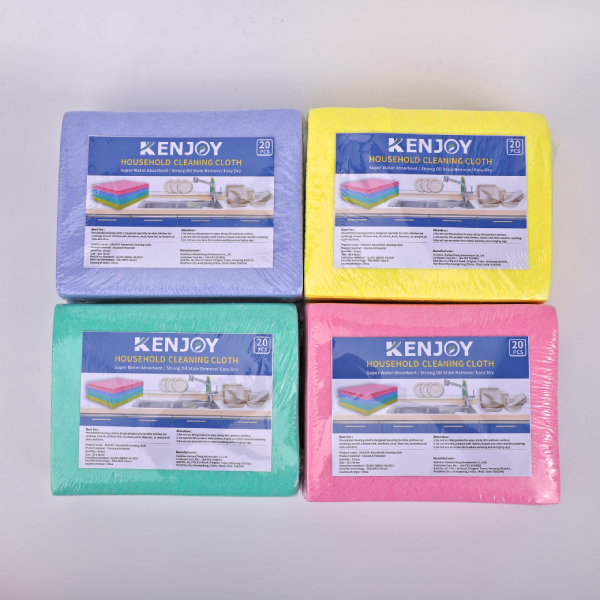
How Should Buyers Calculate Quantities for Different Colors in Bulk Orders?
The purchasing quantity for a commercial cleaning project should not simply be divided equally among all colors. Different areas may have significantly different floor areas, cleaning frequencies, employee numbers, and washing turnaround times.
If the actual consumption of each area differs, the required purchasing quantities for each color should also differ.
Buyers can estimate their requirements by considering the following factors.
First, calculate the actual usage requirements for each area.
List all areas that need to be managed and record how many employees work in each area, how many cleaning tasks are completed each day, and approximately how many cloths are needed for each task.
For example, a hotel with a large number of guest rooms may need more cloths for housekeeping, while public restrooms or food service areas should be estimated separately according to their actual cleaning frequency.
Second, consider usage across different shifts.
If a business operates morning, evening, or multiple shifts, it should determine how many cleaning cloths each shift requires and whether different shifts share the same inventory.
Purchasing based only on the requirements of one shift may result in insufficient available stock when used cloths have not yet completed washing and drying.
Third, calculate washing turnaround requirements.
For reusable cleaning cloths, purchasing quantities should also account for the time required for use, collection, washing, drying, and returning the cloths to service.
If the washing and drying process takes longer, businesses generally need enough cloths in circulation to avoid situations where all available products are being used or processed at the same time.
Fourth, reserve a reasonable amount of backup stock.
During daily operations, products may be damaged, lost, contaminated, or replaced earlier than expected. Buyers should therefore determine backup quantities according to their operating scale and replenishment lead time.
Backup stock should not be calculated using one fixed percentage for every business. It should be based on actual consumption records and the time required to replenish products.
Fifth, calculate the total quantity for each color separately.
After estimating area requirements, shift usage, washing turnaround, and backup stock, buyers can calculate the total demand for each color.
A purchasing list can be organized as follows:
Color | Designated Area | Main Task | Specification | Initial Order Quantity |
Color A | Area A | Daily surface cleaning | To be confirmed | Based on actual usage |
Color B | Area B | Restroom cleaning | To be confirmed | Based on actual usage |
Color C | Area C | Public area cleaning | To be confirmed | Based on actual usage |
Color D | Area D | Other designated tasks | To be confirmed | Based on actual usage |
This is only an example of a purchasing list, not a universal color allocation standard. Businesses should fill in the colors, areas, and quantities according to their own management procedures.
For hotel chains, restaurant groups, and large property management projects, buyers should also consider differences in demand between individual locations. One approach is to consolidate estimated requirements across all locations before preparing a centralized purchasing plan, while keeping separate consumption and replenishment records for each location.
How Should Buyers Plan Cleaning Cloth Packaging, Labels, and Replenishment?
If a business confirms colors only during its first purchase without considering future replenishment, it may still encounter problems such as mixed colors, inconsistent packaging, or difficulty identifying products from different batches.
For this reason, packaging and replenishment requirements should be clarified during the initial order stage.
Separate packaging by color
If each color corresponds to a different cleaning area, buyers can ask the supplier to package products separately according to the confirmed colors and quantities.
Buyers should specify how many cloths are required in each package, how many packages should be packed in each carton, and whether different colors need to be packed in separate cartons.
For projects with limited storage space, packaging should also be practical for handling, storage, and distribution to cleaning staff.
Add identification information to packaging
Packaging labels may include product names, colors, dimensions, materials, quantities, customer product codes, or designated cleaning areas.
If a customer already uses an internal product coding system, the relevant information can be provided during purchasing to confirm whether the supplier can follow the required packaging identification.
It is important that labels and packaging information match the actual products. Marking the color on the outer packaging alone cannot replace confirmation of the product's actual color and specifications.
Maintain specification records for repeat orders
Customers with long-term purchasing requirements should keep records of approved samples and product specifications, including material composition, GSM, thickness, dimensions, colors, packaging methods, and labeling requirements.
For future replenishment, the mutually approved specifications and samples should serve as the reference. Buyers should not rely only on product names or descriptions from previous purchase orders.
Confirm color consistency requirements
Products from different batches may be affected by materials, dyeing, or other production conditions. If color consistency is important to the buyer, the reference color sample, acceptable color variation, and agreed confirmation method should be clarified before ordering.
The supplier needs to confirm the actual color control capabilities, color variation standards, and batch management procedures according to the specific product and production conditions.
How Can Brands Integrate Color Management into Private-Label Products?
For cleaning product importers, wholesalers, and private-label customers, color is not only a way to distinguish cleaning areas. It can also become part of product range management.
For example, a brand can develop different color-coded cleaning cloth ranges according to its target customers' cleaning management needs. Packaging, labels, and product codes can then help end users identify each product.
If a brand sells household cleaning products, restaurant cleaning supplies, and property cleaning products at the same time, it can organize product ranges according to different markets and applications rather than selling all cleaning cloths as one general-purpose product.
For OEM/ODM purchasing, buyers should confirm the following details in advance:
Product colors: Specify which colors are required, which product models each color belongs to, and whether reference color samples need to be provided.
Product specifications: Confirm whether all colors will use the same materials, GSM, thickness, and dimensions, or whether different specifications are required.
Logo and packaging: Clarify whether the products need a brand logo, product labels, barcodes, instructions, or customized packaging. Different printing and packaging requirements should be confirmed separately.
Product combinations: Confirm the colors and quantities included in each package and carton, and whether different colors need to be packed separately.
Replenishment plans: Provide the expected initial order quantity, estimated demand for each color, and plans for future repeat orders.
The existing needle-punched cleaning cloth product page from HuiZhou JinHaoCheng Nonwovens Co., Ltd. lists polyester, viscose, bamboo fiber, and customized blended materials. It also provides customization options for color, dimensions, GSM, thickness, surface structure, and packaging. Specific available colors, specification combinations, and packaging arrangements should be confirmed according to the selected product model and order requirements.
For buyers interested in big-roll materials or printed products, processing and packaging requirements can also be discussed according to the specific product format. The existing big-roll product page lists digital printing and OEM/ODM options, but customized colors and separate color-based supply arrangements still need to be confirmed with the supplier.
What Should Buyers Confirm Before Requesting a Cleaning Cloth Quotation?
If buyers have already established a color management system, they should provide clear product requirements when requesting a quotation rather than simply asking for cleaning cloths in several colors.
The following information can help both parties confirm product specifications and quotation requirements more accurately.
Purchasing Item | Information to Provide or Confirm |
Application | Hotel, restaurant, office building, property management, or professional cleaning project |
Area allocation | The area and cleaning task assigned to each color |
Color requirements | Required colors, reference samples, and color consistency requirements |
Material composition | Polyester, viscose, bamboo fiber, or specified blend ratio |
GSM and thickness | Required GSM and thickness for each product |
Dimensions | Finished dimensions, roll dimensions, or other product formats |
Packaging | Individual packaging, separate packaging by color, bulk packaging, or customized packaging |
Branding | Logo, labels, barcodes, and private-label packaging |
Order quantity | Initial order quantity for each color and total order quantity |
Replenishment | Expected purchasing frequency and future replenishment requirements |
Sample approval | How colors, materials, dimensions, and packaging will be approved |
For orders involving multiple colors, buyers should confirm physical samples of each color before bulk production and keep records of the final approved specifications.
If products in different colors are required to use the same materials and dimensions, this should also be clearly stated in the order. Doing so helps reduce purchasing problems caused by misunderstandings about colors, specifications, or packaging.
Buyers should also confirm whether the supplier can provide repeat orders according to the agreed colors and specifications. For long-term projects, consistency between the initial order and future replenishment is just as important as the price of a single purchase.
Conclusion: Establish the Management Rules Before Confirming Cleaning Cloth Specifications
The purpose of color-coded cleaning cloth management is not to purchase as many colors as possible. It is to establish an identification system that employees can understand, purchasing teams can implement, and suppliers can follow through clearly defined product specifications.
Before purchasing, businesses should identify the different areas and cleaning tasks, establish color allocation rules, and combine them with suitable labels, dimensions, packaging, and storage arrangements.
For bulk orders, purchasing quantities for each color should be calculated according to area usage, shift schedules, washing turnaround, and backup inventory. For long-term purchasing and private-label projects, buyers should confirm reference colors, product specifications, packaging requirements, and repeat-order arrangements in advance.
For cleaning cloth suppliers, clearly defined color and product specifications also make it easier to evaluate customization requirements and prepare accurate quotations.
Establish the management rules first, then confirm product specifications and purchasing quantities. This is how color coding can effectively support the daily operation of commercial cleaning programs.




