
Cotton vs. Polyester Medical Nonwoven Fabric: A Material Selection Guide for Healthcare Products
When developing medical and healthcare products, fiber selection can affect material softness, strength, absorbency, and durability. For medical product manufacturers, cotton and polyester are both worth evaluating, but they have different performance characteristics. Neither is the best choice for every medical application.
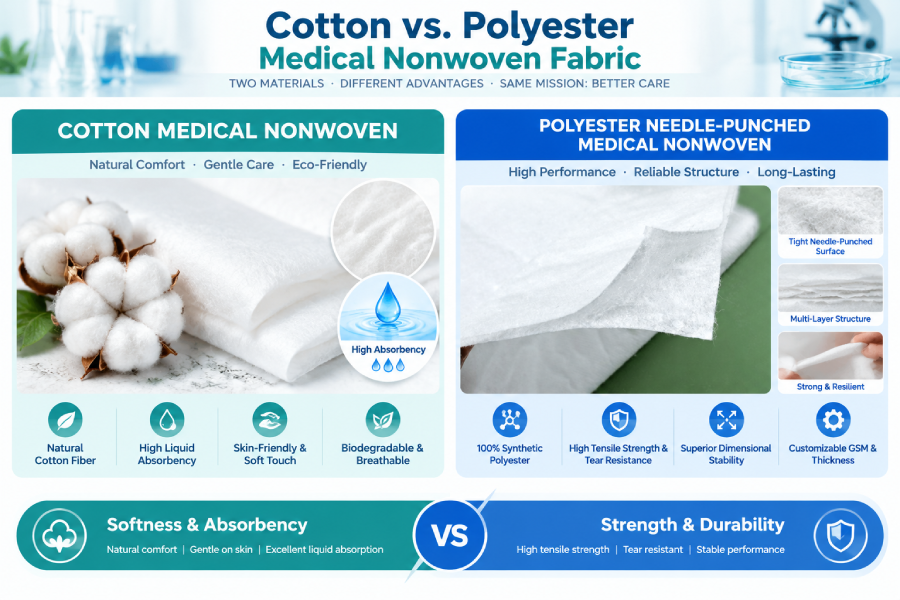
Cotton medical nonwoven fabric is typically made from natural cotton fibers. Buyers may consider it for its moisture-absorbing characteristics and natural fiber feel. Polyester medical nonwoven fabric, by contrast, is made primarily from polyester fibers and offers different design advantages in areas such as mechanical strength, dimensional stability, and durability.
However, fiber type alone does not determine the performance of the finished material. Nonwoven manufacturing processes, fiber arrangement, fiber proportions, grammage, and thickness can also affect the final results. Medical product developers should therefore select materials according to the intended function of the finished product rather than relying solely on the fiber name or price.
Why Should Medical Product Developers Compare Fiber Types?
Different medical products have different material requirements. Some prioritize a soft feel, others require liquid absorption, and some need materials that remain stable during slitting, lamination, or other manufacturing processes.
If buyers compare only raw material prices, they may overlook the relationship between material properties and product design. For example, a fiber with good absorbency may not meet every structural strength requirement, while a material with good mechanical strength may not provide the liquid absorption performance required by the target product.
When selecting medical nonwoven fabric, buyers should first define the product's primary function and then compare cotton and polyester in terms of softness, strength, absorbency, and durability.
For material development projects, it is also important to distinguish the characteristics of the fibers themselves from the performance of the finished nonwoven material. Actual results depend on fiber composition, manufacturing processes, and specific material specifications. The fiber name alone is not enough to determine suitability.
Basic Differences Between Cotton and Polyester Fibers
Cotton is a natural plant-based fiber with hydrophilic properties. Its moisture-absorbing characteristics make it worth evaluating for certain absorbent products. Cotton may also be suitable for product designs that prioritize the feel of natural fibers.
Polyester is a synthetic fiber commonly used in nonwoven materials that require a certain level of mechanical strength, dimensional stability, and durability. By adjusting fiber structures and manufacturing parameters, manufacturers can develop polyester nonwovens with different grammages, thicknesses, and levels of softness.
However, this does not mean that cotton is always softer or polyester is always more durable. Final performance also depends on fiber quality, fiber fineness, material density, web-forming methods, and fiber-bonding processes.
For medical product manufacturers, a more effective approach is to use fiber type as an initial screening criterion, then evaluate the candidate material against the target product's performance requirements and sample test results.
Softness: Which Fiber Better Meets the Product's Feel Requirements?
Softness is an important consideration when selecting materials for medical and healthcare products, particularly when the product design specifies requirements for surface feel or flexibility.
Cotton has the characteristic feel of a natural fiber, which may make it attractive for products where tactile properties matter. However, not every cotton-based nonwoven is necessarily soft. Its final feel still depends on fiber quality, material structure, and manufacturing processes.
Polyester fibers can also be used to develop nonwoven materials with different levels of softness by adjusting fiber fineness, web structure, and production parameters. There can be significant differences in feel between different polyester nonwoven materials as well.
Buyers should not judge softness by fiber name alone. Instead, they should define the target product's requirements for feel, surface uniformity, and flexibility, then compare samples.
If the material will be laminated with other layers or undergo additional processing, its feel and structural performance should also be evaluated under appropriate post-processing conditions.
Strength: Which Fiber Better Meets Processing and Structural Requirements?
Material strength affects whether a nonwoven fabric can maintain the required structural integrity during processing, handling, and its intended use.
Polyester fibers are commonly used in material designs that require good mechanical strength and dimensional stability. However, actual strength still depends on fiber type, material structure, grammage, thickness, and the way the fibers are bonded.
Cotton fibers can also be used in nonwoven materials with a certain level of structural strength, but their performance must likewise be confirmed through specific material specifications and test results.
For medical product manufacturers, strength evaluation should begin with an understanding of the material's role in the finished product. If the material will undergo slitting, lamination, heat pressing, or other processing, buyers should assess its integrity and stability under the relevant processing conditions.
Depending on the product design, buyers may evaluate tensile performance, structural integrity after processing, or dimensional stability under specified conditions. The test methods should match the product requirements rather than relying on fiber type alone to predict finished-material performance.
Absorbency: Which Fiber Is Suitable for the Product's Liquid Management Requirements?
When a medical or healthcare product needs to absorb liquid, the moisture-related properties of the fiber are an important consideration in material selection.
Cotton fibers are hydrophilic and can absorb moisture, making them worth evaluating for applications where moisture absorption matters. However, the actual absorption performance of a material depends not only on fiber type but also on fiber structure, pore distribution, material thickness, and processing methods.
Polyester fibers generally have lower moisture absorption than cotton. Nevertheless, the structure of a polyester nonwoven can still affect how liquid moves through the material. If a product needs to absorb and retain liquid, buyers should not determine suitability from the fiber name alone.
During material evaluation, buyers should distinguish between the rate at which liquid enters a material, its absorption capacity, and its liquid retention performance. These are different indicators and should not be treated as interchangeable.
If the target product has specific absorbency requirements, buyers should explain the liquid type, intended use conditions, and product function during the quotation stage. They should then agree with the supplier on appropriate test methods and sample acceptance criteria. Final suitability should be determined from actual material test results.
Durability: Which Fiber Is Better Suited to the Intended Use Conditions?
Durability involves more than whether a material is easily damaged. It can also include the material's ability to maintain the required performance during processing, compression, repeated use, or other anticipated conditions.
Polyester fibers are commonly associated with good abrasion resistance and dimensional stability, making them worth evaluating for product designs that require mechanical durability or structural stability. However, the final performance level still depends on the specific fiber structure and manufacturing parameters.
Cotton materials should also be evaluated in relation to their intended use. If a product will encounter liquids, undergo washing, or experience mechanical stress, buyers should verify changes in strength, structural stability, and other relevant properties under the expected conditions.
The evaluation criteria for disposable and reusable products may also differ. For disposable products, buyers should confirm that the material meets requirements during the intended use and processing stages. If the product is designed for repeated use, material performance should be assessed under the relevant usage conditions and validation requirements.
Therefore, buyers should not decide which material is more durable based on the words "cotton" or "polyester" alone. Defining the intended use conditions is the foundation for selecting the appropriate fiber material.
How Should Buyers Choose Between Cotton and Polyester Fibers?
There is no single answer that makes cotton or polyester the better choice for every medical product. A more reliable selection process begins by identifying the product's primary function, prioritizing the relevant performance characteristics, and comparing candidate materials through sample evaluation.
If a product prioritizes natural fiber characteristics and moisture absorption, cotton-based materials may be worth evaluating first. Buyers should still confirm actual softness, structural strength, and other product requirements.
If a product prioritizes mechanical strength, dimensional stability, and durability, polyester-based materials may be worth evaluating first. Their softness, absorption performance, and suitability for downstream processing should also be verified.
When a product must meet several performance requirements at the same time, buyers should not make a decision based on a single indicator. They can discuss different fiber options and specifications with the material supplier, then use sample testing to determine which option better meets the overall requirements of the intended product.
For medical-related products, buyers must also confirm the requirements applicable to the final use, target market, and relevant regulations. A fiber's individual properties do not automatically establish that a material made from it meets all requirements for a specific medical application.
What Specifications Should Buyers Confirm Before Requesting Samples?
Before requesting a quotation or samples, buyers should provide clear material requirements so that different samples can be compared under consistent conditions.
First, confirm the fiber composition. Specify whether the target material should use cotton fibers, polyester fibers, or another fiber combination, and identify any raw material requirements that must remain fixed.
Second, define grammage and thickness. Grammage is usually expressed in grams per square meter (GSM), while thickness should be confirmed under clearly specified measurement conditions. Record these parameters separately rather than assuming that materials with similar GSM will perform identically.
Third, identify the product's key performance requirements, including softness, strength, absorbency, and durability. For particularly important characteristics, specify the evaluation method, test conditions, and acceptance range whenever possible.
Fourth, explain the downstream processing requirements. If the material will undergo slitting, lamination, heat pressing, or other processing, provide this information in advance so that its compatibility with the production process can be evaluated.
Finally, maintain sample approval records. Keeping approved samples, material specifications, and relevant test results helps buyers verify consistency during bulk purchasing and reduces the risk of misunderstandings about specifications.
By confirming these details in advance, buyers can compare supplier proposals more effectively and establish a clear specification basis for quotation, sample evaluation, and subsequent bulk production.
Conclusion: Select Medical Nonwoven Fibers Based on Product Requirements
Cotton and polyester fibers have different characteristics in terms of softness, strength, absorbency, and durability. However, the final performance of a nonwoven material also depends on fiber quality, manufacturing processes, material structure, and specific specifications.
For medical product manufacturers, selecting suitable cotton medical nonwoven fabric or polyester medical nonwoven fabric should not depend solely on the fiber name or purchase price. The decision should start with the product's function and actual performance requirements.
HuiZhou JinHaoCheng Nonwovens Co., Ltd. offers various nonwoven material manufacturing and customized processing capabilities and can discuss material options based on customers' applications, fiber compositions, and specification requirements. For medical-related projects, the suitability of a specific material should still be confirmed through sample evaluation, technical requirement reviews, and any necessary compliance validation.
When requesting a quotation, buyers should provide the intended application, fiber composition, GSM, thickness, key performance requirements, and downstream processing methods. With these conditions clearly defined, buyers can compare material options more effectively and establish clear, verifiable quality standards for subsequent bulk purchasing.




