How Many Floor Protection Rolls Fit in a 20GP or 40HQ? A Container Loading Guide for Buyers
For importers, wholesalers, and distributors purchasing Floor Protection Roll from China, product price is not the only factor that determines the final purchasing cost.
Many buyers ask suppliers:
“How many Floor Protection Rolls can fit in a 20GP container?”
“How many rolls can fit in a 40HQ?”
“How many rolls should I order for one container?”
“If I need 500 rolls, should I choose a 20GP or a 40HQ?”
These questions may seem simple, but there is actually no fixed container loading quantity that applies to every Floor Protection Roll specification.
The same type of Floor Protection Roll can have very different loading quantities depending on its GSM, thickness, width, roll length, roll diameter, weight per roll, and packaging method.
Therefore, for overseas importers, the most important question is not simply:
“How many rolls can fit in one container?”
Instead, it is:
“Based on my exact product specification, how many rolls can be safely and efficiently loaded into a 20GP or 40HQ?”
This guide explains the logic behind Floor Protection Roll Container Loading, common loading ranges, the key factors that affect container quantity, and the specifications buyers should confirm before placing an order.
1. Why Should You Not Ask Only “How Many Rolls Fit in One Container?”
When overseas buyers purchase Floor Protection Roll from China for the first time, they often expect suppliers to provide a simple answer such as:
“A 20GP can load 500 rolls, and a 40HQ can load 2,000 rolls.”
However, this answer may not be accurate.
Container loading is generally affected by two major limitations:
Available Space and Weight Capacity.
A 20GP has a theoretical internal volume of approximately 33 CBM, while a 40HQ has approximately 76 CBM. However, the actual usable space cannot simply be calculated at 100% of the theoretical container volume.
Packaging, roll dimensions, stacking methods, and loading operations all affect actual container utilization.
For Floor Protection Roll, buyers also need to consider:
Roll Width
Roll Length
GSM
Thickness
Roll Diameter
Weight per Roll
Packaging Method
Pallet or Floor Loading
When these specifications change, the final number of rolls that can be loaded into a container can also change significantly.
Therefore, a professional floor protection roll manufacturer should not only provide a product price. The supplier should also help buyers determine a suitable container loading plan based on the actual product specifications.
2. How Many Floor Protection Rolls Can Fit in a 20GP or 40HQ?
Depending on product specifications and packaging methods, the actual loading quantity of Floor Protection Roll can vary considerably.
As a reference range for our Floor Protection Roll products:
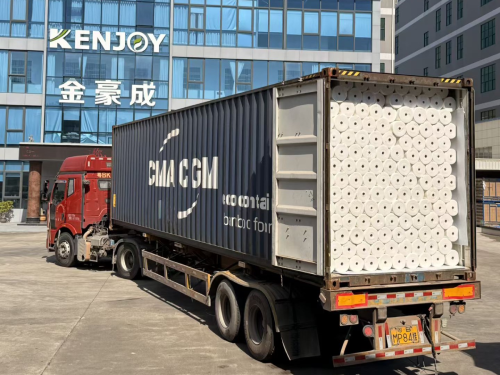
20GP: approximately 300–600 rolls
40HQ: approximately 1,500–5,000 rolls
It is important to understand that these are reference ranges, not fixed container loading standards.
Why can one 20GP container load approximately 300 rolls in one case and around 600 rolls in another?
Why can a 40HQ sometimes load around 1,500 rolls while another specification can reach 5,000 rolls?
The key reason is:
Different product specifications require different amounts of space and have different weights per roll.
For example, a thicker, heavier Floor Protection Roll with a larger roll diameter will normally occupy more container space. A lighter product with a smaller roll diameter and optimized packaging may allow more rolls to be loaded.
Therefore, if a buyer wants to know the accurate container loading quantity, the supplier needs to know the exact product specifications.
3. Which Specifications Determine How Many Floor Protection Rolls Fit in a Container?
This is one of the most important considerations when planning Floor Protection Roll Container Loading.
1. GSM Determines Product Weight
GSM, or grams per square meter, is an important specification for Floor Protection Roll.
For example, products with the same width and roll length may be available in:
130 GSM
160 GSM
180 GSM
200 GSM
220 GSM
300 GSM
Different GSM levels result in different weights per square meter and therefore different total roll weights.
As GSM increases, the material weight per square meter generally increases, which can also increase the total cargo weight.
For buyers, it is important not to assume:
Higher GSM = Better Product
The correct GSM should be selected according to the final application.
Light renovation work, general floor protection, painting projects, high-traffic areas, and heavy-duty applications may require different material structures and performance levels.
2. Roll Width Directly Affects Loading Efficiency
Roll width is another important factor affecting container loading.
For example:
0.65m Width
1m Width
Different roll widths can result in different roll diameters, stacking arrangements, and space utilization.
If your target market mainly sells 1-meter-wide products, the supplier should calculate the container loading quantity based on your actual target specification rather than using loading data from another product.
This is why a professional floor protection roll manufacturer needs to confirm the Width before providing an accurate loading calculation.
3. Roll Length Affects Roll Diameter and Weight per Roll
Many buyers only tell a supplier:
“I need a 1-meter-wide Floor Protection Roll.”
However, this information is not enough.
Roll Length also directly affects the final loading quantity.
For example, products with the same 1-meter width may be produced as:
25m/roll
50m/roll
100m/roll
Each roll will have a different material weight, roll diameter, and packaging volume.
Therefore, buyers should confirm at least:
Width + Roll Length + GSM + Thickness
before asking for an accurate container loading calculation.
4. Why Is Roll Diameter So Important for Container Loading?
For rolled materials, buyers often overlook one important specification:
Roll Diameter.
In theory, a container may be able to hold a large number of rolls. However, if the roll diameter is large, each roll will occupy more internal container space.
For example, two Floor Protection Roll products may have the same GSM and width but different roll diameters because of differences in:
Roll Length
Thickness
Winding Density
Packaging
These differences can directly affect:
How many rolls fit in a container?
Therefore, for large-volume purchasing, the most accurate approach is not to calculate only theoretical CBM. Instead, the supplier should determine the loading plan based on the actual product specifications and roll diameter.
5. Is Floor Protection Roll Limited by Weight or by Volume?
This is another issue that many importers overlook.
For Floor Protection Roll, the final container quantity normally needs to consider both:
Volume
and
Payload
In other words:
Available Space and Weight Capacity
If the product is relatively light but takes up a large amount of space, the container may become full based on volume first.
If the product is thick, has a high GSM, and has a high weight per roll, the container may approach its weight limit before all available space is fully utilized.
Therefore, buyers should not simply assume:
“A 40HQ has approximately twice the volume of a 20GP, so it must hold twice as many rolls.”
A 40HQ provides more internal volume, but the final loading quantity is still affected by cargo weight and the loading method.
This is why a professional supplier should consider:
Roll Quantity + CBM + Gross Weight + Loading Method
when preparing a container loading plan.
6. Should Floor Protection Roll Be Loaded on Pallets or Directly into the Container?
The loading method can also have a significant impact on the final container quantity.
Common loading methods include:
Pallet Loading
and
Floor Loading
Pallet loading can make transportation, handling, and warehouse operations easier, but the pallets themselves occupy additional space and add weight.
Floor loading can make more efficient use of the internal container space, although unloading may require more manual handling.
Therefore, importers and wholesalers should not focus only on:
Maximum Rolls per Container
They should also consider their own warehouse and unloading conditions.
If your warehouse has forklifts, pallet systems, and standardized storage procedures, the packaging and loading method can be selected accordingly.
If your main goal is to maximize the number of rolls per container, you can ask the supplier to develop a more space-efficient loading plan based on your product structure.
7. How Should Buyers Choose Between a 20GP and a 40HQ?
If the purchasing quantity is relatively small, or if you are testing a new market, a 20GP may be more suitable.
For example, if you are testing a new Floor Protection Roll specification or only need several hundred rolls, a 20GP may be a practical option.
If you already have stable sales channels and need to replenish inventory in larger quantities, a 40HQ may be more suitable for bulk purchasing.
For Floor Protection Roll, the key question is not:
“Which container is bigger?”
Instead, it is:
“Which container gives me the best cost per roll for my actual specification?”
This is particularly important for importers.
Ocean freight, product quantity, and freight allocation per roll can all affect the final landed cost.
8. How Can Buyers Calculate the Transportation Cost per Floor Protection Roll?
Suppose you are purchasing a batch of Floor Protection Roll.
If one 20GP can load 500 rolls:
Container Freight ÷ 500 Rolls = Freight Cost per Roll
If optimized specifications allow one 40HQ to load 2,500 rolls:
Container Freight ÷ 2,500 Rolls = Freight Cost per Roll
In this case, even if the total ocean freight for the 40HQ is higher, it does not necessarily mean that the transportation cost per roll is higher.
The correct comparison should be:
Total Container Cost ÷ Actual Loaded Rolls
rather than simply comparing:
20GP Freight vs 40HQ Freight
For importers and wholesalers purchasing regularly, this calculation provides a more realistic way to evaluate purchasing costs.
9. Which Floor Protection Roll Specifications Can Have the Biggest Impact on Container Loading?
If you are planning to import Floor Protection Roll from China, we recommend confirming at least the following specifications when requesting a quotation:
GSM
Thickness
Width
Roll Length
Roll Diameter
Weight per Roll
Packaging
Pallet or Floor Loading
Color
Backing Material
For products such as:
buyers should also confirm the PE film thickness, composite structure, and final roll diameter.
For:
Self-Adhesive Protective Fleece
the adhesive layer, release material, and overall packaging dimensions should also be considered.
For:
Painter Felt / Protective Fleece
the appropriate GSM and thickness should be selected according to absorbency, surface protection requirements, and the actual construction application.
Different product structures cannot simply use the same container loading quantity.
10. Why Can the Packaging Method of Floor Protection Roll Affect Purchasing Costs?
Packaging is not only about making the product look better.
For export purchasing, packaging can affect:
Container Utilization
Product Protection
Handling Efficiency
Warehouse Storage
and ultimately:
Cost per Roll
For example, if the packaging dimensions are not optimized, a lightweight product may still leave significant unused space inside the container.
Therefore, a professional Floor Protection Roll supplier needs to consider both the product itself and the export packaging.
Importers and wholesalers can confirm the following with their supplier in advance:
Individual roll packaging
Outer carton packaging
Pallet packaging
Roll labels
Product specification labels
Brand LOGO
Loading method
This allows the final Container Loading Plan to be confirmed before production.
11. Why Should You Not Ask Only “How Many Rolls Fit in a 20GP?”
If you simply send a supplier:
“Please tell me how many rolls fit in a 20GP.”
The supplier may only be able to provide a rough estimate.
A more professional inquiry would be:
“Please calculate the container loading quantity based on my exact roll specification.”
For example, provide:
GSM: 180gsm
Width: 1m
Roll Length: 50m
Thickness: XX mm
Packaging: Roll Packaging
Then ask the supplier to confirm:
20GP Loading Quantity
40HQ Loading Quantity
Total CBM
Gross Weight
Rolls per Container
Loading Method
This information provides much more practical value for purchasing decisions.
12. Why Is Working Directly with a Floor Protection Roll Manufacturer Better for Long-Term Purchasing?
For importers and wholesalers, Container Loading is not just a one-time logistics issue.
If you need to replenish Floor Protection Roll every month or every quarter, stable product specifications and packaging are very important.
A professional floor protection roll manufacturer can maintain consistent:
GSM
Thickness
Width
Roll Length
Roll Diameter
and packaging specifications.
This makes it easier for buyers to predict:
How many rolls fit in a 20GP or 40HQ?
This consistency is also valuable for long-term inventory planning and purchasing budgets.
13. Why Is OEM Capability Important When Purchasing Floor Protection Roll?
Market requirements are not exactly the same in every country.
Some markets may prefer:
130–160 GSM
while others may be more suitable for:
180–220 GSM
Higher-performance or heavy-duty applications may require higher GSM or customized composite structures.
Customers may also require:
Custom Width
Custom Roll Length
Custom Color
PE Backing
Anti-Slip Surface
Self-Adhesive Layer
Custom Packaging
Private Label
Logo Printing
If a supplier can only provide fixed specifications, it can be difficult for importers to develop their own product lines.
A manufacturer with OEM/ODM capabilities can develop Floor Protection Roll according to the buyer's target market, application requirements, and target cost.
14. Why Is Needle Punched Nonwoven Suitable for Developing Floor Protection Roll?
Floor Protection Roll often needs to provide several performance characteristics at the same time:
Surface Protection
Absorbency
Abrasion Resistance
Cushioning
Anti-Slip Performance
Liquid Protection
Needle punched nonwoven can be engineered by adjusting fiber type, GSM, thickness, needle punching density, and composite structure to develop products with different performance characteristics.
For example:
Protective Fleece
Painter Felt
PE-Backed Cover Fleece
Self-Adhesive Protective Fleece
can all be developed for different renovation and construction environments.
Therefore, for importers who want to build a long-term Floor Protection product line, working with a manufacturer that has needle punched nonwoven R&D and production capabilities can provide greater flexibility for future product development.
15. Why Choose Jinhaocheng as Your Floor Protection Roll Supplier?
If you are importing Floor Protection Roll from China, the supplier's production capacity and customization capabilities are both important factors to consider.
Huizhou Jinhaocheng Nonwovens Co., Ltd. was established in 2005 and has more than 20 years of experience in nonwoven R&D and manufacturing.
The company has an approximately 26,000-square-meter production base, 15 automated production lines, and an annual production capacity of more than 10,000 tons.
As a professional needle punched nonwoven felt manufacturer, Jinhaocheng provides customized Floor Protection solutions for overseas importers, wholesalers, distributors, and construction material suppliers.
Depending on project requirements, the following specifications can be customized:
GSM
Thickness
Width
Roll Length
Color
Backing Material
Surface Treatment
Packaging
Logo
Jinhaocheng also provides:
OEM
and
ODM
services.
Key Floor Protection products include:
Floor Protection Roll
Painter Felt
Protective Fleece
PE-Backed Cover Fleece
Self-Adhesive Protective Fleece
Therefore, if your goal is not simply to purchase a standard product but to develop your own long-term Floor Protection product line, working directly with a professional needle punched felt manufacturer can be a more suitable solution.
16. How curately FinCan Buyers Acd Out How Many Floor Protection Rolls Fit in a Container?
This is the most important question.
If you want to know:
“How many rolls can actually fit in a 20GP?”
or:
“How many rolls can actually fit in a 40HQ?”
you cannot simply tell the supplier:
“I need Floor Protection Roll.”
You need to provide the specific product specifications.
At minimum, provide:
GSM
Width
Roll Length
Thickness
Backing Material
Packaging Requirements
Estimated Order Quantity
If you already have an existing product, you can also provide:
Product photos
Existing samples
Competitor product specifications
Target market
Target selling price
Current packaging method
A professional sales team can use this information to help you determine a suitable specification and container loading quantity.
17. What Logic Should Buyers Use to Plan a Container of Floor Protection Roll?
Importers and wholesalers can use the following purchasing logic:
Application
↓
Required Performance
↓
GSM / Thickness
↓
Width / Roll Length
↓
Roll Diameter / Weight
↓
Packaging Method
↓
20GP / 40HQ Container Loading
↓
Total Rolls
↓
Freight Cost per Roll
↓
Final Landed Cost
This approach helps buyers avoid focusing only on:
“Which supplier offers the lowest price?”
A more professional purchasing decision should compare:
Product Cost + Container Utilization + Freight Cost + Product Consistency
A product with a lower unit price does not necessarily have a lower overall purchasing cost if fewer rolls can be loaded into each container.
18. What If You Do Not Know Which Specification to Choose?
If you are not sure which Floor Protection Roll specification you need, there is no need to worry.
This is common among buyers who are importing Floor Protection Roll for the first time.
You can tell us:
Your Application
Target Market
Floor Type to Be Protected
Estimated Purchasing Quantity
Preferred Roll Width
Target Selling Price
Or you can simply send us photos or specifications of the product you are currently selling.
Our professional sales team can help you confirm:
Recommended Specification
GSM
Thickness
Width
Roll Length
Packaging
as well as:
20GP Loading Quantity
40HQ Loading Quantity
If you want to know exactly how many Floor Protection Rolls your specific product specification can load into a 20GP or 40HQ, contact us.
Because:
300 rolls, 600 rolls, 1,500 rolls, or 5,000 rolls are not fixed answers.
The accurate quantity needs to be calculated according to your exact product specifications and packaging method.
Conclusion: When Purchasing Floor Protection Roll, Do Not Look Only at the Price—Confirm the Container Loading Quantity First
For overseas importers, wholesalers, and distributors, the real objective when purchasing Floor Protection Roll is to calculate the complete purchasing cost rather than looking only at the product unit price.
As a reference:
20GP: approximately 300–600 Rolls
40HQ: approximately 1,500–5,000 Rolls
However, the final quantity depends on:
GSM + Thickness + Width + Roll Length + Roll Diameter + Weight + Packaging + Loading Method
Therefore, if you need accurate floor protection roll container loading information, the best approach is not to rely on general loading numbers found online. Instead, ask the manufacturer to calculate the actual loading plan according to your exact specifications.
If you are sourcing Floor Protection Roll from China and want to know which specification is suitable for your market, how many rolls can fit in a 20GP or 40HQ, and how to reduce transportation costs per roll, contact us.
Our professional sales team can help you calculate the suitable specification and container loading quantity for your order.