How Hot Can Different Needle Punched Felts Withstand? Choosing the Right Material for Industrial Applications
When manufacturers need thermal insulation, heat protection, cushioning or component separation for machinery and electrical appliances, needle punched felt is often considered because of its flexible structure, mechanical stability and wide range of material options.
However, one common sourcing problem is often overlooked: different needle punched felt materials have very different temperature resistance.
A polyester felt that works well in a household appliance may not be suitable for a high-temperature industrial machine. Selecting a material based only on price, thickness or appearance can result in shrinkage, deformation or premature material failure when the actual operating temperature exceeds its suitable range.
For industrial manufacturers, distributors and nonwoven material buyers, the better approach is to match the fiber composition, temperature requirement, thickness, density and functional performance with the actual application.
As an experienced needle punched felt manufacturer China, HUIZHOU JINHAOCHENG NONWOVENS CO., LTD. provides customized needle punched nonwoven materials for industrial, automotive, household and other applications, with OEM and ODM production capabilities.
Why Do Different Needle Punched Felts Have Different Temperature Resistance?
Although different types of needle punched felt may look similar, their thermal performance can vary significantly because the fiber itself determines much of the material's temperature resistance.
During manufacturing, fibers are opened, carded, formed into a web and mechanically entangled through needle punching. The resulting three-dimensional fiber structure provides flexibility and mechanical strength.
However, the needle punching process itself does not automatically make a material suitable for high temperatures.
The actual thermal performance depends on factors such as:
Fiber composition
Continuous operating temperature
Short-term peak temperature
Material density
Thickness
Exposure time
Flame-retardant treatment
Contact with heat sources or flames
This means buyers should not simply ask how many degrees a particular felt can withstand. They should first define the actual working conditions.
How Much Heat Can Polyester Needle Punched Felt Withstand?
Polyester needle punched felt is one of the most widely used nonwoven felt materials because of its good mechanical properties, abrasion resistance, dimensional stability and cost efficiency.
It is commonly used in automotive components, household appliances, machinery, packaging, industrial protection and other applications where extreme temperatures are not involved.
Under typical conditions, conventional polyester needle punched felt may begin to experience noticeable thermal deformation at around 170°C, although the actual temperature resistance depends on the specific polyester fiber, material construction, exposure time and application conditions.
For ordinary equipment, household appliances and moderate-temperature insulation applications, polyester felt can provide a practical balance between performance and cost.
However, buyers should avoid assuming that increasing the felt thickness will automatically increase its temperature rating.
Thickness can affect thermal insulation performance, but it does not fundamentally change the heat resistance of the fiber itself.
If the application involves continuous exposure above the suitable temperature range of polyester, a higher-temperature fiber should be considered.
Is Glass Fiber Needle Punched Felt Suitable for High-Temperature Applications?
When the working temperature becomes significantly higher, glass fiber needle punched felt can be a more suitable option.
Glass fiber has excellent thermal resistance and is widely used in high-temperature insulation, industrial equipment, steel production, metallurgy and furnace-related applications.
Depending on the glass fiber type, construction and product design, certain glass fiber needle punched materials can be used across temperature ranges of approximately 350°C to 1000°C or more in specialized applications.
However, buyers should not assume that every glass fiber felt can continuously operate at 1000°C.
Actual performance depends on:
Glass fiber composition
Fiber structure
Material density
Operating temperature
Exposure duration
Direct contact with the heat source
Surrounding chemical environment
Therefore, the stated temperature range should always be treated as an application reference rather than a universal rating for every glass fiber product.
Another important consideration is handling. Glass fiber products can cause skin irritation during cutting and processing, so appropriate handling procedures should be followed.
For steel, metallurgy and high-temperature equipment manufacturers, glass fiber needle punched felt can provide a useful solution where conventional polyester materials are not suitable.
How Heat Resistant Is Aramid Needle Punched Felt?
Aramid needle punched felt is manufactured from high-performance aramid fibers and is designed for applications where heat resistance, flame resistance and mechanical performance are required together.
Depending on the specific aramid fiber and material construction, aramid felt can commonly withstand temperatures around 200°C or higher in suitable applications.
Compared with standard polyester felt, aramid offers a stronger combination of heat resistance, flame resistance and mechanical stability.
This makes it useful for selected industrial protection, automotive components, thermal insulation and other applications where ordinary polyester may not provide sufficient thermal performance.
For buyers, the advantage of aramid is not simply its temperature rating. It is the combination of thermal and mechanical properties that can make it valuable in demanding applications.
Can Wool Felt Be Used for Heat Insulation?
Wool felt is a natural fiber material with good resilience, moisture absorption and natural thermal insulation characteristics.
It can be used in traditional industrial products, automotive components, household applications, gaskets, cushioning materials and other products where natural fiber properties are desired.
However, wool felt should not be treated as a high-temperature material simply because wool has good insulating properties.
Its practical thermal performance depends on fiber quality, density, moisture conditions and application environment. It is generally more suitable for moderate-temperature applications rather than direct exposure to extreme heat or open flame.
For applications requiring softness, cushioning and moderate thermal insulation, wool or blended needle felt can be considered.
Where continuous high-temperature exposure is involved, specialized heat-resistant or flame-resistant fibers are generally more appropriate.
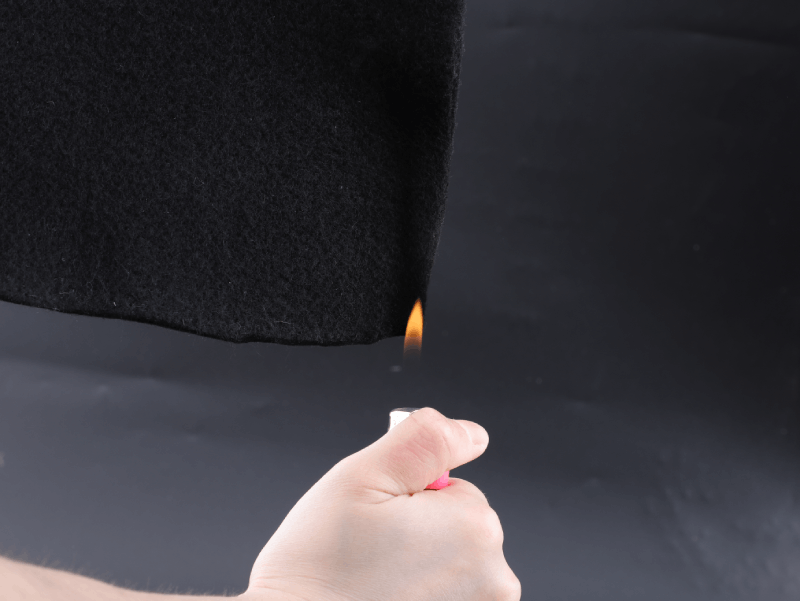
What Is High-Temperature Flame-Resistant Felt Used For?
Some industrial applications require more than temperature resistance.
The material may also need to provide flame resistance, thermal stability, insulation and resistance to heat aging.
In such cases, high-temperature fibers or specially engineered fire resistant felt can be considered.
Potential applications include industrial equipment, automotive components, thermal protection systems and specialized insulation products.
However, buyers should clearly distinguish between heat resistance and flame resistance.
A material that can maintain its physical structure at an elevated temperature does not necessarily meet a specific flame-retardant test requirement.
If the final product requires both properties, the supplier should evaluate temperature resistance and flame performance separately and confirm the relevant test requirements before production.
What Are the Typical Temperature Ranges of Different Needle Punched Felt Materials?
As a general material-selection reference, different fibers can be considered for different temperature conditions.
Polyester needle punched felt is generally suitable for conventional industrial, household appliance, automotive and moderate-temperature applications, with conventional polyester materials beginning to face thermal deformation risks around the 170°C range.
Wool felt is suitable for applications where natural fiber characteristics, cushioning and moderate thermal insulation are important, but it is not intended for extreme high-temperature environments.
Aramid needle punched felt is suitable for applications requiring a combination of heat resistance, flame resistance and mechanical performance, with common applications around the 200°C range depending on the specific material.
Glass fiber needle punched felt is suitable for substantially higher-temperature industrial applications, with specialized grades potentially covering approximately 350°C to 1000°C or more.
These figures are only general references.
The actual temperature capability of a finished felt depends on fiber type, product structure, density, thickness, exposure duration and operating conditions.
For critical applications, buyers should always request technical data and conduct application-specific testing before mass production.
Why Should Buyers Not Simply Choose the Felt With the Highest Temperature Rating?
A common purchasing mistake is to assume that the material with the highest temperature resistance is automatically the best choice.
In reality, this can increase material costs without providing additional value.
For example, if a household appliance operates at a relatively moderate temperature, using an expensive high-temperature glass fiber material may be unnecessary.
On the other hand, using polyester felt in an application with continuous exposure to several hundred degrees Celsius could result in deformation, performance loss and premature replacement.
The better material-selection process is:
Actual operating temperature → exposure duration → required functions → fiber selection → thickness and density → total cost
This approach helps manufacturers select a material that provides the required performance without unnecessarily increasing procurement costs.
What Other Properties Should Be Considered Besides Temperature Resistance?
Temperature resistance is only one part of industrial felt selection.
Depending on the application, buyers may also need to evaluate abrasion resistance, tensile strength, compression recovery, flame resistance, acoustic absorption, thermal insulation, density, thickness and dimensional stability.
For automotive interiors, abrasion resistance, acoustic performance and forming properties may be more important.
For machinery, thermal insulation, cushioning and wear resistance may be the priority.
For high-temperature industrial equipment, thermal stability, flame resistance and dimensional stability are often critical.
If the felt will undergo secondary processing, buyers should also confirm whether the material is suitable for lamination, die cutting, thermal bonding or molding.
This is why working directly with an experienced needle punched nonwoven felt manufacturer can be valuable during industrial material development.
Can Needle Punched Felt Be Customized for Different Temperature Applications?
Industrial equipment does not have a universal design.
Different machines can have different temperatures, dimensions, installation methods and performance requirements. Standard felt specifications therefore may not always be suitable.
A professional custom needle punched felt manufacturer can adjust material specifications according to the application.
Possible customization parameters include:
Fiber composition
GSM
Thickness
Width
Density
Hardness
Color
Flame resistance
Thermal performance
By adjusting these parameters, manufacturers can develop a material construction that better matches the actual equipment and finished component.
For distributors and international industrial material buyers, working with a supplier that supports OEM and ODM production can also make it easier to develop different specifications for different markets and applications.
Why Choose an Experienced Needle Punched Felt Manufacturer?
For industrial material buyers, the biggest risk is not always the initial purchase price. Inconsistent quality between production batches can create much greater problems.
Variations in GSM, thickness, density or hardness can affect downstream processing and the performance of the final product.
Choosing an experienced needle punched felt manufacturer can therefore provide greater control over production consistency.
HUIZHOU JINHAOCHENG NONWOVENS CO., LTD. has more than 20 years of nonwoven manufacturing experience, with an approximately 26,000㎡ production facility and 15 automated needle punching production lines.
As a professional needle punched felt manufacturer China, nonwoven felt manufacturer and nonwoven manufacturer China, we provide customized nonwoven materials with different GSM, thickness, width and functional requirements.
Our capabilities include OEM, ODM and custom nonwoven products, supporting customers that require stable specifications for long-term production.
Our nonwoven materials are used across multiple industries, including automotive, industrial insulation, construction, floor protection, agriculture and filtration.
Our product range includes needle punched felt, floor protection felt, anti-condensation felt, thermal bonded wadding and laminated foam fabric, among other customized nonwoven materials.
For overseas customers requiring stable long-term supply, direct cooperation with an OEM needle punched felt factory can simplify communication from sample development and specification confirmation to mass production.
How Should You Choose Needle Punched Felt According to Operating Temperature?
For ordinary household appliances, equipment cushioning and moderate-temperature insulation, polyester needle punched felt can often provide an economical and practical solution.
For applications requiring improved heat and flame resistance, aramid felt or other specialized high-temperature fibers may be more appropriate.
For steel production, metallurgy, furnaces and high-temperature industrial equipment, glass fiber needle punched felt can provide significantly higher temperature resistance.
For applications requiring natural fibers, softness, cushioning and moderate thermal insulation, wool or blended needle felt may be considered.
The final selection should never be based on temperature alone. Operating temperature, exposure time, direct heat contact, flame exposure, mechanical requirements and installation conditions should all be evaluated together.
Conclusion: The Right Needle Punched Felt Depends on the Actual Working Temperature
Different needle punched felt materials provide different levels of temperature resistance.
Polyester needle punched felt is suitable for many conventional industrial and moderate-temperature applications.
Aramid needle punched felt provides a useful combination of heat resistance, flame resistance and mechanical performance.
Glass fiber needle punched felt is more suitable for demanding high-temperature industrial environments.
Wool felt can be considered where natural fiber properties, cushioning and moderate thermal insulation are required.
For buyers, the goal should not be to find the felt with the highest possible temperature rating. The better strategy is to select a material whose thermal performance matches the actual working environment and product requirements.
If you are looking for a reliable needle punched felt manufacturer, needle punched felt factory China, custom needle punched felt manufacturer or industrial felt manufacturer, HUIZHOU JINHAOCHENG NONWOVENS CO., LTD. can develop customized nonwoven solutions based on your required temperature, dimensions, GSM, thickness and functional requirements.