
SAP Absorbent Pads for Meat and Seafood Packaging: Material Design and Sourcing Requirements
In chilled meat, fish and seafood packaging, liquid often accumulates at the bottom of the tray as products release moisture during storage. This liquid may come from natural product exudate or from residual moisture associated with processing, handling, or packaging. If it continues to collect inside the package, it can affect the appearance of the product and make liquid management more difficult during transportation, storage, and retail display.
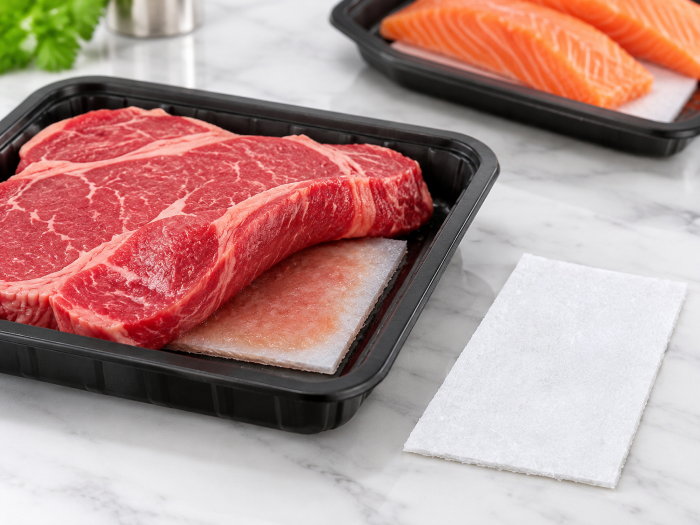
For this reason, food packaging manufacturers often place an absorbent pad or absorbent layer at the bottom of a tray to collect and retain excess liquid released inside the package.
For packaging products that require higher absorption and liquid retention, superabsorbent polymer (SAP) is a material worth evaluating. SAP absorbs liquid, swells, and forms a gel. This differs from conventional fibrous materials, which absorb and retain liquid mainly through their fiber structure and internal pores.
However, simply adding SAP does not automatically make a material suitable for food packaging. Buyers also need to consider how SAP is combined with the fiber carrier, whether the material remains stable after absorbing liquid, whether SAP particles may migrate or leak, and whether the complete absorbent pad meets the food-contact requirements of the target market.
This article explains the material structure, performance evaluation, and supplier assessment considerations for SAP absorbent pads used in meat and seafood tray packaging.
Why Do Meat and Seafood Packages Need Absorbent Pads?
Fresh meat, poultry, fish, and seafood may release moisture and liquid during chilled storage and transportation. This liquid can gradually accumulate at the bottom of the packaging tray or around the product.
In meat packaging, the liquid may come from natural exudate released during storage. In fish and seafood packaging, the liquid may also contain salt and may be affected by ice, product handling, and packaging conditions. Therefore, the liquid generated by different food products is not necessarily the same.
Without a suitable liquid-management structure, accumulated liquid can affect the appearance of the package, making the inside of the tray look wet. It may also increase the risk of liquid overflow when packages are tilted, handled, or transported.
A food tray absorbent pad is usually placed underneath the food or at the bottom of the tray as an absorbent component of the packaging structure. Its main function is to absorb and retain excess liquid inside the package. It does not replace the tray, inner liner, or outer sealing film as a leak-prevention component.
For food packaging manufacturers, the absorbent pad needs to match the tray dimensions, food weight, liquid release volume, packaging method, and storage conditions. Selecting an absorbent material based only on the type of food is usually not enough to determine the final specification.
Buyers should first understand how much liquid the product may release during the intended storage period, where the liquid is likely to accumulate, and where the absorbent pad will be positioned inside the package. These factors provide the basis for selecting the material and structure.
What Is the Role of SAP in Food Packaging Absorbent Pads?
Superabsorbent polymer (SAP) is a functional material that absorbs liquid and swells. When SAP comes into contact with water or another suitable liquid, its polymer structure takes up the liquid and forms a gel-like substance known as a hydrogel.
In food packaging absorbent pads, SAP helps absorb and retain liquid released inside the package. Unlike conventional absorbent materials that rely mainly on the spaces between fibers to hold liquid, SAP provides another liquid-retention mechanism by swelling and forming a gel structure.
However, buyers should understand that SAP does not perform identically under all liquid conditions.
Results from clean-water tests cannot automatically represent the actual performance of an absorbent pad in meat or seafood packaging. Salts and other dissolved substances in the liquid, temperature, contact time, and external pressure may all affect SAP absorption and swelling behavior.
This is particularly important in fish and seafood packaging, where the liquid may contain salt. Some SAP materials may absorb less liquid in saline conditions than in clean water. Therefore, buyers should not rely only on a supplier's free-swell absorption figures to determine whether a material is suitable for seafood packaging.
Another important distinction is that liquid absorption capacity is not the same as liquid retention under pressure. Although SAP forms a gel after absorbing liquid, this does not mean that the material will never release liquid when subjected to food weight, package stacking, or transportation pressure. Buyers should also confirm whether the material can retain liquid under the expected pressure conditions and maintain its structural integrity after absorption.
For this reason, food packaging projects should define their testing conditions according to the actual liquid environment rather than focusing only on higher SAP content or greater free-swell absorption figures.
How Do SAP and Fiber Carriers Form Composite Absorbent Materials?
SAP can be used as loose absorbent particles or combined with fiber materials and other carrier structures to develop composite absorbent materials.
For nonwoven material development, a needle-punched nonwoven carrier can provide a fiber structure and sheet format. SAP provides the liquid absorption, swelling, and gel-forming functions. Combining these components is one possible direction for developing absorbent materials for food packaging.
However, combining SAP with needle-punched nonwoven fabric does not automatically mean that the SAP is fully immobilized or that the finished material has the migration-control and leakage-prevention properties required for food packaging.
When developing a specific absorbent pad, buyers need to understand how the SAP is retained or enclosed, how the fiber carrier is structured, and whether the different layers remain stable after absorbing liquid.
For absorbent pads with a multilayer structure, buyers should also confirm the function of each layer. For example, an outer layer may allow liquid to enter while providing material protection. The internal absorbent layer may absorb and retain liquid, while other layers may provide support or separation. The actual number of layers, material composition, and bonding method should be confirmed from the product design. Product performance should not be assumed from a structural illustration alone.
Buyers should pay particular attention to whether SAP remains within the designed structure in both dry and swollen conditions. If SAP particles escape from the material during cutting, handling, absorption, or compression, the integrity of the absorbent pad may be affected, creating a potential packaging contamination risk.
The absorption provided by the fiber carrier should also be distinguished from the absorption provided by SAP. Conventional needle-punched absorbent felt mainly relies on fiber hydrophilicity and internal pores to absorb and distribute liquid. SAP composite materials add the polymer's liquid absorption and swelling mechanism.
Buyers who want to understand conventional fibrous absorbent materials can explore needle punched absorbent felt materials. For PET needle-punched absorbent felt used in packaging, they can also refer to PET absorbent felt for packaging applications. These materials have different absorption mechanisms and should not be treated as interchangeable.
What Absorption Performance Is Required for Different Food Packaging Applications?
Meat, poultry, fish, and seafood packaging may all use tray absorbent pads, but the liquids released by different products and their packaging conditions are not necessarily the same. Therefore, absorbent pad specifications should not be determined by food category alone.
For fresh meat and poultry packaging, buyers should consider the exudate released during chilled storage and whether the absorbent pad can absorb and retain this liquid under actual contact conditions. Food weight, available tray space, and the intended storage period also affect the pad design.
For fish packaging, buyers need to understand the specific fish product, packaging method, and liquid release conditions. Different fish products may vary in moisture condition, processing method, and storage requirements. A single absorption target should not automatically be applied to every fish packaging application.
For shrimp, crab, and other seafood products, the package may contain saline liquid and may also be affected by ice and meltwater. Buyers should clarify whether the absorbent pad needs to manage liquid released by the seafood itself, melted ice, or both.
Liquid salinity is an important factor to confirm when developing seafood absorbent pads. If the material has only been tested with clean water, buyers should also evaluate its absorption and retention performance under the target salinity and actual packaging conditions.
The dimensions, thickness, and available swelling space of the absorbent pad must also match the tray structure. The material may expand after absorbing liquid. Therefore, checking whether the dry pad fits inside the tray is not enough. Buyers should also examine its height, shape, and position after absorption to determine whether it affects food placement, package sealing, or transportation.
For each food packaging application, the evaluation criteria should be defined separately. These may include absorption capacity, absorption speed, liquid retention under pressure, liquid release or rewetting, wet strength, and dimensional changes. The actual requirements should be determined by the buyer according to the product and packaging conditions, then verified through sample testing rather than copied from another food packaging project.
How Can SAP Migration, Package Sealing, and Liquid Retention Be Controlled?
For SAP food packaging absorbent pads, absorption capacity is only one basic requirement. Whether the material remains intact after absorbing liquid, whether SAP may migrate, and whether the package can be reliably sealed are also important to the finished product.
First, buyers need to confirm the SAP particle retention and migration-control design.
If SAP is incorporated into the absorbent material in particle or powder form, buyers should understand how it is retained inside the material and whether particles may escape during cutting, transportation, placement, or actual absorption.
Inspection should not be limited to the dry material. The structure should also be examined after SAP has absorbed liquid and swollen. Buyers can request samples from the supplier and observe whether SAP particles leak out, powder is released, edges become damaged, or the internal structure becomes loose under defined absorption conditions.
Second, buyers should confirm the edge construction and layer integrity of the absorbent pad.
If the finished pad uses an enclosed or multilayer structure, its edges should be checked for incomplete sealing. Buyers should also examine whether delamination occurs after absorption or whether the internal absorbent material becomes exposed during handling and compression.
It is important to distinguish between sealing the edges of the absorbent pad and heat-sealing the packaging film over the food tray. The first concerns whether the absorbent material is securely enclosed. The second concerns whether the tray package can be sealed according to its packaging design. The fact that an absorbent pad can absorb liquid does not mean that the complete package is leakproof.
Third, buyers should verify liquid retention under pressure.
Meat and seafood placed in a tray create pressure on the absorbent pad underneath. Packages may also be compressed during stacking, handling, and transportation. Buyers should confirm whether the material releases a noticeable amount of liquid after absorption and whether the pad maintains its structural integrity under pressure.
Fourth, buyers should evaluate the compatibility of the absorbent pad with the tray and packaging film.
An absorbent pad that is too large may interfere with the tray edges or sealing area. An unsuitable thickness or swelling allowance may also affect food placement or packaging equipment operation. Therefore, both the dry dimensions and the swollen condition of the material should be checked in the actual tray.
Migration control, edge sealing, layer stability, liquid retention under pressure, and tray-film sealing should be evaluated as separate requirements. A single absorption test report cannot prove that the complete absorbent pad or food packaging system meets all of these requirements.
What Compliance Documents and Tests Should Food Packaging Manufacturers Confirm?
Food packaging absorbent pads may contain several materials, including SAP, fiber carriers, surface covering materials, films, adhesives, or other auxiliary components. If any component may migrate into food under normal or foreseeable conditions of use, its suitability needs to be assessed according to the regulations of the target market.
Therefore, buyers should not only ask whether the SAP raw material is suitable for food contact. They should also confirm the material composition, source of each layer, intended use, and final conditions of use of the complete absorbent pad.
For the US market, buyers should check the applicable FDA regulations or authorization routes such as a Food Contact Substance Notification (FCN) according to the specific substance and intended use. An FDA FCN is not a general certification covering every SAP material or all absorbent pad products. For example, FDA FCN 2174 concerns cross-linked sodium polyacrylate from a specific notifier for use in food packaging absorbent materials. Its scope is subject to the notifier, manufacturer, substance specifications, and conditions of use. Other suppliers cannot claim that their materials have the same authorization simply by referring to this FCN number.
For the EU market, food contact materials need to be assessed against the general requirements of Regulation (EC) No 1935/2004 and any applicable specific material regulations. If the absorbent pad contains plastic layers, buyers should also check the relevant requirements of Regulation (EU) No 10/2011 for applicable plastic materials and articles. The applicable regulations, migration tests, and documentation requirements should be confirmed according to the material composition and final intended use.
When evaluating suppliers, buyers should focus on the following documents and verification items.
Material composition and supply-chain information. Buyers should understand the chemical type, supplier, and specifications of the SAP, as well as the material information for the fiber carrier, films, adhesives, and other components. For multilayer structures, the source and function of each layer should be identified.
Food-contact compliance documents. Buyers should confirm the applicable declarations of compliance, raw material authorization basis, supplier assurances, and supporting documents required for the target market. These documents should correspond to the actual supplier, specific materials, and intended conditions of use. A general certificate unrelated to the actual product is not sufficient.
Migration testing. Appropriate migration evaluation methods should be determined according to the food type, contact method, temperature, and contact time. If the product involves direct or indirect food contact, buyers should confirm whether the relevant components and final structure meet the applicable requirements of the target market.
SAP migration and particle leakage inspection. The absorbent pad should be checked for SAP particle or powder leakage during dry handling, absorption, cutting, and compression. This is different from food-contact migration testing, and the two checks cannot replace each other.
Absorption and liquid retention testing. According to the target food and liquid conditions, testing should evaluate absorption speed, absorption capacity, swelling changes, liquid retention under pressure, and rewetting or liquid release. For seafood applications, the effect of actual salinity on SAP absorption should also be considered.
Wet structure and packaging validation. The material should be checked for delamination, damage, deformation, or loss of structural integrity after absorption. Its dimensions, position, edge enclosure, and compatibility with the top-film heat-sealing process should also be verified using the actual tray and packaging equipment conditions.
It is important to understand that raw material documents provided by a supplier do not automatically prove that the finished absorbent pad complies with food-contact requirements. Food packaging manufacturers, material suppliers, and finished-product converters should confirm their respective documentation and validation responsibilities according to the materials and production stages they handle.
If a supplier does not currently have the relevant food-contact documentation, buyers should first clarify the target market and intended conditions of use. They can then determine whether additional material assessments or third-party testing are required. Without sufficient supporting evidence, a product should not be advertised as FDA-approved, EU food-contact certified, or suitable for direct food contact.
What Information Should Buyers Provide When Sourcing Custom SAP Food Packaging Absorbent Materials?
If a food packaging manufacturer wants to develop a customized SAP absorbent pad, simply stating that high-absorption material is needed or that the product will be used for meat packaging is usually not enough to determine the material structure. The supplier needs to understand the food type, liquid conditions, tray dimensions, and final packaging method before discussing a suitable material direction.
First, buyers should describe the target food and packaging application. For example, the product may be fresh meat, poultry, fish, shrimp, or another seafood product. Buyers should also specify whether it will be packed in a standalone tray, a film-wrapped tray, or another packaging format. The source of the liquid should be explained, including whether melted ice or saline liquid is involved.
Second, buyers should provide the tray and absorbent pad dimensions. This information should include the internal tray dimensions, required pad length and width, intended placement, whether the pad needs to cover the entire tray bottom, and the maximum available swelling space after absorption. If tray drawings, packaging photographs, or samples of an existing absorbent pad are available, they can also be provided.
Third, buyers should describe the required absorption performance. They can provide the target absorption capacity, absorption time, liquid type, salinity conditions, pressure requirements, and storage environment. If specific values have not yet been established, buyers can first explain the current product problems, such as liquid accumulation at the tray bottom, rewetting after absorption, material damage, or SAP leakage. The supplier can then discuss an appropriate sample evaluation approach.
Fourth, buyers should clarify the material structure and processing format. This includes the proposed combination of SAP and fiber carrier, whether a surface covering layer, edge enclosure, or other composite structure is required, and whether the final material should be supplied in rolls, sheets, or die-cut shapes. For projects involving automated packaging, the placement method and packaging equipment requirements should also be explained in advance.
Fifth, buyers should specify food-contact and target-market requirements. They should provide the countries or regions where the product will be sold, the intended food-contact conditions, storage temperature and duration, and any regulatory documents or tests required by their customers. This allows compliance requirements to be considered during the early stages of material development and helps avoid discovering documentation or testing gaps after sample development.
Finally, buyers should provide information about sample quantities, estimated order volumes, packaging methods, and future purchasing plans. For long-term supply projects, it is advisable to retain the mutually approved material specifications and acceptance requirements after sample approval. This helps support consistency checks for subsequent production batches.
If a complete technical specification is not yet available, buyers can start by providing the food type, tray dimensions, packaging photographs, and the main liquid-management problem. Once the application is clear, SAP content, fiber composition, GSM, thickness, dimensions, and testing requirements can be discussed step by step.
Conclusion: Match the Absorbent Pad Structure to Actual Packaging Conditions
SAP absorbent pads for meat, fish, and seafood packaging should not be evaluated only by clean-water absorption figures or SAP content. The composition and salinity of food exudate, liquid release volume, tray structure, food weight, and storage conditions can all affect the performance of the final material.
For food packaging manufacturers, a more reliable sourcing approach is to define the target food and liquid conditions first, then determine the material structure combining SAP with a fiber carrier. Particular attention should be given to SAP migration control, structural integrity after absorption, liquid retention under pressure, and packaging sealing performance.
Food-contact compliance must also be evaluated according to the specific raw materials, suppliers, finished-product structure, and target market. General material descriptions, individual raw material reports, or FDA notifications issued for other companies cannot automatically replace compliance evidence for the product being sourced.
HuiZhou JinHaoCheng Nonwovens Co., Ltd. can discuss customization requirements for materials combining SAP with needle-punched nonwoven structures. For food packaging projects, buyers should first provide the target food, tray structure, liquid conditions, and compliance requirements. Material specifications, sample proposals, and required validation items can then be discussed. Final suitability for food packaging and specific contact conditions must be determined based on the relevant material documentation and test results.




