
Thermal Bonded Nonwoven for Air Filter Pre-Filtration: What Should Buyers Specify?
When sourcing air filtration materials, many buyers start by asking about GSM, thickness, and price. However, for nonwoven materials such as thermal bonded wadding, these specifications alone are usually not enough to determine whether the material is suitable for a particular air filtration application.
When thermal bonded nonwoven is used as an air filter pre-filtration layer, buyers also need to consider fiber composition, material density, air permeability, initial pressure drop, and whether the material needs to be laminated with other filtration materials.
These parameters are related, but they cannot replace one another. For example, two types of thermal bonded wadding with the same GSM may have different thicknesses and air permeability characteristics because of differences in fiber composition, fiber distribution, and material density.
Therefore, when purchasing thermal bonded filter media, buyers should not simply provide a GSM value to the supplier. They should first clarify the role of the material within the overall filter structure, then confirm the material specifications and testing requirements according to the actual application.
For air filter manufacturers, air purifier brands, and filtration material buyers, defining these requirements in advance helps suppliers evaluate suitable material options more accurately and reduces specification discrepancies during sample approval and bulk production.
Why Do Air Filters Need a Pre-Filtration Layer?
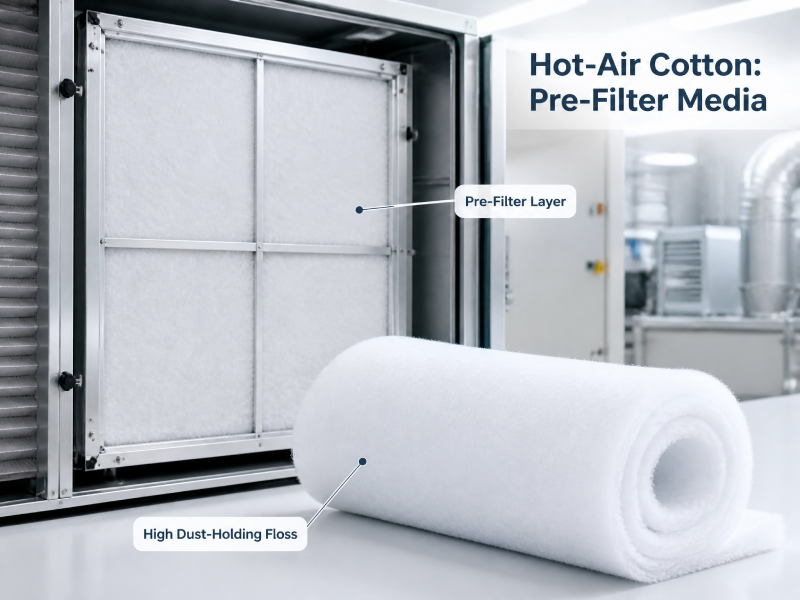
A pre-filtration layer is the initial filtration stage in many air filtration systems. Its main function is to capture larger particles before the air reaches subsequent filtration layers, helping reduce the particle load on downstream filter media.
In a multi-layer filtration structure, different materials usually perform different functions. Pre-filter media can capture larger particles, while downstream filtration layers handle more specific particle filtration requirements according to the system design.
For some air purifiers, air conditioner filters, and industrial ventilation systems, the material structure of the pre-filter layer can affect airflow performance and the operating conditions of subsequent filter media.
Thermal bonded wadding has a relatively open fiber structure and can be evaluated for pre-filtration applications according to the specific product design. Its suitability needs to be assessed based on fiber composition, GSM, thickness, density, and actual air filtration requirements.
Buyers should understand that pre-filtration media is not the same as final high-efficiency filtration media. Thermal bonded wadding cannot be classified as HEPA filter media simply because of its material name or appearance. Specific filtration efficiency or particle retention rates should not be claimed without the corresponding test results.
Therefore, before requesting a quotation, buyers should first clarify the position and function of the thermal bonded nonwoven within the filter. Is it intended to capture larger particles as a pre-filter layer, or does it serve as an auxiliary structural layer for other filtration materials? This distinction provides the basis for selecting the appropriate material specifications.
What Is Thermal Bonded Nonwoven Filter Media?
Thermal bonded nonwoven is a type of nonwoven material formed through a thermal bonding process. It is also commonly known as thermal bonded wadding or hot air nonwoven fabric.
Its basic structure consists of different fibers. During production, the fibers are opened, blended, and formed into a web. Controlled heating then softens or melts the low-melting-point bonding components, creating bonding points between the fibers. After cooling, the material forms a three-dimensional fiber structure with a certain degree of loft and air permeability.
Unlike needle-punched felt, which relies on mechanical needle punching to entangle fibers, thermal bonded wadding mainly uses thermal bonding to form its structure. These different manufacturing methods produce different fiber network characteristics, so the two materials should not be treated as identical filtration media.
For air filtration applications, buyers should focus not simply on whether the product name contains the words nonwoven or filter, but on whether the actual fiber structure meets the requirements of the intended filtration layer.
The material structure of thermal bonded wadding can be adjusted according to project requirements, including fiber type, fiber ratio, GSM, thickness, and density.
For air filtration applications, the material must also be evaluated in relation to air permeability, pressure drop, and subsequent lamination requirements. The same product name does not mean that thermal bonded wadding from different suppliers will have identical filtration performance.
HuiZhou JinHaoCheng Nonwovens Co., Ltd. has actual experience supplying thermal bonded wadding to air filter and air purifier customers and has also manufactured various composite filtration products. For each specific project, the appropriate material solution needs to be confirmed according to the customer's filter structure and performance requirements.
Where Can Thermal Bonded Nonwoven Be Used in Air Filtration?
Depending on the product structure and purchasing requirements, thermal bonded wadding can be evaluated for various air filtration applications. Different applications have different filtration conditions and material requirements, so buyers should not assume that one material specification is suitable for every filter product.
Air Conditioner Filters
In air conditioner filters, thermal bonded wadding can be considered as a potential pre-filtration material. Buyers should provide the filter dimensions, installation structure, target airflow, and requirements for material air permeability and pressure drop.
If the filter uses a multi-layer structure, buyers should also clarify whether the thermal bonded wadding will be combined with other filtration media.
Automotive Cabin Air Filters
Automotive cabin air filters need to be evaluated according to the vehicle's interior space, filter structure, and actual operating conditions.
Buyers should provide the filter design dimensions, material layer arrangement, airflow requirements, and whether lamination with other filtration materials is required. The application name alone does not mean that ordinary thermal bonded wadding can meet every automotive filtration requirement.
Air Purifier Pre-Filters
The pre-filter layer in an air purifier needs to be selected according to the overall filtration structure of the product.
If thermal bonded wadding is used for initial filtration, buyers should clarify the target particles, airflow requirements, and whether other filtration materials will be used downstream. The material's suitability needs to be verified through specific specifications and sample evaluation.
Vacuum Cleaner Filter Components
Vacuum cleaner filter components may use different material structures depending on the filter type, equipment design, and the position of the material within the filtration system.
If thermal bonded wadding is intended for an auxiliary layer or pre-filtration component, buyers should provide a structural drawing, an existing material sample, or photographs of the filter component so the supplier can evaluate material suitability.
Industrial Pre-Filtration
For industrial ventilation and air treatment equipment, pre-filtration materials need to be evaluated according to actual airflow, particle characteristics, and operating environments.
Different industrial environments may involve different dust types, humidity levels, and operating conditions. Therefore, the material specifications cannot be determined based on the general application description of industrial pre-filtration alone.
These applications can serve as starting points for project development. However, the specific product structure and suitability still need to be confirmed according to the actual filter design, samples, and performance requirements.
Pre-Filter Media vs. Final Filtration Media: What Is the Difference?
When purchasing thermal bonded wadding for air filtration, an important step is to distinguish between pre-filter media, final filtration media, and a filter support layer.
These three terms should not be used interchangeably because they describe different functions within a filtration system.
Pre-Filtration Media
Pre-filtration media is usually positioned at the front of a filtration system. Its main function is to capture larger particles and reduce the particle load on downstream filtration materials.
When selecting pre-filter media, buyers need to consider airflow performance, material structure, GSM, thickness, and actual particle capture requirements.
Thermal bonded wadding can be evaluated for pre-filtration applications according to the specific structure, but its actual filtration performance needs to be verified through appropriate testing.
Final Filtration Media
Final filtration media performs more specific filtration tasks within the filtration system. Its filtration efficiency and particle retention capability need to be verified according to the target filtration grade and applicable testing standards.
For example, some air purifiers use multiple filtration layers, and the final filtration layer may have a completely different material structure from the pre-filter layer.
Therefore, ordinary thermal bonded wadding should not be promoted as high-efficiency filter media or HEPA material simply because it has air filtration applications.
Filter Support Layer
A filter support layer mainly helps other filtration materials form a stable product structure. Its specific function depends on the filter design.
It does not necessarily perform the main particle filtration function and should not automatically be treated as pre-filter media.
If buyers require thermal bonded wadding as a filter support layer, they should provide the material layer arrangement, lamination method, and final product requirements. The supplier can then evaluate the appropriate material solution.
When requesting a quotation, buyers should clearly identify which type of structure they need instead of simply asking for air filter nonwoven material. This helps reduce misunderstandings about the intended application.
How Do GSM, Thickness and Density Affect Filter Media Selection?
GSM, thickness, and density are important basic specifications when purchasing thermal bonded wadding.
These parameters affect the fiber structure and air permeability characteristics of the material, but none of them can independently determine its final filtration performance.
GSM
GSM refers to the weight per square meter and is one of the most commonly used basic specifications for thermal bonded wadding.
For air filtration applications, buyers should determine the target GSM according to the filter structure and actual application requirements rather than assuming that a higher GSM always means better filtration performance.
Under similar fiber composition and structural conditions, changes in GSM may affect material thickness and fiber distribution. However, materials from different suppliers cannot be compared simply by their GSM values.
Thickness
Thickness affects the overall structure of the filtration material and the space required for installation.
If the material needs to fit into a filter frame with fixed dimensions or be laminated with other filtration layers, buyers must confirm the finished thickness and acceptable tolerance in advance.
For multi-layer filtration structures, buyers should also clarify whether the specified thickness refers to the thermal bonded wadding layer alone or the entire laminated product.
Density
Density is related to the mass of material per unit volume and is an important parameter for understanding the fiber structure of thermal bonded wadding.
Under otherwise similar conditions, changes in density may affect the internal pore structure and airflow characteristics. However, it is not accurate to assume that higher density always means higher filtration efficiency or that lower density always results in lower pressure drop.
Actual performance is also affected by fiber type, fiber diameter, fiber distribution, material thickness, and manufacturing structure.
Therefore, when providing specifications, buyers are advised to confirm the following information together:
Base fiber composition.
Target GSM.
Material thickness.
Material density or structural requirements.
Finished width and supply format.
Intended application and installation structure.
If buyers already have filtration materials in use, they can provide samples, drawings, or specification sheets. Comparing the existing material with the proposed material helps the supplier understand the purchasing requirements more accurately.
Why Should Buyers Check Air Permeability and Pressure Drop?
For air filtration materials, Air Permeability and Pressure Drop are two important performance indicators that buyers should evaluate.
Air permeability describes the ability of air to pass through a material, while pressure drop describes the pressure loss that occurs as air passes through it. These two indicators are related, but they are not the same.
If the air permeability of a material does not match the filter design, it may affect the overall airflow and operating performance of the filter.
Buyers should not judge air permeability based only on the material's appearance, thickness, or GSM. They should also avoid directly applying test data from another supplier's product.
When requesting a quotation, buyers are advised to clarify the following information:
Air Permeability
Confirm the target air permeability value, as well as the testing method and test conditions.
Results may vary under different testing conditions. Therefore, an air permeability value without an explanation of the testing method is not sufficient for accurate comparison.
Initial Pressure Drop
Initial pressure drop refers to the initial pressure loss that occurs when air passes through the filtration material. It needs to be evaluated together with test air velocity, effective testing area, material structure, and testing equipment.
If buyers have a target pressure drop requirement, they should also provide the corresponding test air velocity and testing conditions.
Testing Method
If buyers require a third-party test report, they should clarify the test items, applicable testing standards, sample requirements, and intended use of the report in advance.
For customized projects requiring air permeability or pressure drop data, the corresponding tests can be arranged according to customer requirements. Testing costs and specific arrangements need to be confirmed with the sales team in advance.
Sample Verification
If buyers already have reference materials, they are advised to compare the existing material with the proposed thermal bonded wadding sample.
In addition to test data, buyers should confirm whether the sample is suitable for the actual filter structure and whether it meets the design requirements when combined with other filtration layers.
It is important to understand that higher air permeability does not automatically mean better filtration performance, and lower pressure drop alone cannot prove that a material meets a target filtration grade. Buyers need to evaluate these factors together with filtration efficiency, particle characteristics, and the requirements of the complete filtration system.
Can Thermal Bonded Nonwoven Be Laminated with Other Filter Materials?
In actual air filtration products, the filtration structure does not always consist of a single layer of nonwoven fabric.
Some filters use multiple layers of materials, with different layers performing pre-filtration, primary filtration, support, or protection functions. Therefore, buyers may need to laminate thermal bonded wadding with other filtration materials to create a structure that meets the requirements of the final product.
Thermal bonded wadding can be evaluated for lamination according to specific project requirements, but the lamination materials and final product structure need to be clarified in advance.
Confirm the Layer Structure
Buyers should provide information about the complete material layer arrangement.
For example, which side of the filtration structure will the thermal bonded wadding be positioned on? Will it be combined with other fiber materials, filtration media, or support materials? What function does each layer perform?
If an existing product sample or structural drawing is available, it is recommended to provide it when requesting a quotation.
Confirm the Composite Requirements
For composite projects, buyers need to clarify the specifications of each material layer, finished thickness, width, and final application method.
If the product needs to undergo subsequent die cutting, slitting, folding, or other converting processes, these requirements should also be explained in advance so the supplier can evaluate whether the material structure is suitable for further processing.
Evaluate the Finished Composite Sample
After different materials are combined, the finished product's thickness, flexibility, structural stability, and air permeability may change.
Therefore, buyers should not inspect only the individual thermal bonded wadding sample. They should also confirm whether the completed composite structure meets the purchasing requirements.
The factory has produced various composite filtration products and can discuss possible lamination directions according to project requirements. However, the specific combination of thermal bonded wadding with other filtration materials needs to be confirmed according to the actual materials, product structure, and manufacturing requirements.
What Should Buyers Confirm Before Ordering Custom Filter Media?
Before purchasing thermal bonded nonwoven for air filtration, buyers are advised to prepare a complete technical specification sheet.
If buyers provide only a product name and target GSM, suppliers usually cannot accurately determine whether the material is suitable for the actual filter structure.
The following information is recommended when preparing an inquiry.
Purchasing Item | Information to Provide |
Application | Air conditioner filters, air purifiers, automotive cabin air filters, vacuum cleaner filter components, or industrial air filtration |
Filtration Stage | Pre-filter layer, final filtration layer, or filter support layer |
Fiber Composition | PET, PP, ES fiber, or other specified fiber composition |
GSM | Target GSM and acceptable tolerance |
Thickness | Material thickness and acceptable tolerance |
Density | Target density or reference material structure |
Air Permeability | Air permeability requirements and testing conditions |
Pressure Drop | Target pressure drop, test air velocity, and testing conditions |
Filtration Requirements | Target particles, filtration efficiency, or applicable filtration grade requirements |
Composite Structure | Whether lamination with other filtration materials is required and the arrangement of each layer |
Roll Width | Finished material width |
Supply Form | Rolls, sheets, or other customized dimensions |
Sample | Existing material samples, filter samples, or product drawings |
Testing Report | Whether third-party test reports for air permeability, pressure drop, or other performance indicators are required |
Order Quantity | Sample requirements, trial order quantity, and estimated bulk purchasing volume |
Packaging | Packaging method and transportation requirements |
If buyers do not have complete technical specifications at the beginning, they can first provide existing filtration material samples, filter photographs, product drawings, or application descriptions.
The supplier can use this information to understand the product structure and then confirm the material specifications and testing requirements that need to be provided.
For projects requiring test reports, the test items and testing standards should be clarified during sample development. Testing costs need to be confirmed separately according to the specific project and testing laboratory requirements.
Before bulk purchasing, buyers are advised to complete the following checks:
First, confirm whether the sample's fiber composition, GSM, thickness, and structure meet the requirements.
Second, confirm whether the material's air permeability and pressure drop meet the specified targets under the agreed testing conditions.
Next, confirm whether the material can be laminated with other filtration layers and whether the finished composite product meets the dimensional and structural requirements of the filter.
Finally, use the samples, technical specifications, and testing requirements approved by both parties as the basis for bulk production.
For air filtration material buyers, selecting thermal bonded wadding should not be based only on the product name or a single GSM value. Instead, the decision should consider the pre-filtration function, material structure, airflow performance, and requirements of the final product.
If you are developing an air purifier, air conditioner filter, or another air filtration product, you can first provide the intended application, filtration structure, GSM, thickness, and testing requirements, then discuss a suitable thermal bonded wadding solution with the supplier.




