
When Is Anti-Condensation Felt Not the Right Roof Solution?
Anti-condensation felt is commonly used in metal roofing systems to absorb condensation that forms on the underside of metal roof sheets and gradually release the moisture when environmental conditions allow. However, this does not mean that anti-condensation felt is suitable for solving every roof moisture problem.
If a building already has roof insulation, experiences persistently high indoor humidity, has inadequate ventilation, or suffers from rainwater leaks, how should buyers determine whether anti-condensation felt is still suitable?
The key is to identify the source of the problem. Condensation, moisture continuously generated inside a building, and rainwater leaking through the roof are different issues. Anti-condensation felt can serve a useful purpose in a suitable roofing system, but it cannot replace every insulation, ventilation, waterproofing, or repair measure.
For metal roofing manufacturers, steel-structure contractors, and overseas building-material buyers, understanding these limitations helps clarify the actual problem before purchasing and reduces the risk of selecting a material that does not match the intended application.
Does Existing Roof Insulation Mean Anti-Condensation Felt Is Unnecessary?
Having roof insulation does not automatically mean that anti-condensation felt is unnecessary. Whether additional felt is appropriate depends on the design of the existing insulation system, the roof structure, indoor humidity, and the moisture problem observed in practice.
Insulation materials and anti-condensation felt do not serve exactly the same purpose. Insulation primarily reduces heat transfer, while anti-condensation felt is designed to temporarily absorb condensation that forms on the underside of metal roofing and release moisture when conditions allow.
Therefore, buyers should not decide whether to use anti-condensation felt based only on whether a building already has insulation.
If the existing insulation system meets the project's thermal and moisture-management requirements and there is no significant condensation problem, buyers should first confirm whether adding anti-condensation felt would provide a practical benefit. If the insulation has design defects, installation problems, or moisture-related issues, the cause should be identified before another material is added.
For roofs with existing insulation, buyers should also examine the structure, installation method, and moisture-management design of the current materials. Roofing systems vary considerably, so the compatibility of two materials should not be determined by their product names alone.
When Is Persistent High Humidity a Limitation?
Persistent high humidity is an important condition for buyers to evaluate.
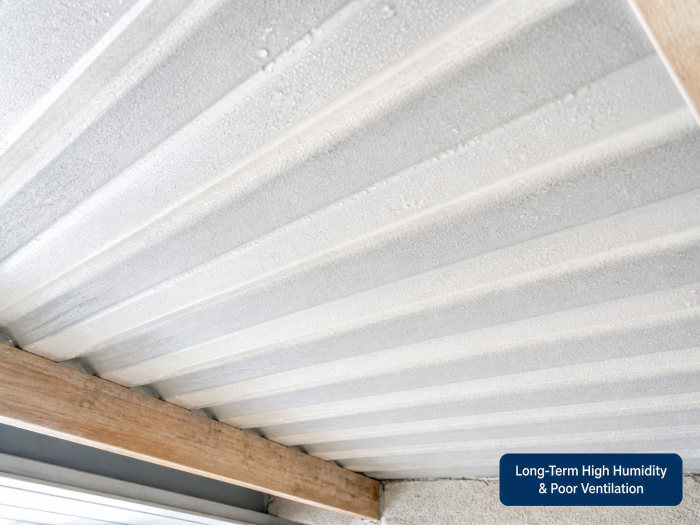
For example, some agricultural buildings, livestock facilities, food-processing plants, and industrial buildings that continuously generate water vapor may maintain high indoor humidity for extended periods. If condensation forms repeatedly on the metal roof and the felt does not have enough time to release moisture between condensation events, moisture may gradually accumulate.
Anti-condensation felt temporarily absorbs condensation and gradually dries when conditions allow. It is not a material that can store water indefinitely, nor can it independently eliminate water vapor that is continuously generated inside a building.
Buyers should therefore identify the main sources of moisture in the building. For example, they should determine whether moisture comes from production processes, cleaning operations, livestock activities, or continuously operating equipment. They should also assess whether indoor humidity remains high for long periods and whether existing ventilation and humidity-management measures are adequate.
If moisture is continuously generated and the environment does not provide suitable drying conditions, simply choosing a thicker or higher-GSM anti-condensation felt may not solve the problem.
In this situation, buyers should first evaluate the moisture sources, ventilation conditions, and overall roof design before deciding whether anti-condensation felt is suitable as part of the system.
Can Anti-Condensation Felt Work Without Adequate Ventilation?
Anti-condensation felt should not be treated as a substitute for a ventilation system.
After the material absorbs condensation, it still needs suitable environmental conditions to release moisture. If the roof space lacks effective airflow for extended periods, moisture may be difficult to remove, limiting the material's drying process.
Therefore, even when anti-condensation felt is installed, ventilation conditions may still affect the condensation-control performance of the overall roofing system.
Buyers should distinguish between two situations.
The first is a roof with some airflow that still experiences condensation under certain temperature and humidity conditions. In this situation, anti-condensation felt may remain suitable, but its performance should be evaluated in relation to the roof structure and actual operating conditions.
The second is a roof space with persistently inadequate ventilation, where indoor moisture continues to accumulate. In this case, buyers should first examine whether the existing ventilation design is appropriate and whether airflow improvements or other humidity-management measures are necessary.
For warehouses, industrial buildings, and agricultural buildings, the suitability of a roofing system cannot be determined solely by whether anti-condensation felt has been installed. Roof construction, ventilation, moisture sources, and material performance must be considered together.
If the ventilation conditions are unclear, buyers should provide relevant roof information before bulk purchasing and consult qualified building or roofing professionals to confirm the system design. The selection of anti-condensation felt should be based on an understanding of the actual application conditions, rather than the assumption that the material can compensate for every ventilation problem.
Is Anti-Condensation Felt the Right Solution for a Leaking Roof?
If a metal roof has rainwater leaks, anti-condensation felt is generally not a substitute for roof leak repairs.
Condensation forms when water vapor in the air condenses on a colder metal surface. Roof leaks, by contrast, are commonly associated with joints, fasteners, damaged roof sheets, flashing details, or other waterproofing components. These problems have different sources and require different inspection methods.
For example, if dripping occurs during rainfall but not under dry weather conditions, buyers should pay particular attention to roof joints, fasteners, and other potential leak points. However, this observation alone cannot identify the exact cause, and a professional inspection may be necessary.
If a roof has both condensation and rainwater leaks, the two problems should be evaluated separately. Repairing leaks and managing condensation on the metal surface are different tasks. Installing anti-condensation felt should not be a reason to overlook the waterproof integrity of the roof.
For projects involving obvious leaks, standing water, or damaged roof sheets, buyers should arrange appropriate inspection and repairs before evaluating whether anti-condensation felt is also needed.
This distinction is particularly important for overseas procurement projects. If buyers treat a leaking roof as a condensation problem, even a suitable material may fail to address the actual source of the fault.
When Should Buyers Consider Another or Additional Roof Solution?
When the main problem is not simply condensation on the metal surface, or when the existing roofing system has significant limitations, buyers should consider other or additional measures.
Project Condition | What Buyers Should Prioritize | Possible Role of Anti-Condensation Felt |
Existing insulation meets project requirements, with no significant condensation problem | Confirm whether additional material is necessary and whether it fits the roof design | May not be necessary; assess according to actual needs |
The insulation system has defects or does not meet project requirements | Evaluate the insulation design, installation, and thermal requirements first | Cannot replace necessary insulation improvements |
The building has persistent high humidity and continuously generates substantial moisture | Assess moisture sources, ventilation, and humidity-management measures | May form part of the system, but cannot independently eliminate continuous moisture sources |
Roof ventilation is inadequate | Examine the ventilation design and airflow conditions | Cannot replace necessary ventilation measures |
The roof has rainwater leaks | Inspect roof sheets, joints, fasteners, and waterproofing components, and carry out necessary repairs | Cannot replace leak repairs |
The project has both condensation and other roofing problems | Identify each problem separately and evaluate the entire roofing system | May be used for condensation management when the conditions are suitable |
This table does not mean that anti-condensation felt is unsuitable in every situation listed. It highlights that the material's ability to address the target problem depends on what the project actually needs to solve.
If the main problem is rainwater leakage, the waterproofing fault should be addressed first. If the problem is moisture continuously generated indoors, the moisture sources and ventilation conditions should be evaluated. If the problem relates to insulation, the existing insulation design needs to be examined.
Once these underlying conditions are understood, buyers can make a more informed decision about whether anti-condensation felt is appropriate and whether it needs to work alongside other measures.
What Should Buyers Confirm Before Selecting Anti-Condensation Felt?
Before purchasing anti-condensation felt, buyers can assess whether the product matches the project by reviewing several factors.
First, identify the actual problem. Determine whether the roof is experiencing condensation, rainwater leakage, or both. Different sources of moisture may require different solutions.
Second, understand the existing roof structure. Confirm whether insulation, other lining materials, or composite materials are already installed, and identify the function each material serves within the roofing system.
Third, understand the building's operating environment. For buildings with persistently high humidity, clarify the sources of indoor moisture, ventilation conditions, and actual operating requirements as far as possible. The building type alone is usually not enough to determine whether a material is suitable.
Fourth, confirm compatibility between the material and the roof structure. Different roof-sheet designs, manufacturing methods, and installation conditions may affect material selection. For metal roofing produced on continuous roll-forming lines, buyers should also consider whether the material is compatible with the actual production process.
Fifth, confirm sample-evaluation requirements before bulk purchasing. If the project has specific requirements for material structure, GSM, width, bonding, or other properties, agree on the relevant verification methods and acceptance criteria in advance. If the application cannot be assessed from the available information, further testing or professional evaluation may be necessary.
For overseas importers, roofing-panel manufacturers, and building-material distributors, clarifying these details early can reduce the risk of a mismatch between product specifications and the intended application. Materials should be evaluated against project requirements rather than selected solely by product name or a single specification.
HuiZhou JinHaoCheng Nonwovens Co., Ltd. has been engaged in nonwoven material development and production since 2005. Depending on project requirements, buyers can discuss the GSM, width, color, roll length, and customization options of anti-condensation felt and related needle-punched nonwoven materials. For metal roofing projects, buyers can provide information about the roof structure, operating environment, and target specifications to help clarify product requirements and evaluate samples.
Conclusion: Match the Material to the Actual Roofing Problem
Anti-condensation felt is not a universal solution for every roof moisture problem. Existing insulation, persistent high indoor humidity, inadequate ventilation, and rainwater leaks all require an assessment of the specific conditions rather than a simple classification of the material as either suitable or unsuitable.
If the existing insulation system already meets the project's needs, confirm whether additional anti-condensation felt is necessary. If the building continuously generates substantial moisture, evaluate the moisture sources and drying conditions. If ventilation is inadequate, examine airflow throughout the roofing system. If the roof leaks, prioritize inspection and repair of the waterproofing problem.
For buyers, the correct decision-making process is to identify the source of the problem first, evaluate the roofing system, and then determine whether anti-condensation felt is suitable and what product requirements must be met.
If a project does require management of condensation forming on the underside of metal roofing, buyers can explore Anti-Condensation Felt product structures and customization options, then confirm suitable specifications and sample-evaluation requirements based on the actual roof conditions.




