
Acoustic Pipe Wrap: Can Needle-Punched Felt Help Reduce Plumbing and HVAC Noise?
Water flowing through drainage pipes, noise from water supply systems, and vibration generated by HVAC piping can travel through pipe walls, pipe supports, and building structures into indoor spaces. For these situations, acoustic pipe wrap can be evaluated as an auxiliary material solution. However, wrapping a pipe with a layer of felt does not solve every type of pipe noise.
Needle-punched felt has a flexible fibrous structure and can be used as an acoustic absorption or cushioning layer in certain applications. For some pipe-related projects, it may serve as an additional outer wrapping layer to help improve the local acoustic environment or reduce certain contact-related noises. Its actual performance depends on the noise source, material thickness, density, pipe structure, installation method, and overall system design.
Before selecting pipe soundproofing felt, buyers should first identify whether the noise comes from water flow, pipe-wall vibration, or contact between pipes and supports or walls. They can then determine whether needle-punched felt is suitable as part of the proposed solution. Noise reduction should never be judged solely by the material name or GSM value.
Why Do Plumbing and HVAC Pipes Generate Noise?
Pipe noise is generally associated with fluid movement, equipment operation, and vibration transmitted between pipes and building structures. Different piping systems operate under different conditions, so their noise sources are not always the same.
In residential drainage systems, water flowing through vertical drainpipes, elbows, and connecting sections can generate continuous flow noise or localized impact sounds. When drainage pipes are located near bedrooms, living rooms, or other noise-sensitive areas, vibrations from the pipe walls and the resulting sound radiation may affect the indoor environment.
Noise in water supply pipes may come from changes in water velocity, valves opening or closing, pressure fluctuations, and turbulence as water passes through fittings. In some situations, changes in water flow can also cause pipe vibration.
In HVAC systems, pumps, fans, valves, and other equipment may transmit vibration through connected pipes. During operation, hot- and chilled-water piping may also generate flow noise, equipment vibration, and noise transmitted through pipe support structures.
Therefore, buyers should not select a wrapping material simply because a pipe is described as noisy. A more practical approach is to identify where the noise occurs, under what operating conditions it appears, and how it travels. This helps determine whether the main issue is sound radiated from the pipe surface, localized contact noise, or vibration transmitted from equipment and support structures.
Common Types of Pipe Noise: Water Flow, Vibration, and Impact
Pipe noise can be classified according to how it is generated. Different noise types require different control approaches, and the suitability of needle-punched felt wrapping will vary accordingly.
Water Flow Noise
Flow noise is generally associated with water velocity, pressure changes, pipe geometry, and components such as valves and elbows. When water passes through restricted areas, valves, or sections where the pipe cross-section changes suddenly, turbulence and additional noise may occur.
For this type of problem, the first step is to examine the fluid operating conditions and piping design. A needle-punched felt wrapping layer can be evaluated as an auxiliary acoustic material on the outside of the pipe, but it cannot change the internal flow velocity, pressure, or turbulence. Nor can it replace measures that address the noise source itself.
Pipe Vibration Noise
When pumps, valves, or other equipment operate, mechanical vibration may travel into connected pipes. This can cause the pipe walls to vibrate and radiate sound into the surrounding space.
If pipes are rigidly connected to walls, floors, or metal supports, vibration may also be transmitted into the building structure.
In these situations, the selection of pipe noise reduction material needs to be considered together with pipe supports, equipment connections, and vibration isolation structures. Adding a layer of needle-punched felt to the outside of a pipe does not, by itself, provide complete vibration isolation for the piping system.
Impact and Contact Noise
When pipes come into contact with supports, walls, metal components, or other pipes, equipment operation or changes in water flow may cause minor impacts, friction, or continuous vibration.
If the noise comes from a clearly identifiable contact point, flexible felt material may be evaluated as a cushioning layer. Its purpose is to introduce a flexible material at the contact interface, not to replace dedicated vibration-isolation supports, pipe fixings, or structural support solutions.
Identifying the noise type is an important step before selecting a material. Depending on the source, buyers may need to evaluate pipe wrapping, equipment vibration isolation, pipe supports, and adjustments to the fluid system separately.
How Needle-Punched Felt Works as an Acoustic Wrapping Layer
Needle-punched felt is produced by mechanically entangling fibers through a needle-punching process, forming a three-dimensional fibrous structure. The spaces between fibers create a porous structure, which allows this type of material to be used as a porous fibrous layer in certain acoustic applications. It may absorb some sound energy that enters the material.
When needle-punched felt is used as an outer pipe wrapping layer, it may provide auxiliary benefits under suitable conditions.
First, its fibrous structure can be evaluated as an acoustic absorption layer. When some sound enters a porous fibrous structure, interactions between the fibers and the air may dissipate part of the sound energy. However, this does not mean that wrapping a pipe with ordinary needle-punched felt will necessarily produce a significant reduction in indoor noise.
Second, flexible felt may act as a cushioning or contact-isolation layer on the outside of a pipe. When the installation structure is suitable, it may reduce direct contact between certain hard surfaces and help control noise caused by minor friction or impact.
In addition, flexible rolls can be cut and wrapped according to the pipe profile. For straight pipes, elbows, and pipes with different diameters, buyers can evaluate the required material width, thickness, and wrapping method based on the actual installation structure.
However, three concepts must be clearly distinguished: sound absorption, sound insulation, and vibration damping are not the same performance characteristics.
Sound absorption refers to the absorption of some sound energy entering a material. Sound insulation concerns the transmission of sound from one space to another. Vibration damping or isolation focuses on controlling the transmission of mechanical vibration energy. Needle-punched felt may serve as a functional layer in certain acoustic structures, but its fibrous structure alone does not establish that it provides complete pipe sound insulation or equipment vibration isolation.
If a project requires a specific noise reduction value in decibels, the actual material structure and installation method should be tested acoustically. Data from ordinary sound-absorbing felt should not be applied directly to a different pipe wrapping system.
Applications in Drainage Pipes and Residential Plumbing
Drainage systems are an important application area to consider when evaluating pipe noise control. In particular, vertical drainage pipes in residential buildings, apartments, hotels, and commercial properties often pass through walls, floors, or service spaces. The sound of flowing water may travel through the pipe walls and building structures.
For drainage risers, buyers should first identify the main source of noise. If the primary issue is sound radiated from the pipe surface into the surrounding space, they can further evaluate whether an external acoustic wrapping material may help.
If the main problem is vibration transmitted through contact between the pipe and a wall or support, the support structure and contact points should also be inspected. Needle-punched felt may be used as an auxiliary cushioning layer in a suitable structure, but it cannot replace dedicated vibration-isolation supports or an engineered pipe sound insulation system.
For water supply pipes, water velocity, pressure changes, valves, and fitting geometry may have a significant influence on noise. Buyers should determine whether the noise occurs continuously during normal water supply or mainly when valves open or close or equipment starts operating.
It is also important to consider that drainage and water supply pipes may operate under different temperature and humidity conditions. Cold-water pipes, in particular, may be affected by condensation and surface moisture. Wrapping materials should therefore be evaluated for more than their potential acoustic function. Ordinary needle-punched felt should not automatically be regarded as a moisture-resistant layer or vapor barrier.
For residential plumbing projects, acoustic pipe wrap is therefore better treated as an auxiliary material option that needs to be evaluated according to the pipe type, installation location, and actual noise problem, rather than as a universal pipe noise reduction solution.
Acoustic Wrapping for HVAC and Industrial Pipelines
Noise in HVAC piping systems may come from pumps, valves, fluid movement, and equipment vibration transmitted through connected pipes into surrounding structures.
For hot- and chilled-water circulation pipes and certain industrial pipelines, buyers should first determine whether the project mainly requires acoustic control, thermal insulation, fire protection, or a combination of these functions.
If the main concern is sound radiated from the outside of the pipe, needle-punched felt may be evaluated as an auxiliary acoustic wrapping layer. If the noise mainly originates from pumps or other equipment, equipment foundations, flexible connections, and pipe support structures should also be considered.
If the pipes carry hot water, chilled water, or other temperature-sensitive fluids, the material must also meet the relevant operating temperature and environmental requirements. Ordinary acoustic needle-punched felt cannot automatically replace dedicated thermal insulation materials. Its potential sound absorption properties do not mean that it is suitable for every hot- or cold-water pipeline.
For commercial buildings and industrial projects with fire safety requirements, buyers should also specify the applicable flame-retardant standards and testing requirements. Ordinary polyester needle-punched felt, self-adhesive felt, and flame-retardant needle-punched felt should not be treated as interchangeable materials.
It is also important to distinguish HVAC piping from HVAC ductwork. This article focuses on the wrapping of pipes carrying water or other fluids. It does not establish that the same material is suitable for large ventilation ducts or complete duct silencer systems.
If a project also involves pipe insulation and fire protection, buyers can learn more about flame-retardant nonwoven fabric in pipe insulation systems. However, thermal, fire-retardant, and acoustic properties must be evaluated separately. One property cannot be used as proof of another.
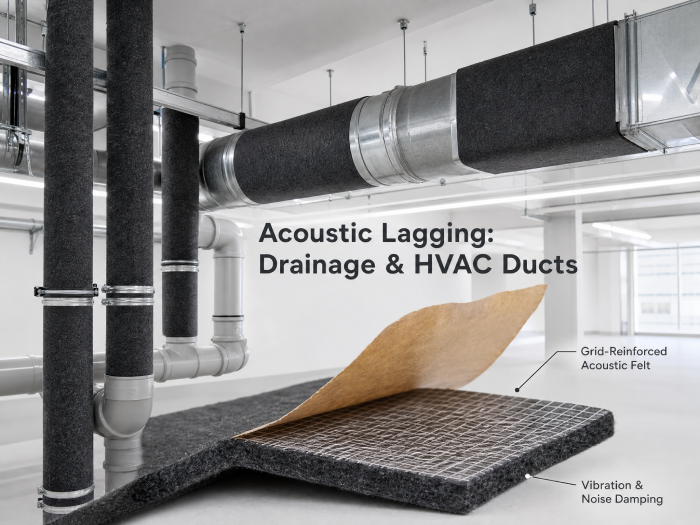
Why Flexible Self-Adhesive Felt Is Convenient for Pipe Wrapping
For projects that require material to be attached to the outside of a pipe, self-adhesive felt pipe wrap is one material structure worth evaluating.
Self-adhesive needle-punched felt generally consists of a needle-punched felt base, a pressure-sensitive adhesive layer, and a release liner. Before installation, the release liner covers the adhesive surface. During installation, the liner is removed and the material is applied to the target surface.
Compared with materials that require separate glue application or an independent fixing method, a self-adhesive structure can simplify some installation steps and help hold the material in the intended position.
For pipe wrapping projects, flexible rolls can be cut according to the pipe diameter and required wrapping length. Buyers should confirm whether continuous wrapping is needed, how seams should be handled, and whether allowances are required around elbows, tees, valves, and pipe supports.
However, whether a self-adhesive material can remain securely attached depends on the pipe substrate, surface preparation, temperature, humidity, and adhesive properties. Metal pipes, plastic pipes, coated pipes, and surfaces contaminated with oil or condensation may have different bonding conditions.
JHC's existing self-adhesive needle-punched felt rolls use a composite structure consisting of needle-punched nonwoven felt, pressure-sensitive adhesive, and a kraft paper release liner. Material, thickness, width, and adhesive specifications can be discussed according to project requirements. However, this does not mean that the product has already been validated for every pipe surface or operating environment.
For an actual pipe project, buyers are advised to test samples on the target pipe surface first. Initial tack, edge lifting, long-term adhesion, and performance after changes in temperature and humidity should be evaluated before deciding whether the material is suitable for bulk installation.
What Affects the Acoustic Performance of Pipe Wrap Materials?
When selecting acoustic pipe wrap, buyers should not compare materials based only on GSM or thickness. Material structure, pipe conditions, and installation methods can all affect actual performance.
Material Thickness and Density
Thickness and density influence the fibrous structure, material flexibility, and condition of the installed wrapping layer. Needle-punched felt with different thicknesses and densities may have different sound absorption characteristics. However, greater thickness does not necessarily mean better pipe noise reduction.
Buyers should select specifications according to the target noise type, available installation space, and wrapping structure, then verify performance through samples or testing of the actual assembly.
Fiber Structure and Material Composition
Polyester needle-punched felt, needle-punched felt made from other fiber compositions, and acoustic materials produced through different processes may have different structures and performance characteristics. Buyers should confirm the fiber type, needle-punched structure, GSM, thickness, and density rather than relying only on the product name "acoustic felt."
Wrapping Coverage and Installation Structure
The covered area, seams, overlap method, number of wrapping layers, and presence of air gaps may all influence actual acoustic performance.
If gaps appear around elbows, connections, or pipe supports, the installed structure may differ from the structure used in sample testing. Therefore, the test setup should be as close as possible to the final installation method.
Pipe Material and Operating Environment
The vibration characteristics of metal pipes and plastic pipes are different. Pipe diameter, wall thickness, operating pressure, and fluid conditions may also influence noise performance.
In addition, operating temperature, humidity, condensation, cleaning agents, and outdoor exposure may affect the long-term stability of the material and adhesive. Cold-water pipes require particular attention to condensation risks and whether a separate moisture-resistant or vapor barrier structure is needed.
Adhesive and Fixing Method
For self-adhesive materials, buyers should confirm adhesive compatibility with the pipe surface, bonding stability, and suitable operating temperature range. For coated surfaces, plastic pipes, or pipes exposed to moisture, testing should be carried out on the actual substrate.
Acoustic Testing Conditions
If a project has specific acoustic performance requirements, buyers should confirm whether the test applies to the material alone or to the complete assembly, including the pipe, wrapping layer, seams, and installation structure.
Sound absorption data for a material alone cannot be directly treated as noise reduction data for a complete pipe system. Without actual test results, suppliers should not promise a fixed noise reduction value in decibels.
What Should Buyers Confirm Before Ordering Acoustic Pipe Wrap?
To determine whether needle-punched felt is suitable for a pipe noise control project, buyers should provide sufficient application and technical information. Simply requesting "soundproofing felt" or "self-adhesive pipe wrapping material" is usually not enough to identify the appropriate product structure.
Information to Confirm | Details Buyers Should Provide |
Pipe Application | Drainage pipes, water supply pipes, HVAC hot- or chilled-water pipes, or other industrial pipelines |
Noise Source | Water flow noise, pipe-wall vibration, impact or friction, or noise transmitted from equipment |
Pipe Material | Metal, PVC, other plastics, or coated pipes |
Pipe Dimensions | Outside diameter, straight pipe length, elbows, and connection sections |
Operating Conditions | Operating temperature, humidity, pressure, and environment |
Material Requirements | Fiber composition, GSM, thickness, density, and color |
Wrapping Structure | Whether self-adhesive backing and a release liner are required, as well as wrapping width and overlap method |
Adhesive Requirements | Target pipe surface, bonding stability, and operating temperature |
Special Properties | Flame retardancy, moisture resistance, temperature resistance, or other project requirements |
Acoustic Requirements | Target noise type, test method, and actual acceptance criteria |
Order Quantity | Sample requirements, estimated usage, and bulk purchasing plan |
For customized projects, buyers are advised to provide pipe photos, outside diameter measurements, installation drawings, samples of existing wrapping materials, and the operating conditions under which the noise occurs. Any acoustic testing standards or customer-specific performance requirements should also be shared before requesting a quotation.
During sample evaluation, it is best to use the same or a similar substrate to the actual pipe and reproduce the real wrapping method as closely as possible. Buyers should inspect material fit, seams, edge fixing, adhesive stability, and whether peeling or lifting occurs after changes in temperature and humidity.
If the project requires verified noise reduction performance, before-and-after measurements should be conducted under clearly defined test conditions. The pipe type, installation structure, noise source, and measurement location should be recorded. Results are meaningful only when the test conditions and test objects are consistent.
For projects without measured data, suppliers can discuss potential material options based on the material structure and application conditions, but should not promise a fixed noise reduction value in decibels.
Ultimately, whether needle-punched felt is suitable for pipe noise control depends on its actual role within the complete piping system. For buyers, identifying the noise source and confirming the material structure, bonding conditions, operating environment, and testing requirements are more important than simply choosing felt with a greater thickness or higher GSM.




