Anti-Condensation Felt for Warehouses, Factories and Agricultural Buildings: What Buyers Should Check
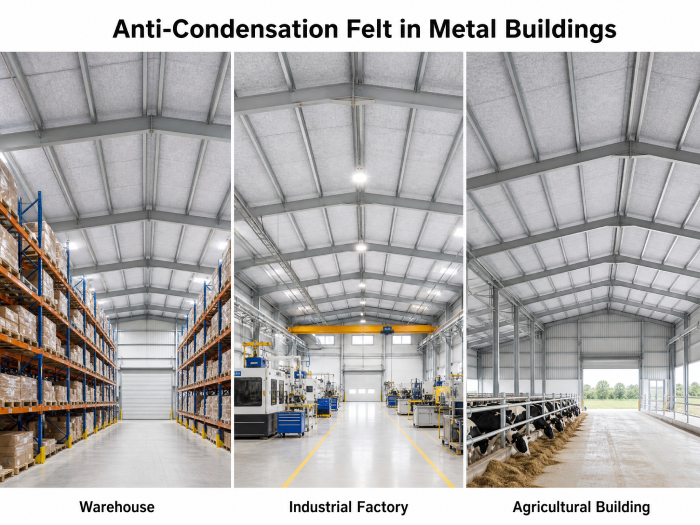
Warehouses, manufacturing factories, agricultural buildings, and machinery storage facilities may all use single-skin metal roofing. However, their indoor activities, sources of moisture, and protection requirements are not the same. When purchasing anti-condensation felt for industrial buildings, buyers should not select a product based only on the building type or roof area.
For industrial warehouses, the main concern is whether condensation dripping could affect stored goods, packaging, and inventory. For manufacturing factories, buyers need to understand whether production processes generate continuous moisture, dust, or other contaminants. Agricultural buildings require additional consideration of livestock activities, cleaning operations, and agricultural product storage. Machinery storage facilities may need to address the risk of moisture affecting metal equipment, tools, spare parts, and electrical components.
The selection of anti-condensation felt should start with the building application and actual roof environment, followed by material specifications, roof compatibility, and sample validation requirements. The same material may not be suitable for every building environment, and a higher GSM alone does not prove that a product is appropriate for a particular project.
Why Do Different Industrial Buildings Require Different Anti-Condensation Felt Purchasing Considerations?
Anti-condensation felt is commonly used on the underside of metal roofing sheets. It temporarily absorbs condensation that forms on the metal surface and gradually releases moisture when environmental conditions allow, helping reduce the risk of water dripping directly from the roof.
However, the intended use of a building affects the environment beneath the roof.
For example, an ordinary warehouse may mainly need to prevent dripping from affecting goods and packaging. A manufacturing factory may have production equipment, water-using processes, cleaning operations, or heating processes. Agricultural buildings may experience moisture from livestock activities or the storage of feed and agricultural products. Machinery storage facilities may need to pay particular attention to precision equipment and metal components.
Buyers should therefore distinguish between three questions.
First, what is stored or produced inside the building? This determines which goods, equipment, or production activities may be affected by dripping condensation.
Second, where does the indoor moisture come from? Moisture may be generated by people, production processes, cleaning, livestock activities, or stored materials.
Third, does the roofing system provide conditions compatible with the material? Roof panel construction, installation methods, ventilation, and drying conditions all influence the performance of the overall roofing system.
This is why anti-condensation felt should not be selected according to simple rules such as "a certain GSM for warehouses, another GSM for factories, and a higher GSM for agricultural buildings." The building application helps identify what needs to be evaluated, but it cannot replace technical specification confirmation.
Industrial Warehouses: Focus on Protecting Goods, Packaging, and Inventory
For industrial warehouses, the main purchasing concern is usually whether condensation dripping from the roof could affect stored goods, packaging, and inventory management.
Warehouse contents can vary considerably. A warehouse storing general building materials may have different requirements from one storing cardboard packaging, textiles, electronic products, or raw materials.
For example, cardboard packaging, paper products, and some textiles may be affected by moisture, which can influence their appearance, packaging integrity, or subsequent use. Electronic products and their packaging may require more careful control of storage conditions.
Therefore, buyers should not provide only the warehouse area and roof dimensions. They should also explain what is stored beneath the roof and whether the goods are directly exposed to the roof area.
For warehouse projects, buyers should pay particular attention to the following information:
Evaluation Item | Information to Confirm | Why It Matters for Purchasing |
Stored goods | Cardboard boxes, textiles, electronic products, building materials, or other goods | Helps identify the potential impact of dripping |
Storage arrangement | Whether goods are placed on racks, pallets, or directly beneath the roof | Helps identify the areas requiring protection |
Roof structure | Metal panel type, profile, roof pitch, and existing lining | Helps assess material compatibility |
Indoor environment | Whether there are wet goods, cleaning activities, humidification, or other moisture sources | Helps identify sources of indoor humidity |
Ventilation conditions | Whether eaves, ridge, or other ventilation systems are provided | Helps evaluate the drying conditions after moisture absorption |
For warehouse projects, buyers should distinguish between ordinary inventory storage and storage of moisture-sensitive goods. Even if two warehouses have the same floor area, their purchasing requirements may be quite different.
If a warehouse stores goods that are highly sensitive to humidity, anti-condensation felt should not be treated as a complete warehouse humidity-control system. Buyers should also evaluate the building's overall ventilation, humidity management, and goods packaging conditions.
Manufacturing Factories and Workshops: Focus on Production Activities and Indoor Conditions
The environment beneath the roof of a manufacturing factory or industrial workshop may be more complex than that of an ordinary warehouse.
Different production activities generate different amounts of heat, moisture, and airborne contaminants. For example, production areas involving cleaning, wet processing, steam, or hot water may have continuous or intermittent sources of water vapor. Some processing areas may also generate dust, oil mist, or other contaminants.
These factors influence the evaluation of anti-condensation felt for factories. Buyers should not simply describe the building as a "factory workshop." They should explain what production activities actually take place inside.
For manufacturing factory projects, the following information should be confirmed first:
Evaluation Item | Information to Confirm |
Production type | Machining, assembly, cleaning, wet processing, or other manufacturing activities |
Moisture sources | Whether steam, hot water, cleaning, or drying processes are involved |
Equipment operation | Whether continuously operating equipment generates heat or moisture |
Air conditions | Whether dust, oil mist, chemicals, or other contaminants are present |
Roof structure | Single-skin metal sheets, insulated panels, or another roofing system |
Ventilation conditions | Whether continuous exhaust, local exhaust, or natural ventilation is available |
It is particularly important to understand that manufacturing factories are not a single, uniform application category.
A workshop mainly used for dry assembly may have very different environmental conditions from a production facility that continuously uses hot water or steam.
If a production area contains corrosive gases, chemicals, persistent high humidity, or significant dust, buyers should first confirm whether these conditions fall within the intended material's application limits. Material suitability should not be determined solely by the product name or standard specifications. Special industrial environments may require further evaluation by roofing engineers, material suppliers, or other relevant professionals.
For manufacturing factory projects, buyers should also confirm whether the anti-condensation felt will be laminated to the underside of the metal roofing sheet during production or installed at another construction stage. If the material is intended for a continuous roll-forming line, the actual processing method and relevant equipment requirements should be provided to avoid incompatibility between the material construction and the production process.
Agricultural Buildings: Focus on Livestock Activities, Cleaning, and Continuous Moisture Sources
Indoor conditions vary significantly among agricultural buildings. They should not all be treated as the same application.
Livestock barns, poultry houses, agricultural machinery sheds, feed warehouses, and crop storage buildings may all use metal roofing, but their moisture sources, indoor activities, and storage requirements are different.
For example, livestock activities may generate continuous moisture and changes in indoor humidity. Cleaning operations may increase local humidity, while the storage of feed, hay, and agricultural products may create additional concerns about moisture and dripping.
Therefore, buyers should first identify the specific purpose of the agricultural building.
Livestock Buildings
Buyers should confirm the livestock type, stocking density, indoor cleaning frequency, drinking-water areas, and ventilation arrangements. Livestock activities and building cleaning may keep indoor humidity relatively high, so the actual moisture sources and roof drying conditions need careful evaluation.
Feed and Agricultural Product Storage Buildings
Buyers should identify the stored materials, packaging methods, whether goods are directly exposed, and whether roof dripping could affect storage quality. They should also distinguish between humidity already present inside the building and condensation forming on the metal roof.
Agricultural Machinery Sheds
Buyers should confirm whether the building mainly stores tractors, harvesting equipment, agricultural vehicles, or other tools. For metal equipment stored over extended periods, roof dripping may increase the risk of surface moisture. The storage location and roof structure should therefore be considered together.
Agricultural Building Type | Main Concern | Information to Confirm Before Purchasing |
Livestock Buildings | Continuous moisture and indoor humidity changes caused by livestock activities | Livestock type, cleaning frequency, ventilation, and moisture sources |
Poultry Buildings | Environmental changes caused by poultry activities and cleaning | Poultry management methods, cleaning arrangements, and ventilation |
Feed and Crop Storage | Moisture affecting feed, hay, or agricultural products | Stored goods, packaging, storage location, and roof dripping risk |
Agricultural Machinery Sheds | Moisture affecting agricultural equipment and vehicles | Equipment type, parking location, and roof structure |
Agricultural buildings require particular care when evaluating persistently high-humidity environments. If large amounts of moisture are continuously generated inside the building and there are insufficient drying conditions, simply increasing the GSM of the anti-condensation felt cannot guarantee that the problem will be solved.
For high-humidity or special agricultural environments, buyers should first confirm the roofing system, ventilation, and actual moisture sources before deciding whether anti-condensation felt is suitable. Additional building humidity-management measures may also be necessary.
Machinery and Equipment Storage Buildings: Focus on Moisture Risks to Metal Equipment and Components
Machinery and equipment storage buildings differ from ordinary warehouses. Their contents may include industrial machinery, metal tools, spare parts, vehicles, electrical equipment, and other products that need to be kept in suitable storage conditions.
For these buildings, buyers need to consider more than the total quantity of stored inventory. They should identify which equipment components may be affected by roof dripping and whether the equipment has additional protective measures.
For example, metal machinery stored over extended periods may require attention to surface moisture. Spare parts and tools may be stored in cardboard boxes, plastic packaging, or other protective materials. Electrical equipment and control components may have more specific storage environment requirements.
Buyers can evaluate the project using the following information:
Evaluation Item | Information to Confirm Before Purchasing |
Equipment type | Heavy machinery, agricultural equipment, industrial vehicles, or precision equipment |
Storage arrangement | Uncovered storage, packaged storage, or enclosed shelving |
Moisture-sensitive components | Metal surfaces, connecting parts, electrical components, or precision parts |
Roof conditions | Metal roof panel type, structure, and existing lining |
Operating environment | Whether temperature changes, cleaning, or other moisture sources are present |
Protection requirements | Whether equipment covers, packaging, or other humidity-control measures are already used |
If equipment has specific storage humidity requirements, buyers should follow the storage recommendations provided by the equipment manufacturer. Installing anti-condensation felt alone does not mean that the equipment has received sufficient protection.
For equipment storage facilities with special protection requirements, buyers should also confirm whether additional roofing or indoor environmental control measures are necessary.
Anti-Condensation Felt Purchasing Priorities for Different Building Applications
The main differences among the four building types discussed above are their indoor activities, the goods or equipment that need protection, and their sources of moisture.
Buyers can use the following table to identify which conditions should be confirmed first for each project.
Application | Main Concern | Key Purchasing Information | Sample Validation Focus |
Industrial Warehouse | Dripping affecting goods, packaging, and inventory | Stored goods, roof structure, ventilation, and indoor moisture sources | Material specifications, roof compatibility, and project-related performance |
Manufacturing Factory | Equipment, production areas, and continuous moisture sources | Production processes, temperature and humidity changes, cleaning, and exhaust conditions | Material construction, installation method, and actual operating conditions |
Agricultural Building | Livestock activities, cleaning, and agricultural product storage | Specific building use, moisture sources, ventilation, and special environmental conditions | Material suitability under representative environmental conditions |
Machinery Storage | Moisture affecting metal equipment, tools, and spare parts | Equipment type, storage arrangement, and roof dripping areas | Material specifications, roof compatibility, and equipment storage requirements |
This table cannot directly determine the GSM required for a particular project, nor can it replace engineering design. Its purpose is to help buyers identify the main differences between applications before requesting quotations, rather than providing suppliers with only a general description such as "industrial building" or "agricultural warehouse."
What Roof and Building Conditions Should Buyers Confirm Before Purchasing Anti-Condensation Felt?
After identifying the building application, buyers should also organize information about the roof structure and operating environment. These details help suppliers understand the actual application conditions and discuss suitable material constructions and sample requirements.
Roof Panel Type and Structure
Confirm the metal roofing panel material, profile, surface coating, and cross-sectional structure. If available, provide roof panel drawings, photographs, or an existing sample.
Different roof panel structures and manufacturing methods may create different requirements for material width, lamination methods, and installation arrangements.
Installation Method of Anti-Condensation Felt
Confirm whether the material will be laminated to the metal roofing panel during production or used at another installation stage.
If a self-adhesive construction is required, clarify the roof panel surface condition, bonding requirements, and actual installation method. If the material will be used on a continuous roll-forming production line, the relevant production conditions should also be confirmed.
Indoor Humidity and Moisture Sources
Do not simply describe the environment as "high humidity." Explain where the moisture comes from, such as production water, steam, cleaning operations, livestock activities, or wet goods storage.
If indoor temperature and humidity records are available, provide the monitoring period and measurement locations to help the supplier understand the environment.
Ventilation and Drying Conditions
Confirm whether the building has ridge ventilation, eaves ventilation, mechanical exhaust, or other airflow arrangements.
Anti-condensation felt is not a permanent water-storage material. The moisture it absorbs needs to be gradually released when conditions allow. Therefore, ventilation and drying conditions must be considered as part of the overall roofing system.
Target Material Specifications
After confirming the building conditions, buyers can discuss material type, GSM, width, color, roll length, and backing construction.
If the required GSM has not yet been determined, buyers can first provide the building application, roof structure, and intended use. The supplier can then discuss specifications for evaluation instead of automatically selecting the product with the highest GSM.
How Should Buyers Confirm Anti-Condensation Felt Samples for Their Building Applications?
Sample approval should not be based only on the material's appearance, feel, or whether its GSM matches expectations.
For different building projects, buyers should determine the sample evaluation requirements according to the actual application.
For example, warehouse projects should first confirm material specifications and roof compatibility. Manufacturing factory projects may also need to consider production conditions and installation methods. Agricultural building projects should clearly state whether persistent high humidity or special contaminants are present. Machinery storage facilities should evaluate the actual roof location and equipment protection requirements.
Sample approval can be divided into three parts.
Material Specification Confirmation
Confirm whether the sample's material construction, GSM, thickness, width, color, and backing construction match the quotation or technical documentation. If specific tolerances apply, agree on the inspection method and acceptable limits in advance.
Roof Compatibility Confirmation
If the material will be used with a specific metal roofing panel, provide an actual roof panel sample or relevant drawings whenever possible. This helps confirm whether the material construction, bonding method, and installation conditions are suitable for the project.
If the project involves continuous roll-forming production, the roofing panel manufacturer or production line technical team should confirm whether the material is compatible with the actual processing conditions. A simple manual bonding test cannot fully replace production-line validation.
Application Environment Confirmation
If the project has specific condensation-management or bonding-stability requirements, agree on the sample test conditions, evaluation methods, and acceptance criteria in advance.
Do not judge whether a material is suitable for long-term use based only on a simple water-droplet demonstration. Sample testing should reflect the actual application conditions as closely as practical, while distinguishing between the test results of the material itself and the performance of the entire roofing system.
For long-term purchasing projects, buyers should also retain approved samples, specification documents, and acceptance records as references for subsequent mass production and repeat orders.
Frequently Asked Questions
Is anti-condensation felt suitable for all industrial warehouses?
Not necessarily. Warehouses differ in their stored goods, indoor humidity, roof structures, and ventilation conditions. Buyers should evaluate material suitability according to the type of goods and actual roof environment rather than relying on the building's general purpose alone.
Can anti-condensation felt be used in manufacturing factories?
It can be evaluated as a condensation-management material for certain metal roofing projects. However, buyers should first understand the factory's production activities, moisture sources, dust and chemical environment, and the ventilation and drying conditions of the roofing system. Special industrial environments require additional suitability evaluation.
Is anti-condensation felt suitable for livestock buildings?
Livestock buildings can be evaluated as an application for anti-condensation felt, but continuous moisture generation, cleaning frequency, indoor ventilation, and roof drying conditions require particular attention. Buyers should not assume that standard product specifications are suitable for every livestock environment.
Does a higher GSM always mean better performance?
No. GSM represents the mass per unit area of a material. It does not directly indicate water absorption capacity or prove that the material is suitable for a particular building environment. Buyers should evaluate material construction, roof conditions, project requirements, and sample validation results together.
Can anti-condensation felt replace roof ventilation?
No. Anti-condensation felt cannot replace appropriate building ventilation design. The moisture absorbed by the material needs to be released when conditions allow, so roof ventilation and drying conditions remain important.
What information should buyers provide when requesting a sample?
Buyers should provide the building application, roof panel type, roof structure, indoor moisture sources, ventilation conditions, target material specifications, and installation method. Roof panel drawings, photographs, or existing material samples can also be provided if available.
Conclusion: Determine Anti-Condensation Felt Purchasing Priorities According to Building Applications
Industrial warehouses, manufacturing factories, agricultural buildings, and machinery storage facilities may all use metal roofing, but their indoor activities, moisture sources, and protection requirements are different.
Warehouse projects should focus on the risk of moisture affecting goods and packaging. Manufacturing factories need to evaluate production activities and special environmental conditions. Agricultural buildings require an understanding of livestock activities, cleaning operations, and continuous moisture sources. Machinery storage facilities should pay attention to the storage conditions of metal equipment, tools, and components.
For overseas buyers, a practical purchasing process should start by identifying the building application, followed by an evaluation of the roof structure and indoor environment. Material specifications, installation methods, and sample validation requirements can then be confirmed.
Founded in 2005, HuiZhou JinHaoCheng Nonwovens Co., Ltd. has more than 20 years of experience in nonwoven research, development, and manufacturing. The company provides needle-punched nonwoven materials and related anti-condensation felt products, with customization options that can be discussed according to project requirements, including GSM, width, color, roll length, and packaging. For metal roofing projects, buyers can provide the building application, roof panel information, and target requirements to discuss product construction and sample evaluation.
If you are sourcing PET anti-condensation felt for an industrial warehouse, manufacturing factory, or agricultural building, first identify the actual application environment. Then confirm the suitable product specifications according to the roof structure and purchasing requirements, rather than selecting a product based only on the building name or GSM.