How to Choose Automotive Trunk Fire Resistant Felt? 8 Key Questions Buyers Should Ask
An automotive trunk may look like a simple space for storing luggage, tools, and other items. However, for automotive manufacturers, automotive interior suppliers, auto parts wholesalers, and material purchasing teams, selecting the right trunk interior material is more complicated than it may seem.
The trunk area may be exposed to heat, friction, heavy objects, oil contamination, moisture, and continuous vehicle vibration during long-term use. If material selection focuses only on appearance and price while overlooking flame resistance, dimensional stability, abrasion resistance, and batch consistency, problems such as deformation, wear, odor, surface damage, or failure to meet customer testing requirements may occur later.
Therefore, when sourcing Automotive Fire Resistant Felt, Automotive Nonwoven Felt, or Trunk Liner Felt, automotive material buyers are increasingly asking questions such as:
Is this material suitable for automotive trunk applications? What flame-retardant grade does it meet? Are GSM and thickness consistent? Will the material deform during long-term use? Can it be cut and processed according to different vehicle models? Will bulk production maintain the same quality as the approved sample?
For automotive interior manufacturers, component suppliers, and brand customers purchasing materials on a long-term basis, these questions are often more important than simply comparing the initial purchasing price.
Why Should Automotive Trunk Materials Consider Fire Resistant Felt?
The automotive trunk is not necessarily an area completely free from heat sources and related risks.
Different vehicle models have different trunk structures. Depending on the vehicle design, areas around the trunk may be located near exhaust systems, power batteries, high-voltage systems, electrical components, or other heat-generating components. At the same time, the trunk may contain tools, luggage, electronic equipment, outdoor products, and other items.
Therefore, for certain automotive interior and thermal protection applications, materials may need to provide not only basic covering and protection but also appropriate flame retardancy, heat resistance, thermal insulation, and safety performance according to the vehicle design requirements.
Nonwoven materials are already used in different automotive areas, including trunk interiors, carpets, luggage compartment liners, and seat-back components. Depending on the project requirements, some automotive nonwoven materials can also provide functions such as flame retardancy, abrasion resistance, and sound absorption.
However, it is important to understand that not every automotive trunk requires the same type of fire resistant felt.
The appropriate material needs to be determined according to the vehicle structure, installation position, distance from heat sources, applicable vehicle standards, customer testing requirements, and actual operating environment.
Therefore, the most important consideration when sourcing automotive fire resistant felt is not simply finding the material with the “highest temperature resistance,” but selecting a material that matches the actual automotive application.
What Is the Difference Between Standard Trunk Felt and Automotive Fire Resistant Felt?
Standard automotive trunk felt is mainly used for covering, decoration, sound absorption, cushioning, and general protection.
By contrast, fire resistant felt or flame-retardant nonwoven felt designed for specific automotive interior protection areas may require additional flame-retardant or heat-resistant performance in addition to basic physical properties.
The main difference is not simply the color or thickness. It is the material structure and functional purpose.
Standard needle punched felt may mainly be evaluated according to:
GSM
Thickness
Strength
Abrasion resistance
Dimensional stability
Appearance and hand feel
Automotive fire resistant felt may require additional evaluation of:
Flame-retardant performance
Burning test requirements
Dimensional changes after heat exposure
Melt-drip behavior
Structural stability under elevated temperatures
Compliance with specified automotive testing standards
Therefore, if an automotive project has specific flame-retardant requirements, standard trunk felt should not simply be substituted for automotive fire resistant felt.
Likewise, simply calling a material “Fire Resistant Felt” does not mean that it is suitable for every automotive application.
The final performance must be evaluated according to the specific material, thickness, structure, testing method, and customer requirements.
What Problems Are Most Common When Buying Automotive Trunk Fire Resistant Felt?
When purchasing automotive fire resistant felt for the first time, many buyers naturally focus on price, color, and thickness.
However, problems often appear in different areas once the material enters mass production.
First, the approved sample performs well, but the bulk order is different.
If a supplier does not have stable raw materials and effective production control, differences may occur between samples and bulk production in GSM, thickness, density, surface structure, or even flame-retardant performance.
Second, material thickness is inconsistent.
Automotive trunk interior materials often need to be assembled with other components. If thickness varies significantly across the material, it may affect cutting, forming, and final assembly.
Third, the material deforms easily.
Automotive interior felt may need to undergo cutting, bending, heat pressing, or other processing. If the material structure is not sufficiently stable, its dimensions may change after forming.
Fourth, flame-retardant performance is inconsistent.
For automotive projects, providing one test report is not always enough. Buyers also need to confirm whether the material composition and thickness of the tested sample are the same as those of the actual bulk order.
Fifth, the material does not perform well during secondary processing.
Automotive interior felt is rarely used directly as a finished product. Many projects require laser cutting, die cutting, thermoforming, lamination, bonding, or other secondary processing.
Therefore, buyers need to evaluate both the material itself and the subsequent processing requirements.
What Key Parameters Should Buyers Check When Purchasing Automotive Trunk Fire Resistant Felt?
If you are sourcing Automotive Fire Resistant Felt, it is recommended not to ask the supplier only for a price.
At least the following factors should be confirmed.
1. Material Type
The first question is which type of fiber is used.
Different fibers may have significant differences in flame retardancy, heat resistance, strength, flexibility, processing performance, and cost.
Depending on the project requirements, different flame-retardant fibers, heat-resistant fibers, or blended fiber structures may be considered.
For higher-safety applications, it is more important to confirm the specific fiber composition and final material structure rather than simply relying on the product name.
2. GSM and Thickness
GSM and thickness directly affect material weight, hand feel, structural strength, sound absorption, and subsequent processing performance.
For automotive trunk applications, thicker does not necessarily mean better.
Excessive thickness may increase vehicle weight, occupy additional space, and affect final assembly.
If the material is too thin, however, it may not provide the required protection, cushioning, or thermal insulation.
A more appropriate approach is to select the right combination of GSM, thickness, and density according to the actual application.
3. Flame-Retardant Grade and Testing Standards
This is one of the most important considerations when sourcing automotive fire resistant felt.
Buyers should first confirm which testing standard the customer or vehicle project requires, and then ask the supplier to develop and test the material accordingly.
Do not simply ask:
“Is it fireproof?”
A better question is:
“Which flame-retardant or fire-resistance standard does this material meet?”
Buyers should also confirm:
What is the testing method?
What material thickness was tested?
Is the material composition the same as the bulk order?
Is a third-party test report available?
Test results can vary according to material, thickness, and structure. Therefore, a general “fireproof” label should not be treated as a universal indication of suitability for every application.
4. Dimensional Stability
Automotive trunk interior materials often need to be cut and assembled, making dimensional stability particularly important.
If the material experiences significant shrinkage or deformation during production, transportation, or subsequent processing, it may result in:
Inaccurate cutting dimensions;
Poor edge matching;
Changes in assembly gaps;
Uneven finished-product appearance.
For automotive mass-production projects, stable dimensional control can help reduce material waste during subsequent processing.
5. Abrasion and Tensile Resistance
The automotive trunk is not a completely static environment.
Luggage, toolboxes, shopping bags, bicycles, and other items may be moved in and out of the trunk repeatedly, creating friction against the material surface.
Therefore, in addition to flame-retardant performance, automotive trunk felt may also need to provide suitable abrasion resistance, tensile strength, and structural stability depending on the application.
If the material develops excessive fuzzing, surface damage, or loose fibers after repeated friction, it can directly affect service life and visual appearance.
6. Odor and Material Cleanliness
Automotive interior materials are different from ordinary industrial materials.
When materials are used inside vehicles, buyers may also need to consider odor, VOCs, material cleanliness, and applicable environmental requirements.
Therefore, for automotive projects, it is also important to confirm whether the supplier can provide relevant material information and testing documentation.
7. Secondary Processing Capability
Automotive interior felt is usually not the final product.
Buyers may require different widths, thicknesses, roll lengths, colors, and cut sizes.
Some projects may also require:
Die cutting
Laser cutting
Thermoforming
Lamination
Film bonding
Customized dimensions
Therefore, a supplier suitable for automotive projects should not simply “sell a roll of felt.” It should also have certain customization and processing support capabilities.
8. Batch-to-Batch Production Consistency
This is one of the most easily overlooked issues in long-term automotive material sourcing.
A good sample does not necessarily mean that bulk production will remain stable.
What buyers really need to confirm is:
Can the same raw materials be used consistently in production?
Are GSM variations controlled from batch to batch?
Is thickness uniform across the production width?
Can the same flame-retardant requirements be maintained in future batches?
For automotive component manufacturers, batch consistency can directly affect the stability of the finished product.
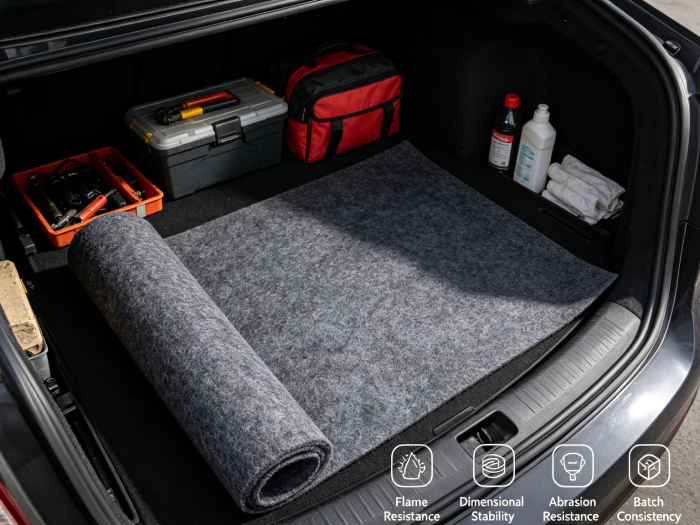
Why Is Needle Punched Construction Suitable for Developing Automotive Fire Resistant Felt?
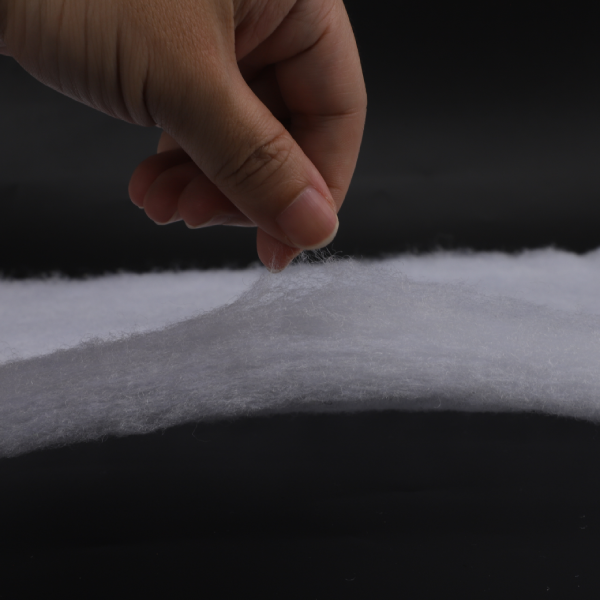
Needle punching mechanically entangles fibers to form a nonwoven material with a certain thickness, density, and structural stability.
By adjusting fiber type, fiber ratio, GSM, needle punching density, thickness, and finishing processes, manufacturers can develop needle punched felt with different performance characteristics.
This adjustability is one of the reasons needle punched nonwoven materials can be used in automotive interiors, trunk liners, and other automotive protection components.
Some automotive nonwoven suppliers use needle punched felt in applications such as trunk liners, floor carpet backing, parcel shelves, and door trim, while adjusting weight, thickness, color, texture, and backing structure according to project requirements.
For buyers, one of the major advantages of needle punched technology is its flexibility for customization.
Even for automotive trunk materials, different vehicle models, installation positions, and customer specifications may require completely different material specifications.
Therefore, instead of searching for one standard product that can supposedly be used for every vehicle model, it is more practical to work with a custom nonwoven felt manufacturer that can adjust the material structure according to project requirements.
What Applications Can Automotive Fire Resistant Felt Be Used For?
Automotive fire resistant felt is not necessarily limited to trunk applications.
Depending on the material performance and vehicle structure requirements, it can be developed for different automotive interior and protection applications.
For example:
Automotive trunk liners
Luggage compartment partitions
Trunk floor protection layers
Trunk covers and panels
Seat-back panels
Automotive carpet backing
Engine compartment thermal protection
Battery-area thermal protection
Automotive interior sound and thermal insulation components
Automotive nonwoven materials are used in trunk, roof, door, and other interior areas, while different applications may have different requirements for flame retardancy, sound absorption, abrasion resistance, and dimensional stability.
Therefore, when developing automotive fire resistant felt, the first step should be identifying the installation position and actual operating conditions, followed by material selection.
Does Automotive Trunk Fire Resistant Felt Need to Withstand the Highest Possible Temperature?
Not necessarily.
This is a common misunderstanding when purchasing automotive materials.
A material that can withstand a higher temperature is not automatically more suitable for an automotive trunk application.
Automotive projects require a balance among:
Actual operating temperature
Distance from the heat source
Flame-retardant requirements
Material thickness
Weight limitations
Flexibility
Processing method
Available installation space
Cost
If the automotive trunk only requires basic flame-retardant performance, selecting a high-temperature material far beyond the actual requirement may unnecessarily increase material costs.
If the installation position is close to a heat source, however, additional heat resistance and thermal insulation performance may need to be considered.
Therefore, a professional material selection process should not simply ask:
“What is the highest temperature this felt can withstand?”
Instead, ask:
“What performance does my application actually require?”
Why Should Automotive Fire Resistant Felt Not Be Compared Only by Price per Kilogram?
For ordinary nonwoven materials, price per kilogram can be an important purchasing indicator.
For automotive interior materials, however, comparing only price/kg can easily overlook the actual project cost.
For example, two materials may have different purchasing prices, but one may offer:
Lower processing waste;
Better dimensional stability;
Better batch consistency;
Easier die cutting;
More stable flame-retardant performance;
Better compliance with customer testing requirements.
Its overall project cost may therefore be lower.
Automotive material sourcing should therefore consider:
Material price + processing cost + waste + quality risk + batch consistency + delivery capability
rather than simply:
Price per KG
This is why long-term automotive projects often require a stable needle punched felt manufacturer rather than simply the lowest-cost supplier.
Why Do Automotive Buyers Need a Stable Needle Punched Nonwoven Manufacturer?
The automotive industry is different from many ordinary consumer-product markets.
Once a project enters mass production, materials may need to be supplied continuously for several months or even longer.
If a supplier later changes raw materials, modifies production parameters, or fails to maintain stable GSM and thickness, the customer may need to repeat testing or even restart material development.
Therefore, when selecting an automotive fire resistant felt supplier, buyers should confirm:
Does the supplier have its own manufacturing facility?
Can it consistently control raw materials?
Does it have established needle punching production lines?
Can it control GSM and thickness?
Can it maintain the same specifications over the long term?
Does it support OEM and customization?
Can it cooperate with customers during product development?
These factors are often more important than saving a few cents on the initial quotation.
Why Choose Jinhaocheng as an Automotive Fire Resistant Felt Supplier?
HUIZHOU JINHAOCHENG NONWOVENS CO., LTD has long focused on the development and manufacturing of needle punched nonwoven and other nonwoven materials.
The company operates an approximately 26,000-square-meter production base equipped with 15 automated needle punching production lines, providing stable needle punched nonwoven materials for automotive interiors, industrial protection, filtration, sound insulation, and other applications.
As a professional needle punched nonwoven felt manufacturer and nonwoven felt manufacturer China, we can adjust GSM, thickness, width, color, density, and material structure according to customer application requirements.
For automotive fire resistant felt projects, different fiber systems and functional requirements can be matched according to the actual application.
We also support OEM/ODM customization, including material specification development, dimensional customization, and subsequent processing requirements.
For automotive component manufacturers, automotive interior suppliers, brand customers, and wholesalers requiring long-term supply, working directly with a manufacturing-capable needle punched felt manufacturer can reduce unnecessary intermediaries while making specification control and long-term supply management more efficient.
8 Questions to Ask a Manufacturer Before Buying Automotive Trunk Fire Resistant Felt
If you are developing automotive trunk fire resistant felt, consider asking the supplier the following questions before placing an order:
1. What fiber is used?
What type of fiber is used?
2. What is the GSM and thickness tolerance?
What are the GSM and thickness tolerances?
3. What flame-retardant standard does the material meet?
Which flame-retardant or fire-resistance testing standard does the material meet?
4. Is the test report based on the same material specification as the bulk order?
Does the test report represent the same material specification as the bulk production?
5. How stable is the material from batch to batch?
How consistent is the material between different production batches?
6. Can the material be customized for our application?
Can the material be customized according to our project requirements?
7. What secondary processing can you support?
Do you support die cutting, laser cutting, thermoforming, lamination, or other secondary processing?
8. Can you maintain the same specification for long-term supply?
Can you consistently maintain the same specifications for long-term orders?
If a supplier can clearly answer these questions and demonstrate stable samples, bulk production, and manufacturing capabilities, it is generally more suitable for a long-term supplier list than a supplier that simply offers the lowest quotation.
How Should You Choose Automotive Trunk Fire Resistant Felt?
There is no single “universal material” suitable for every vehicle model and every automotive trunk position.
If the project is mainly focused on trunk liners, buyers should pay particular attention to abrasion resistance, dimensional stability, processing performance, and appearance.
If the material is located close to a heat source, additional attention should be given to flame retardancy, heat resistance, and thermal insulation.
If the customer has specific automotive testing requirements, the material structure and testing conditions must be confirmed according to those requirements.
For large-volume OEM production, greater attention should be given to GSM, thickness, batch consistency, raw material stability, and long-term supply capability.
Therefore, the correct sourcing process should be:
Application Position → Actual Operating Conditions → Performance Requirements → Material Structure → GSM/Thickness → Testing Standard → Sample Approval → Bulk Consistency → Long-Term Supply
Rather than:
Price → Order
Conclusion: The Key to Automotive Fire Resistant Felt Is Application Matching, Not Simply Higher Cost
The value of automotive trunk fire resistant felt is not simply adding another layer of material.
For automotive interior and protection applications, the real objective is to achieve a practical balance among flame retardancy, heat resistance, abrasion resistance, dimensional stability, processing performance, weight, and cost.
For automotive material buyers, component manufacturers, automotive interior suppliers, wholesalers, and brand customers, choosing a stable needle punched felt manufacturer is often more important than simply selecting the lowest quotation.
Jinhaocheng focuses on needle punched nonwoven felt, automotive nonwoven felt, fire resistant felt, and other customized nonwoven materials, providing OEM/ODM solutions according to different project requirements.
If you are developing materials for automotive trunks, automotive interiors, thermal protection, or flame-retardant applications, materials can be customized according to your fiber type, GSM, thickness, dimensions, flame-retardant requirements, and final application.
For long-term projects, choosing a stable needle punched felt manufacturer, nonwoven felt manufacturer China, and custom nonwoven felt manufacturer can help you better control material quality, batch consistency, and supply stability.
If you are developing automotive trunk fire resistant felt or other automotive flame-retardant nonwoven materials, contact us to discuss a suitable material solution based on your specific application requirements.