Why Does a Car Trunk Need Fire Resistant Felt? Is Standard Trunk Felt Really Enough?
Many people consider a car trunk simply a space for storing luggage, tools, and other items. As a result, they may assume that standard automotive trunk felt is sufficient for decoration, sound insulation, and surface protection.
However, for automotive manufacturers, automotive interior suppliers, automotive component companies, and customers purchasing automotive nonwoven materials on a long-term basis, the real question is not simply whether the trunk felt is thick enough, but:
When there are potential heat sources, electrical components, exhaust-related components, battery systems, or other heat risks around the trunk area, can standard trunk felt meet the actual application requirements?
Automotive trunk materials may need to withstand friction, heavy objects, temperature changes, moisture, vibration, and long-term use. Depending on the vehicle structure, some trunk areas may also be located near electrical systems, exhaust-related components, or other heat sources.
Therefore, for certain automotive interior and functional material applications, fire resistance is not simply an optional feature that can be ignored. It may be an important part of material selection.
Nonwoven automotive materials are widely used in areas such as trunk liners, floor carpets, parcel shelves, and door trims. Different applications have different requirements for abrasion resistance, dimensional stability, thickness, and functional performance.
If an automotive project has specific requirements for flame retardancy, fire resistance, or heat protection, it is better to confirm whether Automotive Fire Resistant Felt is required during the material development stage rather than discovering at the testing stage that standard trunk felt is unsuitable.
Why Does a Car Trunk Also Need to Consider Fire Resistance?
The interior of a vehicle is not completely free from heat sources.
Depending on the vehicle design and structure, the trunk and surrounding areas may contain electrical components, wiring, battery-related components, areas near exhaust systems, or other components that can generate heat.
At the same time, the trunk may contain tools, luggage, outdoor equipment, and other items for extended periods.
For automotive materials, the real question is not simply whether a fire will occur directly inside the trunk. Instead, it is:
How should the material perform if it is exposed to abnormal heat, flame, thermal radiation, or other potential thermal risks?
This is why automotive interior materials should not simply be selected in the same way as ordinary household felt, packaging felt, or decorative felt.
If an automotive project specifies a particular Flame Retardant Grade, Burning Test Standard, or Automotive Material Standard, the material supplier needs to match the material to the actual testing requirements rather than simply stating that the product is “fire resistant felt.”
What Is the Difference Between Standard Automotive Trunk Felt and Fire Resistant Felt?
Standard Automotive Nonwoven Felt is mainly used for decoration, sound insulation, cushioning, covering, and surface protection.
For example, standard automotive needle punched felt can be used for:
Trunk floors;
Trunk side panels;
Luggage compartment liners;
Parcel Shelves;
Floor Carpet Backing;
Door Trims;
Wheel Arch Liners and other automotive interior applications.
Automotive nonwoven felt is widely used in vehicle interiors because of its lightweight structure, processing flexibility, and certain level of abrasion resistance.
However, if the application has requirements for flame propagation, burning performance, thermal stability, or specific flame-retardant testing, standard automotive felt may not be the most suitable material.
The key difference with Automotive Fire Resistant Felt is that its material system and manufacturing design need to be developed according to specific flame-retardant or fire-resistance requirements.
This means:
Standard trunk felt focuses on whether the material performs well in general use.
Fire resistant felt also needs to consider:
How does the material perform when exposed to flame?
Is it likely to continue burning?
Does it meet the specified testing standard?
Does the structure remain stable after heat exposure?
Can the performance remain consistent during mass production?
Therefore, fire resistant felt is not simply standard felt made thicker.
Why Should You Not Look Only at the Maximum Temperature Resistance?
This is a common misunderstanding when purchasing automotive materials.
When customers see descriptions such as “High Temperature Resistant” or “Fire Resistant,” one of the first questions they often ask is:
“What is the maximum temperature resistance?”
However, for automotive trunk materials, comparing only the maximum temperature cannot fully determine whether a material is suitable.
Different testing environments and actual application conditions can be completely different.
For example, the material may need to deal with:
Short-term flame exposure;
Continuous high temperature;
Thermal radiation;
Localized heat sources;
Hot air;
Enclosed spaces;
Or a specific automotive burning test.
These conditions do not necessarily place the same requirements on the material.
Therefore, a more appropriate selection process for Needle Punched Fire Resistant Felt is:
Actual Application Location → Heat Source Conditions → Required Flame-Retardant Performance → Testing Standard → Material Structure → GSM → Thickness → Processing Method
rather than:
Higher Maximum Temperature = Better Material
For automotive applications, the most important factor is matching the material to the actual application conditions.
What Practical Problems Can Automotive Trunk Fire Resistant Felt Help Address?
Reducing the Burning Risk of the Material Under Specific Flame Conditions
If an automotive project has specific flame-retardant requirements, a properly designed Flame Retardant Felt can help the material meet the corresponding flame-retardant testing requirements.
It is important to note that the actual performance of fire resistant felt depends on factors such as fiber type, flame-retardant system, thickness, density, and the specific test method. Therefore, “fire resistant felt” should not be understood as meaning that the material will never burn under every condition.
Providing Greater Flexibility for Automotive Interior Safety Design
Automotive design is increasingly focused on lightweight construction.
Materials cannot simply become heavier and heavier in order to achieve greater safety margins.
Therefore, achieving a balance between lightweight construction + flame retardancy + structural stability + processability is important.
A needle punched nonwoven structure can be developed by adjusting fiber type, fiber ratio, GSM, thickness, and needle punching parameters.
This also allows Custom Fire Resistant Felt to be developed according to different project requirements.
Reducing the Risk of Structural Changes in Trunk Materials Under Heat
Automotive trunk materials need to consider not only burning performance but also dimensional stability during use.
If a material shrinks, deforms, or undergoes significant structural changes after heat exposure, it may affect subsequent assembly.
Therefore, automotive projects should confirm not only whether a material has flame-retardant properties, but also:
How does the material change after heat treatment?
Is the thickness stable?
Is the material likely to deform?
Can the performance remain consistent across production batches?
These questions are particularly important for long-term supply projects.
Which Automotive Trunk Areas Are More Suitable for Fire Resistant Felt?
Not every trunk area necessarily requires the highest level of fire resistant felt.
A more appropriate approach is to select the material according to the specific structure and thermal risk.
Trunk Floor
The trunk floor is one of the most common application areas for nonwoven automotive felt.
Standard materials generally need to provide luggage support, surface protection, sound insulation, and decorative functions.
If there is a specific heat source near the lower structure or the project has flame-retardant requirements, Automotive Fire Resistant Felt with the required performance can be considered.
Trunk Side Panels and Wheel Arch Areas
Side panels and wheel arch areas need to consider friction, vibration, dimensional stability, and sound insulation performance.
If flame-retardant performance is also required, the material needs to be matched comprehensively during the material structure development stage.
Trunk Covers and Luggage Compartment Covering Materials
Trunk covers and related covering components need to balance weight, appearance, strength, and processing performance.
For projects requiring die cutting, thermoforming, lamination, or bonding with other materials, fire resistant felt also needs to provide stable secondary processing performance.
Areas Close to Heat Sources or Electrical Systems
If certain material installation areas are located close to potential heat sources, electrical components, or other high-temperature areas, flame-retardant and thermal stability requirements may become more important.
Such projects should not simply use standard trunk felt specifications. Instead, the material should be developed according to the vehicle structure and actual testing requirements.
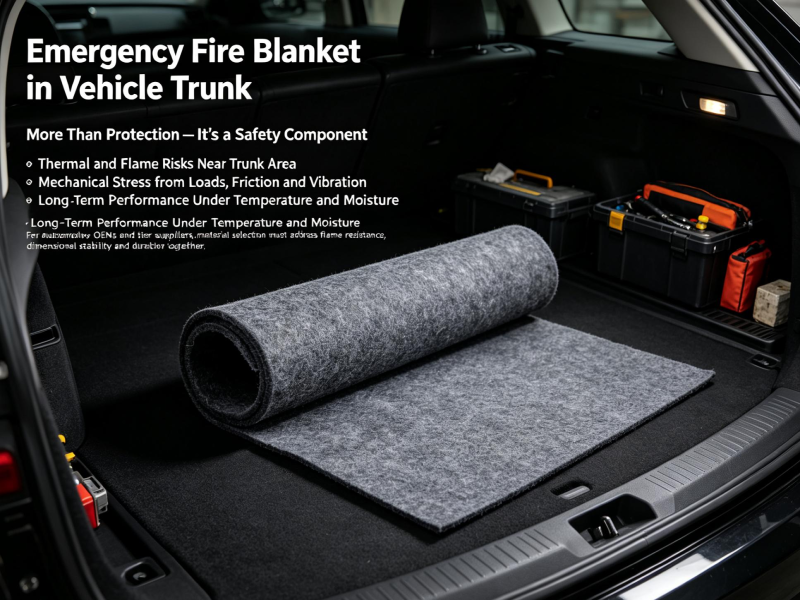
Why Is a Needle Punched Structure Suitable for Customized Automotive Fire Resistant Felt?
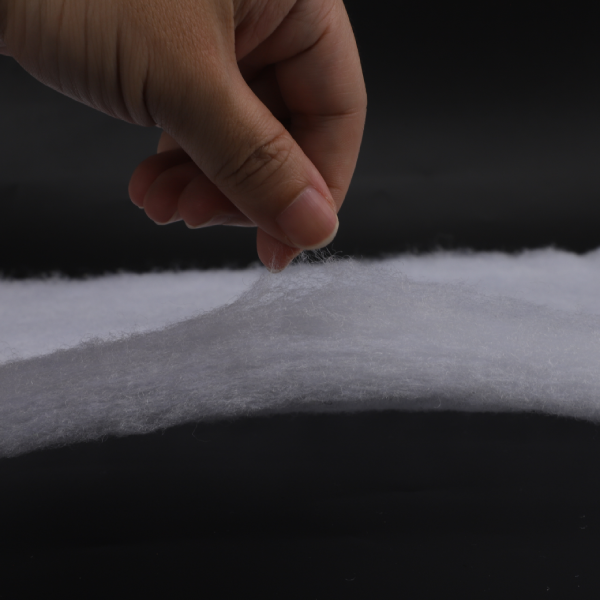
One important advantage of Needle Punched Nonwoven is that mechanical needle punching can create a stable three-dimensional fiber structure.
During production, different product requirements can be addressed by adjusting:
Fiber Type
Fiber Blend
GSM
Thickness
Density
Needle Punching Parameters
Width
Color
as well as subsequent lamination and processing methods.
This means automotive customers do not necessarily have to choose only from fixed standard specifications.
For different vehicle models, components, and testing requirements, suitable Needle Punched Fire Resistant Felt can be developed according to the actual project.
Needle punched automotive nonwoven materials are also used in automotive interior applications such as trunk liners, floor carpets, parcel shelves, and door panels.
Why Can't Standard Trunk Felt Simply Replace Fire Resistant Felt?
If an automotive project clearly specifies flame-retardant performance, standard PET needle punched felt cannot be considered an equivalent replacement simply because it looks similar.
The biggest difference between standard automotive felt and fire resistant felt is not appearance.
The real differences include:
Different material systems.
Different functional requirements.
Different testing requirements.
Different application risks.
For example, standard automotive felt may be highly suitable for trunk decoration and sound insulation. However, if the project requires the material to pass a specific burning test, the material must be verified according to that testing requirement.
Therefore, automotive component companies should ask:
“Does this material meet the testing requirements of my automotive project?”
rather than simply:
“Is this material also called Fire Resistant Felt?”
Why Should Fire Resistant Felt Not Be Compared Only by Price per Kilogram?
In automotive material purchasing, Price per KG is often an important consideration.
However, comparing only the price per kilogram can easily overlook the factors that actually affect project costs.
For example:
If material specifications are unstable, production waste may increase.
If thickness varies, subsequent processing may be affected.
If flame-retardant performance is inconsistent, retesting may be required.
If batch-to-batch differences are significant, long-term vehicle project supply may be affected.
Therefore, a more comprehensive calculation should consider:
Material Cost + Processing Cost + Waste Cost + Testing Risk + Supply Risk
rather than simply comparing:
Lowest Price per KG
For automotive projects, a Needle Punched Felt Manufacturer that can maintain the same specifications and stable performance over the long term may provide greater value than a supplier that simply offers the lowest price.
What Is the Biggest Risk When Purchasing Automotive Trunk Fire Resistant Felt in Bulk?
One of the most common problems is not that the first batch is completely unusable, but that:
The first batch performs well, but the following batches begin to change.
For example:
GSM changes;
Thickness changes;
Color differs;
Density is inconsistent;
Surface structure changes;
Flame-retardant performance fluctuates;
Cutting dimensions are unstable.
For automotive projects, these problems may affect subsequent production and testing.
Therefore, long-term supply requires close attention to whether the supplier has stable control over:
Raw Material Control
Production Parameters
GSM Control
Thickness Control
Needle Punching Process
Finished Product Inspection
and Batch-to-Batch Consistency.
This is why automotive customers should not evaluate a Needle Punched Felt Manufacturer based only on a single sample or product photo.
How Can You Tell Whether an Automotive Fire Resistant Felt Manufacturer Is Suitable for Long-Term Cooperation?
For automotive interior material projects, a supplier's manufacturing capability is itself part of the product.
When evaluating an Automotive Nonwoven Felt Manufacturer, customers can focus on several areas.
First, does the manufacturer have its own production lines?
Second, can it control raw materials and production parameters?
Third, can it consistently control GSM and thickness?
Fourth, can it provide customized specifications?
Fifth, can it provide secondary processing such as lamination, cutting, or die cutting according to customer requirements?
Sixth, after sample approval, can it maintain consistency between the approved sample and mass production?
Seventh, can it support long-term OEM/ODM projects?
These factors ultimately determine whether the material can become part of a stable long-term supply chain.
How Does Jinhaocheng Provide Automotive Fire Resistant Felt and Needle Punched Nonwoven Materials?
HUIZHOU JINHAOCHENG NONWOVENS CO., LTD has long focused on the development and manufacturing of needle punched nonwoven materials.
The company has an approximately 26,000-square-meter production base equipped with 15 automated needle punching production lines, providing stable Needle Punched Nonwoven Felt production capabilities for automotive, industrial, and other applications.
As a professional Needle Punched Nonwoven Felt Manufacturer, Needle Punched Felt Manufacturer, andNonwoven Felt Manufacturer China, we can adjust:
GSM
Thickness
Width
Density
Fiber Structure
Color
as well as other product structures and processing requirements according to different project needs.
For automotive projects, different material solutions can be developed according to actual applications, including Automotive Fire Resistant Felt, Automotive Nonwoven Felt, Automotive Needle Punched Felt, and Trunk Liner Felt.
For customers requiring long-term supply, OEM/ODM cooperation can also be used to develop automotive nonwoven materials according to specified requirements.
The real value is not simply supplying a roll of felt, but providing a stable solution from material structure development through mass production according to the customer's actual application requirements.
How Should You Choose Automotive Trunk Fire Resistant Felt? Follow This Selection Logic
If you are developing automotive trunk materials, it is not recommended to begin by asking which type of fire resistant felt is “the best.”
A more practical process is:
Step 1: Confirm the Material Installation Location
Trunk floor? Side panel? Cover? Wheel arch? Or an area close to a heat source?
Step 2: Confirm the Actual Operating Environment
Is there high temperature, a heat source, flame, electrical components, or long-term vibration?
Step 3: Confirm the Automotive Project Requirements
Is there a specified burning test or flame-retardant grade?
Step 4: Confirm the Material Structure
Should you use standard automotive felt, flame-retardant PET felt, another flame-retardant fiber felt, or a higher-performance fire-resistant material?
Step 5: Confirm GSM and Thickness
Do not simply assume that thicker is better. The material should match the required weight, available space, and processing requirements.
Step 6: Confirm the Processing Method
Does the material require die cutting, cutting, lamination, thermoforming, or other secondary processing?
Step 7: Confirm Sample-to-Bulk Consistency
This is particularly important for long-term automotive projects.
Step 8: Confirm Long-Term Supply Capability
Automotive projects are not one-time purchases. Stable material specifications and manufacturing capabilities are equally important.
Conclusion: The Right Automotive Trunk Fire Resistant Felt Is Not the Thickest—It Is the One That Fits the Application
The automotive trunk may look like a simple storage space, but the nonwoven materials used there may need to provide multiple functions, including decoration, sound insulation, cushioning, abrasion resistance, dimensional stability, flame retardancy, and thermal protection.
For areas without specific flame-retardant requirements, standard Automotive Nonwoven Felt may already meet the application requirements.
However, for automotive projects with specific burning tests, flame-retardant requirements, or potential thermal risks, selecting suitable Automotive Fire Resistant Felt becomes more important.
Professional material selection is not about blindly pursuing the highest temperature resistance or simply comparing price per kilogram. Instead, it should follow:
Application Location → Actual Environment → Safety Requirements → Testing Standard → Material Structure → GSM/Thickness → Processing Performance → Sample Approval → Bulk Consistency → Long-Term Supply
For automotive manufacturers, automotive interior companies, component suppliers, and customers purchasing automotive nonwoven materials on a long-term basis, choosing a Needle Punched Felt Manufacturer with stable production capacity, customization capabilities, and batch-to-batch consistency can help reduce uncertainty during material selection and long-term supply.
Jinhaocheng focuses on Needle Punched Nonwoven Felt, Automotive Nonwoven Felt, and Fire Resistant Felt, and supports OEM/ODM customization to provide flexible nonwoven material solutions for different automotive and industrial applications.