Fire Resistant Felt vs Heat Resistant Felt: Are They the Same? Why Do Many Engineering Projects Choose the Wrong Material?
Many people searching for Fire Resistant Felt are actually looking for a material that can withstand high temperatures. At the same time, customers searching for Heat Resistant Felt may actually expect a material that can prevent or resist flame combustion.
In reality, although these two terms often appear together in industrial, automotive, construction, and welding applications, they represent two different performance concepts.
This is also one of the most common mistakes during material selection for engineering projects: treating “fire resistance” and “heat resistance” as the same requirement. As a result, the selected material may not match the actual operating conditions.
For industrial insulation, welding protection, automotive thermal management, and high-temperature equipment protection, the real question is not simply “Which material is better?” but:
Does your application need resistance to flame, or does it need to withstand continuous high temperatures?
This article explains the difference between Fire Resistant Felt and Heat Resistant Felt from a performance perspective, helping you understand the two concepts and identify the more suitable material direction for different working conditions.
Why Are Fire Resistant and Heat Resistant Often Confused?
In everyday communication, “fire resistant” and “heat resistant” are often used as if they were interchangeable. Because of this, many customers also use these two keywords interchangeably when sending inquiries to suppliers.
For example, when looking for a welding fire protection pad, a buyer may ask for heat resistant felt.
When looking for an equipment insulation layer, another buyer may request fire resistant felt.
In reality, these two terms describe how a material performs under different thermal environments.
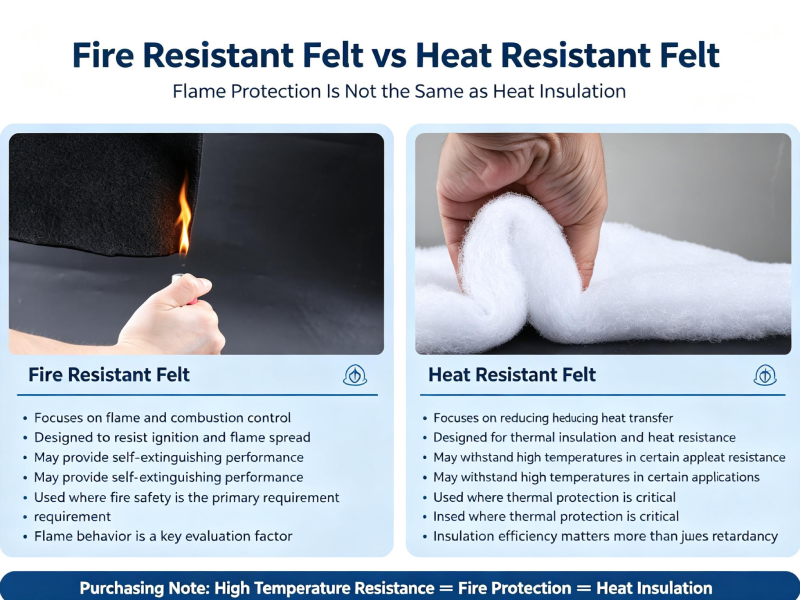
Fire Resistant focuses more on the material's combustion behavior when exposed to flame, while Heat Resistant focuses more on the material's ability to remain stable under continuous high-temperature conditions.
Therefore, they address two different types of requirements rather than describing exactly the same property.
The Core Function of Fire Resistant Felt Is Flame Control, Not Long-Term High-Temperature Resistance
Fire Resistant Felt is designed to help reduce combustion, limit flame spread, or provide self-extinguishing behavior when exposed to flame.
Therefore, it usually focuses more on:
Combustion behavior after flame exposure
Self-extinguishing performance
Flame retardant ratings
Safety protection requirements
For welding fire protection pads, emergency fire blankets, automotive fire protection layers, and building protection products, the material's ability to control flame can be more important than its ability to simply withstand high temperatures.
Therefore, when a project involves open flame, sparks, or combustion risks, paying attention to Fire Resistant Felt may be more meaningful than looking only at a material's maximum heat resistance temperature.
The Core Function of Heat Resistant Felt Is Withstanding Continuous High-Temperature Environments
Unlike fire resistance, Heat Resistant Felt places greater emphasis on the material's ability to maintain structural stability under continuous high temperatures.
It is commonly used for:
Industrial equipment insulation
Pipe insulation
Thermal management systems
Mechanical insulation layers
High-temperature protective covers
These products are often exposed to a stable heat source rather than direct flame.
Therefore, heat-resistant materials place greater emphasis on:
Continuous operating temperature
Dimensional stability
Thermal insulation performance
Mechanical strength
Long-term service life
In other words, a material that can withstand a relatively high temperature does not necessarily mean that it has excellent flame-resistant performance.
Why Can the Same Material Have Both Fire Resistant and Heat Resistant Properties?
Many industrial materials are not designed with only one performance characteristic.
For example, some needle punched nonwoven materials can be engineered with different fiber systems so that the final product provides both a certain level of flame resistance and heat resistance.
However, it is important to understand:
Having both properties does not mean that the two properties are exactly the same.
A material may provide good flame-resistant performance but may not be suitable for long-term high-temperature operation.
Likewise, a material may have good heat resistance but may not be specifically designed for direct flame protection.
Therefore, during product development, the more important step is to clearly identify which performance characteristic the project actually requires rather than simply requesting a material that is “fire resistant and heat resistant.”
Does UL94 Represent Heat Resistance?
This is one of the most common misunderstandings among buyers.
No.
UL94 is primarily used to evaluate the burning behavior of materials when exposed to flame, meaning their flame-retardant or flammability performance.
It does not mean that a material can operate continuously at a specific temperature, nor can it directly represent its long-term heat resistance.
Therefore, if a project requires a material for long-term use in high-temperature equipment, industrial insulation, or thermal management systems, checking UL94 alone is not enough.
A more appropriate evaluation should confirm the following:
Whether flame resistance is required
Whether continuous heat resistance is required
What the actual operating temperature is
Whether the material will directly contact flame
Only after these conditions are clearly defined can the right material direction be selected for the actual operating environment.
Which Applications Are More Focused on Fire Resistant Felt?
When a product is mainly exposed to flame, sparks, or combustion risks, flame-resistant performance is generally more important.
Typical applications include:
Welding fire protection pads
Emergency fire blankets
Spark protection products
Automotive fire protection layers
Building fire protection components
These products focus more on the material's safety performance under flame exposure and therefore often require material development based on specific flame-retardant requirements.
Which Applications Are More Focused on Heat Resistant Felt?
When a product operates continuously in a high-temperature environment rather than being directly exposed to open flame, heat resistance is generally more important.
For example:
Industrial equipment insulation
High-temperature pipe insulation
Thermal management systems
Mechanical insulation covers
Equipment insulation layers
These products focus more on long-term temperature stability rather than combustion behavior itself.
Therefore, Heat Resistant Felt is more suitable as a material direction for insulation and thermal protection in continuous high-temperature environments.
How Can You Determine Which Performance Your Application Needs?
When selecting materials, you can begin by answering four questions:
First, will the product come into direct contact with flame?
Second, will the material face short-term sparks or continuous high temperatures?
Third, does the project require a flame-retardant testing standard such as UL94?
Fourth, is the material mainly responsible for fire protection, safety protection, or thermal insulation?
If the main requirement is flame safety, Fire Resistant Felt should be the primary performance consideration.
If the main requirement is thermal protection under continuous high-temperature conditions, Heat Resistant Felt should be the key performance consideration.
For some complex industrial products, a customized material structure can also be developed to provide both performance characteristics according to the actual operating conditions.
Why Do OEM Projects Need to Clearly Define “Fire Resistant” and “Heat Resistant”?
Many OEM projects initially describe their requirement as “fire resistant and heat resistant material.”
However, this requirement is still too broad for a manufacturer to develop the right product.
A more accurate project description should include:
Actual operating temperature
Whether the material will contact flame
Whether a flame-retardant requirement such as UL94 is needed
Product thickness and GSM
Final application environment
Only when these conditions are clearly defined can a manufacturer design a needle punched nonwoven material that matches the project requirements instead of replacing it with a generic specification.
How Does Jinhaocheng Develop Needle Punched Nonwoven Materials with Different Performance Characteristics?
HUIZHOU JINHAOCHENG NONWOVENS CO., LTD has more than 20 years of nonwoven manufacturing experience, with a production base of approximately 26,000 m² and 15 automated needle punching production lines.
As a professional needle punched nonwoven felt manufacturer, we can develop customized materials for different applications, including:
Flame resistant needle punched felt
Heat resistant needle punched felt
Industrial insulation felt
Thermal management nonwoven materials
OEM and ODM customized specifications
Based on the customer's operating temperature, flame-retardant requirements, thickness, GSM, and final product application, we can provide material solutions that are better aligned with actual operating conditions.
Conclusion: Fire Resistance and Heat Resistance Are Not the Same—Choosing the Right Performance Matters More Than Choosing the Right Name
Fire Resistant Felt and Heat Resistant Felt often appear together in industrial material applications, but they focus on different performance requirements.
Fire Resistant addresses flame safety and flame-retardant requirements.
Heat Resistant addresses stability and thermal protection under continuous high-temperature conditions.
For welding, fire protection, automotive, construction, and industrial equipment projects, the most important factor is not simply the material name, but the actual working environment the material will face.
When developing an OEM product, clearly defining the flame environment, operating temperature, and required performance is far more valuable than simply requesting a “fire resistant and heat resistant” material.
If you are looking for a professional fire resistant felt manufacturer or a customized heat resistant felt solution, Jinhaocheng can provide stable needle punched nonwoven material solutions for different industrial applications.