From Cotton Fiber to Batting: How Needle Punched Cotton Wadding Is Made
For overseas buyers sourcing cotton quilt batting, bedding filling materials, and cotton needle punched nonwovens, understanding the raw materials and manufacturing process helps them evaluate whether a supplier understands the material structure and can meet their purchasing requirements. It can also reduce the risk of receiving products with unclear fiber composition.
Many products on the market are described as Needle Punched Cotton Batting or Cotton Wadding. However, the product name alone does not fully confirm the actual fiber composition. Buyers need to understand not only whether the material is made through a needle punching process, but also whether the fibers are genuinely 100% cotton and whether the finished product meets the agreed specifications.
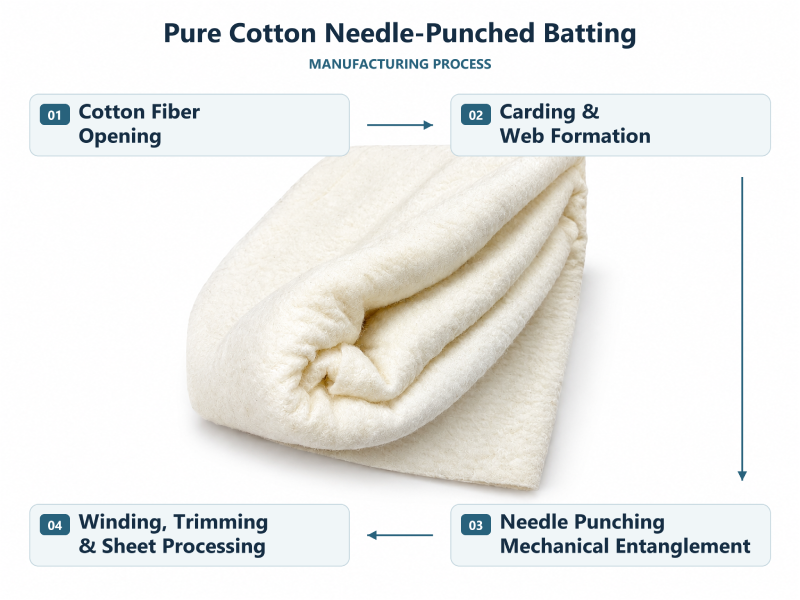
The production of 100% Cotton Needle Punched Batting starts with cotton fiber preparation. The fibers then go through opening, carding, web formation, and mechanical needling before the material is finished through edge trimming, winding, or sheet cutting. Each stage contributes to the structure and appearance of the finished batting.
This article follows the actual production sequence to explain how needle punched cotton batting is made, from raw cotton fibers to finished material. It also explains what buyers should check when evaluating suppliers and approving samples.
What Are the Raw Materials and Structure of Cotton Needle Punched Batting?
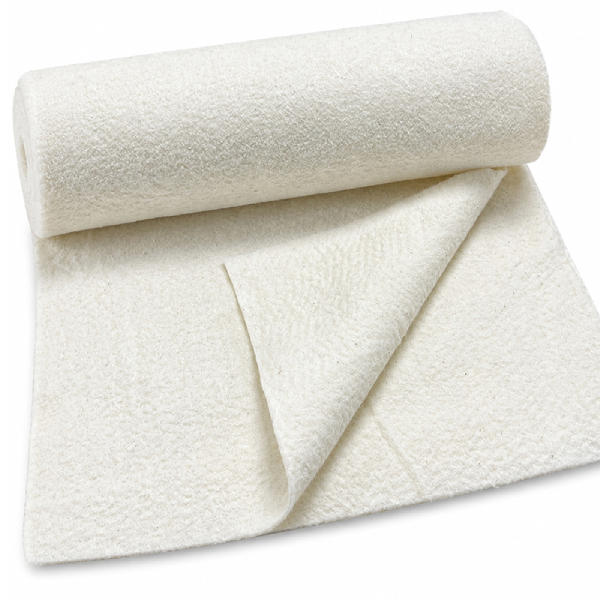
Needle punched cotton batting is a nonwoven material made from cotton fibers through a needle punching process. It is not traditional woven cotton fabric, nor is it made by weaving cotton yarns. Its structure mainly consists of fibers that are interlaced and mechanically entangled with one another.
During production, cotton fibers first go through preparation and processing to form a relatively uniform fiber web. The web is then mechanically needled so that the fibers become entangled, creating a cotton batting material with a certain degree of structural stability.
For a product labeled 100% Cotton, buyers need to pay particular attention to whether the fiber composition meets their requirements. A 100% Cotton declaration means that the stated fiber composition is cotton. However, this label alone does not confirm whether the product contains additional supporting materials, other structural layers, or bonding materials. These details need to be confirmed according to the actual product construction and the supplier's material declaration.
JHC's cotton quilt batting uses 100% Cotton fiber composition and is a needle punched cotton batting product. It is available in roll or sheet form and supports customized packaging according to purchasing requirements.
Understanding the raw materials and product structure is the starting point for understanding the following manufacturing stages. Buyers should distinguish between fiber composition and processing method: cotton fibers determine the material's fiber composition, while the needle punching process determines how the fibers form a nonwoven structure.
Cotton Fiber Opening: Preparing the Fibers for Further Processing
Before entering the web-forming stage, cotton fiber raw materials need to go through an opening process.
In their raw state, cotton fibers may be tangled, compressed, or gathered into clumps. If they enter the next processing stage without sufficient opening, the fibers may not disperse evenly, which can affect the formation of the fiber web. The main purpose of opening is to loosen the gathered fibers and help them disperse more effectively, preparing them for carding and web formation.
The opening process mainly focuses on the looseness and dispersion of the fibers. If the fibers are not sufficiently opened, local fiber clusters may remain. This can contribute to uneven thickness or differences in local density in the subsequent fiber web.
For cotton fiber materials, raw material preparation also needs to take the condition of the fibers into account. Different batches of raw materials may vary in fiber length, fineness, impurity content, and overall condition. Suppliers therefore need to arrange the preparation process according to the actual characteristics of the raw materials.
After opening, the cotton fibers are better prepared for the carding and web-forming stages.
It is important to understand that the purpose of opening is not to change the basic composition of the cotton fibers. Instead, it changes the fibers from a relatively compact or tangled state into a looser condition that is more suitable for further processing.
Carding and Web Formation: Turning Cotton Fibers into a Fiber Web
After opening, the cotton fibers enter the carding and web-forming stages.
The main purpose of carding is to further separate and organize the fibers so that they form a relatively uniform arrangement and distribution. After carding, the loose cotton fibers gradually form a continuous fiber web, which provides the material needed for the subsequent needle punching process.
The uniformity of the fiber web affects the overall structure of the finished batting. If too many fibers accumulate in a particular area, that section may become thicker. If some areas contain fewer fibers, they may become locally thinner.
Therefore, carding and web formation do more than turn cotton fibers into a fiber web. They are also important stages in achieving a more consistent finished material.
For needle punched cotton batting, the fiber web needs to have a structure suitable for further needling. A more appropriate fiber distribution helps the subsequent mechanical entanglement process form a relatively uniform material structure.
When evaluating a supplier's manufacturing capabilities, buyers can ask whether the supplier has the relevant processing stages, from cotton fiber opening to carding and web formation, rather than focusing only on the final product's GSM and thickness.
Needle Punching: How Does a Cotton Fiber Web Become Batting?
Needle punching is the key stage in the production of needle punched cotton batting.
After carding and web formation, the cotton fibers have already formed a fiber web. However, the fibers still need to be further connected to create a material with a certain degree of structural stability.
The needle punching process mainly uses specially structured needles with barbs that repeatedly penetrate the fiber web. During this movement, the barbs catch and carry some fibers into the web, causing fibers from different positions to become interlaced and mechanically entangled.
As the needling process continues, the relatively loose fiber web gradually develops into a nonwoven structure with greater overall integrity.
Unlike traditional spinning and weaving, needle punching does not require cotton fibers to be spun into yarn and then woven into fabric using warp and weft yarns. Instead, it uses mechanical needling to entangle the fibers and form the material.
The needle punching process is closely related to the final material structure. The condition of the fiber web, the needling conditions, and the required product specifications all influence the structure of the finished material.
For buyers, understanding the needle punching principle helps them evaluate whether the product name matches the actual manufacturing method. If a supplier describes a product as Needle Punched Cotton Batting, the supplier should be able to explain how the cotton fiber web is mechanically needled to form the finished material, rather than providing only a product name or appearance photos.
GSM, Thickness, and Uniformity: Specifications to Monitor During Production
After the needle punched cotton batting has been formed, its GSM, thickness, and material uniformity need to be considered according to the product requirements. These specifications help determine whether the delivered material meets the agreed order requirements.
GSM
GSM stands for grams per square meter. It indicates the weight of one square meter of material. For cotton batting, GSM helps buyers understand the amount of material used per unit area.
During production and purchasing, GSM needs to be considered together with the product dimensions, intended application, and order requirements. Products made from the same fiber composition do not necessarily have the same GSM.
Thickness
Thickness refers to the distance between the two surfaces of a material under specified measurement conditions. Cotton batting is a fibrous material with a certain degree of loft, so the pressure and method used during measurement may affect the final reading.
When specifying thickness, buyers should also confirm the measurement method and acceptable tolerance. This helps avoid difficulties when comparing samples from different suppliers that may use different measurement conditions.
Material Uniformity
Material uniformity mainly concerns whether fiber distribution, thickness, and overall appearance remain relatively consistent across different areas of the material.
If the fiber web is unevenly formed, or if differences occur during subsequent processing, the finished product may have noticeable variations in thickness. For buyers who need to carry out further quilting, cutting, or processing, these differences may affect subsequent manufacturing and the appearance of the finished product.
Therefore, buyers should not confirm a product based on a GSM figure alone. They should also evaluate thickness, surface condition, and the actual sample.
It is important to remember that GSM and thickness are not interchangeable specifications. Buyers should provide their target GSM and thickness requirements separately and check both specifications during sample approval.
Winding, Edge Trimming, and Sheet Cutting: Preparing the Finished Batting for Supply
After needle punching, the cotton batting needs further processing according to the order requirements so that it can be supplied in a suitable format for transportation, storage, and use.
For roll products, the material needs to go through the relevant edge-trimming and winding processes. Buyers generally need to confirm the material width, roll length, roll diameter, and packaging requirements.
For sheet products, the material is cut according to the required dimensions. Different customers may need different lengths, widths, and sheet sizes. Therefore, buyers should confirm the actual dimensions before ordering rather than specifying only the product name.
Rolls and sheets serve different purposes. Rolls are suitable for applications that require continuous material or further cutting, while sheets are suitable for buyers who have already determined the required piece dimensions and want material that can proceed directly to subsequent processing.
JHC's cotton quilt batting is available in roll or sheet form and supports customized packaging according to purchasing requirements. For bulk orders, buyers are advised to confirm the supply format, dimensions, and packaging method during sample approval to avoid differences between the approved sample and the bulk order.
How Can Buyers Verify Cotton Fiber Composition and Manufacturing Processes?
Understanding the manufacturing process is only one part of the purchasing decision. For overseas buyers, it is even more important to confirm whether the supplier's actual product meets the requirements stated in the specifications and purchase agreement.
When sourcing 100% Cotton Needle Punched Batting, buyers should not rely only on the product name, color, or appearance to determine its fiber composition.
Check the Fiber Composition Declaration
First, ask the supplier to clearly state the product's fiber composition.
If the purchasing requirement is 100% Cotton, confirm whether the supplier explicitly declares the fiber composition as 100% Cotton. Also ask whether the product contains other fibers, supporting layers, or auxiliary materials.
If the product construction includes other materials, ask the supplier to explain their specific location and purpose. This helps prevent confusion between the fiber composition and the overall product structure.
Understand the Actual Manufacturing Process
Buyers can ask whether the product goes through cotton fiber opening, carding, web formation, needle punching, and finishing.
The supplier should be able to provide a reasonable explanation of the main manufacturing stages. For purchasing projects that require further verification, buyers can also request production photos or videos that correspond to the actual product.
Check the Product Specifications
Meeting the fiber composition requirement does not automatically mean that all other product specifications are correct.
Buyers should also confirm whether the GSM, thickness, width, roll length or sheet dimensions, and surface condition meet the order requirements.
If material uniformity is important, the relevant acceptance criteria should also be clearly defined during specification confirmation.
Consider Third-Party Testing When Necessary
For orders with strict fiber composition requirements, buyers can consider using a qualified third-party testing organization to identify the fiber composition of the sample or carry out other relevant material tests.
The testing items should be selected according to the purchasing purpose, material structure, and agreement between the buyer and supplier. Supplier product declarations, physical samples, and third-party test results can provide different levels of verification.
Make Sure the Approved Sample Matches the Bulk Order
During sample approval, record the key specifications, including material composition, GSM, thickness, dimensions, and supply format.
Before bulk production begins, both parties should have a consistent understanding of the final approved sample and the order specifications. Any potential changes to the specifications should be discussed and confirmed in advance.
What Information Should Buyers Confirm Before Ordering Cotton Batting?
To reduce communication gaps during quotation and production, buyers should provide as much product information as possible when requesting a quotation.
Fiber Composition
Clearly specify 100% Cotton, or explain whether other fibers and auxiliary materials are acceptable.
Target GSM
Provide the required GSM. If it has not yet been determined, explain the intended application and desired material characteristics so that the supplier can discuss suitable specifications.
Target Thickness
Specify the required thickness and measurement conditions. If a reference sample is available, it can also be provided to the supplier.
Product Dimensions
Confirm the required width and roll length, or the length and width of the sheets.
Supply Format
Specify whether rolls or sheets are required and whether additional cutting is needed.
Packaging Requirements
Clarify the requirements for inner packaging, outer packaging, labels, and any other customized packaging.
Application
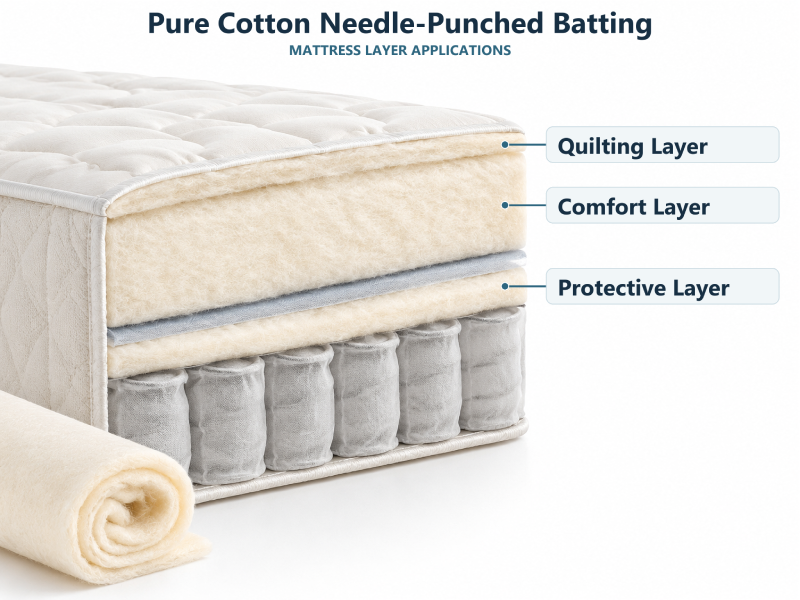
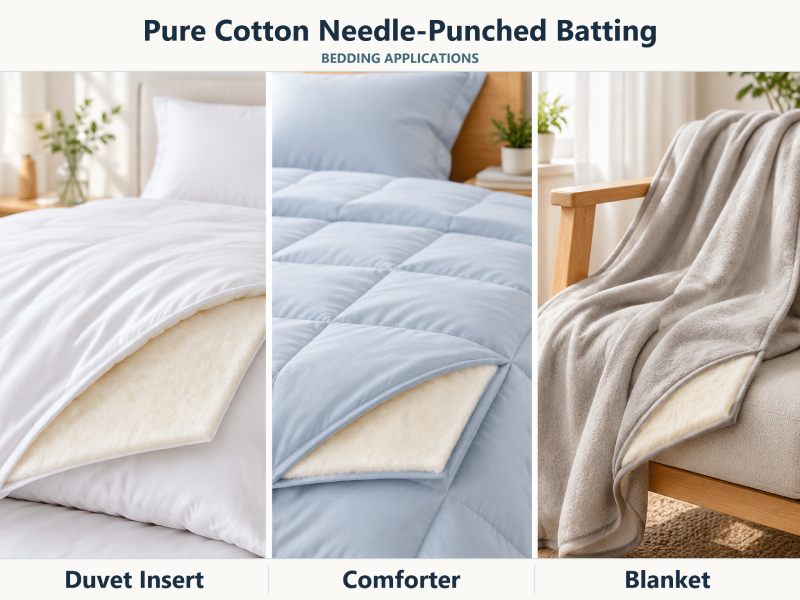
Explain whether the material will be used for quilt batting, comforter filling, bedding, sewing products, or another application. Different applications may require different specifications and processing arrangements.
The more complete the information, the easier it is for the supplier to assess the requirements and reduce differences between sample approval and bulk production.
Conclusion: Understand the Manufacturing Process Before Sourcing Cotton Batting
Needle punched cotton batting is not simply made by pressing cotton fibers together. It goes through raw material preparation, opening, carding, web formation, mechanical needle punching, and subsequent edge trimming, winding, or sheet cutting to form a nonwoven cotton batting material that meets the purchasing requirements.
For overseas buyers, choosing a supplier should involve more than comparing product names and prices. Fiber composition, manufacturing method, GSM, thickness, material uniformity, and final supply format also need to be confirmed.
HuiZhou JinHaoCheng Nonwovens Co., Ltd.supplies 100% Cotton cotton quilt batting in roll or sheet form and supports customized packaging. Buyers can provide their target GSM, thickness, dimensions, application, and packaging requirements when making an inquiry, so that the product specifications can be further confirmed.
If you are looking for cotton needle punched batting for quilts, bedding, or other sewing applications, visit our 100% Cotton Quilt Batting product page to learn more about the product and submit your purchasing requirements.