Cotton Quilt Batting Thickness and GSM: Matching the Filling Layer to Your Quilt Design
For manufacturers of quilted bedding and patchwork quilts, GSM and thickness are usually two of the first specifications to consider when selecting cotton quilt batting.
However, these two parameters alone cannot determine the appearance and feel of the finished quilt.
Even at the same GSM, different fiber structures, loft levels, and compression conditions may result in different thicknesses and textures. The overall thickness of a finished quilt is also influenced by more than just the filling layer. The quilt top, backing fabric, quilting method, and compression during processing all play a role.
Therefore, when sourcing 100% cotton quilt batting, buyers should not simply tell a supplier the required GSM. They should also explain the quilt construction, desired loft, fabric types, and actual quilting method.
This guide explains how to understand cotton batting GSM and thickness from the perspective of quilt construction, and what specifications buyers should consider before requesting quotations, approving samples, and placing bulk orders.
Where Does Cotton Quilt Batting Fit in Quilt Construction?
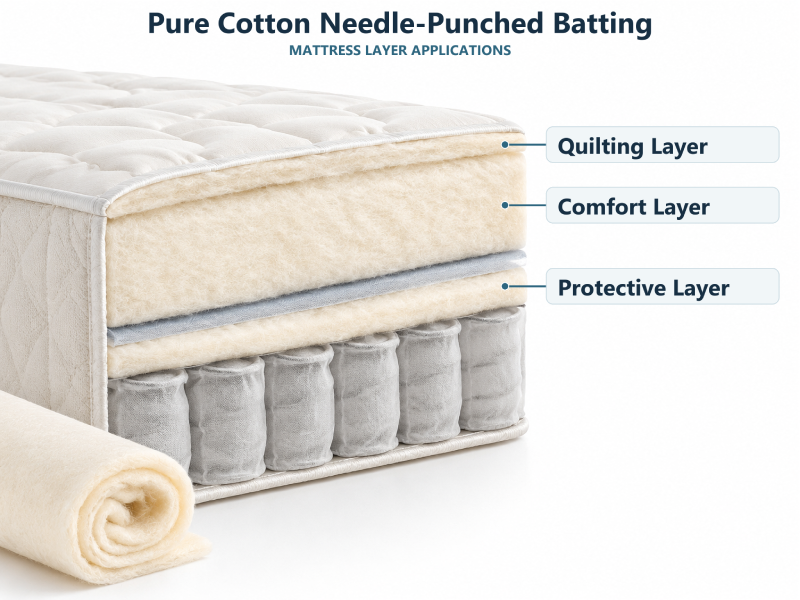
In a typical quilt construction, the filling material is placed between the top fabric and the backing fabric.
From the outside to the inside, a quilt can generally be understood as having three main layers.
Quilt Top: This is the visible outer layer of the quilt. It may use plain fabric, printed fabric, or a patchwork design. The fabric's thickness, softness, and surface texture all influence the appearance and feel of the finished product.
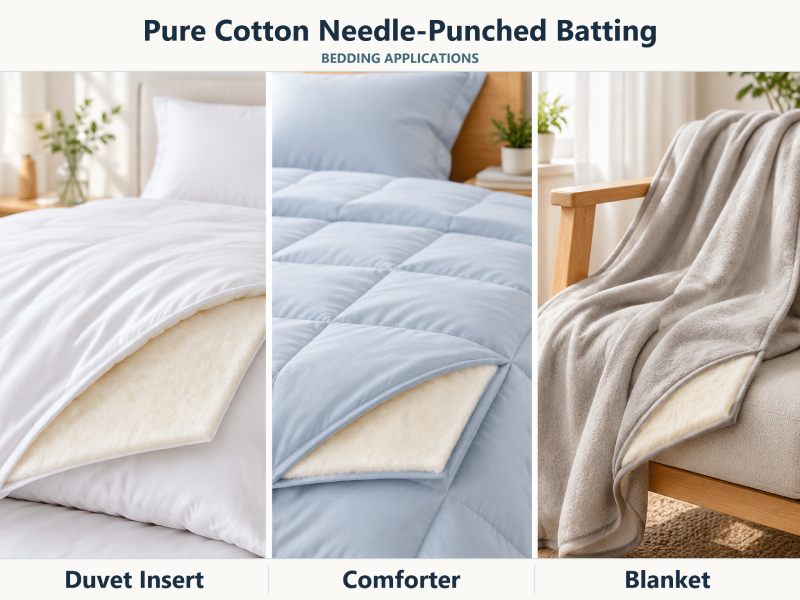
Batting: This is the filling layer between the top and bottom fabrics. It helps create the quilt's thickness, loft, and overall feel. 100% cotton quilt batting is one of the material options used for this layer.
Backing Fabric: This is the fabric on the back of the quilt. Together with the quilt top, it encloses the filling layer and contributes to the overall construction and feel of the finished product.
Quilting stitches hold these layers together, helping keep the filling material in position while creating different quilting patterns.
For buyers, it is important to distinguish between two concepts: the thickness of the batting itself and the overall thickness of the finished quilt.
They are not the same. Even when the same batting is used, different top fabrics, backing fabrics, or quilting structures may produce different finished appearances and textures.
Therefore, when selecting cotton batting for quilts, buyers should first define the quilt construction and then determine the filling specifications, rather than choosing batting thickness based only on the desired overall quilt thickness.
What Do GSM and Thickness Mean?
GSM and thickness are two specifications commonly discussed when purchasing quilt batting, but they represent different physical properties.
GSM (Grams per Square Meter) refers to the weight of the material per square meter.
For example, a material specified at 150 GSM has a target weight of 150 grams per square meter under the agreed specification and measurement method.
GSM is mainly used to define the material's weight per unit area. It is also an important reference for estimating material consumption, comparing samples, and confirming order specifications.
Thickness refers to the distance between the two surfaces of a material.
For soft batting and needle-punched nonwoven materials, the pressure applied during measurement may affect the final reading. Therefore, when comparing thickness data from different suppliers, buyers should confirm whether the measurement methods and conditions are consistent.
For example, if two samples are measured under different pressures, the same recorded thickness does not necessarily mean they have the same loft or material structure.
This is why buyers should not specify GSM while overlooking thickness requirements.
When purchasing cotton batting, it is better to confirm the following information separately.
GSM: Define the target weight per square meter and the acceptable tolerance agreed upon by both parties.
Thickness: Specify the target thickness, measurement method, and measurement conditions.
Feel and Loft: Evaluate these properties using physical samples rather than estimating them from GSM alone.
Fiber Composition: Confirm whether the material is 100% Cotton and whether it contains any other fibers or additional materials.
It is important to understand that a higher GSM does not necessarily mean a thicker material, and a greater thickness does not automatically mean a higher weight per square meter. Material structure, fiber characteristics, and processing conditions can all influence the final result.
Therefore, GSM and thickness should be confirmed as two separate purchasing specifications.
How Do Different Thicknesses and GSM Levels Affect a Quilt's Appearance and Feel?
Quilt manufacturers generally focus on three aspects when selecting a filling layer: the finished appearance, loft, and feel.
The GSM of cotton batting helps buyers define its weight per unit area, but it cannot independently determine how thick the finished quilt will be, how lofty it will look, or how soft it will feel.
Even with the same fiber composition, different material structures and processing conditions may cause samples with the same GSM to have different thicknesses and textures.
Effect on Finished Thickness
The filling layer is one part of the overall quilt construction. Its actual thickness affects the space occupied by the filling material, but the finished quilt thickness is also influenced by the top fabric, backing fabric, quilting compression, and processing method.
If buyers want a relatively flat finished appearance, they need to consider whether the batting thickness is suitable for the overall construction.
If the product design requires a more pronounced loft, the filling layer should be evaluated together with the fabrics and quilting structure rather than selecting a higher GSM automatically.
Effect on Loft
Loft is related to the internal fiber structure and thickness of the material.
Even when two samples have the same weight per square meter, differences in fiber distribution and structural compactness may result in different levels of loft.
Therefore, when comparing cotton quilt wadding from different suppliers, buyers should examine the material's natural thickness, surface uniformity, and actual feel.
Effect on Feel
The feel of a finished quilt is not determined by the batting alone.
The material and thickness of the quilt top, the softness of the backing fabric, and the fiber characteristics of the filling layer all influence the final feel.
If buyers want a soft and natural feel, they should make a sample using the actual quilt top and backing fabric before deciding whether the batting meets their expectations.
A product name or GSM value alone cannot guarantee a specific level of softness or loft.
For bulk purchasing, evaluating an actual sample is more useful than comparing specifications alone.
What Are the Different Batting Requirements for Hand Quilting, Machine Quilting, and Longarm Quilting?
Different quilting methods affect how the filling layer is secured, how the material is processed, and how the finished quilt is constructed. Therefore, when selecting cotton batting for quilting, buyers should inform the supplier of the actual quilting method in advance.
Hand Quilting
Hand quilting involves manually passing a needle and thread through the fabric layers and filling material.
For this method, buyers should consider how easily the batting can be combined with the fabrics, as well as the handling and sewing experience during the actual quilting process.
If the filling layer is too thick or its structure is unsuitable for the project, it may make needle penetration and stitching more difficult. Therefore, it is advisable to test the material with the actual fabrics during the sample stage.
Machine Quilting
Machine quilting uses equipment to perform continuous or repeated stitching operations.
Compared with hand quilting, machine processing requires closer attention to material thickness consistency, the combination of fabric and batting layers, and whether the material is suitable for the actual machine settings and processing conditions.
Buyers should explain the equipment type, product construction, and processing requirements to the supplier. When necessary, samples can be tested on the actual machine to check whether the material is suitable for production.
Longarm Quilting
Longarm quilting is commonly used for larger quilts and more complex quilting patterns.
Because the processing area and pattern design may be more complicated, buyers should consider how the filling layer is distributed throughout the quilt and whether it can maintain the expected position and appearance during the actual quilting process.
Different machines, patterns, and quilting settings may create different requirements for the filling material. Therefore, it is not appropriate to assume that one GSM or thickness is suitable for every longarm quilting project.
For all three quilting methods, the most important step is to test the batting with the actual fabrics before confirming bulk specifications. Whether the supplier can provide support for specific quilting compatibility should also be discussed separately during the quotation and sampling stages.
How Are Batting Thickness, Fabric Layers, and Quilting Stitch Spacing Related?
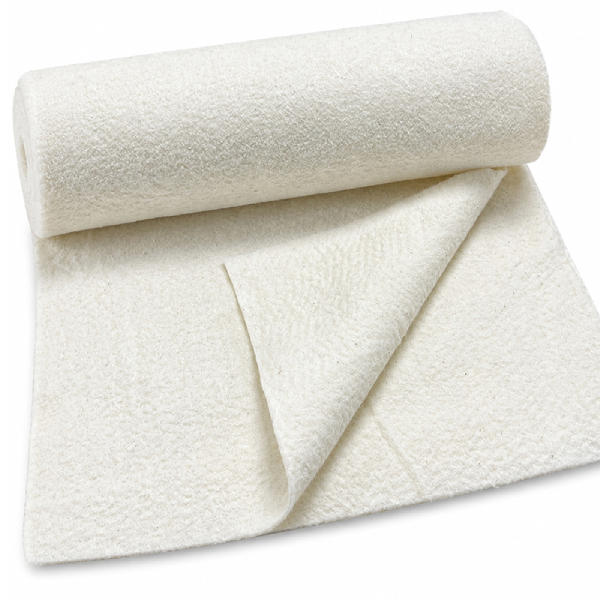
Batting thickness should not be evaluated separately from the overall quilt construction.
When the quilt top, filling layer, and backing fabric are combined, quilting stitches hold the different layers together. Stitch spacing and quilting patterns can also affect how the filling material is distributed in the finished quilt.
Therefore, buyers need to consider batting thickness, fabric-layer construction, and quilting design together.
Matching Fabric Thickness with the Filling Layer
If the quilt top and backing fabric are relatively thick, the batting specifications should be evaluated in relation to the entire product construction.
If the fabrics are lightweight, buyers should pay closer attention to the surface uniformity and actual appearance of the filling layer to avoid a finished result that differs from the design expectations.
This does not mean that thick fabrics always require thick batting or that lightweight fabrics can only use thin batting. The appropriate specifications should still be determined according to the product design and sample evaluation.
Matching Quilting Stitch Spacing with the Filling Layer
Quilting stitch spacing affects where the filling layer is secured and how the overall quilting pattern looks.
Whether stitching is too close or too far apart cannot be judged independently of the filling material, fabric combination, quilting pattern, and machine conditions.
Buyers should provide the planned quilting pattern and stitch spacing requirements, then use actual samples to confirm whether the filling material meets the processing and appearance requirements.
For batting with different thicknesses, buyers should also check whether quilting causes noticeable local compression, uneven thickness, or changes in appearance.
Do Not Judge the Final Result from Unquilted Batting Alone
Unprocessed batting and a completed quilt may have different structural characteristics.
Therefore, buyers should ideally examine both the filling material itself and a finished quilt sample. The first helps confirm the material specifications, while the second helps determine whether the material is suitable for the actual quilt construction.
What Information Should Buyers Provide to a Supplier About Quilt Size, Target GSM, and Thickness?
If buyers only tell a supplier that they need "100% cotton batting," the supplier may not have enough information to understand the actual project requirements.
To reduce repeated communication, buyers should prepare the following information before requesting a quotation.
Finished Product Application: Explain whether the material will be used for Handmade Quilts, Patchwork Quilts, Machine Quilted Quilts, or Longarm Quilting projects.
Fiber Composition: Clearly specify whether 100% Cotton is required. Do not rely on the general term Cotton Batting alone. Confirm the actual fiber composition supplied by the manufacturer.
Target GSM: Provide the desired weight per square meter and state whether an agreed tolerance is acceptable.
Target Thickness: Provide the required filling-layer thickness and confirm the measurement method and conditions.
Quilt Dimensions: Provide the finished quilt's length and width so the supplier can understand the application size and material cutting requirements.
Quilt Top and Backing Fabric: Whenever possible, provide the material type, thickness, or physical samples of the quilt top and backing fabric.
Quilting Method: Specify whether the project uses hand quilting, machine quilting, or longarm quilting, and provide the relevant processing requirements.
Quilting Pattern and Stitch Spacing: If the pattern and stitch spacing have already been decided, include these details. If they have not yet been finalized, explain the current design stage.
Supply Format: Confirm whether rolls or sheets are required, and provide the requested width, length, cut dimensions, and packaging requirements. JHC can supply its cotton quilt batting in roll or sheet form and supports customized packaging. Specific requirements can be discussed during the quotation process.
Target Feel and Appearance: Reference photos, existing product samples, or finished quilt samples can help the supplier understand the expected thickness, loft, and feel.
Providing this information helps the supplier understand the actual project requirements and reduces repeated adjustments based on a single GSM value.
What Should Buyers Check When Approving Samples?
Before placing a bulk order, buyers should not check only the GSM and thickness stated on the sample label. The material should also be evaluated according to the actual production requirements.
Does the Fiber Composition Meet the Requirement?
First, confirm that the sample meets the required 100% Cotton composition. For products that require a pure cotton fiber composition, buyers should ask the supplier to clearly confirm the material composition and record it in the sample specification or purchasing documents.
The fiber composition of JHC's cotton quilt batting is 100% Cotton. Buyers should still confirm that the specific sample and order specifications are consistent for each project.
The fiber composition should not be judged by color, appearance, or product name alone.
Does the GSM Meet the Agreed Specification?
Check the sample's weight per unit area using the method agreed upon by both parties, and confirm the acceptable tolerance.
If batch inspection will be required for future orders, the inspection method and acceptance criteria should be agreed upon during the sample approval stage. This helps avoid using different evaluation methods for samples and bulk production.
Does the Thickness Meet the Agreed Conditions?
When checking sample thickness, confirm the measuring instrument, measurement positions, and applied pressure.
For soft materials, measurement pressure may affect the reading. Results obtained under different measurement conditions are not directly comparable.
Are the Surface and Thickness Uniform?
Examine different areas of the sample and check for noticeable local thickness variations, uneven fiber distribution, or other conditions that may affect subsequent processing.
For products intended for large quilting projects, overall material uniformity deserves particular attention.
Is the Material Suitable for the Actual Quilting Process?
Use the planned fabrics, backing material, and quilting method to make a trial sample. Observe whether the material is suitable for the actual processing conditions.
Check the finished appearance, filling-layer distribution, local compression, and overall feel after quilting rather than evaluating only the unprocessed batting.
Should Changes After Washing Be Checked?
If the finished quilt needs to be washed or cleaned repeatedly, testing conditions should be established according to the actual washing requirements of the finished product.
During sample evaluation, buyers can examine whether dimensional changes, filling-layer distribution, appearance, and feel after washing meet the product requirements.
It is important to note that the washing performance of a finished quilt cannot be judged from the appearance of the raw batting sample alone. For projects with washing requirements, it is better to make a sample using the actual fabric and filling-layer construction before carrying out the relevant evaluation.
Are the Approved Sample Specifications Consistent with the Bulk Order?
After sample approval, record the fiber composition, GSM, thickness, width, supply format, and mutually agreed appearance standards.
If the sample has undergone an actual quilting trial, retain the sample and its corresponding processing information as references for subsequent bulk production and quality acceptance.
This helps prevent buyers from confirming only the material name while overlooking the specifications that directly influence the finished product.
Conclusion: Define the Quilt Construction Before Selecting Cotton Batting Specifications
When purchasing cotton quilt batting, GSM and thickness are both important basic specifications, but neither can independently determine the final appearance, loft, or feel of a finished quilt.
The quilt top, filling layer, backing fabric, quilting method, and finished construction all influence the final result.
For manufacturers of quilted bedding and patchwork quilts, a more practical purchasing approach is to first define the finished dimensions, fabric combination, and quilting requirements. The supplier can then confirm the appropriate GSM, thickness, and supply specifications for the 100% cotton batting.
Before bulk production, buyers should also evaluate samples using the actual fabrics and quilting method, then record the approved specifications and acceptance criteria.
JHC's cotton quilt batting uses 100% Cotton fiber composition. It is available in roll or sheet form and supports customized packaging according to purchasing requirements.
If you are sourcing 100% cotton quilt batting for quilting projects such as handmade quilts, patchwork quilts, or other home textile products, it is recommended that you provide your target GSM, thickness, quilt dimensions, quilting method, and packaging requirements when requesting a quotation. This will help both parties discuss the specific material requirements for your project.