Cotton Wadding for Mattress Construction: Where Needle-Punched Cotton Fits
When mattress manufacturers select filling materials, the first step is to identify where the material will be used in the finished product. Quilted mattress top panels, filling layers in removable mattress protectors, and internal mattress support structures may all involve padding or wadding, but they serve different purposes.
100% cotton needle-punched wadding can be used as a non-load-bearing filling material in mattress top panels or quilted protective layers. It should not be considered a replacement for springs, latex, foam, or other materials designed to provide the core support of a mattress. Buyers need to evaluate its suitability based on the finished construction, face fabric, backing material, quilting method, and required thickness.
For mattress manufacturers, the key question is not simply how many grams of cotton wadding to purchase. It is whether the material fits the complete product structure and whether the assembled sample meets the intended requirements.
Common Filling and Cover Layers in Mattress Construction
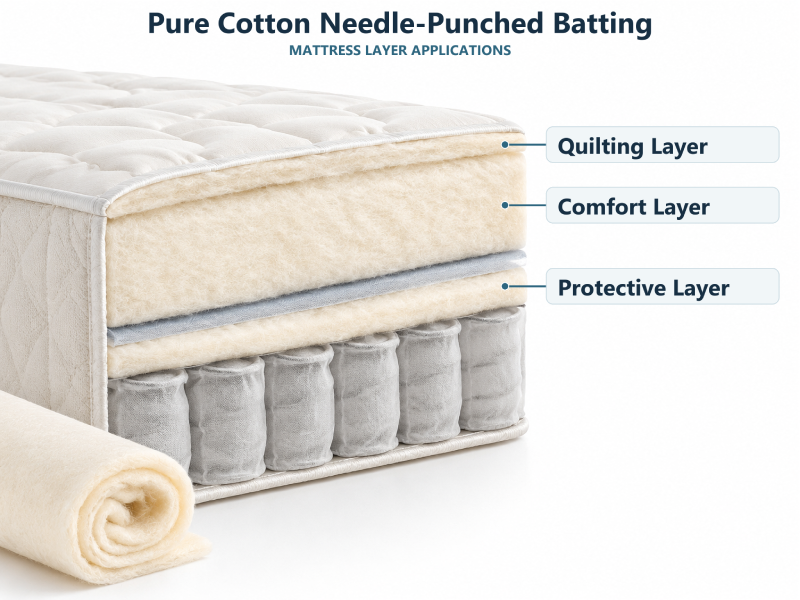
A mattress usually consists of several layers with different functions. The materials and designs vary between products, but when sourcing filling materials, it is useful to distinguish between the top covering structure, internal comfort layers, and the core support structure.
The top covering structure is located at the upper surface of the mattress. The surface that users come into contact with is usually the mattress fabric or a quilted top panel. In some designs, cotton wadding, thermal bonded wadding, or other filling materials are placed between the face fabric and the layers underneath to create the required surface thickness and construction.
Internal comfort layers are positioned between the top covering structure and the core support system. The materials used depend on the mattress design. Foam, latex, and other materials may be used in this part of the mattress. They are different from needle-punched cotton filling and should not be treated as interchangeable materials.
The core support structure provides the main load-bearing function of the mattress. It may use springs, foam, latex, or other specially designed support materials. Cotton needle-punched wadding should not be used as a substitute for these support materials.
A mattress protector is also different from the mattress itself. A removable mattress protector is a separate finished product fitted over the mattress. Depending on its design, it may consist of a face fabric, an internal filling layer, and a backing material. If waterproof protection is required, a separate waterproof fabric or membrane needs to be considered. Cotton wadding itself should not be treated as a waterproof material.
Therefore, when sourcing Cotton Mattress Padding or Cotton Wadding for Mattresses, the first step is to identify whether the material will be used in a mattress top panel, a quilted mattress protector, or another separate structure.
Different Applications of Cotton Wadding in Mattress Comfort Layers, Quilted Layers, and Protectors
The application of cotton needle-punched wadding in mattress products needs to be evaluated according to the specific finished construction. For material suppliers and buyers, the following applications should be considered separately.
As a Quilted Filling Layer in Mattress Top Panels
Some mattresses have a quilted top panel in which the fabric and internal filling material are joined through a quilting process. In this construction, the filling material is positioned between the face fabric and the layer underneath.
If a manufacturer plans to use cotton needle-punched wadding, it is important to confirm whether its thickness is suitable for the face fabric, quilting pattern, and sewing method. The weight and thickness of the filling material can affect the appearance and construction of the finished quilted panel. Therefore, the finished result should not be judged only by examining the filling material on its own.
In this application, needle-punched cotton wadding mainly serves as a filling material within the quilted structure, not as the mattress's load-bearing core.
In Removable Quilted Mattress Protectors
A mattress protector has a different construction from a mattress top panel. It is usually a separate product placed over the mattress. Some designs use quilting to hold the face fabric, filling material, and backing layer together.
In this construction, cotton needle-punched wadding can be evaluated as an intermediate filling layer. Buyers need to consider the face fabric, backing material, filling thickness, quilting pattern, and edge finishing or fastening method together.
If the protector has a waterproof design, the position of the waterproof membrane also needs to be specified. Buyers should consider whether it affects the overall thickness, sewing process, or finished construction. Cotton wadding itself cannot replace a waterproof membrane or waterproof fabric.
In Additional Mattress Comfort Layers or Other Covering Structures
Some mattress products include a separate additional covering layer or removable comfort layer. These products are not exactly the same as conventional mattress protectors, and their filling thickness, overall construction, and fixing methods may also differ.
If cotton needle-punched wadding is being considered for this type of product, buyers should provide a finished-product construction drawing or an existing sample. The position of the wadding should be clearly identified before confirming whether the material is suitable for subsequent cutting, sewing, and assembly.
A product name such as Mattress Topper or Mattress Padding alone is not enough to determine whether the same type of cotton wadding is suitable for every design.
For manufacturers sourcing custom cotton batting for mattress padding, the most important step is to identify the exact application position before confirming the material specifications.
Differences Between 100% Cotton Needle-Punched Wadding and Polyester Thermal Bonded Wadding
Different types of filling materials can be used in mattresses and bedding products. Both cotton needle-punched wadding and thermal bonded wadding may be used in filling structures, but their fiber compositions and bonding methods are different.
100% cotton needle-punched wadding is defined by its fiber composition and needle-punching process. In 100% cotton needle-punched wadding, the fiber composition is cotton. The fibers are mechanically entangled through needle punching to form a continuous nonwoven structure.
Thermal bonded wadding refers to a bonding method that uses heat. Its specific fiber composition needs to be confirmed according to the product specifications. If polyester fibers are used, polyester thermal bonded wadding differs from 100% cotton needle-punched wadding in both fiber composition and bonding method.
Therefore, buyers should not judge material performance only by names such as Cotton Wadding or Thermal Bonded Wadding. A more accurate comparison should consider fiber composition, material structure, GSM, thickness, and the intended application.
If a project is comparing different bedding filling materials, thermal bonded wadding used in mattress constructions can be reviewed as an alternative material option. The final choice should depend on the requirements of the specific product.
For projects that require natural cotton fiber, buyers should confirm whether the fiber composition is 100% Cotton rather than relying only on whether the material name includes the word Cotton.
How GSM, Thickness, and Softness Affect Mattress Construction
GSM and thickness are two specifications that need to be confirmed separately when sourcing needle-punched cotton wadding. They are related, but they do not mean the same thing.
GSM refers to the weight per unit area, usually expressed in g/m². It helps manufacturers confirm the weight of the material per square meter, but it does not determine the final thickness or directly indicate how soft the finished product will feel.
Thickness refers to the physical thickness of the material. In mattress top panels or quilted protectors, thickness affects the space occupied by the filling layer and the overall dimensions after it is combined with the face fabric and backing material.
Softness needs to be evaluated in relation to the fiber structure, material thickness, face fabric, and quilting method. Even when two materials have the same GSM, their finished products may not have exactly the same hand feel.
For this reason, mattress manufacturers should not provide only a GSM value and expect the supplier to determine the final material. A more practical approach is to specify the target GSM, thickness range, finished construction, and reference sample together.
If the exact specifications have not yet been determined, buyers can refer to cotton batting GSM and thickness to understand how weight and thickness can be selected according to the finished product structure. However, mattress projects still need to be evaluated through actual assembled samples. Specifications used for quilts or other bedding products should not automatically be applied to mattress constructions.
How to Combine Cotton Wadding with Mattress Face Fabrics
Mattress filling materials are not used in isolation. For quilted mattress top panels and mattress protectors, buyers need to consider the face fabric, internal filling material, and backing material together.
The face fabric affects the appearance and surface feel of the finished product. Different fabric thicknesses, constructions, and surface characteristics may influence the overall result when combined with a filling layer.
The internal filling layer needs to match the fabric and quilting construction. If the filling layer is too thick, it may change the overall dimensions after quilting. If the filling material is not suitable for the quilting method, it may also affect the finished appearance and how securely the filling is held in place.
The backing material also needs to be confirmed in advance. A standard quilted mattress protector and a waterproof mattress protector may use different backing constructions. If waterproof protection is required, the waterproof layer should be treated as a separate structural requirement.
For multi-layer composite or quilted products, buyers should avoid providing only the specifications of the cotton wadding. Instead, they should provide the complete layer sequence whenever possible. For example, this may include the face fabric, cotton needle-punched wadding, backing fabric, and any additional waterproof membrane or composite material.
This information helps the material supplier understand the role of the cotton wadding in the finished product and reduces the risk of sample discrepancies caused by selecting materials based on a single specification.
How Mattress Manufacturers Should Prepare Cotton Wadding Sample Specifications
Before requesting a quotation or sample, mattress manufacturers should prepare a specification sheet for the filling material.
First, confirm the fiber composition. If the project requires 100% Cotton, state this clearly rather than using general terms such as Natural Fiber or Cotton Blend. This helps avoid receiving blended materials when pure cotton is required.
Next, confirm the manufacturing process and material structure. If needle-punched cotton is required, specify Needle-Punched Cotton Wadding and explain whether it will be used in a mattress top panel, quilted mattress protector, or another structure.
The required GSM, thickness, width, and material dimensions should then be provided. If the target GSM and thickness have not yet been determined, buyers can share an existing sample or the construction requirements of the finished product so the supplier can discuss suitable options.
The supply format should also be specified. Whether the material is required in rolls or sheets, together with the sheet dimensions, roll width, and packaging requirements, may affect subsequent cutting and production arrangements.
Most importantly, buyers should provide information about the fabric and finished construction. For mattress quilting projects, it is helpful to share the face fabric, backing material, quilting pattern, sewing method, and a construction diagram. If a similar finished product is already available, it can also be provided as a reference sample for material evaluation.
For customers with long-term purchasing plans, the expected order quantity, sample requirements, and future order arrangements should also be clarified. This allows the supplier to evaluate the material specifications and supply format more accurately.
HuiZhou JinHaoCheng Nonwovens Co., Ltd.supplies 100% cotton needle-punched wadding. The current product information includes roll and sheet formats, with customized packaging available. For mattress application projects, buyers can first provide their target construction and specification requirements so the suitability of the material can be evaluated.
For more information about preparing specifications for bulk purchasing, refer to custom cotton wadding specifications for bedding manufacturers to understand the information bedding manufacturers need to prepare when confirming cotton wadding requirements.
What Should Be Checked Before Bulk Purchasing?
Sample approval should not be based only on the appearance of the cotton wadding itself. For mattress manufacturers, it is more important to place the material into the actual product construction and check whether it meets the finished-product requirements.
First, confirm whether the material is suitable for the cutting process. Check the sample width, thickness, edge condition, and actual cutting dimensions to make sure they meet the requirements of subsequent production.
Next, check the structure after quilting. Combine the cotton wadding with the specified fabrics and observe whether the quilted areas are even and whether there is any noticeable accumulation, empty space, or localized movement of the filling material. Different quilting patterns and sewing methods may produce different results, so the material should be evaluated using the actual production construction whenever possible.
For projects with compression or recovery requirements, the buyer should define the test method, pressure conditions, test duration, and acceptance criteria. The sample can then be evaluated according to the agreed conditions. A single manual press is not enough to determine whether the material can meet long-term use requirements.
If the finished product has waterproof, washable, or other special performance requirements, buyers should also clarify which layer is responsible for each function and what standards the finished product needs to meet. The properties of one individual material should not automatically be treated as the performance of the complete mattress protector.
Finally, before placing a bulk order, confirm that the approved sample and order specifications are consistent. These should include fiber composition, GSM, thickness, dimensions, supply format, and packaging requirements. For long-term purchasing projects, it is advisable to keep the approved sample and final specification document as references for subsequent orders.
Choosing Cotton Needle-Punched Wadding According to Mattress Construction
Cotton needle-punched wadding can be used as a filling material in mattress top-panel quilting or removable quilted mattress protectors, but its suitability needs to be evaluated according to the finished construction.
Buyers should first identify the position of the material and then consider fiber composition, GSM, thickness, fabric combinations, and quilting methods. Different mattress constructions should not automatically use the same specifications. Cotton needle-punched wadding should also not be treated as a replacement for a core support layer or waterproof layer.
Before bulk purchasing, it is best to combine the material with the actual fabrics and finished construction to prepare a sample. This allows manufacturers to check whether the material is suitable for cutting, sewing, and the requirements of the finished product.
If you are sourcing 100% cotton needle-punched wadding for mattress top panels or quilted mattress protectors, you can provide the target GSM, thickness, dimensions, fabric combination, and estimated order quantity to discuss suitable material specifications.