
Mattress Foam Laminated Fabric: Applications in Quilted Panels and Mattress Side Materials
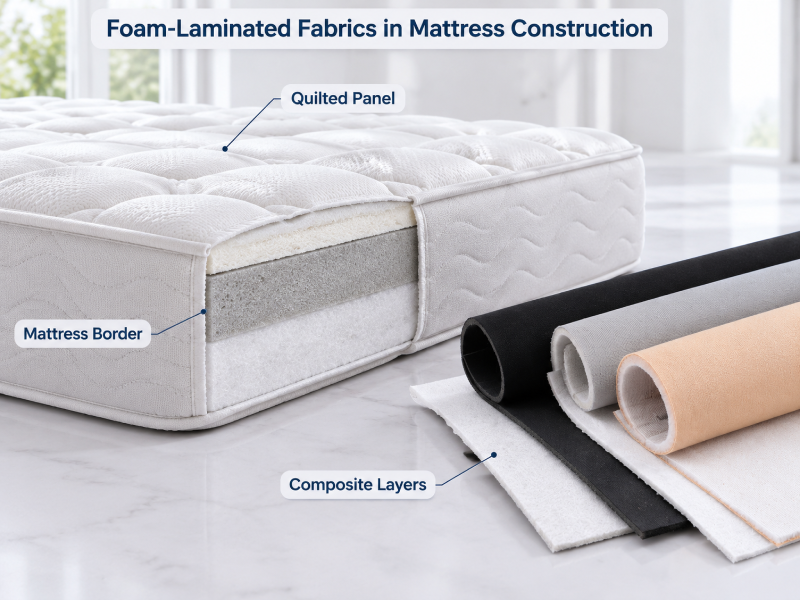
Composite materials used in mattress manufacturing serve different purposes depending on their position in the finished product. The quilted panels on the mattress surface, side panels, and other internal composite sections may use different combinations of fabric, foam, and auxiliary materials. Even when similar fabrics or foam materials are used, their structural requirements and processing methods may vary.
For mattress manufacturers sourcing Mattress Foam Laminated Fabric, the first step is to identify where the material will be installed and what role it will play in the mattress structure. Materials used for quilted panels need to be evaluated for surface appearance, softness, and quilting compatibility. Materials used for mattress side panels require attention to covering, cutting, sewing, and side-panel appearance. Other internal composite layers should also be selected according to their specific design requirements rather than following one standard structure.
This article explains the applications of foam laminated materials in different mattress components, the differences between foam laminated fabric and other mattress materials, and the key points buyers should confirm during material development, sample evaluation, and before placing bulk orders.
Why Can't the Same Foam Laminated Structure Be Used for Every Mattress Component?
A mattress usually consists of multiple material layers with different functions. These components have different requirements in terms of appearance, contact, structural position, and subsequent processing. Therefore, material selection should not be based only on foam thickness or fabric type.
For example, the quilted panel on the top of a mattress is usually a visible and directly contacted area. Its materials need to match the outer fabric, quilting pattern, and overall appearance. Mattress side panels, on the other hand, form the covering structure around the mattress. Buyers need to consider fabric appearance, softness, cutting, and sewing requirements.
In addition, some mattress designs may include different internal liners, covering layers, or auxiliary composite structures. The specific function of these materials depends on the mattress design and cannot be determined simply by calling them "mattress laminated fabric."
From a purchasing perspective, buyers should clarify at least three questions before selecting mattress foam laminated fabric.
First, where will the material be installed? Will it be used for the top quilted panel, the mattress side panels, or another internal composite section?
Second, what function should the material perform? Is it mainly intended to provide surface appearance, a soft feel, auxiliary cushioning, or support for subsequent sewing and assembly?
Third, what processing steps will the material go through? Will it need quilting, cutting, sewing, binding, or assembly with other mattress components?
These questions directly affect the selection of fabric, foam, and lamination structure. Buyers should not provide only a broad product name such as "Mattress Foam Fabric." They should explain the material's actual position and application in the mattress.
How Should Foam Laminated Materials Be Used in Mattress Quilted Panels?
Quilted panels are an important part of a mattress's exterior structure. They are generally made by combining an outer fabric with internal filling or padding materials, followed by quilting to create a specified pattern and structure.
In some mattress designs, foam laminated fabric can be considered as one of the composite material options for developing quilted panels. By bonding fabric and foam in advance, manufacturers can evaluate the surface appearance, thickness, and processing suitability of the composite material as a combined structure.
However, it is important to understand that foam laminated fabric is not the same as a complete mattress quilting structure. An actual quilted panel may also contain other fabrics, wadding, liners, or auxiliary materials. Whether foam laminated fabric can be used directly in the quilting process needs to be confirmed according to the specific structure and equipment conditions.
When developing materials for quilted panels, mattress manufacturers should focus on the following points.
Evaluation Item | What Buyers Should Consider |
Face fabric | Whether the fabric color, texture, appearance, and hand feel match the mattress design |
Foam layer | Whether the foam type, thickness, and softness suit the intended panel structure |
Total laminated thickness | The overall thickness of the composite material, not just the foam thickness |
Quilting compatibility | Whether the composite material is suitable for the actual quilting stitch, pattern, and equipment conditions |
Surface condition | Whether wrinkles, deformation, or other appearance issues occur before or after quilting |
Subsequent assembly | Whether the material can be connected to other mattress panels and components |
The final appearance of a quilted panel is not determined by foam alone. The fabric structure, softness after lamination, total thickness, and quilting method can all affect the processing results.
For example, a material that feels soft when laid flat may not necessarily be easy to process during actual quilting. If the thickness, softness, or layer condition of the composite material does not match the equipment requirements, it may affect material feeding, sewing, and the appearance of the finished panel. Therefore, buyers should evaluate samples under conditions close to actual mattress production whenever possible, rather than relying only on the appearance of a small flat sample.
What Is the Difference Between Mattress Side Panel Materials and Quilted Panels?
Although mattress side panel materials and top quilted panels may both use laminated fabric structures, their installation positions and processing requirements are different.
Quilted panels mainly form the top surface or other designated quilted areas of a mattress. Side panel materials are used around the mattress to create its exterior sides. Side panel designs vary between mattresses. Some use separate side panel fabrics, while others incorporate padding or laminated structures.
If a mattress side panel requires Foam Backed Mattress Fabric, buyers should first confirm the actual function of the foam layer and whether the laminated material is suitable for subsequent covering and sewing.
Compared with quilted panels, side panel materials generally require attention to the following factors.
Selection Factor | Mattress Side Panels | Quilted Panels |
Main position | Around the perimeter and sides of the mattress | The top surface or designated quilted areas |
Appearance requirements | Side color, texture, and overall covering appearance | Surface pattern, texture, and appearance after quilting |
Softness | Needs to match side covering and sewing requirements | Needs to match the panel filling structure and quilting process |
Main processing requirements | Cutting, covering, sewing, and edge connection | Quilting, cutting, and connection with other panels |
Structure confirmation | Fabric, foam, and any additional layers | Fabric, foam or filling materials, and other quilting layers |
These are application differences to consider during material selection. They do not mean that every mattress side panel or quilted panel must use foam laminated fabric.
When sourcing Mattress Side Panel Material, mattress manufacturers should provide an actual side panel structure drawing or an existing material sample. If the side panel needs to cover the mattress edges, connect with the top panel, or go through a specific sewing process, the material's softness, thickness, and dimensional stability should be evaluated according to the actual processing method.
In addition, the appearance requirements for side panel materials may differ from those for top panels. Even if both components use the same base fabric, this does not mean they can use the same foam thickness or lamination structure. Buyers should confirm the specifications for each component separately to avoid problems during finished mattress assembly caused by applying one material standard to every section.
How Should Material Structures Be Selected for Other Mattress Composite Layers?
In addition to quilted panels and side panels, some mattress designs also use internal covering layers, auxiliary liners, or other composite materials. These components may be positioned between the outer fabric and the internal mattress structure. Their material selection should be based on the specific product design.
When developing Foam Bonded Fabric for Bedding, buyers should not select materials based only on the final application being a mattress. They should also explain the installation position, contact surfaces, and subsequent processing requirements of the composite material.
For example, some internal composite layers may mainly be used to cover or connect other materials. Other components may require a certain level of softness or auxiliary cushioning. Their requirements are not necessarily the same.
Mattress manufacturers can evaluate material structures from the following perspectives.
Composite Section | Function to Clarify | Material Information to Confirm |
Top quilted panel | Appearance, hand feel, and quilting process | Fabric type, foam or filling layer, total thickness, and quilting requirements |
Mattress side panels | Side covering, appearance, and sewing | Fabric, foam layer, softness, dimensions, and sewing method |
Internal covering layers | Covering or connecting internal mattress components | Layer structure, material contact surfaces, and assembly method |
Other auxiliary composite sections | Specific material support based on mattress design | Actual installation position, material combination, and processing requirements |
It is important to note that these categories are intended to help buyers organize their requirements. They are not fixed standard structures for every mattress. Different mattress brands, product ranges, and internal designs may use different material combinations.
If buyers have not yet finalized the composite structure, they can provide a mattress cross-section drawing, component photos, or existing material samples. This helps the supplier understand the position and function of each layer before discussing possible fabric and foam combinations.
Do not automatically classify every internal layer as foam laminated fabric before confirming its structure. Some mattress components may be more suitable for standalone fabric, thermal bonded wadding, needle-punched nonwoven, or other materials. Different materials should be evaluated according to their actual functions.
What Is the Difference Between Foam Laminated Fabric and Mattress Core Support Foam?
This is an important distinction in mattress material purchasing.
Foam laminated fabric is a composite material, while mattress core support foam is part of the internal support structure of a mattress. Although both may contain foam, their installation positions and functions in the mattress are different.
Foam laminated fabric is generally made by bonding foam with one or more layers of fabric or other materials. Depending on the design, it may be used for mattress quilted panels, side panels, or other sections that require a combination of fabric and foam. The fabric layer can provide appearance, surface feel, or a material base for subsequent processing, while the foam layer provides the required thickness and auxiliary cushioning.
Mattress core support foam, on the other hand, mainly belongs to the internal support system of the mattress. It needs to perform the support function required by the mattress design. The presence of foam in a laminated fabric does not make the two materials interchangeable.
Comparison Item | Foam Laminated Fabric | Mattress Core Support Foam |
Material structure | Foam laminated with fabric or other materials | Mainly standalone foam material or a mattress core structure |
Main application | Panels, side sections, or other composite components | Internal mattress support structure |
Fabric layer | Usually includes a fabric layer or other composite layers | Does not necessarily include a fabric layer |
Purchasing focus | Fabric, foam, composite structure, total thickness, and processing suitability | Support design, foam specifications, and overall mattress structure |
Can they replace each other? | Cannot directly replace the mattress core support structure | Cannot be treated as the same product as foam laminated fabric |
Therefore, if buyers need mattress core support foam, they should source the appropriate material according to the technical requirements of the core support structure rather than requesting foam laminated fabric.
If buyers need Mattress Foam Laminated Fabric, they should provide the composite layer structure and installation position to avoid having the material mistaken for ordinary mattress sponge or standalone foam cores.
How Can Material Suitability Be Confirmed Through Actual Mattress Component Samples?
Whether foam laminated material is suitable for mattress production cannot be determined only by its product name, product photos, or the appearance of a flat sample. More importantly, buyers need to confirm whether it can meet the processing and assembly requirements of the actual mattress component.
For mattress manufacturers, sample evaluation should ideally be based on the final installation position.
If the material is intended for a quilted panel, the sample should be evaluated using a fabric combination and quilting conditions close to actual production. Buyers should check the material thickness, surface condition, sewing results, and appearance after quilting.
If the material is intended for side panels, the main evaluation points should include cutting, covering, bending, sewing, and edge connection. The feel and appearance of a flat sample can provide an initial reference, but they cannot replace processing verification on an actual side panel component.
If the material is intended for an internal composite layer, buyers should confirm how it contacts adjacent materials, how it is connected, and where it is installed. This helps prevent a material from meeting the requirements of an individual layer while failing to suit the complete mattress structure.
Buyers are advised to evaluate samples according to the following points.
Sample Evaluation Item | What to Check |
Material structure | Whether the sequence of fabric, foam, and other layers matches the requirements |
Total thickness | Whether the overall laminated thickness meets the component design |
Surface appearance | Whether the color, texture, flatness, and surface condition meet requirements |
Softness | Whether it is suitable for the actual quilted panel or side panel application |
Layer bonding | Whether the bonding condition between layers is suitable for subsequent processing |
Quilting process | Whether it is suitable for the required quilting pattern and equipment conditions |
Cutting and sewing | Whether deformation or other problems affecting assembly occur after processing |
Finished assembly | Whether it can be properly connected with other mattress components |
If a product has specific performance requirements, such as particular flame-retardant, antibacterial, breathability, or durability standards, buyers need to provide the corresponding test methods, test conditions, and acceptance criteria in advance. These properties should not be assumed based only on the material name or composite structure.
During sample confirmation, it is advisable to keep records of material specifications, sample versions, and processing details. This allows both parties to compare subsequent bulk orders against the approved sample and technical requirements, reducing the risk of misunderstandings between sample approval and mass production.
What Information Should Mattress Manufacturers Provide Before Requesting a Quotation?
For foam laminated fabric projects, the more clearly mattress manufacturers describe their requirements, the easier it is for suppliers to understand the actual application and evaluate possible material combinations and processing arrangements.
If buyers have not yet finalized the complete material specifications, they do not need to guess every parameter. They can first provide the final application, component position, and existing samples, then discuss possible material structures with the supplier.
RFQ Information | Recommended Details |
Mattress component position | Quilted panel, side panel, internal covering layer, or another section |
Final application | Explain the specific function of the material in the mattress |
Fabric requirements | Fabric type, fiber composition, color, texture, and surface requirements |
Foam requirements | Foam type, thickness, density, or other confirmed specifications |
Lamination structure | Single-sided, double-sided, or multilayer structure, with the sequence of each layer clearly identified |
Overall thickness | Total thickness after lamination and acceptable tolerance |
Material dimensions | Required width, roll length, or sheet dimensions |
Subsequent processing | Quilting, cutting, sewing, covering, or other processing methods |
Sample information | Existing material samples, mattress component photos, or structural drawings |
Order information | Estimated order quantity, sample requirements, and delivery requirements |
Acceptance criteria | Appearance, dimensions, layer bonding, and other inspection items |
For projects where the foam or fabric combination has not yet been finalized, buyers can first explain the intended mattress component and processing method. The supplier can then evaluate possible material directions. The specific foam type, fabric combination, and lamination method still need to be confirmed according to material compatibility and sample results.
In foam composite material development, HuiZhou JinHaoCheng Nonwovens Co., Ltd. has related experience involving PU and EVA foam and different fabric lamination methods. For specific applications such as mattress quilted panels, side panels, or other components, feasibility should still be confirmed according to the actual structure, processing requirements, and sample results.
Buyers can start by providing mattress component drawings, existing samples, or material specifications, clearly identifying the installation position and subsequent processing requirements. The customized composite structure can then be discussed in more detail. Rather than simply asking for a general type of mattress foam fabric, clearly explaining the application and material layers of each component makes it easier to obtain suitable samples and accurate quotations.




