
Meltblown vs. Spunbond in Filter Media: Which Layer Should Do the Filtering?
When developing multilayer filter media, choosing the right nonwoven material is only part of the decision. Buyers also need to understand what each layer is expected to do within the complete structure.
Meltblown nonwoven and spunbond nonwoven are often used in discussions about composite filtration materials. However, they do not automatically perform the same function. A meltblown layer may be selected for its fine-fiber structure and filtration role, while a spunbond layer may provide mechanical support, surface protection, or other functions depending on the design.
For filtration equipment manufacturers, filter media converters, and OEM buyers, the important question is not simply which material is better. It is how to combine the layers to meet the requirements of the final product.
This guide explains the differences between meltblown and spunbond layers, how filtration, support, and protective functions are allocated, and what buyers should confirm before ordering multilayer filter media.
1. Why Should You Not Evaluate Multilayer Filter Media by the Meltblown Layer Alone?
Meltblown nonwoven is commonly used in filtration-related applications because its fine-fiber structure can provide a filtration function. However, a multilayer filter material is not designed around the meltblown layer alone.
In a composite structure, different layers may have different responsibilities. One layer may contribute to particle capture, while another helps maintain mechanical strength, protects the filtration layer, or supports downstream processing.
If buyers evaluate only the meltblown layer, they may overlook important factors such as the strength of the complete material, layer stability, surface condition, and compatibility with the final product.
For example, a filter media roll may need to be slit, pleated, folded, cut, or assembled into a filter element. The material must therefore meet not only filtration requirements but also the mechanical and processing requirements of the finished product.
This is why multilayer filter media should be evaluated as a complete structure rather than as a single filtration layer.
2. What Are the Structural Differences Between Meltblown and Spunbond Nonwovens?
The main difference between meltblown and spunbond nonwovens comes from their fiber formation processes and resulting fiber structures.
Meltblown nonwoven is generally produced by extruding molten polymer through fine openings and drawing the polymer streams into fine fibers with high-speed hot air. The fibers are collected to form a web.
Because meltblown materials typically have a fine-fiber structure, they can provide a relatively large fiber surface area and a network suitable for particle capture in appropriate filtration applications.
Spunbond nonwoven is produced by extruding polymer into continuous filaments, stretching them, and laying them into a web before bonding. The resulting structure is generally based on longer, continuous filaments.
Depending on its specifications and construction, spunbond material can provide mechanical strength, dimensional stability, and surface protection. It may also serve other functions within a filtration product.
These are general structural characteristics, not universal performance guarantees. Actual properties depend on polymer type, fiber structure, basis weight, thickness, bonding method, and other manufacturing parameters.
Therefore, buyers should not assume that every meltblown material is suitable as the main filtration layer or that every spunbond material can only be used as a support layer. The appropriate function must be determined by the requirements of the complete product.
3. What Do the Filtration, Support, and Protective Layers Actually Do?
When developing multilayer filter media, it is useful to define each layer according to its intended function.
Filtration Layer
The filtration layer is responsible for capturing or retaining the target particles.
In suitable applications, a meltblown filtration layer may be selected because its fine-fiber network can provide particle capture. Its performance depends on factors such as fiber structure, basis weight, thickness, pore characteristics, and the filtration conditions.
However, a fine-fiber structure alone does not prove that the material meets a particular filtration efficiency or particle rating. The required performance must be verified using an appropriate test method.
Support Layer
The support layer helps maintain the mechanical stability of the complete filter media.
Depending on the product design, a spunbond layer may provide support for a finer filtration layer. It can help the composite material maintain its structure during handling, converting, and use.
The required support properties depend on the finished product. For example, materials used in a filter cartridge may face different mechanical requirements from materials used in a flat filter pad.
Protective Layer
A protective layer may help reduce direct damage to a more delicate filtration layer during handling, processing, or use.
It can also provide a more suitable surface for downstream converting or product assembly, depending on the design.
A spunbond layer may be used for this purpose in some composite structures, but the actual arrangement depends on the material and application.
It is important to understand that filtration, support, and protection are functional roles. They are not fixed material categories. A layer may perform more than one function, and the same material may be used differently in different product designs.
4. How Should Meltblown and Spunbond Layers Be Combined?
There is no single layer arrangement suitable for every filtration application. The structure should be selected according to the required filtration performance, mechanical properties, processing method, and final product design.
Several common structures can be used as starting points for product development.
Meltblown + Spunbond
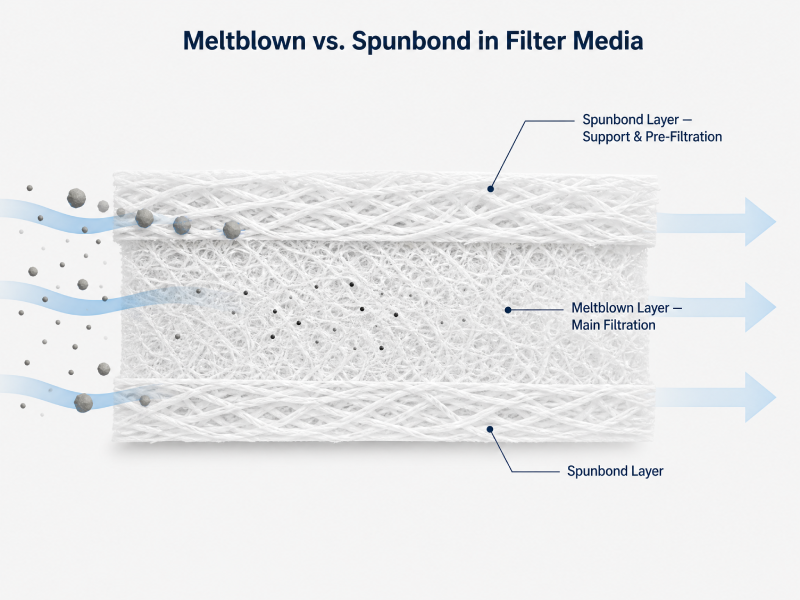
A meltblown layer can provide the main filtration function, while a spunbond layer can provide support or surface protection.
This type of combination may be considered when the product requires a fine-fiber filtration layer together with additional mechanical stability.
The exact layer order and whether one or both sides require a support layer depend on the final application.
Spunbond + Meltblown + Spunbond
A three-layer structure may place a meltblown layer between two spunbond layers.
In this arrangement, the meltblown layer may provide the primary filtration function, while the outer spunbond layers may provide support and protection.
However, this structure should not automatically be treated as the best solution for every filter product. The number of layers, material specifications, and bonding method need to be evaluated according to the intended use.
Other Multilayer Structures
Some applications may require more than two or three layers. Different materials can be combined to meet specific requirements for filtration, strength, surface properties, or processing.
The appropriate construction depends on the target particles, operating conditions, flow requirements, and finished-product structure.
For buyers, the key is to define what each layer needs to achieve before deciding on the material combination. A structure should not be selected simply because it is commonly used in another product category.
5. How Can Lamination and Converting Affect Filter Media Performance?
Selecting suitable meltblown and spunbond materials is only one part of composite filter media development. The bonding and downstream processing methods can also affect the complete structure.
Lamination and Bonding
The bonding method determines how different layers are combined and how well the composite maintains its structure.
Depending on the selected process, bonding may influence material flexibility, thickness, permeability, and layer stability.
If the bonding process changes the structure or blocks part of the material's open area, it may affect airflow or liquid flow. Therefore, buyers should consider the bonding method together with the filtration requirements.
Slitting and Cutting
Filter media is often supplied in rolls or converted into sheets and smaller components.
Slitting and cutting requirements should be confirmed before production. Buyers need to provide the required width, length, dimensional tolerances, and final product format.
The material should also be suitable for the customer's downstream equipment and processing method.
Pleating and Forming
Some filtration products require the media to be pleated, folded, shaped, or assembled into a filter element.
In these cases, the composite material needs sufficient structural stability and flexibility for the intended processing method.
A material that performs adequately as a flat sample may behave differently after pleating or forming. Therefore, the final structure should be evaluated in the relevant processing conditions.
Layer Stability
The layers should remain properly bonded during handling, converting, and use.
Buyers may need to confirm whether the composite structure is suitable for the required mechanical handling and whether the bonding method meets the product's stability requirements.
The specific bonding process and converting capabilities should be confirmed with the supplier before placing an order.
6. Why Does Final Filtration Performance Depend on the Complete Composite Structure?
A filtration result obtained from one individual layer does not automatically represent the performance of the complete composite material.
When meltblown and spunbond layers are combined, the final structure may differ from the original materials in terms of thickness, permeability, mechanical properties, and overall filtration behavior.
Several factors need to be considered together.
Fiber type and fiber structure influence the physical characteristics of each layer.
Basis weight and thickness affect the amount of material used and the structure of the composite.
Layer arrangement determines how the individual layers work together.
Bonding and lamination may influence the open structure, flexibility, and stability of the material.
Operating conditions such as airflow, liquid flow, pressure, temperature, and target particle characteristics also affect the actual filtration performance.
For this reason, buyers should distinguish between three different evaluation levels.
First, the performance of an individual raw material or layer.
Second, the performance of the complete laminated or composite filter media.
Third, the performance of the finished filtration product under its actual operating conditions.
These three levels should not be treated as interchangeable.
For example, if the composite media will be pleated and installed in a filter cartridge, testing only a flat meltblown sample may not fully represent the final product.
The appropriate validation method should therefore reflect the actual material structure and intended application. For a more detailed discussion of test methods and performance data, refer to Meltblown Filter Media Requirements.
For medical or respiratory protection applications, the finished product must also be evaluated against the applicable product standards and test requirements. A material-level result alone should not be used to make unsupported claims about the final product.
7. What Should Buyers Confirm Before Ordering Multilayer Filter Media?
Before requesting a quotation, buyers should prepare the basic requirements of the complete filtration product.
The following information can help suppliers understand the intended structure and assess material suitability.
Final Application
What product will use the filter media? Is it intended for air filtration, liquid filtration, industrial equipment, a filter cartridge, a filter bag, or another application?
Filtration Medium and Target Particles
Will the material filter air, water, oil, or another liquid? What type of particles need to be captured, and is there a specified particle size range?
Layer Structure
How many layers are required? Should the structure use meltblown, spunbond, or a combination of different nonwoven materials?
Buyers should also clarify the intended function of each layer, including filtration, support, and protection.
Material Specifications
Confirm the material type, basis weight, thickness, width, roll length, and any other required physical specifications for each layer.
If different layers require different specifications, provide them separately rather than giving only one overall GSM or thickness value.
Layer Order and Bonding Method
Specify the intended layer arrangement and whether the materials need to be laminated or bonded.
If the final structure has already been developed, provide a sample, drawing, or material specification for reference.
Performance Requirements
Confirm the required filtration performance, permeability, mechanical strength, and other application-specific properties.
Where applicable, provide the test method, test conditions, and acceptance criteria. Avoid comparing performance figures obtained under different test conditions.
Downstream Processing
Will the material be slit, cut, pleated, folded, shaped, or assembled into a finished product?
The supplier needs to understand these requirements because the material must be suitable for the customer's actual manufacturing process.
Sample and Bulk Acceptance
Before mass production, buyers should confirm the sample structure and the inspection requirements for bulk orders.
The agreed specifications should cover the complete composite material, not only one individual layer.
8. What Information Should You Provide When Asking JHC About Customized Composite Filter Media?
When contacting a supplier about customized composite filtration media, buyers should explain the final application and the intended function of each layer.
For example, you can provide the following information:
Final product and application.
Required filtration medium and target particles.
Preferred fiber materials, such as PP or PET.
Number of layers and intended layer arrangement.
Basis weight and thickness of each layer.
Required width, roll length, or converted product dimensions.
Bonding or lamination requirements.
Filtration performance and permeability requirements.
Downstream processing method.
Sample, drawing, or existing material reference, if available.
The more clearly these requirements are defined, the easier it is to evaluate whether the proposed material structure is suitable for the project.
HuiZhou JinHaoCheng Nonwovens Co., Ltd. lists meltblown nonwoven materials, filtration materials, and related composite processing products and capabilities on its website. Specific meltblown and spunbond combinations, processing methods, and performance targets should be confirmed according to the actual project specifications, samples, and testing requirements.
9. Conclusion: Define the Function of Each Layer Before Selecting the Material Combination
When choosing between meltblown and spunbond for multilayer filter media, buyers should not focus only on which material has better individual properties.
Instead, start by defining the function of each layer.
The meltblown layer may provide the main filtration function in suitable applications.
The spunbond layer may provide mechanical support, surface protection, or other functions depending on the design.
The complete structure must also be suitable for lamination, converting, and the operating conditions of the final product.
Most importantly, the performance of an individual layer should not be treated as the performance of the complete composite filter media or finished filtration product.
Before bulk purchasing, confirm the final application, layer arrangement, material specifications, bonding method, processing requirements, and relevant performance tests.
A well-defined multilayer structure starts with the requirements of the finished product—not simply the names of the materials.




